








































In this article
What happens when AI can help design a physical product and a factory can interpret that design? The Matter Compiler is one attempt to close that gap. It raises a compelling business question: could the distance between imagining a useful device and making it become much shorter?
This guide explains the announcement, the evidence available and the questions a potential customer should ask. C3i3’s perspective is product communication and commercialization. We have reviewed public materials, have not tested the equipment and have no commercial relationship with Atomic Machines.
The most useful way to follow this story is to connect three levels: the manufacturing platform, the first named device and the customer job that device might serve. Each level needs a different explanation. A platform description explains a method, a product specification describes a particular output and an application evaluation determines whether that output fits a real need.
Independent C3i3 research and analysis. Sources checked November 18, 2026. Read the sources and editorial method.
Why does the Matter Compiler matter now?
Atomic Machines dated its micro-machine essay October 7, 2026. The essay explicitly describes the applications in its grid as illustrations rather than a catalog. That is a useful starting point for following a new manufacturing platform: identify what has been introduced, then keep the wider opportunity visible without turning every illustration into an available product.
The surrounding technology landscape is moving too. In a November 8, 2026 update, NVIDIA described physical AI work across Korean semiconductor engineering, robotics and autonomous vehicles. These are separate organizations and projects. Their relevance here is that intelligence, simulation and physical systems are increasingly discussed together.
For a business audience, the timing creates a research opportunity. A company can learn the language, identify a problem worth solving and prepare a better brief before purchasing a technology. A designer can distinguish a manufacturing constraint from a marketing description. A reader can understand why a small component may reveal more about a platform than an expansive future vision.
Early attention is useful when it produces better questions and clearer decisions. It becomes less useful when several announcements are combined into a fictional integrated system. This guide keeps the relationship conceptual unless a source establishes something more specific.
What is the Matter Compiler and why does it matter?
Atomic Machines describes the Matter Compiler as an AI-native fabrication platform combining digital design, manufacturing and measurement. The company emphasizes functional devices with different materials and moving elements. Its stated ambition is to make a change in design primarily a change in software.
The important distinction for a business reader is between a promising manufacturing architecture and a finished service that anyone can order. A platform announcement introduces a direction. A customer-ready offer also needs a defined scope, commercial terms, an acceptance process and support.
Consider a hypothetical company developing a compact mechanism. Its challenge is more specific than “make this smaller.” It needs to know what the mechanism must do, what loads it faces, which environment it enters and how the finished part will be evaluated. Those requirements remain valuable even if software handles more of the implementation.
The business opportunity is therefore broader than generating a striking concept image. It is the possibility of connecting design intent to a repeatable physical result. That possibility deserves attention, while the supporting evidence deserves close reading.
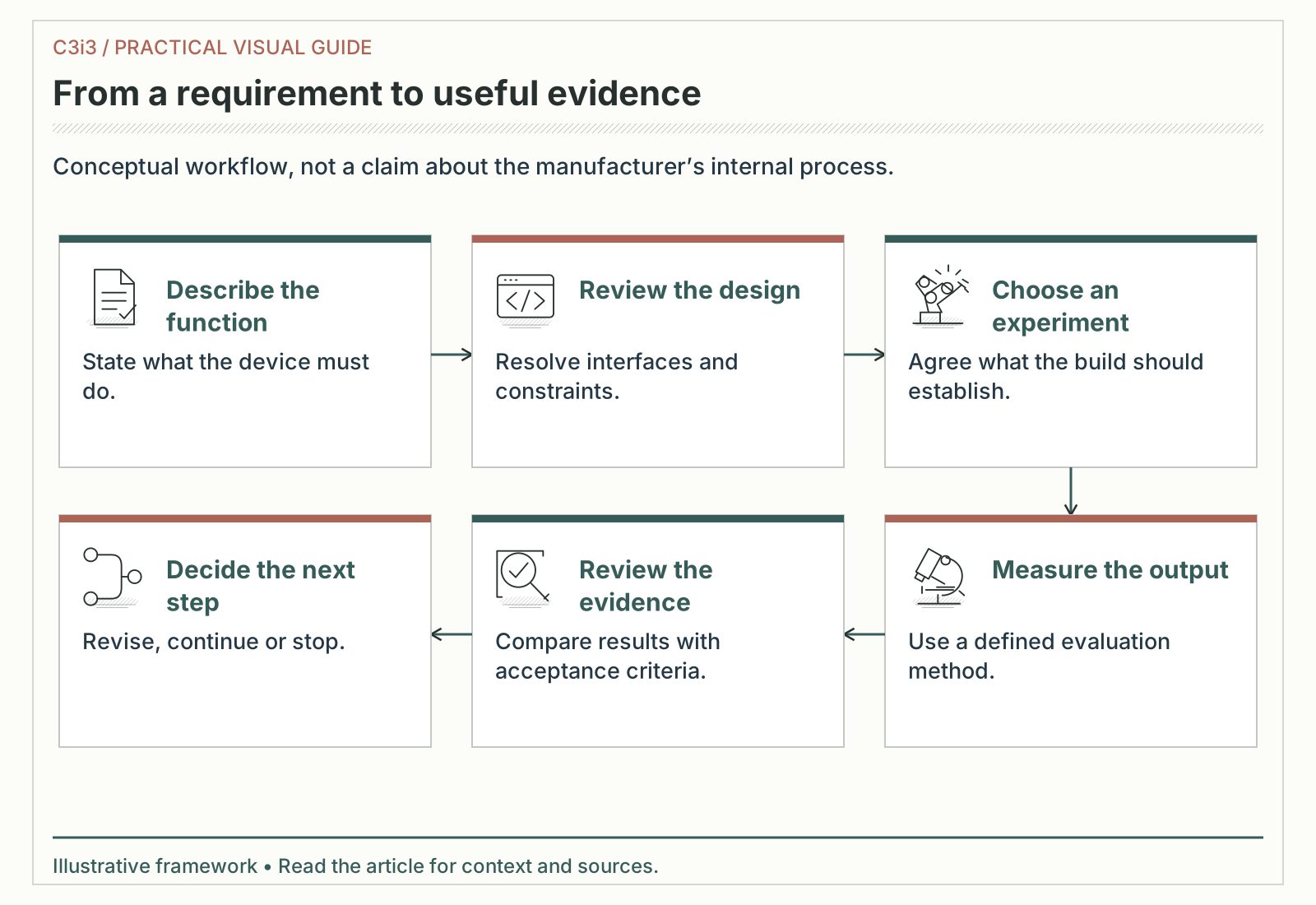
Describe the function: State what the device must do. Review the design: Resolve interfaces and constraints. Choose an experiment: Agree what the build should establish. Measure the output: Use a defined evaluation method. Review the evidence: Compare results with acceptance criteria. Decide the next step: Revise, continue or stop.
Does the Matter Compiler assemble products atom by atom?
The current public offer should be understood at the micro-machine level. Atomic Machines' company overview places nano-scale and eventual atomic-scale control within its longer-term mission. That does not establish atom-by-atom construction as a feature a customer can order today.
Scale words are easy to blur. In the SI prefix system, micro means one millionth and nano means one billionth. A micrometer is therefore one thousand nanometers. These units describe dimensions; they do not explain how an object was manufactured.
Also distinguish a device's outside dimensions from its internal feature sizes. An assembly can be millimeters across while containing much smaller gaps or moving structures. A photograph of a small package does not reveal the smallest feature it contains, and a small feature does not prove that every part of the device has that dimension.
Ask which dimension a claim concerns: the complete package, a channel, a contact gap or another feature. Then ask which manufacturing and measurement methods support it. This simple distinction helps readers interpret both product specifications and dramatic illustrations without needing to become microfabrication specialists.
How does this fit into the established MEMS industry?
Microelectromechanical systems, usually shortened to MEMS, are already an important manufacturing field. NIST describes MEMS applications spanning sensing, timing, communications and biomedical diagnostics. A new platform enters an existing technical landscape rather than an empty one.
The fair comparison concerns which devices and process combinations a supplier can support. An established process may be highly capable within its intended scope. A newer platform may propose a wider range of geometries or material combinations. Neither description alone tells a customer which route will satisfy a particular specification.
For example, a hypothetical team might already have a qualified sensor but need a different mechanical interface around it. That is a different project from inventing a new sensor principle or replacing its entire production process. Breaking the product into those questions can reveal that the useful innovation lies in integration rather than in replacing every existing component.
Read platform-level language as a description of direction and differentiation. Evaluate the practical offer against the actual device, supported process and evidence required. This lets a reader appreciate a new approach without dismissing the achievements or usefulness of established manufacturers.
What must connect a digital design to a working physical device?
A digital file is one part of a larger handoff. The receiving system needs to interpret the intended geometry, materials and behavior. The customer also needs to explain what connects to the finished device and which conditions matter outside the factory.
Consider an illustrative miniature mechanism intended to move a small element inside a larger assembly. Its shape matters, but so do its attachment points, the available space, the motion it must produce and the way that motion will be observed. A design that looks convincing in isolation may be unusable if those interfaces remain ambiguous.
Organize the brief into four layers. The function states what must happen. The interfaces explain what touches, powers, controls or receives output from the device. The operating context identifies conditions the design team must consider. The acceptance statement explains how the proposed result will be evaluated.
These layers help different specialists communicate. A designer can work on geometry while an integration engineer clarifies mounting or connection needs. A purchaser can request a defined deliverable. A marketing team can explain the intended use without inventing details that the technical team has not approved.
The ability to interpret more of this information in software could be valuable. It still requires the information to be coherent. Better manufacturing automation increases the usefulness of a well-structured brief rather than making the customer's purpose irrelevant.
What product has Atomic Machines actually introduced?
The company identifies PrimeSwitch as its first device. It is an electromechanical relay, a component that opens or closes an electrical connection. The product page lists sampling availability.
That creates a concrete starting point for research. Ask for the current product documentation, evaluation conditions and the criteria used to accept a sample. A working component supports a narrower claim than a universal factory, but it gives customers something specific to examine.
A compelling demonstration should answer three questions: what was built, what function was measured and under which conditions? A product photograph answers only the first question incompletely. Specifications, test methods and evaluation results help explain the rest.
Our companion guide, what the Matter Compiler can build today, separates the named product from future application ideas.
Why is measurement part of the manufacturing story?
A design describes an intended result. Measurement supplies information about what was made. Connecting those two is the basis of an informative feedback loop: compare the observed result with the intended one, investigate the difference and decide what to change.
It helps to distinguish three questions. Geometry asks whether the relevant dimensions match the design. Function asks whether the device performs the intended action. Repeatability asks whether the result can be obtained consistently across the relevant set of outputs. A single attractive artifact cannot answer all three.
In an illustrative development program, a mechanism might fit its envelope but fail to move as intended. Another version might perform the action once but behave differently after repeated evaluation. These outcomes suggest different next steps, so recording only that a prototype was completed would conceal useful information.
For the buyer, a meaningful report identifies the version, the observation and the conditions. It also explains which conclusion the observation supports. For the writer, that creates a more useful story than treating every measurement as a general quality guarantee.
Atomic Machines describes measurement as part of its platform. The evaluation questions here are C3i3's framework for reading that claim. They do not assert a particular inspection instrument, test procedure or production result inside the company's facilities.
What remains a future goal?
The official platform page calls one-shot prompt-to-product manufacturing an aim. We interpret that wording as a roadmap, not confirmation of an unrestricted public service. A visitor should not infer that every illustrated application can already be ordered.
For a buyer, capability has several dimensions. A process may produce an experimental device but lack an established qualification pathway. It may support a material combination but not a required operating environment. It may make one item successfully without establishing the economics of a production order.
Keep a simple record with three headings: publicly described, directly confirmed and still unknown. Put each finding in the appropriate column with its source and date. This prevents a future concept from becoming a purchase assumption after several people repeat it.
It also improves conversations with the supplier. “Can you make anything?” is difficult to answer usefully. “Can your current process support this mechanism, material and acceptance test?” gives the team a practical starting point.
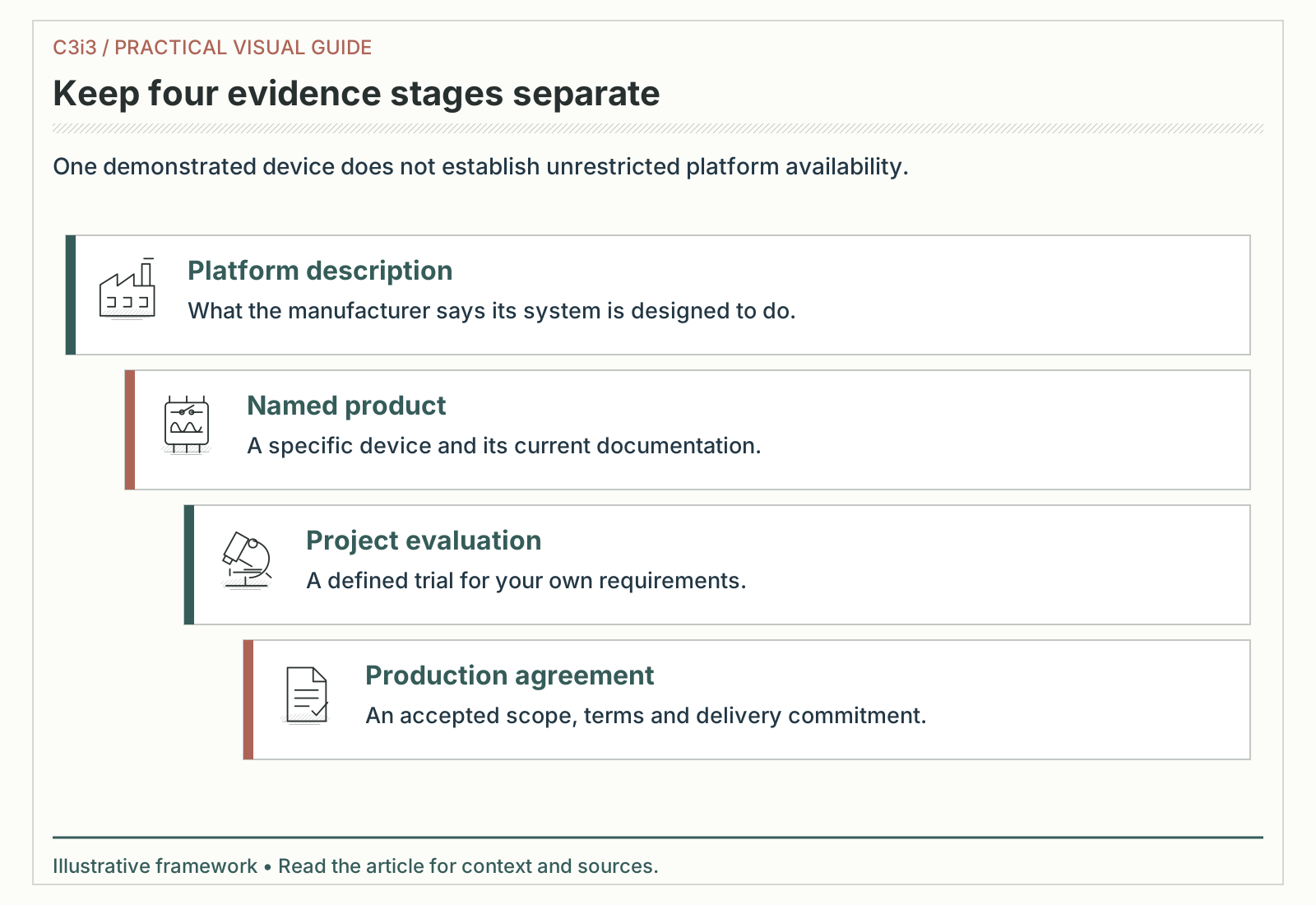
Platform description: What the manufacturer says its system is designed to do. Named product: A specific device and its current documentation. Project evaluation: A defined trial for your own requirements. Production agreement: An accepted scope, terms and delivery commitment.
What would demonstrate a broadly useful manufacturing platform?
A first product can show that a process produced something valuable. A platform's wider usefulness becomes clearer as evidence accumulates across different customer tasks. That evidence should explain which capabilities were reused and which parts of each project still required development.
Look for meaningful differences between examples. Two versions of the same mechanism can demonstrate iteration, while two substantially different device families may reveal more about flexibility. Neither comparison is automatically superior; it answers a different platform question.
Commercial readiness adds another layer. A buyer needs to understand documentation, acceptance, support and the circumstances under which another order can be placed. An impressive experiment can be technically important before those operating arrangements are established.
A useful progress record might contain the device class, demonstrated function, stated access stage and remaining work. Over time, that record makes changes visible. A new application may strengthen the flexibility case. Better evaluation documentation may strengthen the buyer's ability to investigate. A clear commercial offer may reduce uncertainty around access.
This is a more informative way to follow the field than repeatedly asking whether it has fulfilled its ultimate vision. Progress can be substantial and specific while important questions remain open. The goal is to understand which decision the new evidence actually makes possible.
How can a business get access to the Matter Compiler?
The official contact page welcomes ideas, partnerships and press inquiries. In the public pages reviewed for this guide, we did not find a published Matter Compiler purchase price or a general ordering process.
Prepare a concise brief before contacting the company. Explain the function you want, the current obstacle, the approximate scale and the type of engagement you are seeking. A journalist requesting a demonstration needs a different conversation from an engineer requesting component evaluation.
- Describe the device’s purpose and what success would look like.
- Identify constraints the manufacturer needs to assess.
- Ask what access is available today and who is eligible.
- Request current documentation, commercial terms and evaluation steps.
- Confirm what can be shared publicly before publishing an interview or demonstration.
Do not build a launch date around an assumed sample, quoted price or production slot. First establish whether there is a suitable engagement and what each party must provide. C3i3 does not arrange access or accept orders for Atomic Machines.
What should a first Matter Compiler research brief look like?
Keep the first brief focused on one decision. Write the current problem, why existing approaches are unsatisfactory and what evidence would justify another development step. Include the people who will interpret the result and the relevant constraints they already know.
For an illustrative mechanism project, the initial decision might be whether to explore a new fabrication route. The requested outcome could be a technical feasibility discussion rather than a finished sample. That is an appropriate outcome when materials, interfaces or acceptance conditions are still unresolved.
Include a short list of exclusions too. If the team is researching feasibility, say that a production launch is not yet scheduled. If an illustration is only a concept, label it. Accurate context helps the supplier respond to the actual stage of work.
After the conversation, update the brief with what was learned and who owns the next step. That turns early curiosity into a reviewable project record. It also gives future content a sound foundation: a specific question, an identifiable source and an explanation of what changed.
How does the Matter Compiler compare with 3D printing?
A useful comparison begins with the job, rather than declaring a winner. Are you evaluating a visible prototype, a structural part or an assembled mechanism? What evidence is required before that output can be used?
Our Matter Compiler vs. 3D printing comparison provides a decision worksheet. It avoids treating every additive process as equivalent or assuming that an ambitious platform automatically replaces a qualified supplier.
For early research, ask both suppliers to respond to the same brief. Compare what they will deliver, what remains outside scope and what must happen after delivery. A lower quoted part price can conceal additional assembly, inspection or integration work; a broad platform description can conceal unanswered commercial questions.
What could this mean for businesses and product designers?
Our analysis is that better access to functional prototypes could change how some teams learn. A physical trial can reveal questions that a rendering leaves unanswered. If a future manufacturing service reduces the effort of changing a design, teams may be able to test more focused hypotheses.
That is a conditional opportunity, not a savings forecast. The result would depend on access, cost, iteration speed and the work needed to validate the device. A responsible business case compares a specific alternative with a specific proposed process.
The same distinction matters in marketing. A technical business needs to explain who the product serves, which evidence supports its claims and how a buyer moves toward evaluation. C3i3 explores that communication problem in the Matter Compiler and product launches.
Start with a research project small enough to learn from. Define one unresolved question, the evidence that would answer it and the decision that evidence will inform. Expand after that first question is resolved.
Key takeaways
- Study the named product and the broader platform as different levels of evidence.
- Ask for present access conditions before assuming an ordering route.
- Evaluate a concrete use case against a consistent requirements brief.
- Use future applications as research questions until their availability is confirmed.
- Connect technical claims to documentation and an appropriate next step.
Key terms in this guide
- Micro-machine
- A very small device with an intended physical function. Its overall package and internal features can have different dimensions.
- MEMS
- Microelectromechanical systems, an established field of small integrated devices used in applications such as sensing and timing.
- Metrology
- The science of measurement, including how measurements are made and interpreted.
- Acceptance criteria
- The agreed conditions used to decide whether a proposed deliverable satisfies a defined requirement.
Frequently asked questions
Is the Matter Compiler a consumer product?
The reviewed public materials do not establish a consumer retail offer. Ask Atomic Machines about the access route appropriate to your project.
Can I download the Matter Compiler?
We did not verify a public downloadable manufacturing application. The name describes a manufacturing platform; contact the company to confirm available interfaces or services.
Is Matter Compiler the same as Metal compiler?
They refer to different subjects. This series covers Atomic Machines and physical manufacturing. Apple’s Metal compiler concerns software for its graphics and computing ecosystem.
Has C3i3 used the Matter Compiler?
No. This is independent research and business analysis based on the linked sources, not a hands-on product review.
Primary sources and editorial method
- Atomic Machines platform
Official description of the platform and its stated prompt-to-product goal. Manufacturer claims are not independent test results.
- PrimeSwitch product and availability
Official first-product page and sampling status. Read specifications within their documented conditions.
- Atomic Machines contact
Official route for access, product, partnership and press questions.
- Apple shader libraries
Clarifies that Apple's Metal software tools concern a different subject.
- Atomic Machines: micro-machine context and illustrated applications
Primary technical context supporting the linked discussion in this guide.
- Atomic Machines: present scope and longer-term mission
Primary technical context supporting the linked discussion in this guide.
- NIST: SI prefixes for interpreting scale
Primary measurement, manufacturing or research context for the concepts discussed above.
- NIST: established MEMS applications and measurement research
Primary measurement, manufacturing or research context for the concepts discussed above.
- NVIDIA: November 2026 physical AI developments
Vendor documentation or a dated announcement. Plans and targets remain attributed to the source.
Help people understand your technical product.

C3i3 helps technical businesses explain their products through manufacturing marketing strategy, technical content, websites and product demonstrations and creative campaigns.
Tell us what you are developing and who needs to understand it. For Matter Compiler access or PrimeSwitch evaluation, use Atomic Machines’ official contact route.