








































In this article
A prototype is a question made tangible. A model can test how someone holds an object. A mechanism can test a movement. A connected assembly can test an interface. Problems arise when a team asks one prototype to prove all three and later describes it as a production-ready product.
This guide offers an original pilot-planning worksheet for founders and industrial designers considering AI-assisted hardware development. The Matter Compiler is one possible route to investigate; the framework does not assume that Atomic Machines will accept a particular design or deliver to a promised schedule.
Independent C3i3 research and analysis. Sources checked November 18, 2026. Read the sources and editorial method.
Why does this topic matter now?
The July 3, 2026 smart-manufacturing AI roadmap listed by NIST describes a widening range of industrial AI approaches alongside continuing data and integration challenges. This is a useful context for prototyping: more capable software can change parts of the workflow without removing the need to evaluate physical results.
Autodesk's AU 2026 design and manufacturing update similarly points to AI-assisted work across the product lifecycle. Product-specific introductions and development direction should be read separately from a promise that any idea can move directly into production.
What should a small team take from these developments?
The opportunity is to reduce work on a defined task, learn from an experiment or prepare a clearer design handoff. It is not a reason to skip a brief. A team that cannot explain what it needs to learn may simply generate more alternatives without becoming more certain.
Use emerging capabilities to improve the next decision. If the immediate uncertainty is whether an intended user understands the product, a fabricated internal mechanism may be unnecessary. If the uncertainty concerns physical behavior, another polished rendering may not be enough.
Which kind of prototype do you actually need?
Separate appearance, fit, function, integration and repeatability. An appearance model communicates form. A fit model checks spatial relationships. A functional prototype explores a behavior. An integration prototype connects parts of a larger system. A repeatability study asks whether additional builds support the same conclusion.
These categories are an editorial planning tool, not a mandatory development sequence. Some projects combine categories, while others benefit from deliberately separating them.
| Question | Prototype purpose | What it does not prove alone |
|---|---|---|
| Can users understand the form? | Appearance or interaction model | Internal performance |
| Does the assembly fit? | Spatial or interface check | Long-term behavior |
| Can the mechanism perform the task? | Functional experiment | Production yield |
| Does it work with the surrounding system? | Integration experiment | Every future configuration |
| Can the result be reproduced? | Repeat-build evaluation | Unlimited manufacturing capacity |
Why is “working prototype” an incomplete label?
The phrase omits the function, conditions and acceptance standard. Describe the task the prototype performed and what the team observed. That preserves the value of the experiment while preventing a wider readiness claim than the evidence supports.
Manufacturing.gov's definition also distinguishes rapid prototyping from the whole additive-manufacturing field. A process can serve prototyping and other purposes; the process name does not identify the purpose of your particular artifact.
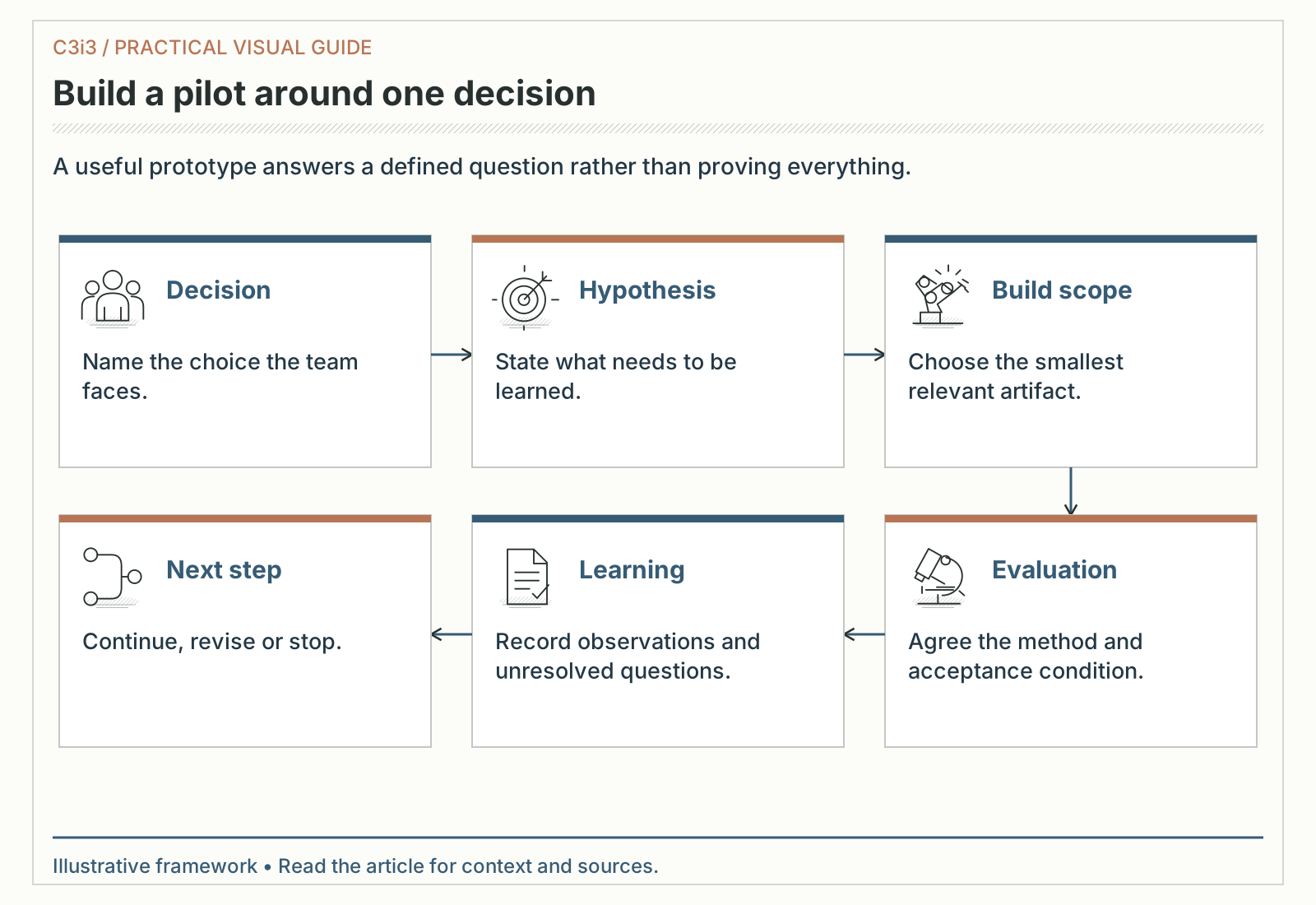
Decision: Name the choice the team faces. Hypothesis: State what needs to be learned. Build scope: Choose the smallest relevant artifact. Evaluation: Agree the method and acceptance condition. Learning: Record observations and unresolved questions. Next step: Continue, revise or stop.
How do you write a pilot around a decision instead of a demonstration?
Write the decision first: continue this mechanism, change an interface, choose a different fabrication route or stop investigating the current approach. Then identify the uncertainty that prevents the decision and the observation that would reduce it.
A weak brief says, “Build an impressive miniature device.” A stronger illustrative brief says, “We need to know whether this proposed movement can fit inside the available assembly space before committing to an enclosure layout.” The second brief gives both the designer and the reviewer a clearer task.
What belongs in the one-page pilot brief?
- The decision the team expects to make afterward.
- The single main uncertainty and relevant constraints.
- The deliverable and the work excluded from this trial.
- The measurement or observation and its acceptance rule.
- The responsible reviewer and documentation required.
- The next action for success, failure or an inconclusive result.
Decide how ambiguity will be handled. A result can be inconclusive because the artifact did not meet the agreed configuration, because the method was inadequate or because the behavior genuinely varied. Those possibilities call for different corrections.
End the brief with a review meeting or another explicit decision point. That prevents an experiment from continuing by default simply because the team has become invested in making the prototype look finished.
What does a completed pilot brief look like?
Consider a fictional team developing a small handling accessory. Its decision is whether to retain the proposed interaction before beginning detailed internal design. Its uncertainty concerns whether an intended user can recognize the grip and operate the concept comfortably in a representative task.
The artifact is therefore an interaction model with the features required for that task. The team identifies the user group, observation method and questions before producing it. The brief explicitly excludes internal durability, manufacturing yield and final material qualification, because this experiment is not designed to answer them.
After review, the team might retain the interaction, revise one feature or change the concept. It records the observation supporting that decision and the technical questions remaining. A later functional mechanism can then address a different uncertainty instead of repeating the interaction study under a more expensive name.
This example illustrates why a future fabrication platform is not automatically the correct first tool. The appropriate route is the one that produces the evidence the current decision requires.
Which revisions must stay connected throughout the build?
Keep the requirements, design, bill of materials, fabrication instructions and test setup connected by clear identifiers. A changed part may require a changed observation or a different interpretation of the result. Record the relationship rather than relying on a filename such as “final-new.”
The bill of materials, or BOM, identifies the parts and materials included in the assembly. It is not the same as the process used to make or assemble them. A prototype can retain a similar BOM while changing a fabrication or assembly step that affects the experiment.
What should a build record show?
Record what was requested, what was actually built and what changed during fabrication. Identify substitutions and unresolved deviations. The evaluator needs that information to know whether the observation addresses the intended question.
In the illustrative movement study, the team might revise a clearance feature after an initial fit review. The later prototype should be identified as a new configuration. It would be misleading to combine a photograph from one version with an observation from another without explaining the difference.
This is especially useful when AI tools generate alternatives quickly. More candidate files increase the importance of knowing which candidate became the physical object. A traceable handoff makes creative iteration easier to assess instead of turning it into a collection of disconnected versions.
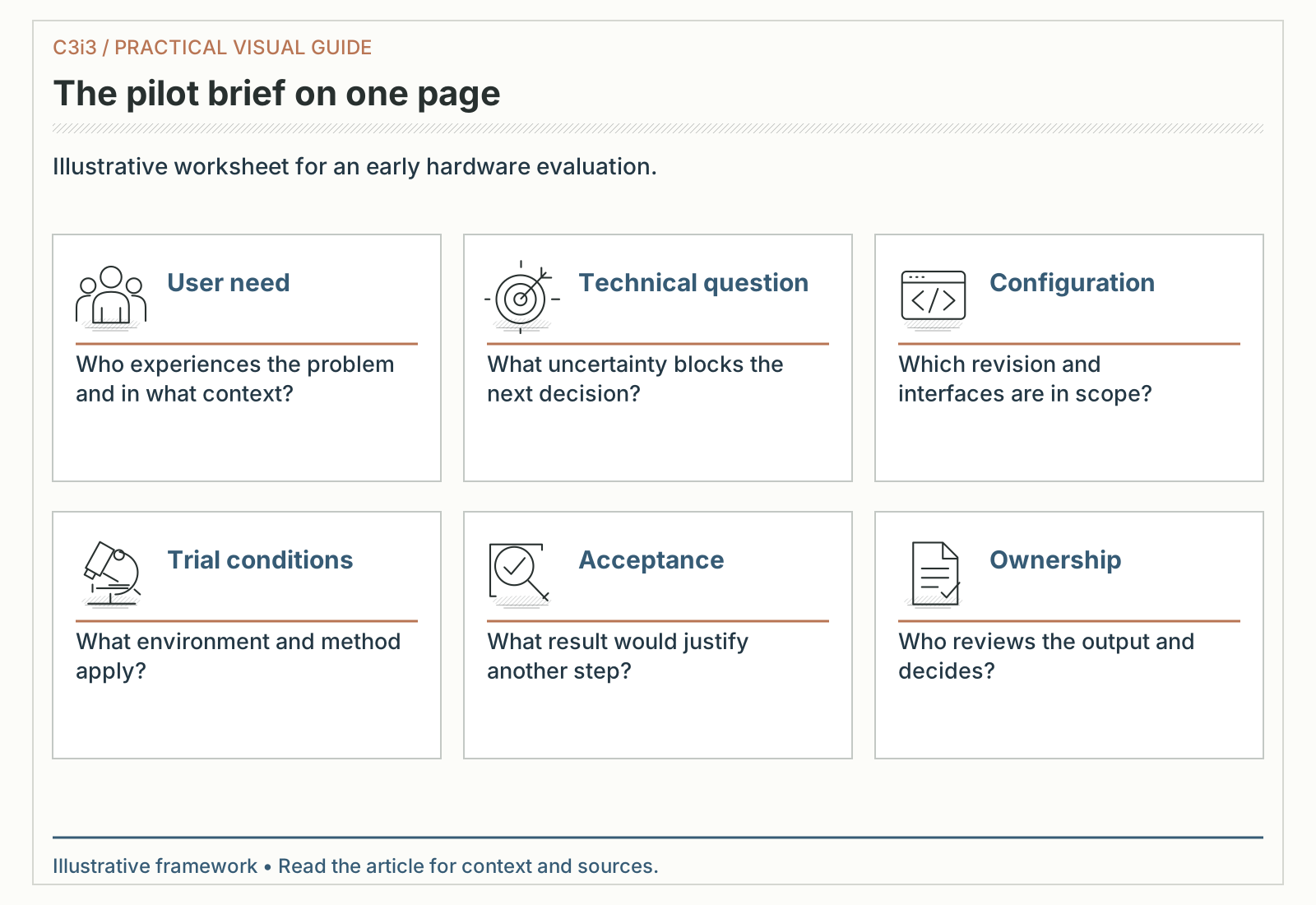
User need: Who experiences the problem and in what context?. Technical question: What uncertainty blocks the next decision?. Configuration: Which revision and interfaces are in scope?. Trial conditions: What environment and method apply?. Acceptance: What result would justify another step?. Ownership: Who reviews the output and decides?.
How do you make a prototype result useful to the next team?
Choose the observation before interpreting it. State where the result comes from, which instrument or method was used and which conditions matter. If the task is qualitative, define who observes the interaction and what they are looking for.
Keep raw observations separate from the conclusion. “The assembly contacted the enclosure at this position” is an observation. “The packaging concept needs revision” is an interpretation. Both belong in the review, but they serve different roles.
How should a team handle an unexpected result?
Review the build and setup before deciding that the concept succeeded or failed. Check whether the artifact and method match the brief. Investigate a plausible alternative explanation when the decision depends on it, rather than choosing the explanation that makes the result more exciting.
NIST MEP recommends assessing the application, building a business case and measuring results when adopting additive manufacturing. That approach is relevant to a new platform as well: the investment needs an application-specific reason and an evaluation method.
The handoff should include the accepted configuration, the observations, the conclusion and unresolved questions. A later team can then decide whether the evidence remains relevant to its revised requirements. A short report with those elements can be more useful than a long presentation of unlabeled prototype photographs.
Why should customer discovery continue alongside fabrication?
A technically promising artifact does not establish that a customer needs it. A customer expressing interest does not establish that the artifact can perform. Treat these as connected learning tracks with different methods.
NSF describes customer discovery as interviewing prospective customers and stakeholders to evaluate potential product-market fit and inform a business model. That purpose is different from asking people whether a prototype looks futuristic.
What should a founder learn from the conversation?
Explore the current task, the consequences of the problem and the alternatives already used. Identify who uses, evaluates and purchases the proposed product. Those may be different people with different constraints.
For an illustrative compact device, a user might care about handling while an integrator cares about an interface and a buyer cares about serviceability. A single enthusiastic demonstration does not resolve all three concerns. Record which audience supplied each observation.
Use the findings to choose the next prototype purpose. If users cannot understand the intended workflow, an interaction model may be more informative than another internal mechanism. If the interface blocks integration, another marketing render is unlikely to resolve it. Customer research helps the team spend its technical effort on a meaningful question.
When is a pilot ready to move toward production planning?
Move forward when the completed trial supports the decision it was designed to inform and the team can identify the next unresolved requirements. That is a more modest and useful threshold than declaring the entire product finished.
Production planning introduces questions about repeatability, supply, process control, inspection and support. The first successful artifact may provide a starting point for that work, but it should not be used as a substitute for it.
How does the Matter Compiler fit the pilot?
It is a manufacturing route to ask about once the team has a clear function and evaluation purpose. Direct confirmation is needed for project acceptance, scope and terms. This guide does not assume a public self-service route or forecast the delivery time for a hypothetical design.
After the pilot, write a concise decision record: what was learned, what remains uncertain and why the next investment is justified. Include the alternative of changing direction. A trial that prevents an unsuitable larger commitment can be valuable even if the device is never commercialized.
For launch communication, describe the evidence at its actual stage. A prototype demonstration can be a credible story when the audience understands its purpose and limits. It becomes confusing when a development milestone is presented as proof of an available production offer.
What should a pilot budget distinguish?
Separate preparation, artifact production, evaluation and the work needed to communicate the result. Also identify the response to an inconclusive trial. A budget that covers fabrication but leaves no time for review can produce a physical object without producing useful learning.
Record quoted supplier work separately from internal effort and future assumptions. Do not describe an early estimate as a production price. If another revision is likely, identify what would need to be repriced rather than silently assuming the first terms will apply indefinitely.
The relevant business measure is whether the trial informs the planned decision. Speed and visual polish can contribute, but neither is a substitute for an interpretable result.
Key takeaways
- Choose prototype purpose before choosing a fabrication process.
- Write the decision and acceptance method into the brief.
- Connect requirements, BOM, process and test revisions.
- Keep observations separate from interpretations.
- Run customer discovery alongside technical learning.
- Treat production readiness as a further evaluation task.
Key terms in this guide
- Fit prototype
- An artifact used to investigate dimensions, interfaces or assembly space.
- BOM
- A bill of materials identifying the components associated with a configuration.
- Acceptance criterion
- A pre-agreed condition used to decide whether an evaluation result is satisfactory.
Frequently asked questions
Is rapid prototyping the same as production manufacturing?
No. Prototyping describes a purpose, while a manufacturing process may serve prototypes or final parts. The deliverable needs a defined evaluation role.
How many prototypes should a first pilot include?
Choose the scope needed for the question and review method. This guide does not prescribe a universal quantity or substitute for technical planning.
Can an AI-generated CAD model establish manufacturability?
Not by itself. The model must be reviewed against the selected process, interfaces, materials and intended acceptance criteria.
What if the prototype works but customers are not interested?
Keep the technical finding and revisit the commercial assumptions. A useful mechanism and a viable customer offer are related but different conclusions.
Primary sources and editorial method
- NIST: 2026 industrial AI roadmap
Primary measurement, manufacturing or research context for the concepts discussed above.
- Autodesk: AI design and manufacturing at AU 2026
Vendor documentation or a dated announcement. Plans and targets remain attributed to the source.
- Manufacturing.gov: rapid prototyping definition
Primary technical context supporting the linked discussion in this guide.
- NIST MEP: application assessment and results
Primary measurement, manufacturing or research context for the concepts discussed above.
- NSF: customer discovery purpose
Primary technical context supporting the linked discussion in this guide.
Help people understand your technical product.

C3i3 helps technical businesses explain their products through manufacturing marketing strategy, technical content, websites and product demonstrations and creative campaigns.
Tell us what you are developing and who needs to understand it. For Matter Compiler access or PrimeSwitch evaluation, use Atomic Machines’ official contact route.