Marketing Strategy.

Make the right decisions.
Then make the work.
A marketing strategy connects your business goals with the customers you want to reach, the offer they need to understand, and the channels worth your time and money.
We help you turn scattered ideas into a written direction. Your strategy sets priorities for messaging, website improvements, content, search, advertising, and follow-up. It also makes the trade-offs clear: what to do first, what to test, and what can wait.
Whether you are launching, changing direction, or trying to understand why enquiries are not becoming customers, we start with your business rather than a list of tools.
Reach the right people.
Choose an audience and buying situation specific enough to guide the work.
Give them a reason.
Explain the value, proof, and next step behind your offer.
Spend with purpose.
Match your channels and production priorities to the budget you can sustain.
A plan you can actually
put to work.
Your scope defines the level of research and detail. A typical strategy brings these decisions together in one usable document, with an action list your team can follow.
- 01Audience & buying needs
Who you are trying to reach, what triggers their search, and what they need before they enquire.
- 02Positioning & message
Your offer, the reasons to choose it, the evidence available, and the language to use consistently.
- 03Channels & customer journey
The role of your website, SEO, content, advertising, and follow-up at each stage of the decision.
- 04Budget & priorities
A recommended order of work that separates media spend, production, tools, and ongoing support.
- 05Action roadmap
Agreed tasks, owners, dependencies, and review points, with a practical first phase of work.
- 06Measurement brief
The enquiries, qualified leads, bookings, or sales to track, plus the gaps in your current reporting.
One direction.
Connected decisions.
Some businesses need a joined-up marketing plan. Others need help deciding where AI belongs in an existing operation. We can define either as a focused engagement or combine them.
Integrated
Marketing Plans.
Connect the website, content, organic search, advertising, and customer follow-up around the same offer.
- Channel roles and campaign priorities
- Content and conversion requirements
- Budget, ownership, and sequencing
AI Marketing
Consulting.
Identify where AI-assisted research, drafting, design, or reporting can support the team, with human review built in.
- Workflow and tool suitability
- Quality, permissions, and review needs
- A manageable pilot before wider use
From a good conversation
to a clear course of action.
Open each step to see the work behind the plan. We agree the scope before starting and bring you into the decisions that shape it.
01Understand the business.
We discuss your customers, services, margins, capacity, goals, and previous marketing. We review the information you can share and identify what is missing.
Bring your current website, campaigns, customer questions, and any useful enquiry or sales records. You do not need a polished brief.
An agreed problem to solve, a practical scope, and a list of assumptions to check.
02Find the useful opportunities.
We examine the audience, competing offers, search questions, website journey, and available campaign evidence. Research depth depends on the engagement; interviews or specialist research are scoped separately when needed.
A prioritized set of opportunities, supported by the evidence available and clearly marked uncertainties.
03Choose the message and the plan.
We turn the findings into positioning, channel roles, content needs, budget priorities, and a sequence of work. You review the direction with us before the final plan is handed over.
A written strategy and action roadmap with owners, dependencies, and review points.
04Put it to work. Learn. Adjust.
Your team can implement the plan, or we can quote the design, content, campaigns, and ongoing management separately. We agree what to measure so the next decision is based on more than activity alone.
A clear handover or a defined delivery phase, with a review rhythm that fits the work.
Less scattered activity.
More connected work.
Imagine a local service business getting enquiries from several sources, but unsure which ones become good customers. The first answer may be a clearer service page and better lead tracking before a bigger advertising budget.
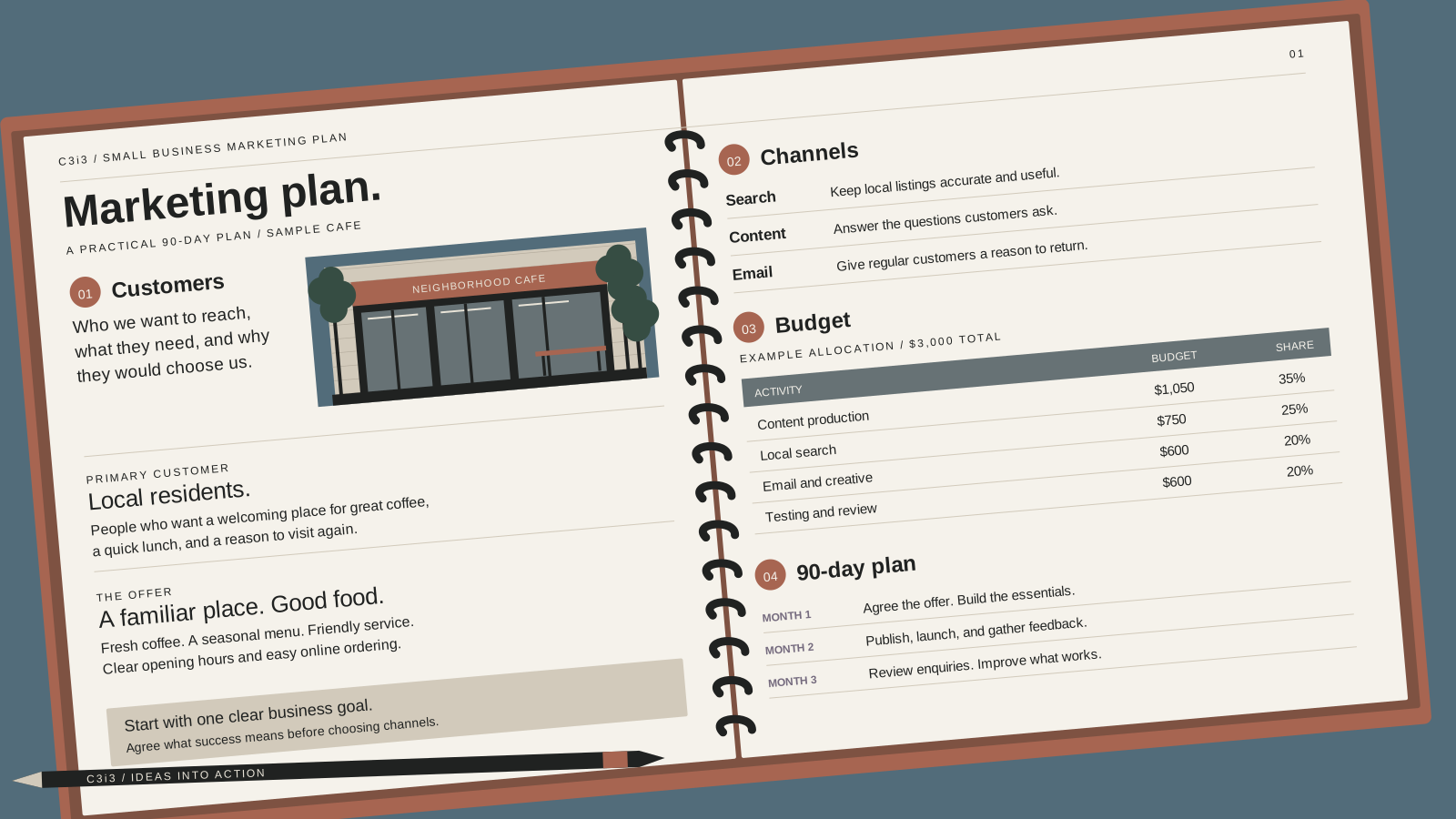
Clarify the offer → improve the enquiry page → record qualified leads → run a focused channel test → review booked work and total cost. The right order depends on the business, its capacity, and the evidence.
Want the detail behind a good plan? Read what a small business marketing plan should include.
Start with the decision.
Define the work around it.
The cost and schedule depend on what you need to decide, the research required, and how many offers, audiences, or locations are involved. We confirm deliverables, review rounds, timing, and fees in a written scope.
| Starting point | Best suited to | What we define together |
|---|---|---|
| A focused strategy | One offer, audience, or marketing decision. | Research needs, priorities, and a clear first phase. |
| An integrated plan | Several channels that need to work together. | Messaging, channel roles, resources, and delivery sequence. |
| Strategy + ongoing support | A business that needs a team to carry out and review the work. | A separate implementation scope and review rhythm. |
Media spend, software subscriptions, original production, and implementation are identified separately when relevant. We do not bundle them into an unexplained number.
Tell us what you’re working towardWhat would you
like to know?
What does a marketing strategy consultant do?
A marketing strategy consultant helps you choose the customers, positioning, channels, and priorities that support your business goals. C3i3 turns those choices into a written plan and can separately support the creative work and delivery.
What is the difference between a marketing strategy and a marketing plan?
Strategy explains the choices: who to serve, what to offer, why customers should choose you, and where to focus. A marketing plan turns those choices into tasks, budgets, owners, and timing. Our engagement can cover both so the direction connects to practical work.
How much does a small business marketing strategy cost?
There is no single price that fits every brief. The fee depends on research depth, the number of audiences or services, available information, and the deliverables. We discuss your goals and budget, then provide a written scope and quote before work begins.
How long does it take to create a marketing plan?
Timing is agreed after we understand the scope, access to information, research needs, and who will review the work. A focused decision needs a different schedule from a multi-channel plan. Your proposal sets the milestones and the input we need from you.
Do I need a strategy before paying for Google Ads or SEO?
You need a clear offer, audience, destination page, budget, and way to assess enquiries before increasing spend. A full strategy is useful when those decisions are unclear; a smaller planning exercise may be enough for a focused test. Our Bay Area advertising comparison explains some of the channel choices.
Can you improve an existing marketing plan?
Yes. We can review the current plan, website journey, campaigns, and available results, then identify what to retain or change. Share the original plan and the problem you are trying to solve so we can scope the review.
Can you implement the strategy as well as write it?
Yes. Our connected services cover design and digital products, website copy and content, commercials and production, and search and advertising. We agree the implementation scope separately, or hand the plan over to your existing team.
How do you use AI in marketing strategy?
AI can help organize research, explore draft ideas, or support repeatable production tasks. People still set the direction, verify important claims, and approve the work. We assess tool suitability, data permissions, quality checks, and expected effort before recommending a workflow.
Does the strategy cover AI search optimization?
It can include priorities for clear service content, useful answers, internal links, technical accessibility, and accurate business information. The detailed work is scoped around your site. Read what AI search optimization involves; no strategy can guarantee rankings or inclusion in an AI answer.
Do you work with businesses across the San Francisco Bay Area?
Yes. We work with Bay Area businesses, including those serving San Francisco, San Jose and surrounding Bay Area communities. A local brief can account for service areas, travel, customer needs, and local search. We also work with businesses beyond the region.
What do I need to prepare before the first conversation?
Bring your website address, a short description of your offer, the customers you want to reach, and what you want to improve. Any current plan, campaign reports, budget range, or enquiry records will help. It is fine to begin without all of these.
How will we know whether the strategy is working?
We agree measures connected to the goal, such as qualified enquiries, bookings, sales, or cost per acquired customer. Where tracking is incomplete, the plan identifies that gap. Review points help separate what the evidence supports from what still needs testing.