



































Campaign Concepts.

Find the idea before making the assets.
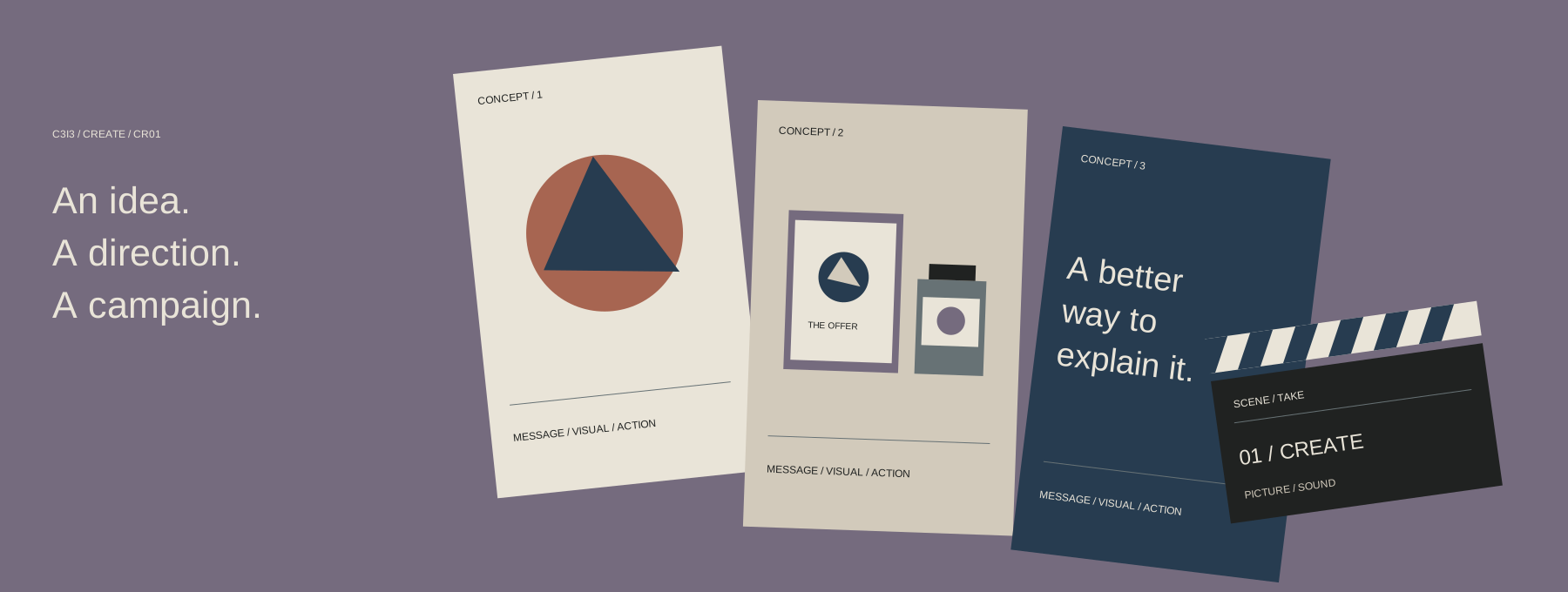
Campaign concept development explores the creative idea behind an advertisement or coordinated campaign. We develop approaches that connect the customer need, offer, message, and visual expression before production begins.
A concept is more than an image or a line. It explains why a particular scene, structure, or message will make the offer understandable. We compare distinct approaches, identify the resources each would require, and refine the selected route with your team. The work provides direction without pretending that an untested idea already has proven campaign results.
A focused concept brief
Agree the audience, communication problem, offer, constraints, and intended response.
Distinct creative routes
Explore different ways to dramatize the customer need and explain the offer.
A clear selection rationale
Compare the meaning, audience fit, brand fit, and practical production implications of each route.
Clear deliverables.
Useful decisions.
Your written scope confirms the depth and final format of the work. These are the components we can bring together for campaign concepts.
- 01A focused concept brief
Agree the audience, communication problem, offer, constraints, and intended response.
- 02Distinct creative routes
Explore different ways to dramatize the customer need and explain the offer.
- 03A clear selection rationale
Compare the meaning, audience fit, brand fit, and practical production implications of each route.
- 04Message and visual references
Show the tone, image approach, story structure, and supporting language.
- 05Chosen concept treatment
Develop the selected idea into a concise treatment your team can evaluate.
- 06Production implications
Identify the scenes, assets, formats, and approvals needed for the next stage.
Go deeper where
the decision needs it.
This work connects to the related creative and production work below. Explore the relevant service to see its distinct scope and deliverables.
Creative Campaign Development
Creative campaign development turns an agreed offer and audience into a clear creative direction. We connect the central idea, message, visual approach, formats, and next step so the campaign works as a coordinated experience.
Explore creative campaign developmentAd Creative Production
Ad creative production develops the finished visual and motion assets a campaign needs. We turn an approved direction into a defined set of advertisements, with the right message, layout, format, and handoff for each agreed placement.
Explore ad creative productionA clear process.
A practical handover.
The production approach follows the message, source material, and agreed scope. Open each step to see what happens and what it produces.
01Frame the communication problem.
We separate what needs to be understood from the initial preference for a particular format.
A clear concept brief.
02Explore alternative routes.
We develop ideas that approach the same objective in different ways.
A set of distinct concept options.
03Review the trade-offs.
We discuss clarity, brand fit, production needs, and any evidence gaps.
A reasoned concept selection.
04Develop the treatment.
We refine the selected route and document how it should be made.
A useful creative treatment.
The work in practice.
An illustrative commercial for a local service could explain the process, show the outcome, or dramatize a common frustration. Those are different ideas, not simply different shots of the same scene. The chosen route should suit the offer and the evidence available.
| The question or stage | What we examine | Why it matters |
|---|---|---|
| Route one | Show the process | Help customers understand what happens. |
| Route two | Show the useful outcome | Connect the offer with a practical benefit. |
| Route three | Begin with a recognizable problem | Create a clear reason to pay attention. |
To show how campaign concepts can support a decision. Your recommendations depend on the evidence, resources, and constraints in your own brief.
Agree the brief.
Then make the work.
The brief determines how many concepts, treatments, examples, and review rounds are needed. Scripts, storyboards, finished visuals, testing, and production are separate deliverables unless included.
| Before we start | What we agree |
|---|---|
| The decision | The audience, offer, question, and boundaries the work needs to address. |
| The deliverables | Creative and production scope, format, review rounds, responsibilities, and handover. |
| The investment | Written fees, schedule, dependencies, and any separate third-party or implementation costs. |
We confirm the proposal before work begins. You can commission a focused engagement, connect it to a wider plan, or ask about a separately scoped delivery phase.
Discuss scope and timingUseful questions.
Straightforward answers.
What will a campaign concept look like?
The agreed format may combine a short written idea, message direction, visual references, and an outline of how the concept unfolds.
Is a concept the same as a storyboard?
No. A concept defines the idea. A storyboard translates a selected idea into a sequence of shots or scenes.
Can we develop a concept we already have?
Yes. We can examine what it communicates, improve the treatment, and identify practical production requirements.
Will you guarantee the concept will perform?
No. Creative judgment and research can inform the direction, but campaign outcomes require real delivery and measurement.
Can one concept support several advertisements?
Yes, when the central idea has enough flexibility. We define what stays consistent and what changes across executions.
What happens after we approve a concept?
The next stage may be scripting, storyboarding, design, asset production, or a focused test, depending on the agreed plan.
What determines the cost and schedule?
The agreed deliverables, source material, original production needs, complexity, review rounds, and delivery requirements determine the proposal. We confirm fees, responsibilities, and timing before starting.
What should we prepare for the first conversation?
Bring the offer, intended audience, where the work will be used, existing brand material, available source files, and any budget or timing constraints. We will identify what else is needed for the brief.
Keep the next step
connected to the plan.
For a useful production guide, read how to write a 30-second service-business video ad script. Or return to all Create services.