



































Pillar Articles.

Give a broad question
a useful home.
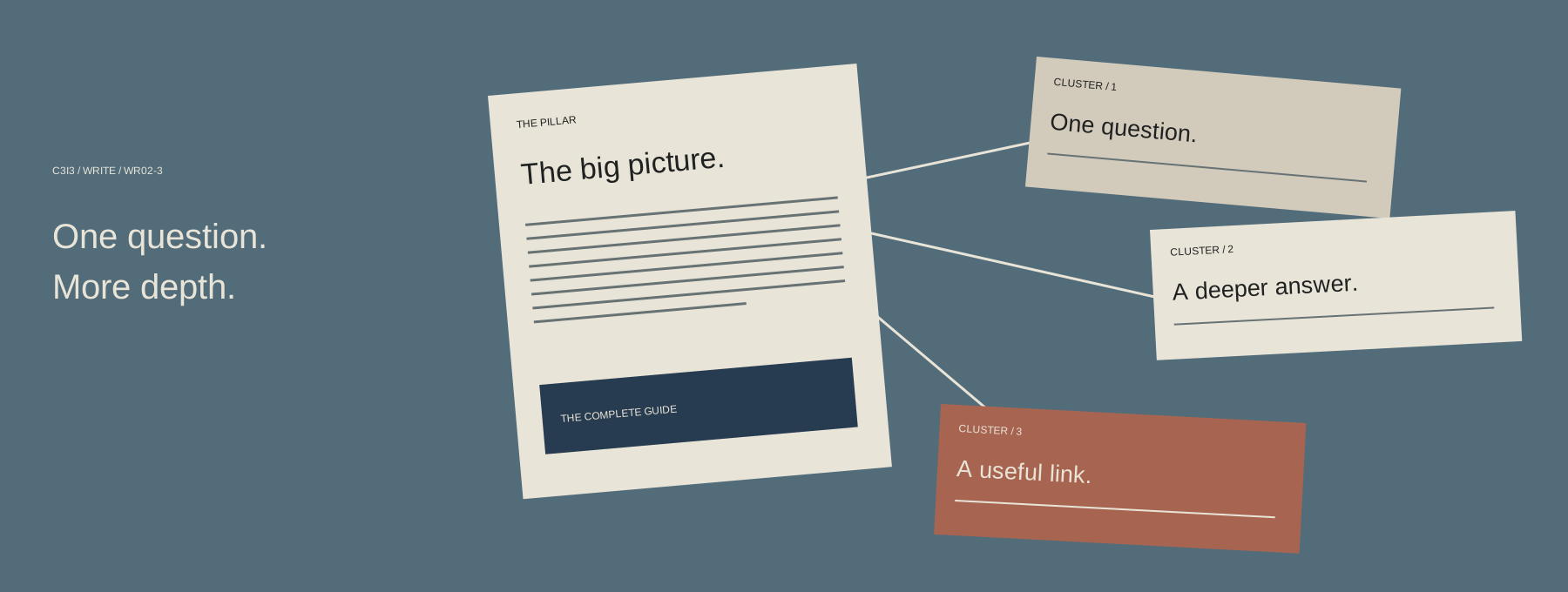
Pillar articles provide a substantial introduction to a broad topic and connect readers to more focused answers. We organize the subject around the questions a reader needs to understand, then develop an evidence-based guide with a clear place in your content structure.
A pillar should do more than collect headings. It establishes definitions, explains important choices, acknowledges limits, and helps readers know which specialist question to explore next. We decide what belongs in the main guide and what deserves a separate article. This keeps the page useful without repeating every supporting piece in full.
Subject boundaries
Define what the guide will cover, who it serves, and what falls outside its purpose.
Question-led outline
Organize the broad topic into a readable sequence of meaningful questions and supporting subtopics.
Research and expert input
Gather sources and internal knowledge appropriate to the claims and complexity of the subject.
Clear deliverables.
Useful decisions.
Your written scope confirms the depth and final format of the work. These are the components we can bring together for pillar articles.
- 01Subject boundaries
Define what the guide will cover, who it serves, and what falls outside its purpose.
- 02Question-led outline
Organize the broad topic into a readable sequence of meaningful questions and supporting subtopics.
- 03Research and expert input
Gather sources and internal knowledge appropriate to the claims and complexity of the subject.
- 04Substantial original draft
Write definitions, comparisons, examples, and practical explanations that make the guide useful on its own.
- 05Supporting-content map
Identify focused articles and service destinations that extend the guide without duplicating it.
- 06Editorial maintenance notes
Flag facts, examples, and product details that should be revisited as the subject changes.
Go deeper where
the decision needs it.
This work connects to the related writing and editorial work below. Explore the relevant service to see its distinct scope and deliverables.
Blog Writing
Blog writing turns relevant customer questions and business expertise into useful articles. We research, structure, draft, and edit original content that belongs on your site and connects readers to the services or deeper resources they need.
Explore blog writingCluster Articles
Cluster articles answer focused questions within a wider subject. We develop each piece with its own intent, evidence, and useful next step, then connect it to the relevant pillar, service, or related explanation.
Explore cluster articlesA clear process.
A practical handover.
The editorial approach follows the reader, source material, and agreed scope. Open each step to see what happens and what it produces.
01Set the scope of the guide.
We define the audience’s broad question and separate it from nearby topics that need their own treatment.
A pillar brief and boundaries.
02Build the information structure.
We map definitions, decisions, examples, and supporting links into a logical reading path.
An approved outline and source plan.
03Develop and verify the content.
We draft the full explanation, check sources, and resolve technical or business facts with your reviewer.
A substantive reviewed guide.
04Connect the topic cluster.
We place descriptive links and document what supporting content exists or should be developed later.
Final pillar copy and a link map.
The words at work.
A guide to commercial kitchen ventilation can introduce system types, planning questions, maintenance, and buying considerations. Separate articles can then examine a particular inspection or installation question without turning the main guide into a catalog of repeated pages.
| The question or stage | What we examine | Why it matters |
|---|---|---|
| Broad guide | Core concepts and major decisions | Orient a reader who is learning the subject. |
| Focused article | One practical question | Provide detail without overloading the guide. |
| Service page | The work available to commission | Separate education from the commercial offer. |
To show how pillar articles can support a decision. Your copy and its structure depend on the reader, evidence, and constraints in your own brief.
Agree the brief.
Then make the work.
Pillar work includes more outlining and research than a short post. We agree the depth, source standard, interviews, diagrams, review stages, and supporting-content map. Writing every cluster article is a separate deliverable unless listed.
| Before we start | What we agree |
|---|---|
| The decision | The audience, offer, question, and boundaries the work needs to address. |
| The deliverables | Writing and editorial scope, format, review rounds, responsibilities, and handover. |
| The investment | Written fees, schedule, dependencies, and any separate third-party or implementation costs. |
We confirm the proposal before work begins. You can commission a focused engagement, connect it to a wider plan, or ask about a separately scoped delivery phase.
Discuss scope and timingUseful questions.
Straightforward answers.
What is a pillar article?
It is a broad, organized guide that explains a subject and points readers to more specific resources. Its usefulness comes from coverage and clarity, not a particular length.
Does a pillar article need 3,000 words?
No fixed word count makes a page a pillar. The appropriate length follows the subject, reader needs, and evidence available.
How is a pillar different from a service page?
A pillar teaches a broad subject. A service page explains the work someone can buy, including scope, process, fit, and how to enquire.
Can one pillar support several local articles?
Yes, when the local articles answer genuinely different questions supported by local facts. Repeating the pillar with city names substituted creates little value.
Do you include sources and internal links?
Yes. We identify appropriate references and relevant internal destinations as part of the content handover.
Who keeps a pillar article current?
An owner and review rhythm should be agreed. We can flag change-sensitive sections and scope future updates when the subject develops.
How do you price a writing project?
We quote from the agreed research, interviews, number and complexity of deliverables, review rounds, and handover requirements. Word count alone does not describe the work. The proposal confirms the fee and what would require a change of scope.
What should we bring to the first conversation?
Bring the intended reader, the business goal, existing material, brand guidance, available subject experts, and any timing constraints. We will identify missing evidence and agree who can approve the copy before drafting.
Keep the message
connected.
For a useful writing guide, read what website copy should answer before a customer contacts you. Or return to all Write services.