



































Editorial Calendar Planning.

Plan the work.
Keep the calendar useful.
Editorial calendar planning turns approved content priorities into a manageable production schedule. We connect each piece to an owner, brief, source requirements, review steps, internal links, and a realistic place in the sequence.
A calendar should help your team finish useful work, not create pressure to fill empty dates. We plan around production capacity, customer needs, campaign dependencies, and the effort required to review the content. A simple tracker can be enough when its fields and responsibilities are clear. The schedule should also make updates and improvements to existing pages visible.
A sustainable workload
Match the publishing sequence to research, writing, design, and review capacity.
Clear responsibility
Make ownership and approval visible before content gets stuck.
Connected publication
Sequence guides, supporting pieces, campaigns, and internal links together.
Clear deliverables.
Useful decisions.
Your written scope confirms the depth and final format of the work. These are the components we can bring together for editorial calendar planning.
- 01Editorial workflow
The stages from idea and brief through writing, approval, publication, and review.
- 02Calendar structure
A practical tracker with stable IDs, page roles, categories, owners, and status.
- 03Prioritized production sequence
An order of work that accounts for dependencies and available resources.
- 04Brief and source checklist
The information each writer or designer needs before beginning.
- 05Approval and handoff rules
Who reviews accuracy, brand fit, links, imagery, and final publication.
- 06Maintenance rhythm
A way to schedule updates, consolidate overlap, and review completed material.
Go deeper where
the decision needs it.
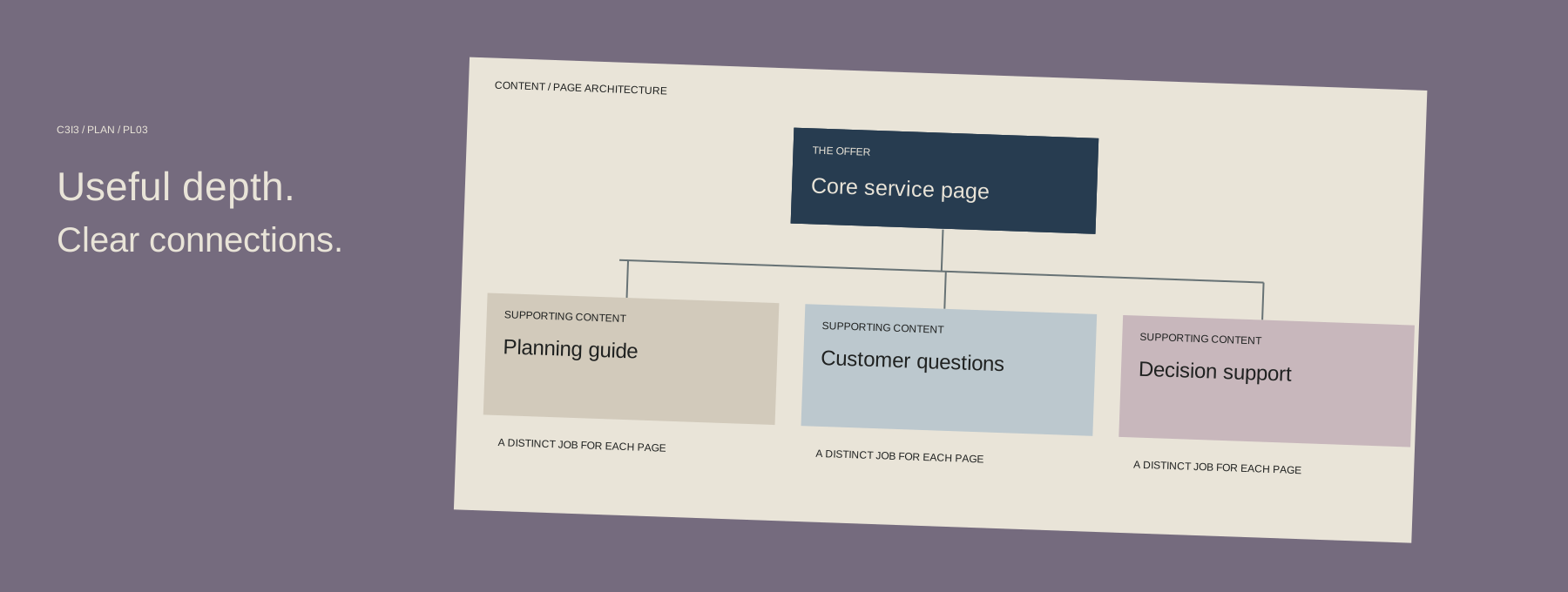
This work connects to the wider planning decisions below. Explore the relevant service to see its distinct scope and deliverables.
Content Strategy
Content strategy defines what your business needs to explain, who the content is for, and how the pieces connect. We plan service pages, articles, customer questions, and supporting assets around a useful journey rather than a publishing quota.
Explore content strategyTopic Research
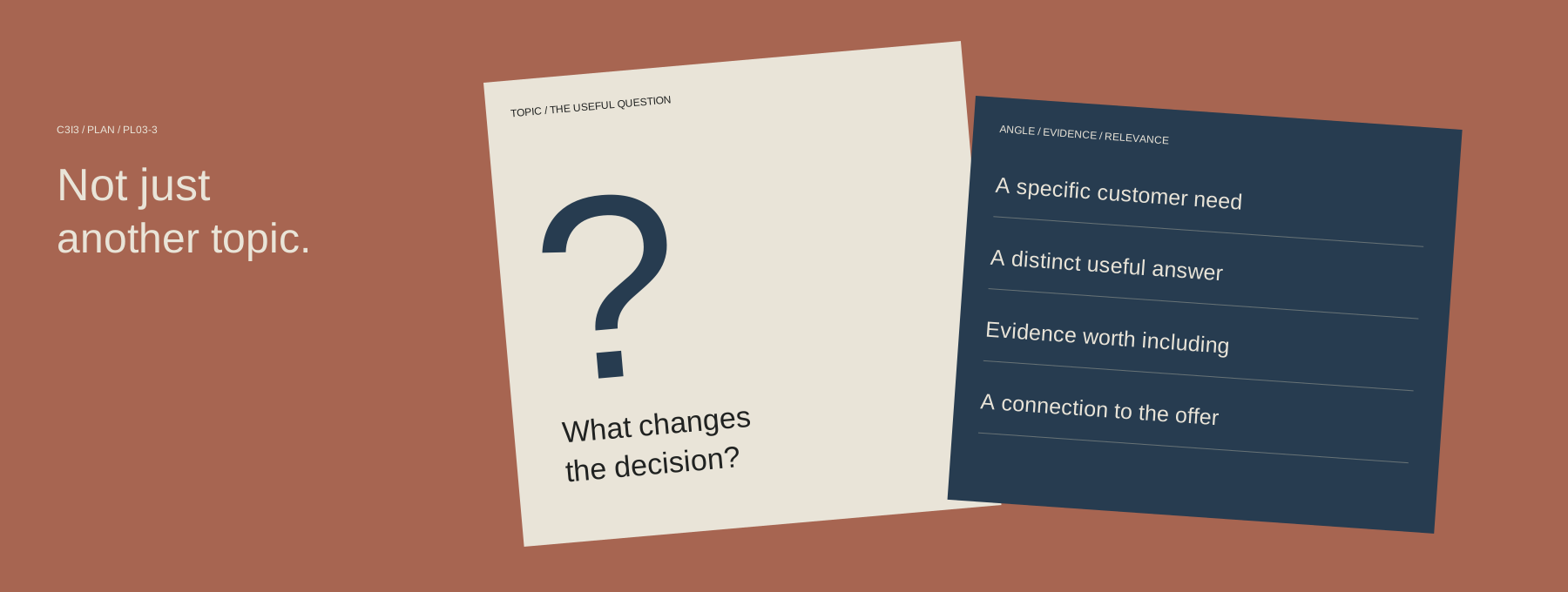
Topic research identifies the questions, decisions, and knowledge gaps your content should address. We explore the subject in context, connect it to your services, and define useful angles with the evidence and expertise each one needs.
Explore topic researchA clear process.
A practical handover.
The method follows the question and agreed scope. Open each step to see what happens and what it produces.
01Review the workload.
We assess what needs to be produced and who has time to research, write, design, and approve it.
A realistic capacity picture.
02Define the stages.
We agree the minimum fields, status definitions, and handoffs needed to keep work moving.
A simple editorial operating workflow.
03Build the first sequence.
We place approved priorities in an order that supports campaigns and connected content without overloading the team.
A usable first publishing schedule.
04Review and adjust.
We define a review routine for blockers, changing priorities, updates, and completed work.
A calendar that stays useful after the first week.
Publishing is more than a due date.
An illustrative team planning a service guide needs the service owner to check the scope, a designer to prepare the artwork, and someone to connect supporting links. The calendar makes those dependencies visible before a publication date is promised.
| The question or stage | What we examine | Why it matters |
|---|---|---|
| Ready to write | Brief and sources approved | The writer has a clear starting point. |
| Ready to publish | Copy, design, and links checked | The publisher has a complete package. |
| Ready to review | Owner and review trigger recorded | The page remains part of the ongoing workload. |
To show how editorial calendar planning can support a decision. Your recommendations depend on the evidence, resources, and constraints in your own brief.
Define the question.
Then define the work.
We can design a new calendar or simplify an existing one. The number of contributors, content types, review stages, and publishing systems affects the work. Automation or CMS integrations are separate unless explicitly included; a simple, well-run sheet may be the right starting point.
| Before we start | What we agree |
|---|---|
| The decision | The audience, offer, question, and boundaries the work needs to address. |
| The deliverables | Research or production depth, format, review rounds, responsibilities, and handover. |
| The investment | Written fees, schedule, dependencies, and any separate third-party or implementation costs. |
We confirm the proposal before work begins. You can commission a focused engagement, connect it to a wider plan, or ask about a separately scoped delivery phase.
Discuss scope and timingUseful questions.
Straightforward answers.
What should an editorial calendar include?
At minimum, a stable content ID, topic or title, purpose, owner, status, planned sequence, and review needs. Additional fields should support a real decision rather than make the sheet difficult to maintain.
Do we have to publish every week?
No fixed cadence suits every business. The plan should reflect your audience, priorities, research needs, and ability to produce and review useful content consistently.
Can the calendar include existing-page updates?
Yes. Updating, combining, and improving existing content should be visible alongside new articles and landing pages.
Can you use Google Sheets instead of a CMS?
Yes. A simple shared sheet can manage editorial work effectively. Publishing integrations are a separate decision and are not required to plan a useful calendar.
How do we prevent duplicate articles?
Use stable IDs, defined page roles, a topic map, and an existing-content check before approving a brief. Closely related ideas may belong in an update rather than a new article.
Who should approve an article?
The right reviewer depends on the subject. We identify who checks factual accuracy, service claims, brand voice, and final publication, rather than assuming one person can approve everything.
What happens when priorities change?
The workflow should allow resequencing while preserving IDs, status, and ownership. A calendar is a decision tool, not a promise that every initial date will remain fixed.
Can you manage production after planning?
Yes. Writing, design, publishing support, and ongoing management can be scoped separately around the workflow and capacity you need.
Keep the next step
connected to the plan.
For a broader planning guide, read what a small business marketing plan should include. Or return to all Plan services.