In this article
You do not need a presentation full of marketing language to decide what to do next. You need a working document that helps you choose where to spend, what to make, and which customers you can realistically serve.
For a Bay Area business, that could mean reaching nearby homeowners, bringing more people into a shop, or helping a buyer understand a specialized service. The right plan connects that specific opportunity to work your team can actually finish.
What business goal should your marketing plan support?
Choose a result that matters to the business before choosing an advertising platform. “More visibility” is difficult to act on. More qualified estimate requests for a particular service gives your team a clearer direction.
Start with a baseline and a target
Write down where you are now, what you want to improve, and when you will review it. If you do not know your current enquiry volume, begin by recording it. Separate an enquiry from a qualified opportunity and a completed sale so the target means something.
A useful goal could be: increase qualified enquiries for commercial cleaning within the service area, while keeping the number of new contracts within the team's delivery capacity. Add your own baseline and target rather than borrowing a percentage from another business.
Decide what you will leave for later
List the products, services, or audiences you are not prioritizing in this round. That small decision protects the budget when new ideas appear. Our marketing strategy services start with this connection between business priorities and practical work.
Who are you trying to reach, and where can you serve them?
Describe the person who needs the offer, the situation that brings them to you, and the questions they ask before buying. Age and location alone rarely explain a decision.
Use conversations you already have
Review sales enquiries, customer emails, and the questions your staff answer repeatedly. Look for patterns: urgency, price concerns, delivery requirements, or uncertainty about the process. These are useful starting points for your message and article topics.
Make local targeting reflect real operations
A Walnut Creek retailer serving walk-in customers needs a different plan from a contractor covering several East Bay cities. Record your actual service boundary, travel limits, delivery coverage, and any differences in the offer by location. Do not add city names simply to make a list longer.
For example, a fictional Dublin bakery pursuing office catering might focus on nearby office managers, advance-order requirements, and reliable delivery. The audience is more specific than “everyone who likes baked goods.”
A clear direction in four lines.
- Customer
- Who has the need?
- Offer
- What are you helping them do?
- Proof
- Why should they believe you?
- Next step
- What should they do now?
Choose the customer before you choose the channel.
What should your offer and marketing message say?
Explain the service, who it helps, and what happens next. Add evidence that supports the promise: relevant project examples, product specifications, genuine customer feedback, or a clear explanation of your process.
Replace broad claims with useful details
“Great service” gives a customer very little to compare. Describing what is included in a consultation, how a quote is prepared, and which work you handle gives them something concrete. Only promise turnaround times, savings, or outcomes that your business can support.
Choose one primary action
The main action might be booking a consultation, requesting an estimate, ordering a product, or calling about availability. Make sure the action suits the buying decision. Someone comparing a complex service may need answers before they are ready for a sales call.
Use the same core offer across your ads and destination pages. See what website copy should answer before a customer contacts you for the questions that belong on the page.
Which marketing channels should a small business choose?
Choose channels according to how customers discover, evaluate, and buy your offer. A manageable mix is easier to learn from than a long list of accounts nobody has time to maintain.
- Search and local visibility: useful when people look for a service or product with a recognizable need.
- Paid advertising: a way to test a specific offer and audience, with a spending limit and a suitable landing page.
- Email and customer follow-up: a way to stay useful to people who have agreed to hear from you.
- Social content and partnerships: useful when demonstrations, community relationships, or recommendations influence the purchase.
Give each channel a job
Record its audience, offer, destination, owner, cost, and success measure. A social post might introduce a service; a search page might answer a comparison question; an email might invite an existing customer to return. They do not all need to do the same thing.
Our marketing services overview shows how search, advertising, and content can work together. Choose the parts that fit the plan rather than adopting every channel at once.
For the search side of the plan, see our guide to AI search optimization.
What website pages and content does your plan need?
Make a list of the pages and creative assets required to explain the offer and support the next step. Check what exists before commissioning something new.
Fix the path from interest to enquiry
Visit the destination on a phone. Can someone understand the service, see relevant proof, find the service area, and contact you without guessing? Test the form and confirm who receives the message. A campaign also needs a reliable response process after the click.
Build articles around real customer questions
Group related questions around a useful main topic. A core service page can explain what you offer, while articles cover comparisons, preparation, costs, and common concerns in more detail. Link between them where it helps the reader continue.
Keep the content calendar realistic: topic, purpose, source material, writer, reviewer, and publishing responsibility. Our content strategy approach helps connect those topics to the wider plan. If the format itself is undecided, compare a website, an app, and a landing page before adding development work.
How much should a small business budget for marketing?
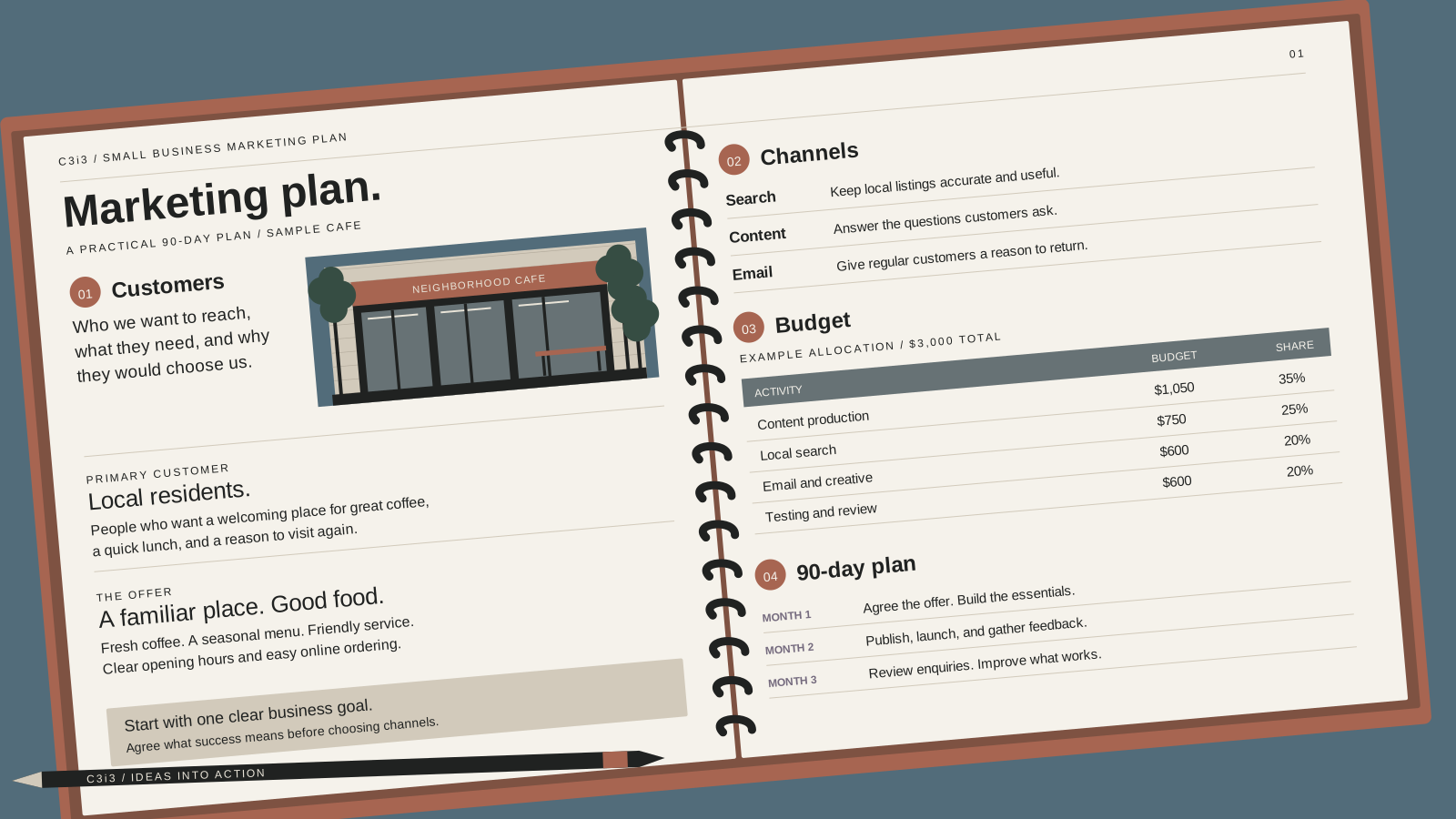
Build a budget from the work you can afford, the value of a suitable customer, and your capacity to deliver. There is no single percentage that gives every small business the right answer.
Include more than advertising spend
| Cost | What to allow for |
|---|---|
| Setup | Research, page improvements, tracking, and initial creative. |
| Ongoing work | Writing, design, campaign management, and customer follow-up. |
| Media and tools | Ad placement, subscriptions, and approved production tools. |
| Testing and review | Time and money to improve the first version. |
Assign a spending limit and a decision point to each test. Keep staff time visible even when no external invoice is involved. A low-cost campaign can still be expensive if it creates hours of unqualified enquiries.
Check the economics of a sale
Revenue alone does not tell you how much acquisition cost is sustainable. Consider delivery costs, margin, repeat business, and how often enquiries become customers. Use your own records and treat early estimates as assumptions to review.
What should your first 90 days of marketing look like?
A 90-day schedule is a practical planning window, not a promise that every channel will produce results in three months. Break the work into stages, with one person responsible for moving each task forward.
| Stage | Priority | Check before moving on |
|---|---|---|
| Days 1–30 | Confirm the offer, fix the destination, and establish measurement. | Can a suitable customer understand and complete the next step? |
| Days 31–60 | Publish the first useful content and launch the selected activity. | Are enquiries reaching the right person and being recorded? |
| Days 61–90 | Review quality, costs, and customer feedback; adjust the next cycle. | What should continue, change, or stop? |
Include approvals and dependencies
A new landing page may need approved copy, project images, and a working form before an ad can launch. Put those dependencies into the schedule. If the owner must review everything, reserve that time rather than assuming it will appear.
How do you know whether your marketing plan is working?
Compare the work completed with the quality of opportunities it creates. Record enquiries, qualified leads, sales, and costs using consistent definitions. Traffic and clicks can help explain the journey, but they do not replace the business goal.
Look at outcomes alongside context
Ask which service the customer wanted, whether they were in your area, and why they did or did not buy. Review response speed and capacity too. Marketing cannot resolve a backlog if nobody can answer an enquiry or deliver the work.
Attribution is often incomplete: someone may see a recommendation, visit later through search, and finally call. Combine available tracking with customer conversations instead of treating a single report as the complete story.
Turn the review into a decision
Choose a regular review rhythm and write down what you will keep, improve, or pause. Allow enough time to evaluate the channel fairly. If your team needs help maintaining that cycle, explore our ongoing marketing support.
Is your marketing plan ready to use?
Before you approve the next round of work, check that you can answer each of these.
More about small business marketing plans.
How long should a small business marketing plan be?
Long enough to make the decisions clear and short enough that the team will use it. Start with a one-page summary, then add a budget, schedule, and supporting research where needed. The useful test is whether someone can understand the priority, their responsibility, and the next action.
Is a marketing plan the same as a business plan?
A business plan covers the wider operation, including what the company sells and how it works. A marketing plan focuses on reaching customers, explaining the offer, supporting a sale, and reviewing that activity. Keep the two connected so marketing promises match what the business can deliver.
Can a small business start marketing with a limited budget?
Yes. Start with a narrow priority and use the assets and relationships you already have. Improving one useful service page, following up with existing customers appropriately, or answering a recurring sales question may be more manageable than launching several campaigns. Include your time in the budget and test before expanding.
Should local SEO be part of the marketing plan?
It can be, when local discovery matters to your customers. Begin with accurate business information and pages that explain your real services and coverage. The plan should also identify who maintains those details and answers enquiries. Local search activity should support the same offer and capacity as the rest of the business.
Can AI help write a small business marketing plan?
AI can help organize notes, compare ideas, and prepare a first draft. You still need to verify the assumptions, supply real customer knowledge, approve the budget, and assign the work. Avoid uploading confidential customer information without an appropriate policy. A polished document is only useful when its recommendations fit your business.
What should you tackle first?
Tell us what you want to improve. We can help connect the plan, the creative work, and the people needed to keep it moving.