



































Content Strategy.

Answer the right questions.
Build a useful body of content.
Content strategy defines what your business needs to explain, who the content is for, and how the pieces connect. We plan service pages, articles, customer questions, and supporting assets around a useful journey rather than a publishing quota.
A growing website needs more than a list of topics. It needs a structure that distinguishes services from advice, broad guides from focused answers, and genuinely local information from repeated city names. We review what exists, identify gaps and overlap, and prioritize the work around customer needs, business value, evidence, and your ability to maintain it.
Useful coverage
Plan the questions that help customers understand and choose.
A clear structure
Connect service pages, guides, and supporting answers without unnecessary duplication.
Sustainable production
Match briefs, review, ownership, and updates to your team's capacity.
Clear deliverables.
Useful decisions.
Your written scope confirms the depth and final format of the work. These are the components we can bring together for content strategy.
- 01Content audit and gap review
What to retain, improve, combine, create, or retire, within the agreed site scope.
- 02Audience and intent map
The questions and decisions each content piece needs to serve.
- 03Topic and page architecture
Service, pillar, cluster, and local content roles with sensible internal relationships.
- 04Prioritized content roadmap
An ordered plan based on usefulness, business relevance, dependencies, and available evidence.
- 05Brief and editorial requirements
Heading direction, source needs, proof, format, next steps, and review responsibilities.
- 06Maintenance and linking plan
How content connects, who keeps it current, and when the plan should be reviewed.
Go deeper where
the decision needs it.
These specialist services develop the work within content strategy. We can combine the relevant parts in one scope or focus on a particular decision.
Keyword Research
Keyword research identifies the search language, intent, and page opportunities relevant to your offers. We organize the findings into a practical map that helps you improve existing pages and choose useful new content.
Explore keyword researchEditorial Calendar Planning
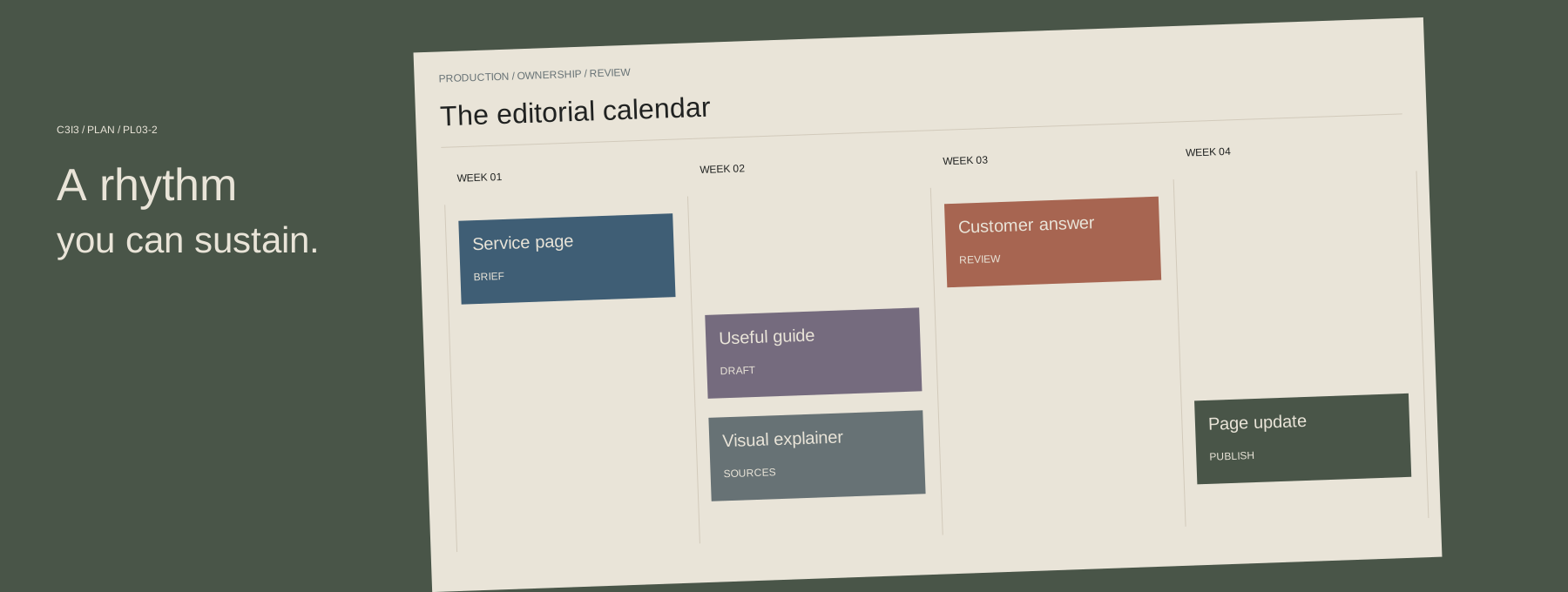
Editorial calendar planning turns approved content priorities into a manageable production schedule. We connect each piece to an owner, brief, source requirements, review steps, internal links, and a realistic place in the sequence.
Explore editorial calendar planningTopic Research
Topic research identifies the questions, decisions, and knowledge gaps your content should address. We explore the subject in context, connect it to your services, and define useful angles with the evidence and expertise each one needs.
Explore topic researchA clear process.
A practical handover.
The method follows the question and agreed scope. Open each step to see what happens and what it produces.
01Understand the content job.
We agree the offers, audiences, and decisions your website needs to support, then review existing material.
A content brief and audit scope.
02Map questions and intent.
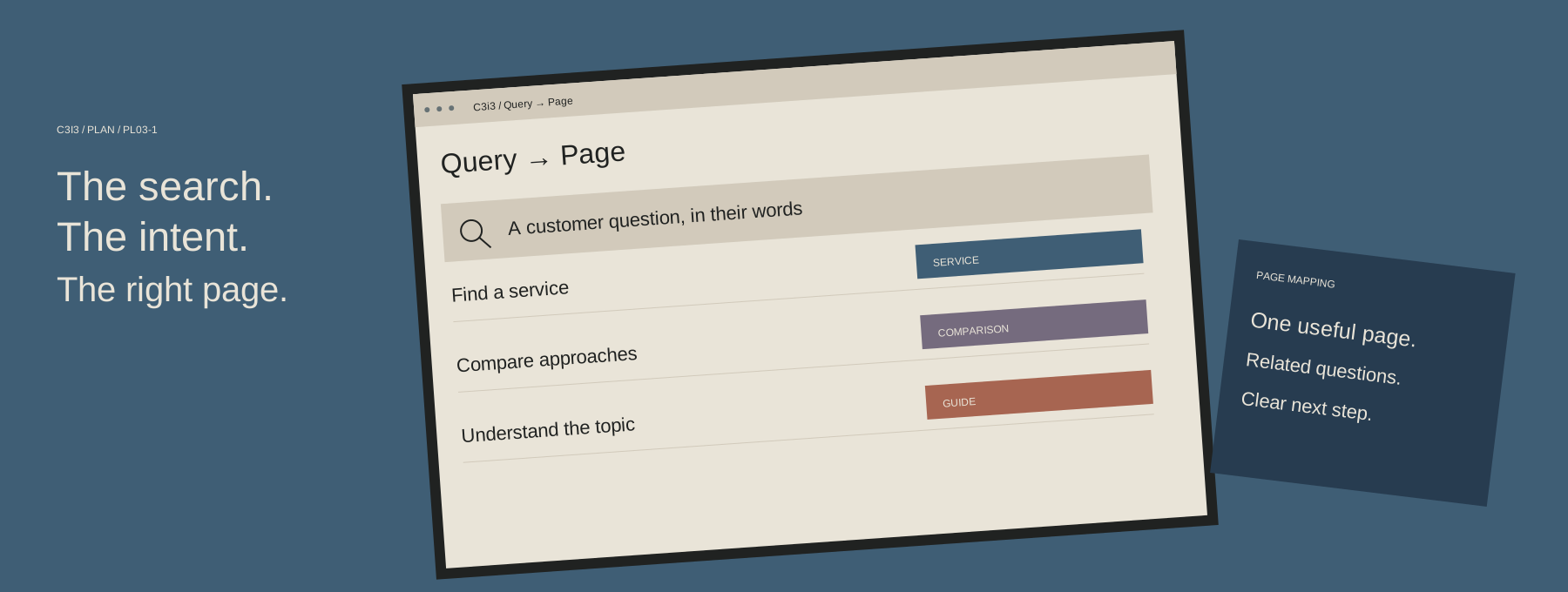
We connect audience, topic, and keyword research without assuming that every phrase needs its own page.
A useful coverage and gap map.
03Define the architecture.
We choose page roles, relationships, briefs, and internal links while resolving overlapping topics.
A prioritized content structure.
04Plan production and upkeep.
We assign ownership, source and review needs, sequencing, and update responsibilities.
An editorial roadmap your team can maintain.
One subject. Different jobs for each page.
For an illustrative service business, a core service page explains the offer, a guide answers the broader planning question, and focused articles resolve specific decisions. Each piece links naturally to the others, instead of repeating the same introduction under a different title.
| The question or stage | What we examine | Why it matters |
|---|---|---|
| Service page | Explain the offer and next step | Help a potential customer assess fit. |
| Pillar guide | Explain the broader subject | Give useful context and link to details. |
| Focused article | Answer a specific question | Resolve a decision without duplicating the guide. |
To show how content strategy can support a decision. Your recommendations depend on the evidence, resources, and constraints in your own brief.
Define the question.
Then define the work.
Scope depends on the volume of existing content, number of offers, research depth, and how detailed the briefs need to be. Writing, design, migration, CMS setup, and ongoing publishing are separate deliverables unless included explicitly. We can plan a focused first group before expanding the library.
| Before we start | What we agree |
|---|---|
| The decision | The audience, offer, question, and boundaries the work needs to address. |
| The deliverables | Research or production depth, format, review rounds, responsibilities, and handover. |
| The investment | Written fees, schedule, dependencies, and any separate third-party or implementation costs. |
We confirm the proposal before work begins. You can commission a focused engagement, connect it to a wider plan, or ask about a separately scoped delivery phase.
Discuss scope and timingUseful questions.
Straightforward answers.
What is included in a content strategy?
An agreed review of existing content, audience questions, page roles, topic coverage, priorities, briefs, internal links, and editorial responsibilities. The level of detail is set in the scope.
How is content strategy different from writing articles?
Strategy decides what to create, why it is needed, and how it connects. Writing produces the material. Separating the decisions helps avoid publishing more of the wrong content.
Does content strategy include SEO and AI search?
It can address clear service explanations, useful query-based topics, internal links, evidence, and maintainable content structure. Technical work and writing are scoped separately; visibility cannot be guaranteed.
Do we need a separate page for every keyword?
No. Closely related phrases may be served by one useful page. We consider intent and distinct customer needs before recommending another URL.
Can you plan city and county content?
Yes, where location creates a useful difference in the information. We avoid a plan built only on swapping city names into otherwise identical copy.
Will you reuse our existing articles?
Where they are useful, yes. The review may recommend updating, combining, restructuring, or retiring material rather than starting everything again.
Can our team write from your briefs?
Yes. Briefs can define the audience, question, structure, source needs, internal links, and review requirements for your writers or ours.
How do you prioritize the first topics?
We weigh customer usefulness, connection to your services, evidence, gaps, duplication, dependencies, and production capacity. A large list is not the same as a useful order of work.
Keep the next step
connected to the plan.
For a broader planning guide, read what a small business marketing plan should include. Or return to all Plan services.