



































Brand Positioning.

Find a position
you can stand behind.
Brand positioning defines who your offer is for, the problem it addresses, and why it is a credible choice among the alternatives. We help turn those decisions into a clear direction for messaging, identity, websites, and campaigns.
Positioning is not a decorative tagline or a claim to be the best. It is a set of choices about customer fit, value, difference, and evidence. We examine the offer, audience, competing options, and what your business can consistently deliver. The result should guide the team when deciding what to say, what to show, and what not to promise.
A defined customer fit
Be specific about the audience and buying situation you serve.
A credible difference
Describe the value you can demonstrate rather than an unsupported superlative.
Consistent direction
Give creative and customer-facing teams the same basis for their work.
Clear deliverables.
Useful decisions.
Your written scope confirms the depth and final format of the work. These are the components we can bring together for brand positioning.
- 01Positioning brief
The customer, need, category, alternatives, and decisions the work needs to resolve.
- 02Offer and evidence review
What you deliver, how it creates value, and which claims your evidence supports.
- 03Positioning options
Distinct directions with their implications and trade-offs made clear.
- 04Positioning statement
A concise internal explanation of audience, value, difference, and reasons to believe.
- 05Message and proof framework
Key themes, supporting points, and evidence requirements for outward communication.
- 06Creative application brief
How the position should guide website content, identity, campaigns, and service presentation.
Go deeper where
the decision needs it.
These specialist services develop the work within brand positioning. We can combine the relevant parts in one scope or focus on a particular decision.
Brand Messaging
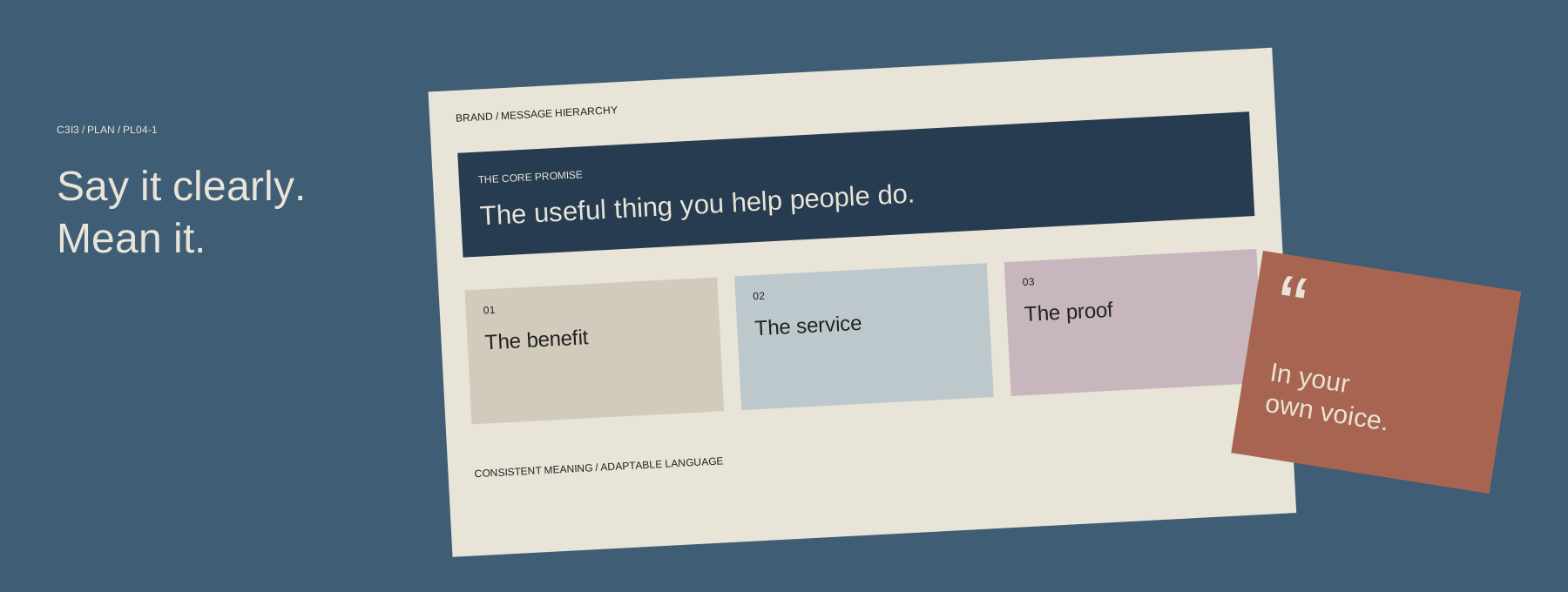
Brand messaging translates your positioning into the language customers encounter across your website, campaigns, presentations, and conversations. We define the main promise, supporting messages, proof, and tone so the team can communicate consistently.
Explore brand messagingValue Proposition Development
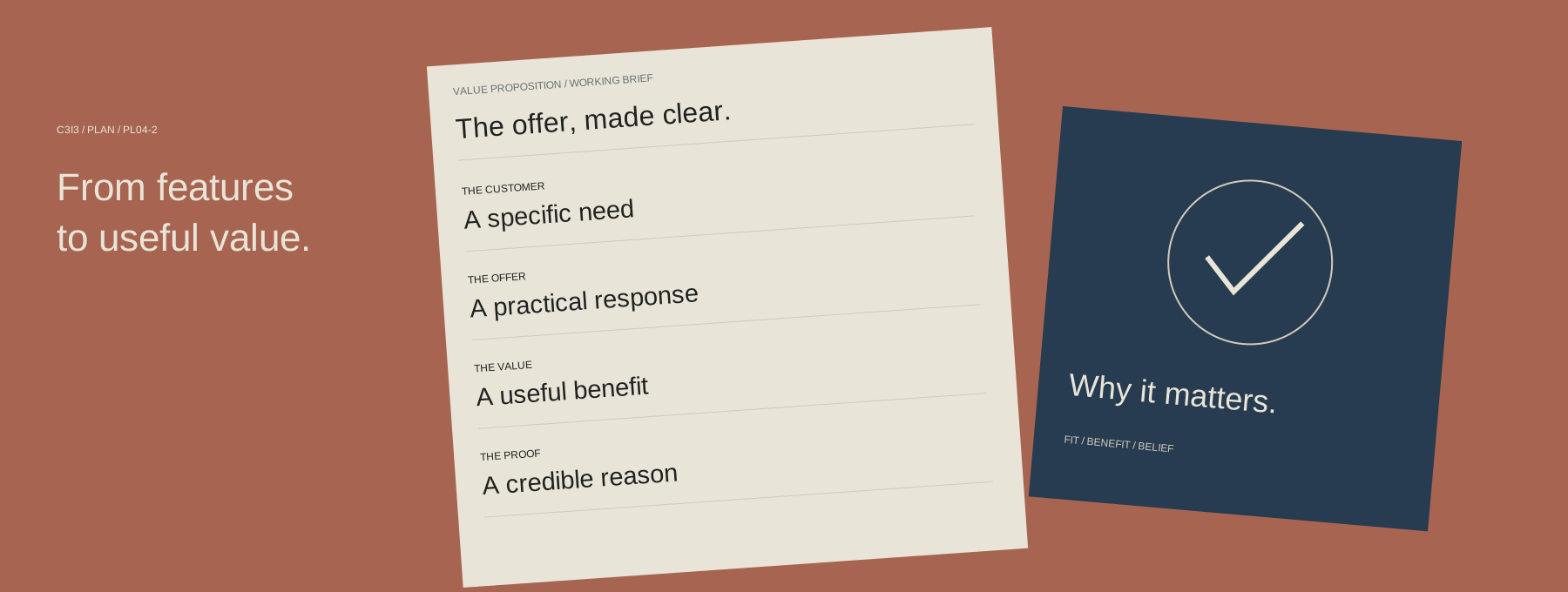
Value proposition development clarifies the customer need your offer addresses, the benefit it delivers, and why it is a useful choice. We help connect the promise with the scope, evidence, and practical realities behind it.
Explore value proposition developmentA clear process.
A practical handover.
The method follows the question and agreed scope. Open each step to see what happens and what it produces.
01Understand the offer.
We examine what customers receive, what the business does well, and which promises it can support consistently.
An offer and proof inventory.
02Explore the customer's choice.
We consider needs and alternatives, using research where the current evidence is insufficient.
A context for credible differentiation.
03Choose the position.
We develop and discuss distinct directions, including the audiences and expectations each one implies.
An agreed positioning statement.
04Make it usable.
We translate the direction into messages, proof requirements, and practical guidance for creative work.
A positioning and communication brief.
A specific promise is easier to prove.
An illustrative specialist studio might choose to emphasize coordinated planning and delivery for a defined kind of project. That position needs a clear scope, process, and supporting work—not simply the words innovative, premium, or full service.
| The question or stage | What we examine | Why it matters |
|---|---|---|
| Audience | Who is this a good fit for? | State the relevant need and context. |
| Value | What becomes easier or better? | Explain the benefit in concrete terms. |
| Evidence | Why should someone believe it? | Use supportable facts, process, and examples. |
To show how brand positioning can support a decision. Your recommendations depend on the evidence, resources, and constraints in your own brief.
Define the question.
Then define the work.
The number of offers, audiences, stakeholders, and research requirements shape the engagement. A focused positioning exercise differs from a full brand research and identity project. Naming, visual identity, copywriting, and customer testing are defined separately when needed.
| Before we start | What we agree |
|---|---|
| The decision | The audience, offer, question, and boundaries the work needs to address. |
| The deliverables | Research or production depth, format, review rounds, responsibilities, and handover. |
| The investment | Written fees, schedule, dependencies, and any separate third-party or implementation costs. |
We confirm the proposal before work begins. You can commission a focused engagement, connect it to a wider plan, or ask about a separately scoped delivery phase.
Discuss scope and timingUseful questions.
Straightforward answers.
What is brand positioning?
It is the choice of who an offer serves, what value it provides, and why it is a credible alternative. It guides communication and experience, rather than existing only as a slogan.
Is positioning the same as a brand identity?
No. Positioning defines the strategic direction. Identity expresses the brand through visual and verbal elements. A clear position can make identity design and copywriting more focused.
Can you help if we already have a logo?
Yes. A positioning engagement can clarify the offer and message without requiring a new logo. Any visual changes should follow a real need, not be assumed at the start.
What if we offer several services?
We examine what connects the offers and where audiences or value differ. Some businesses need one shared position with service-specific messages; others need a more deliberate architecture.
Do you write taglines?
Taglines can be a later copywriting deliverable. We first define the audience, value, difference, and proof so a line has a useful direction behind it.
How do you validate the position?
We review it against customer needs, alternatives, operational reality, and available evidence. Direct customer research or testing can be scoped where needed.
Can positioning help a local Bay Area business?
Yes. A local business still needs to explain fit, value, and reasons to choose it. Geographic relevance is considered where it changes the offer or customer decision.
What happens after positioning?
The direction can guide brand messaging, a value proposition, website content, identity design, and campaigns. We can scope the creative and implementation work separately.
Keep the next step
connected to the plan.
For a broader planning guide, read what a small business marketing plan should include. Or return to all Plan services.