



































Value Proposition Development.

A stronger offer starts
with a clearer value proposition.
Value proposition development clarifies the customer need your offer addresses, the benefit it delivers, and why it is a useful choice. We help connect the promise with the scope, evidence, and practical realities behind it.
Customers need more than a list of capabilities. They need to understand whether the offer fits their situation and what they receive in return for their commitment. We examine the problem, desired outcome, alternatives, objections, and reasons to believe. The resulting proposition should be specific enough to guide a service page, proposal, or campaign without making promises the business cannot keep.
A customer-centered offer
Describe the need and benefit before listing internal capabilities.
A clear exchange
Make the scope and useful outcome easier to understand.
A credible promise
Connect the value claim to evidence and operational delivery.
Clear deliverables.
Useful decisions.
Your written scope confirms the depth and final format of the work. These are the components we can bring together for value proposition development.
- 01Offer discovery brief
The customer, problem, service scope, alternatives, and decision to clarify.
- 02Customer value map
Needs, desired outcomes, concerns, and the parts of the offer that address them.
- 03Benefit and evidence review
A distinction between features, customer benefits, and claims that need proof.
- 04Proposition options
Different ways to express the offer, including the implications and trade-offs.
- 05Agreed value proposition
A concise explanation with supporting points and appropriate qualifications.
- 06Application guidance
How the proposition can guide a service introduction, landing page, proposal, or campaign.
Go deeper where
the decision needs it.
This work connects to the wider planning decisions below. Explore the relevant service to see its distinct scope and deliverables.
Brand Positioning
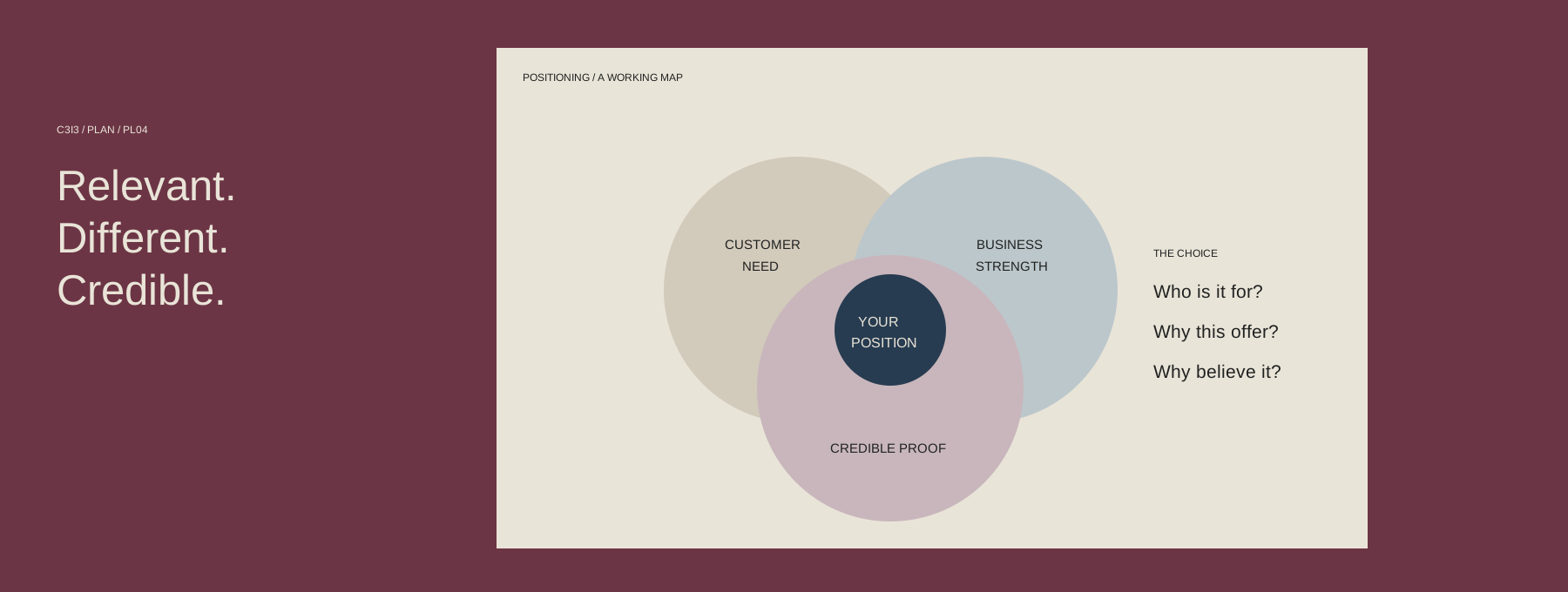
Brand positioning defines who your offer is for, the problem it addresses, and why it is a credible choice among the alternatives. We help turn those decisions into a clear direction for messaging, identity, websites, and campaigns.
Explore brand positioningBrand Messaging
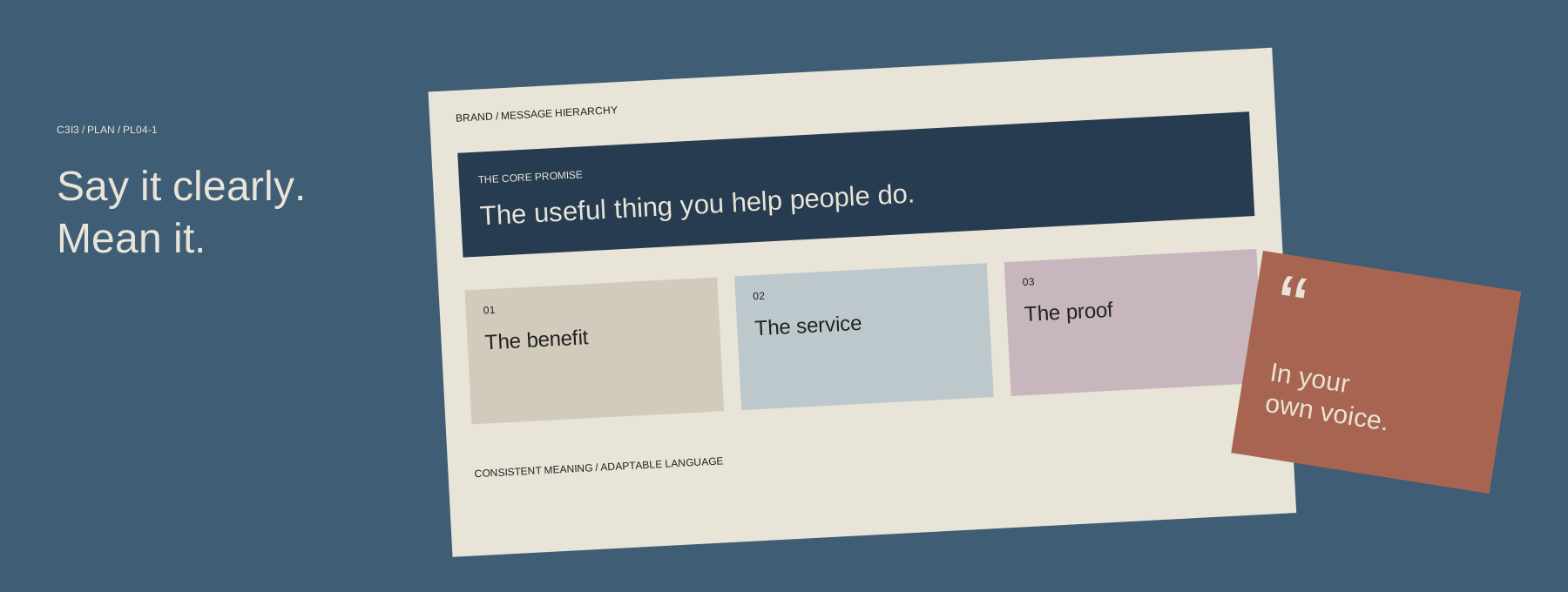
Brand messaging translates your positioning into the language customers encounter across your website, campaigns, presentations, and conversations. We define the main promise, supporting messages, proof, and tone so the team can communicate consistently.
Explore brand messagingA clear process.
A practical handover.
The method follows the question and agreed scope. Open each step to see what happens and what it produces.
01Understand the exchange.
We clarify what the customer needs to achieve and what your offer actually includes.
A shared definition of the offer and customer need.
02Connect benefit to delivery.
We examine how features and service steps create value, and what evidence supports the connection.
A value and proof map.
03Explore propositions.
We develop distinct language options and assess clarity, relevance, credibility, and fit.
An agreed proposition direction.
04Make it practical.
We show how the proposition can be supported and explained in the agreed customer touchpoints.
A usable offer statement and supporting guidance.
Turn a feature into a useful explanation.
An illustrative support service might list monthly reviews as a feature. The value proposition needs to explain what those reviews help the customer decide, what information is examined, and what happens afterward. The benefit must follow from the real service, not from an invented result.
| The question or stage | What we examine | Why it matters |
|---|---|---|
| Feature | What is delivered? | State the service or capability accurately. |
| Benefit | Why does it matter? | Explain the practical value for this customer. |
| Proof | What supports the promise? | Use evidence, scope, and a credible process. |
To show how value proposition development can support a decision. Your recommendations depend on the evidence, resources, and constraints in your own brief.
Define the question.
Then define the work.
The number of offers, customer groups, evidence gaps, and application requirements affects the engagement. Direct customer validation can be scoped where needed. Packaging, pricing decisions, naming, and production copy require their own defined work rather than being assumed within one statement.
| Before we start | What we agree |
|---|---|
| The decision | The audience, offer, question, and boundaries the work needs to address. |
| The deliverables | Research or production depth, format, review rounds, responsibilities, and handover. |
| The investment | Written fees, schedule, dependencies, and any separate third-party or implementation costs. |
We confirm the proposal before work begins. You can commission a focused engagement, connect it to a wider plan, or ask about a separately scoped delivery phase.
Discuss scope and timingUseful questions.
Straightforward answers.
What is a value proposition?
A clear explanation of who an offer helps, what need it addresses, and why it is a useful and credible choice. It should connect the promise with what the business actually delivers.
How is it different from a tagline?
A tagline is a short expression. A value proposition explains the offer and its relevance, usually with supporting points. The proposition can guide a tagline but should not be reduced to one clever line.
Can one company have several value propositions?
Yes. Different offers or audiences may need different explanations, while remaining consistent with the overall brand position.
Do you help distinguish features from benefits?
Yes. We examine what is delivered, why it matters to the customer, and what evidence supports the claimed benefit. That connection helps make service content more useful.
Will you recommend our prices?
Pricing may be discussed as context, but pricing research and financial decisions are not automatically included. We define whether that work is needed and who is responsible.
Can you validate the proposition with customers?
Customer interviews or another suitable method can be scoped. Without direct testing, we distinguish an internally agreed proposition from one validated with customers.
Where will we use the finished proposition?
It can inform service pages, campaign briefs, proposals, presentations, and sales conversations. Finished copy for each application is agreed separately.
What information should we prepare?
Your offer scope, customer needs, common objections, competing alternatives, and available evidence. Customer feedback and examples of how the service is delivered are especially useful.
Keep the next step
connected to the plan.
For a broader planning guide, read what a small business marketing plan should include. Or return to all Plan services.