



































Keyword Research.

Find the questions
worth answering.
Keyword research identifies the search language, intent, and page opportunities relevant to your offers. We organize the findings into a practical map that helps you improve existing pages and choose useful new content.
A keyword list alone does not tell you what to build. We examine whether someone wants an explanation, a comparison, a provider, or a next step, then connect that intent to the right page. Closely related phrases may belong together. A local modifier matters when geography changes the service or decision, not simply because another city name can be added to a title.
Relevant search language
Explore how customers describe the problem and the service.
Intent-led grouping
Group phrases by the decision and the page that can answer it.
A useful priority map
Connect opportunities to your offers, evidence, and content capacity.
Clear deliverables.
Useful decisions.
Your written scope confirms the depth and final format of the work. These are the components we can bring together for keyword research.
- 01Research scope and seeds
The offers, audiences, locations, and starting questions covered by the research.
- 02Keyword and query set
Relevant phrases with source notes and available tool data clearly distinguished from editorial ideas.
- 03Intent clusters
Groups reflecting informational, comparison, and service-seeking needs.
- 04Existing-page mapping
Which current page should serve each group and where overlap needs attention.
- 05Content opportunities
Useful new pages or updates where a distinct intent is not being served.
- 06Priority and brief notes
Recommended sequencing, page type, related questions, and internal link opportunities.
Go deeper where
the decision needs it.
This work connects to the wider planning decisions below. Explore the relevant service to see its distinct scope and deliverables.
Content Strategy
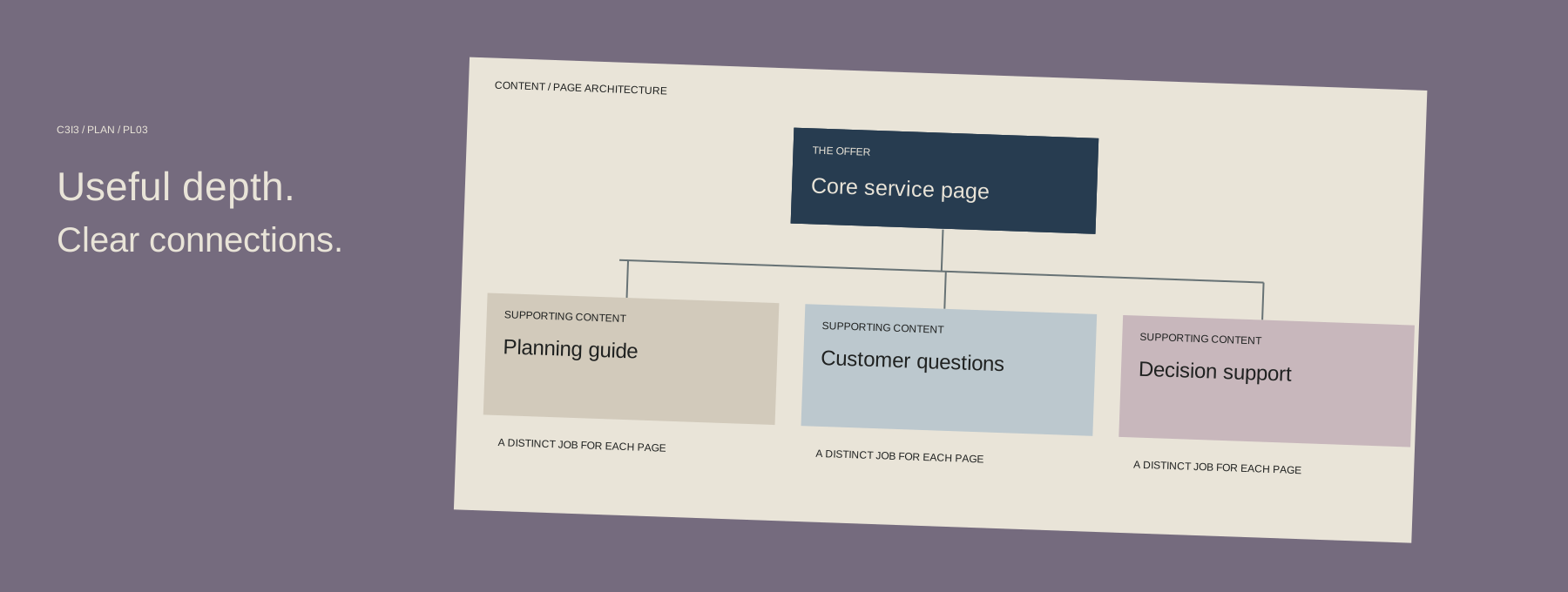
Content strategy defines what your business needs to explain, who the content is for, and how the pieces connect. We plan service pages, articles, customer questions, and supporting assets around a useful journey rather than a publishing quota.
Explore content strategyTopic Research
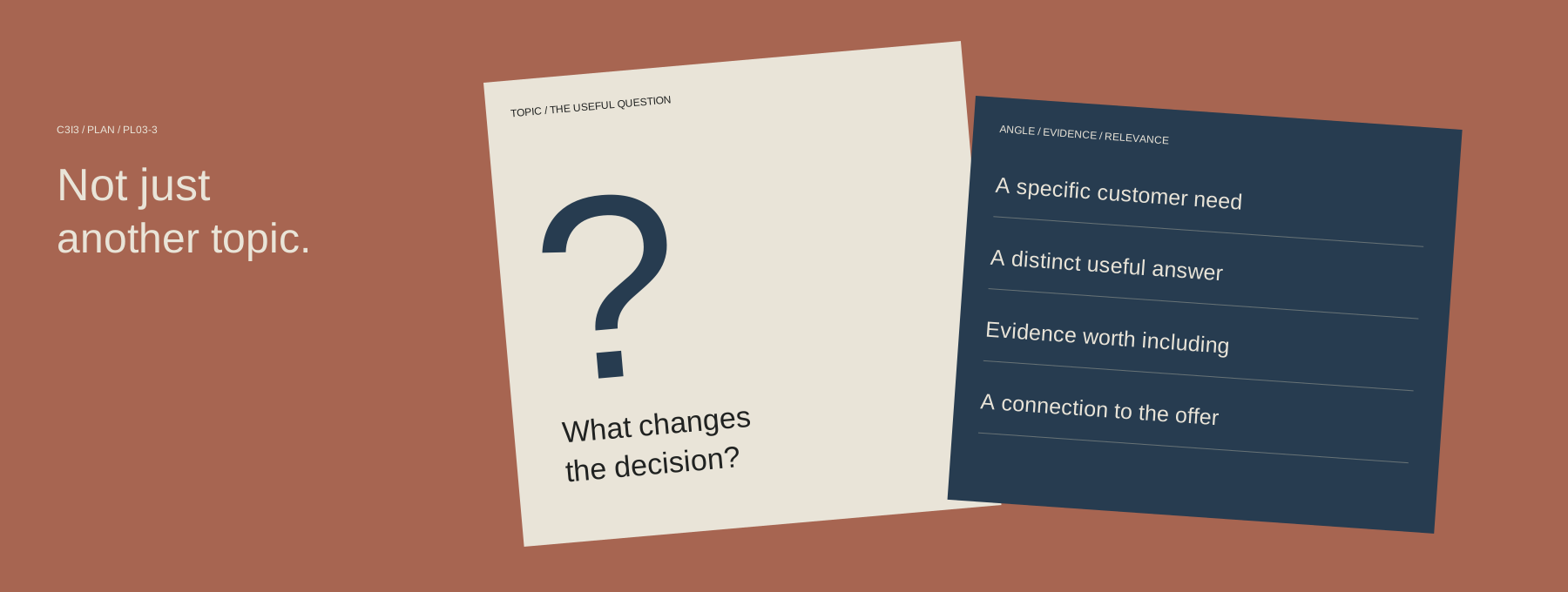
Topic research identifies the questions, decisions, and knowledge gaps your content should address. We explore the subject in context, connect it to your services, and define useful angles with the evidence and expertise each one needs.
Explore topic researchA clear process.
A practical handover.
The method follows the question and agreed scope. Open each step to see what happens and what it produces.
01Define relevance.
We start with what you actually offer and who you can serve, not an unrelated high-volume phrase.
A focused research brief.
02Explore queries and results.
We examine the language and intent around the topic using agreed sources and available research tools.
A sourced set of candidate queries.
03Group and map.
We compare intent, combine close variants, and map each group to an existing or proposed page.
A query-to-page map with overlap flagged.
04Prioritize useful work.
We assess the connection to your offer, available proof, effort, and data limitations before recommending the next pages.
A practical research handover and content priorities.
Several phrases may need one strong page.
An illustrative local provider might encounter phrases about service cost, scope, and choosing a contractor. Research can show which questions fit the core service page and which deserve a separate guide. The aim is useful coverage, not a new URL for every wording variation.
| The question or stage | What we examine | Why it matters |
|---|---|---|
| Service-seeking query | A core service page | Explain fit, scope, evidence, and enquiry. |
| Comparison query | A focused comparison | Explain meaningful choices and trade-offs. |
| Planning question | A guide or article | Help the reader understand the decision. |
To show how keyword research can support a decision. Your recommendations depend on the evidence, resources, and constraints in your own brief.
Define the question.
Then define the work.
Research may cover one service or several topic groups and markets. Tool access, geography, the amount of existing content, and the detail of page mapping affect the scope. Search-volume and difficulty values, when supplied, are tool estimates with a source and should not be treated as guaranteed traffic.
| Before we start | What we agree |
|---|---|
| The decision | The audience, offer, question, and boundaries the work needs to address. |
| The deliverables | Research or production depth, format, review rounds, responsibilities, and handover. |
| The investment | Written fees, schedule, dependencies, and any separate third-party or implementation costs. |
We confirm the proposal before work begins. You can commission a focused engagement, connect it to a wider plan, or ask about a separately scoped delivery phase.
Discuss scope and timingUseful questions.
Straightforward answers.
What will keyword research tell us?
It helps identify relevant search language, intent, page roles, content gaps, and priorities. It informs what to explain and where, rather than promising a particular ranking.
Will you include search volume and difficulty?
Where the agreed tools provide suitable data, those values can be included with source context. We distinguish measured or estimated tool data from editorial topic ideas and never invent figures.
Do long-tail questions have value?
They can be useful when they match a specific customer need and your service. Relevance and intent matter alongside available volume data.
Can you research conversational AI-style questions?
Yes. Natural questions can reveal useful content needs. We still assess whether a page provides a clear, supported answer; phrasing a title as a question is not a guarantee of AI visibility.
Should every city get its own keyword page?
Only when a distinct service area, experience, evidence, or customer need supports useful local content. Repeating a page with a city name changed is not our planning approach.
Can you work with an existing website?
Yes. Mapping queries to existing pages can reveal updates and overlap, which may be more useful than creating another page.
Is keyword research the same as topic research?
Keyword research concentrates on search language, intent, and page mapping. Topic research also explores customer questions, subject coverage, and source requirements that may not begin with a particular phrase.
What happens after the research?
The map can become content briefs, service-page updates, or an editorial calendar. Writing and implementation can be scoped separately.
Keep the next step
connected to the plan.
For a broader planning guide, read what a small business marketing plan should include. Or return to all Plan services.