








































In this article
Two vendors can promise “AI manufacturing” while selling entirely different things. One may provide a software assistant that helps an engineer prepare a design. Another may manage production records. A third may operate equipment that produces a physical artifact.
This guide gives business buyers an original procurement map for distinguishing those offers. It uses the Matter Compiler as the fabrication-side reference, without claiming a verified connector, shared API or partnership among the products discussed. The goal is a clearer purchase decision, not a generic ranking of AI vendors.
Independent C3i3 research and analysis. Sources checked November 18, 2026. Read the sources and editorial method.
Why does this topic matter now?
On October 19, 2026, Siemens described new AI and digital-twin applications at its Erlangen factory. The announcement combines industrial software, automation and production work in one story. A buyer still needs to identify which applications and responsibilities a specific offer covers.
The 2026 industrial AI roadmap listed by NIST also identifies data management, heterogeneous systems and trustworthy operation as continuing issues. Those issues explain why buying an AI feature is not the same as completing an industrial integration.
What changes for procurement?
Teams need to translate broad product language into inputs, outputs and operating responsibility. A demonstration may cross several layers because its creators integrated them. It does not follow that one commercial license delivers that whole demonstration in another factory.
The practical opportunity is to find a bounded task where the offer fits. That could be design preparation, a quality-review workflow or a new fabrication capability. Start with the task and the current system boundary before choosing the AI label that sounds most advanced.
Which parts of the manufacturing software stack should you distinguish?
Computer-aided design, or CAD, describes the product. Simulation explores behavior under specified assumptions. Planning tools organize how work should proceed. Machine-control systems execute relevant equipment actions. Inspection tools collect or interpret observations. These functions may overlap in a platform without becoming identical.
A manufacturing execution system, or MES, concerns production activity and its records. SAP describes MES functions around monitoring, tracking, documenting and controlling manufacturing operations. Quality management functions address deviations, checks and related records. The actual scope depends on the product and configuration.
Why does the distinction matter when AI is added?
An assistant can help a person work within one of these systems. An optimization tool can propose an improvement. Neither description establishes authority to change a controlled production record or send instructions to equipment.
For a first conversation, ask the vendor to mark the inputs it reads, the outputs it creates and the actions it can perform. Identify which output is a recommendation and which is an operational instruction. That map is more informative than a feature list containing the word “agent” several times.
The resulting procurement brief should name the existing owner of each layer. If no one can identify who accepts a change, the missing item is a process decision rather than another software capability.
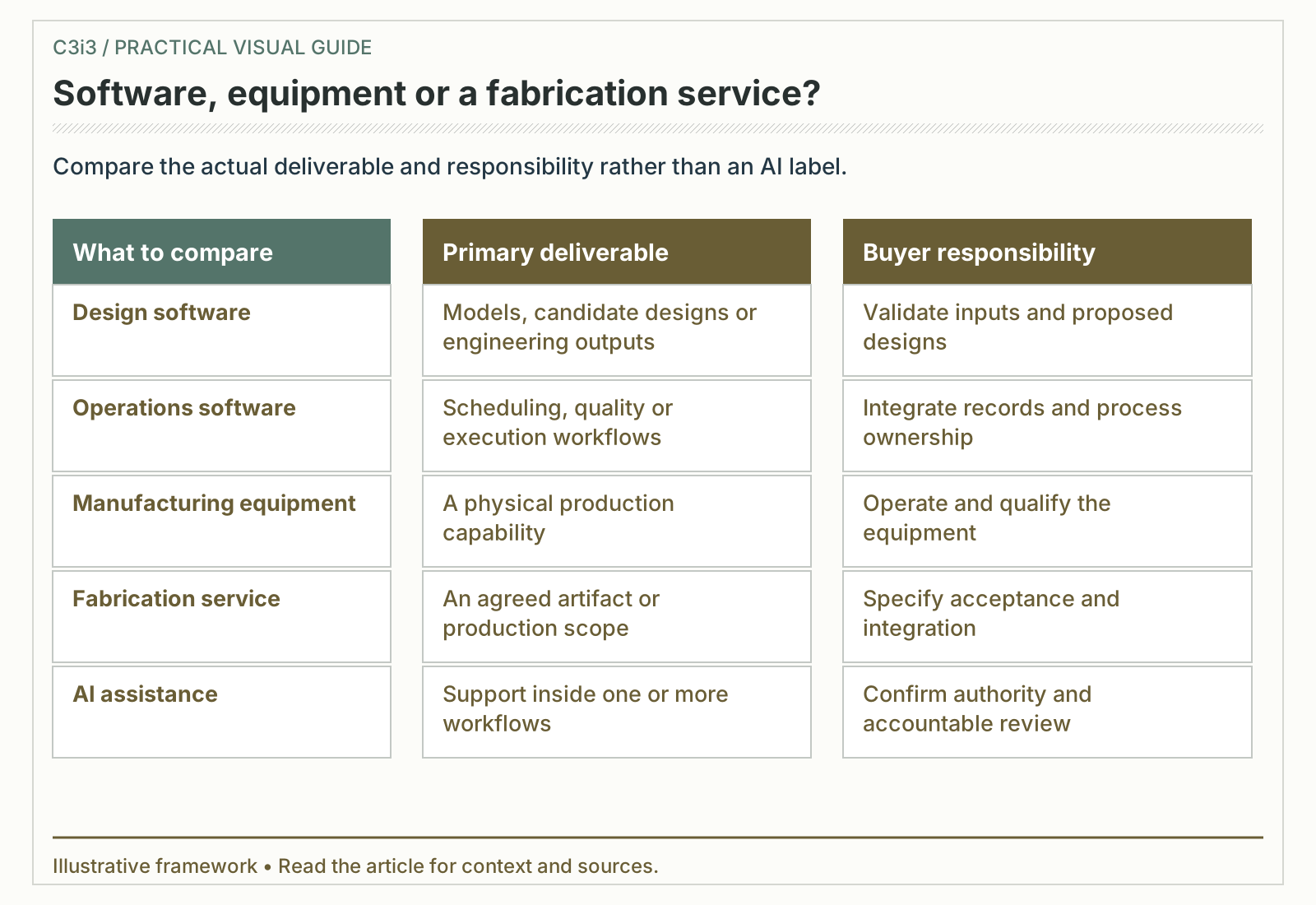
Design software: Models, candidate designs or engineering outputs / Validate inputs and proposed designs. Operations software: Scheduling, quality or execution workflows / Integrate records and process ownership. Manufacturing equipment: A physical production capability / Operate and qualify the equipment. Fabrication service: An agreed artifact or production scope / Specify acceptance and integration. AI assistance: Support inside one or more workflows / Confirm authority and accountable review.
How is a fabrication platform different from software that assists a factory?
A fabrication platform is evaluated partly by the physical output it can deliver. A design or operations application is evaluated by the work it supports and its effect on an existing workflow. Both can involve AI, but their acceptance criteria differ.
| Offer | Primary output | Acceptance question |
|---|---|---|
| Design assistance | Model, drawing or candidate design | Does the reviewed design satisfy the brief? |
| Simulation or optimization | Predicted behavior or recommendation | Is the model suitable for this decision? |
| MES or quality workflow | Production and review records | Does the workflow preserve the required controls? |
| Inspection assistance | Measurement or classification output | Does performance meet the defined evaluation? |
| Fabrication service or equipment | Physical artifact or manufacturing capability | Can the agreed output be produced and accepted? |
Atomic Machines positions the Matter Compiler on the physical manufacturing side of this map. Its current project access, interfaces and terms need direct confirmation. Do not infer a standard software subscription from the presence of a digital-design narrative.
Can one company cover several rows?
Yes, but the scope must be demonstrated and contracted accordingly. A platform description is not a reason to remove questions about the data, equipment or operating processes that remain outside its offer.
What should an AI agent be allowed to change?
Separate reading, recommending, preparing and executing. Reading a work instruction is different from proposing a revision. Preparing a draft record is different from approving it. Sending an instruction to a physical system creates another level of responsibility.
The right boundary depends on the application and the organization's requirements. The buyer should be able to describe the approval path and the evidence retained when an action occurs. A generic claim that a human is “in the loop” does not identify who reviews what or when.
What does a clear action map look like?
For each task, record the input, proposed output, authorized actor and record of completion. Include an exception path for missing information or a request outside the defined scope. The objective is an understandable operating process, not a collection of automatic actions whose ownership is unclear.
Consider an illustrative quality-review assistant. It might summarize observations and prepare a draft for a reviewer. That is a different offer from independently accepting a part or altering the production record. Procurement should not evaluate them using the same acceptance test.
This distinction also improves product communication. A website should explain whether the tool assists a qualified person, changes an information system or controls a machine. Accurate verbs make a complex product easier to understand.
Which data and integration questions should come before a pilot?
Identify the source of truth for the information the pilot needs. It might be an approved design repository, an operations system or a controlled test record. A duplicate spreadsheet created for a demonstration may not have the same revision status or ownership as the live information.
Then examine how the proposed product will obtain that information and return its output. A file export, a documented API and a custom integration have different operating and maintenance implications. Ask which route is actually supported rather than assuming the demonstration's connection is a general feature.
What happens when the systems disagree?
Decide which record controls the task and who resolves a conflict. If the design repository changes after an output is prepared, the receiving team needs to know which revision the output used. The process should not silently attach a new result to an old configuration.
Include deployment and access requirements in the brief. Determine who administers the connection, how permissions are scoped and how the pilot can be discontinued without leaving an unclear data copy or operating dependency.
These are ordinary integration questions, not reasons to reject every new tool. Answering them makes the pilot concrete enough to evaluate and helps separate a promising feature from a production-ready workflow.
What should remain available if the pilot stops?
Agree on how the organization will retain the accepted outputs and interpret them after the trial. A result that can be viewed only in a temporary demonstration account may be difficult to review later. Ask which export or retained record is actually included in the offer.
Also identify the integration owner. A connector can depend on another system's interface, version or permissions. The buyer needs to understand who monitors and repairs that dependency. This is part of the operating cost, even when the initial demonstration appears seamless.
How do you compare proposals without buying the same capability twice?
Compare the offers against a task map of the current workflow. Identify which step consumes effort, which system already supports it and what improvement the team expects. A new tool should have a defined contribution rather than a broad mandate to modernize everything.
For each proposal, list license or service scope, implementation work, required data preparation, operating responsibility and ongoing support. Keep optional development work separate from included functionality. A low subscription price does not establish a low total implementation effort.
What should the pilot deliver?
Choose an output the responsible team can review. A design assistant might be evaluated on a controlled design-preparation task. An inspection tool might be evaluated against an appropriate reference set. A fabrication service needs an agreed physical deliverable and acceptance method.
Do not combine these into a single productivity score before their definitions are clear. A faster recommendation that is unusable in the receiving system may move the bottleneck rather than remove it. A useful evaluation records the handoff as well as the local task.
End the comparison with the missing work. Which tasks remain internal, which require another provider and which would be created by adoption? That view helps a buyer understand what is actually being purchased.
How would an end-to-end workflow reveal a hidden gap?
Consider a fictional manufacturer evaluating an assistant for production-deviation reports. The demonstration reads a test record and produces a clear summary. That looks successful at the local task, but the organization still needs to check which record was read, how the summary identifies the affected configuration and where an approved report will be stored.
The pilot follows that complete path. A reviewer compares the draft with the source, resolves an ambiguity and approves the final record through the existing process. The evaluation notes the preparation needed and any handoff that remains manual. It does not count an attractive draft as a completed controlled record.
If the product is intended only to prepare drafts, those remaining steps may be perfectly acceptable. If the proposal claims an end-to-end workflow, they expose missing scope. The same map can be used to compare a different vendor without forcing both into the same feature vocabulary.
This example is an original procurement scenario, not a report of a customer result or a capability attributed to the Matter Compiler.
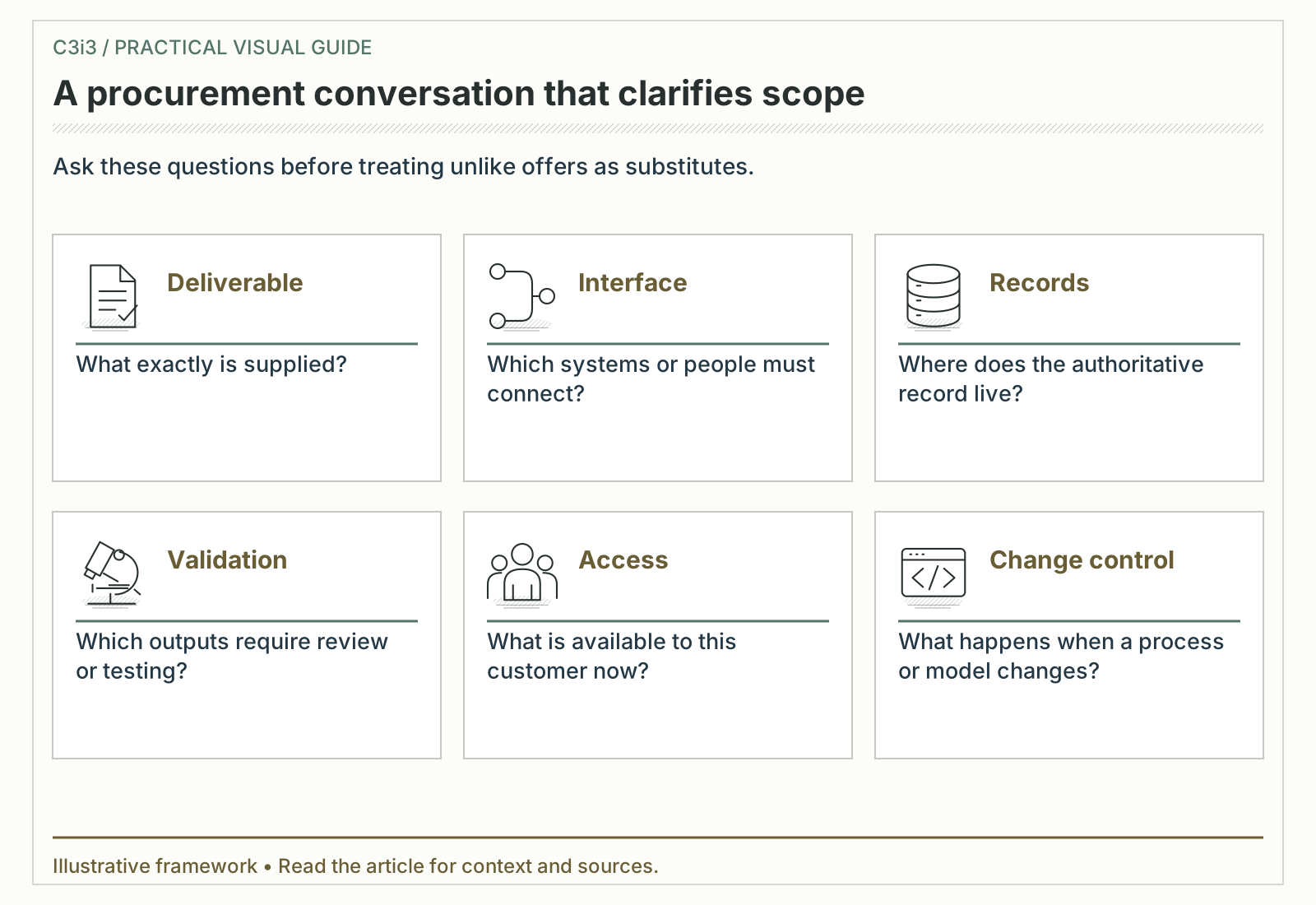
Deliverable: What exactly is supplied?. Interface: Which systems or people must connect?. Records: Where does the authoritative record live?. Validation: Which outputs require review or testing?. Access: What is available to this customer now?. Change control: What happens when a process or model changes?.
How should an AI manufacturing vendor explain its value?
Lead with the user's task and the result the product supports. Then explain the boundary: what data is needed, what the tool produces and who accepts the outcome. Put technical architecture details where they help an evaluator make a meaningful decision.
A useful demonstration begins with a recognizable problem and ends with a reviewable result. It should disclose whether the environment was a controlled example, a research deployment or a customer workflow. A polished interface does not establish that the surrounding integration is available to every buyer.
Which external resources improve the article?
Link the reader to relevant primary documentation, such as the definition of the operating system category, the specific announced application and the current platform description. This lets the reader verify the boundary instead of relying on repeated promotional summaries.
For C3i3's independent coverage, the commercial connection is communication: helping technical businesses explain what they offer and how a qualified buyer begins an evaluation. The article does not claim that C3i3 supplies industrial control software or arranges Matter Compiler access.
The best early sales conversation begins when a prospect can name a task the product is suited to help. Clear scope can reduce unsuitable inquiries while making appropriate ones more specific.
Key takeaways
- Separate design, simulation, operations, inspection and fabrication roles.
- Evaluate a tool by its actual output and operating boundary.
- Distinguish recommendations from approved actions.
- Define source records, revisions and integration responsibility.
- Compare implementation and remaining work alongside commercial terms.
- Avoid inferring a connector or partnership from related announcements.
Key terms in this guide
- MES
- A manufacturing execution system used to manage and record production activities.
- QMS
- A quality management system organizing quality processes and records.
- System of record
- The authoritative location for a defined class of operational information.
Frequently asked questions
Does AI manufacturing software physically make parts?
Some systems connect to equipment, while others support information or decisions. The product’s confirmed scope determines its physical role.
Is the Matter Compiler an MES?
The reviewed platform is described around physical micro-machine manufacturing. This article does not identify it as a general MES replacement.
Can an AI agent replace the approval process?
That depends on the actual application and its authorized operating model. A proposal should identify which actions are allowed and who accepts the outcome.
Should I buy the broadest platform available?
Start with the task and the current workflow. A broader feature list is not automatically a better fit if the relevant output, integration and responsibility remain unclear.
Primary sources and editorial method
- Siemens: October 2026 AI factory applications
Vendor documentation or a dated announcement. Plans and targets remain attributed to the source.
- NIST: 2026 industrial AI roadmap
Primary measurement, manufacturing or research context for the concepts discussed above.
- SAP: manufacturing execution system definition
Primary technical context supporting the linked discussion in this guide.
- Atomic Machines: Matter Compiler platform scope
Manufacturer description of the platform and its stated ambitions.
Help people understand your technical product.

C3i3 helps technical businesses explain their products through manufacturing marketing strategy, technical content, websites and product demonstrations and creative campaigns.
Tell us what you are developing and who needs to understand it. For Matter Compiler access or PrimeSwitch evaluation, use Atomic Machines’ official contact route.