



































Web Application Development Services.
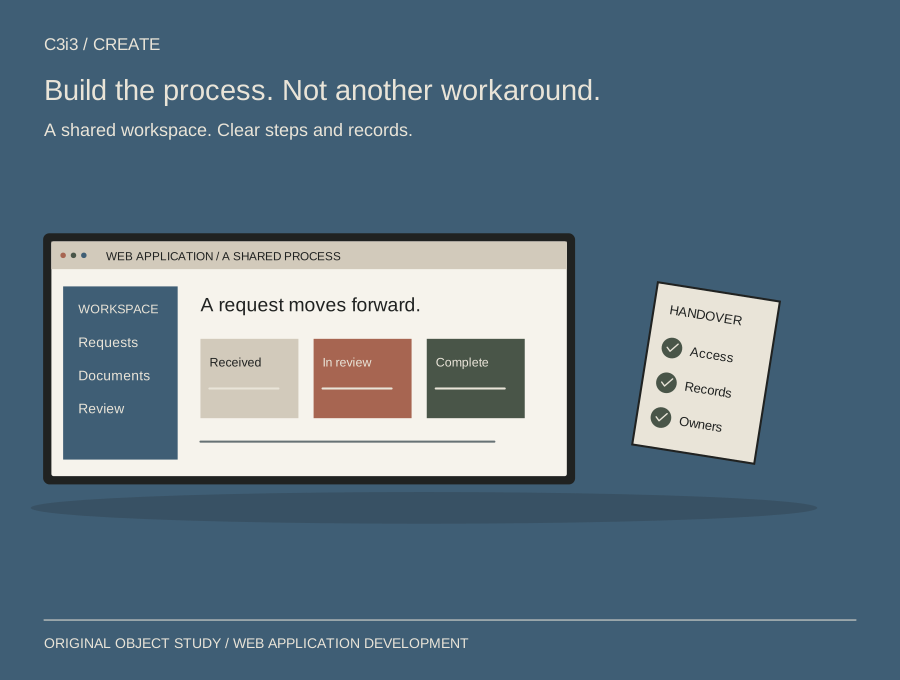
A browser-based tool.
A complete business workflow.
The request starts on a form, moves into a spreadsheet and finishes in an email thread nobody else can follow. A new dashboard will not help if the task still breaks between those steps. C3i3 provides web application development services for defined business workflows that people can use through a browser. We connect the screens, records, rules and responsibilities needed to complete the agreed job.
A web application differs from a brochure website because users do something with continuing records: submit a request, approve work, view an account or update a status. We begin with those tasks and the people authorized to perform them. The scope establishes the relevant devices, browser behavior, data and integrations before implementation. UX and UI design can shape the interaction; general web development supports the technical foundation. This service commissions the working browser-based product and its release handover. A larger application should not be assumed when a focused existing tool or simpler website function already meets the need.
A workflow people can complete
Connect inputs, business rules and the final record across the required browser screens.
Clear roles and information ownership
Define what each user can see or change and which system owns the records involved.
A maintainable release boundary
Document the application, relevant checks and operating responsibilities before later features expand the scope.
Clear deliverables.
Useful decisions.
Your written scope confirms the depth and final format of the work. These are the components we can bring together for web application development services.
- 01Task and record model
Describe the workflow from the initial action to the completed result. Identify record types, required fields, status changes, roles and exceptions. Review real examples with unnecessary personal or sensitive details removed so the specification reflects business behavior rather than an attractive dashboard alone.
- 02Browser experience and prototype requirements
Agree the supported environments, key screens and interaction patterns. Include mobile-browser use when relevant. Define validation, loading states and recovery from an interrupted task. Design can be commissioned as a linked stage, with the agreed prototype providing the implementation reference.
- 03Application screens and business rules
Build the scoped interfaces and operations that create, read, update or route the agreed records. Establish the allowed actions for each role and the meaning of completion. Complex approval chains, documents, searches or exports receive their own explicit requirements.
- 04Authentication and connected systems
Implement the commissioned access approach and integrations within the agreed environment. Specify user administration, account recovery responsibilities and the boundary to outside services. Record exchange rules, failed connections and provider dependencies are included in the plan rather than treated as invisible technical details.
- 05Workflow and permission verification
Check representative tasks using the agreed user roles and sample records. Review successful routes and the relevant missing-input, denied-action or failed-connection states. Browser and device coverage is defined in the scope; a successful screen demonstration does not replace the agreed acceptance checks.
- 06Deployment and operating documentation
Prepare the application release, environment information, account register and administrative handover specified in the agreement. Identify maintenance, backups, incident contacts and the process for later changes. The business receives a usable ownership record rather than only a login link.
Go deeper where
the decision needs it.
This work connects to the related creative and production work below. Explore the relevant service to see its distinct scope and deliverables.
App Development Services
Customers submit the same details twice. Staff move requests between email and spreadsheets. One employee knows which version is current. C3i3 provides app development services to turn a defined business task into a working application. We establish who uses it, what they need to complete and how the business will own the resulting process.
Explore app development servicesInteractive Calculators
Interactive calculator development turns approved business logic into a usable web tool. We design the inputs, validation, calculations, explanations, and next steps so visitors can understand a scenario without mistaking an estimate for a guaranteed result.
Explore interactive calculatorsA clear process.
A practical handover.
The production approach follows the message, source material, and agreed scope. Open each step to see what happens and what it produces.
01Map the process and its users.
We examine the current task, records and exceptions with your business contact. We identify the smallest useful application boundary and any existing-system constraints.
A workflow and role specification.
02Agree the screens and architecture.
We connect the design direction to data, access, integrations and acceptance requirements. Dependencies are resolved or recorded before implementation.
An approved browser-application plan.
03Build and review representative tasks.
We implement the agreed workflows and review them with authorized users. Open issues and deferred requests remain separate from accepted work.
A reviewed application and acceptance record.
04Deploy and transfer ownership.
We confirm the release approach, administration, provider accounts and responsibilities for ongoing care.
A working release and operating handover.
A request register becomes a shared working tool.
Consider an illustrative business coordinating installation requests. Customers supply the defined details, an authorized coordinator reviews the record, and staff see the agreed status and next action. The first version can focus on that shared record instead of duplicating the company’s full accounting system. Permission and exception checks help define whether the commissioned task is complete. This describes a possible workflow, not an existing C3i3 customer application or a measured productivity result.
| The question or stage | What we examine | Why it matters |
|---|---|---|
| Input | Required request information and validation | Reduce uncertainty about what a usable record contains. |
| Review | Authorized decisions and status changes | Make responsibility part of the workflow. |
| Connection | Agreed source record or external interface | Keep system boundaries understandable. |
| Operation | User administration, support and maintenance | Give the released tool an owner. |
To show how web application development services can support a decision. Your recommendations depend on the evidence, resources, and constraints in your own brief.
Agree the brief.
Then make the work.
The written scope covers workflows, roles, screens, data, integrations, environments and verification. Migration, complex permissions, specialist hosting, document processing, extensive reporting or offline behavior are separate unless included. We agree data responsibilities and the appropriate development handover before receiving business records. Your organization supplies process decisions and authorized reviewers. Bring the recurring task, current tools and the point where staff most often have to copy information or chase a decision.
| Before we start | What we agree |
|---|---|
| The decision | The audience, offer, question, and boundaries the work needs to address. |
| The deliverables | Creative and production scope, format, review rounds, responsibilities, and handover. |
| The investment | Written fees, schedule, dependencies, and any separate third-party or implementation costs. |
We confirm the proposal before work begins. You can commission a focused engagement, connect it to a wider plan, or ask about a separately scoped delivery phase.
Discuss scope and timingUseful questions.
Straightforward answers.
How is this different from web design?
Web design establishes the experience and appearance. A web application also implements continuing records, user actions and business rules. The services can work together, with their responsibilities and deliverables defined separately.
Can a web application run on a phone?
A responsive browser interface can support the devices included in the scope. It is different from a native mobile app. Required device functions and operating conditions help determine the appropriate approach.
Can you replace our spreadsheet process?
We can assess the workflow behind the spreadsheet and scope suitable functions. Existing formulas, exceptions and data quality need review first. We do not assume every spreadsheet task should become custom software.
Will users need separate permissions?
Where the workflow requires them, the scope defines the roles and allowed actions. Permissions should follow the business task and data boundaries, with checks for the agreed access behavior.
Can it connect to a CRM or another application?
We review the available interface, record ownership and provider permissions. The proposal identifies the actual data exchange and responsibility for errors or outside-system changes.
What data should we send during discovery?
Begin with a description of the records and anonymized examples where possible. We establish the appropriate private handover and access before receiving customer information or other sensitive business data.
Who looks after the app after launch?
The release handover identifies hosting, maintenance, access, backups and support responsibilities. Ongoing management is commissioned separately unless explicitly included in the development scope.
Can we add more functions later?
Yes, subject to a reviewed change scope. The initial record model and operating approach should be documented so later features can be assessed without confusing them with the agreed first release.
Keep the next step
connected to the plan.
Read how to choose between a website, app and landing page, or return to all Create services.