



































Social Media Management Services.

Keep the accounts current.
Keep the publishing moving.
Social accounts often go quiet when the employee who knows them gets busy or leaves. C3i3 provides social media management services for recurring content preparation, approvals, publishing and agreed account coordination, so the work has a clear process beyond somebody remembering to post.
The starting point is the workload your business can support and the audience the account serves. We review existing channels, account ownership, source material and approval responsibilities before agreeing what will be produced or managed. Your team supplies current business facts and approves the boundaries for responses. We coordinate the commissioned activity and record what is ready, blocked or published. This service sits within Content Operations because its purpose is continuing delivery and account upkeep. A new social strategy, paid campaign or major video-production program connects to the relevant service instead of being assumed inside a publishing engagement.
A usable publishing routine
An agreed queue connects source material, draft work, approval and the publication destination.
Clear account responsibilities
Know who owns access, approves messages and handles customer or sensitive enquiries that need a business response.
A review tied to the work
See what was published, what the available account information shows and which content or operational decision comes next.
Clear responsibilities.
Useful ongoing work.
Your written scope confirms the depth and final format of the work. These are the components we can bring together for social media management services.
- 01Channel and account handover review
Record the commissioned channels, business account owners, appropriate role-based access and recovery contacts. Review profile details and linked destinations for the agreed accounts. Your business keeps ownership; a supplier relationship should not make future access depend on one person’s private login.
- 02Recurring content and source queue
Organize suitable topics, approved business information, existing photography or video and any production requirements. Identify the person who can verify each subject. The queue makes an absent image, missing permission or unanswered factual question visible before the planned publication.
- 03Scoped post and asset preparation
Prepare the agreed captions, graphics, adaptations or other assets for the selected channels. The proposal defines the production capacity and review rounds. We distinguish adapting existing material from commissioning new photography, writing an extensive article or producing a new video.
- 04Approval and publishing coordination
Move the current version through factual review and sign-off, then publish or schedule the approved material using the agreed access. Record the destination and status. A draft in the queue is not reported as published, and unapproved material does not become ready merely because a calendar date arrives.
- 05Defined response and escalation handling
Agree whether monitoring or response coordination is included, which messages your business answers and which issues must be escalated. Sensitive customer matters, complaints and professional advice need clear business boundaries. Coverage hours and response expectations are written down rather than implied by the word management.
- 06Account review and next priorities
Summarize completed activity, available account evidence, relevant destination actions and limitations. Separate audience engagement from confirmed enquiries or sales. Use the review to decide what to continue, revise or investigate rather than presenting a follower count as the complete business result.
Bring the right
specialist into the work.
This work connects to the related website, content, and operational support below. Explore the relevant service to see its distinct scope and deliverables.
Content Operations
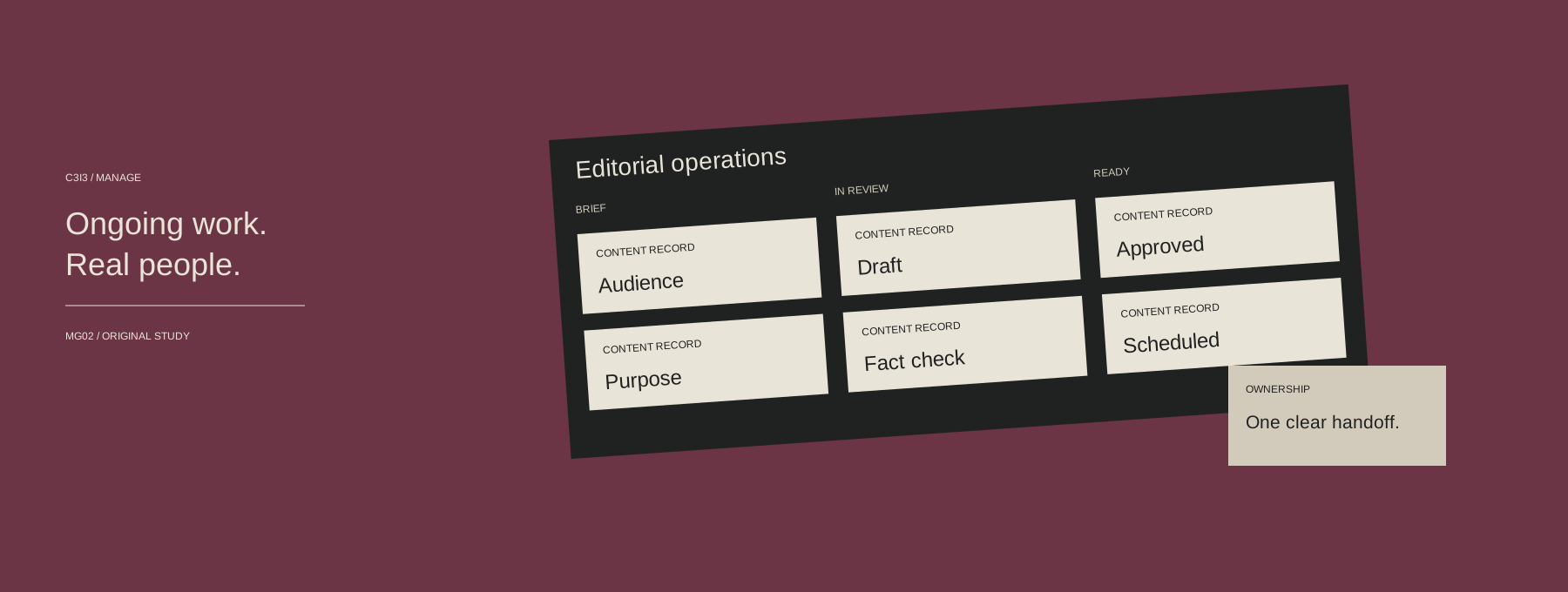
Content operations organize the recurring work behind your website and resource library. We connect topics, briefs, sources, production, approvals, publishing, and maintenance so useful content does not depend on scattered files and last-minute reminders.
Explore content operationsPublishing Workflows
Publishing workflows define how content moves from a brief to a reviewed, released, and maintainable page or asset. We organize the people, versions, approvals, checks, and records needed for the agreed publishing process.
Explore publishing workflowsA clear process.
An accountable team.
The work follows the business priorities, agreed capacity, responsible people, and review process. Open each step to see what happens and what it produces.
01Review the accounts and workload.
We establish the purpose of each commissioned channel, ownership, current material and the work your team can approve. Existing social strategy or business priorities guide the delivery rather than creating an unrelated posting program.
An account brief and defined recurring workload.
02Set the production and approval routine.
We agree topics, source owners, formats, review stages and publication access. The queue records what is missing and who can resolve it, with response and escalation duties defined separately.
A publishing queue, approval process and responsibility map.
03Prepare and publish the approved work.
We produce the commissioned material, coordinate review and release the approved versions. Changes in business information or priorities are reflected in the queue rather than carried forward into an outdated scheduled post.
A publication record and visible open decisions.
04Review and choose the next work.
We discuss completed content, available account evidence and feedback from your business. The next period’s priorities reflect useful subjects, missing inputs and the capacity agreed in the scope.
A readable review and the next content queue.
A business has useful updates but no steady publishing routine.
An illustrative professional-services business has project photographs, answers to common questions and occasional company news in several inboxes. The management work gathers approved sources into one queue, assigns factual reviewers and prepares channel-appropriate posts. Questions requiring a customer-specific answer return to the named business contact. The example shows an operating arrangement, not a client result, a required posting frequency or a promise that regular posts create enquiries.
| The question or stage | What we examine | Why it matters |
|---|---|---|
| Source | Approved information and reusable assets | Start from what the business can support accurately. |
| Review | Current draft and named approver | Prevent an unchecked or outdated version from being scheduled. |
| Publish | Selected channel and confirmed release status | Distinguish planned activity from material that is actually live. |
| Follow-up | Account evidence and business feedback | Choose the next useful subject without inventing sales attribution. |
To show how social media management services can support a decision. Your support plan and priorities depend on the actual systems, workload, people, and constraints in your brief.
Agree the priorities.
Then scope the support.
The proposal names channels, formats, recurring production capacity, review rounds, publication duties, reporting and any response coordination. Paid media, influencer agreements, new photography, substantial video production and continuous customer support are separate unless included. We agree account permissions and authorized contacts before work begins. Bring the accounts, examples of material you already have and the tasks that keep getting delayed. The service can work alongside an internal employee or another specialist with defined handoffs.
| Before we start | What we agree |
|---|---|
| The decision | The business priority, current systems, support need, and boundaries the work needs to address. |
| The deliverables | Management and delivery scope, format, review rounds, responsibilities, and handover. |
| The investment | Written fees, schedule, dependencies, and any separate third-party or implementation costs. |
We confirm the proposal before work begins. You can commission a focused improvement, agree an ongoing support plan, or connect specialist work to a broader service.
Discuss scope and timingUseful questions.
Straightforward answers.
How is this different from social media marketing strategy?
Strategy establishes audience, channel purpose and priorities. This service manages the recurring preparation, approvals, publishing and agreed account activity that carries those decisions into practice. If direction needs to be reconsidered, that work is identified rather than hidden inside routine posting.
Do you create all the images and videos?
The proposal defines the asset production included. We can adapt approved existing material or commission specific creative work when scoped. New shoots, substantial editing and other production needs are made explicit so the publishing plan does not depend on unassigned work.
Will you answer every comment and message?
Only the response work specified in the agreement. We define coverage, approved boundaries and escalation contacts. Customer-specific matters, complaints or sensitive information may need a business employee rather than a public response from a publishing team.
Who owns the accounts and published content?
Your business should retain its account ownership and recovery access. The agreement also sets the rights and handover for commissioned assets. We use access appropriate to the work instead of assuming a shared personal login is an adequate operating arrangement.
Can you work with our current marketing employee?
Yes. An employee may hold business knowledge and final approval while C3i3 coordinates recurring production and publishing. Responsibilities are agreed so the employee does not remain responsible for chasing every handoff that was meant to be delegated.
Can you promise followers, reach or sales?
No. Platforms, audience behavior, the offer and business follow-up affect outcomes. We report the commissioned work and the evidence available, distinguishing engagement from confirmed enquiries and sales rather than promising a target.
Do we have to post on every platform?
No. We select the commissioned channels around audience needs, useful material and manageable capacity. Maintaining a small set of relevant accounts can be more practical than opening channels the business cannot keep current.
What happens if a post is not approved in time?
The queue records the missing decision and its owner. We agree whether to reschedule, use another approved item or hold publication. A missed approval does not authorize publishing unchecked facts or substituting a new offer that the business has not approved.
Keep the ongoing work
connected.

For a related perspective, explore how to keep useful content moving when the business gets busy. Or return to all Manage services.
Need to decide which channels and campaigns to pursue first? Explore Social Media Marketing for strategy and campaign work. This service handles the continuing publishing and account workload.