



































WordPress Maintenance Services.

Updates should come with checks.
And a way back.
An update notice should not leave you choosing between ignoring old software and risking a broken website. C3i3 provides WordPress maintenance services for the agreed core, theme and plugin upkeep, with preparation, compatibility review and checks of the customer tasks the change could affect.
A successful update message does not establish that your forms, booking tool or page templates still work. We begin with the actual WordPress installation, its dependencies and the people responsible for hosting and recovery. Then we agree which changes belong in routine maintenance, which need a separate investigation and what evidence you receive afterward. Your business keeps ownership of its accounts and decides which larger changes to approve. This specialist service sits within website maintenance; it covers the WordPress-specific release work rather than replacing content management, redesign or every possible technical repair.
Know what the installation depends on
A readable record connects core software, themes, plugins, licenses and outside services to the functions your business uses.
Give each update a release approach
Preparation, recovery requirements and post-change checks follow the installation and the importance of the affected task.
See the work that remains
The maintenance record distinguishes completed updates from deferred changes, compatibility issues and decisions your business or another provider must make.
Clear responsibilities.
Useful ongoing work.
Your written scope confirms the depth and final format of the work. These are the components we can bring together for wordpress maintenance services.
- 01Installation and dependency inventory
Record the agreed WordPress installation, active theme, plugins, relevant versions, licenses and connected services. Identify the host, business account owner and renewal contact so an expired license or missing access does not surface only when an update is due.
- 02Update and compatibility review
Review the available changes against the installation and its important functions. Identify dependencies, unsupported components or custom modifications that may need investigation before release. A deferred update receives a reason and an owner for the next decision.
- 03Recovery and staging preparation
Agree the relevant files, database, configuration, available restore point and responsible provider. Use an appropriate staging or review approach where available. Record the limitations when an environment cannot safely reproduce payments, email or an outside integration.
- 04Approved WordPress updates
Carry out the scoped core, theme or plugin changes using the agreed sequence and access. Keep the work within the approved release plan. Large version jumps, custom-code changes and replacement of abandoned software are identified separately when they exceed routine upkeep.
- 05Business-function verification
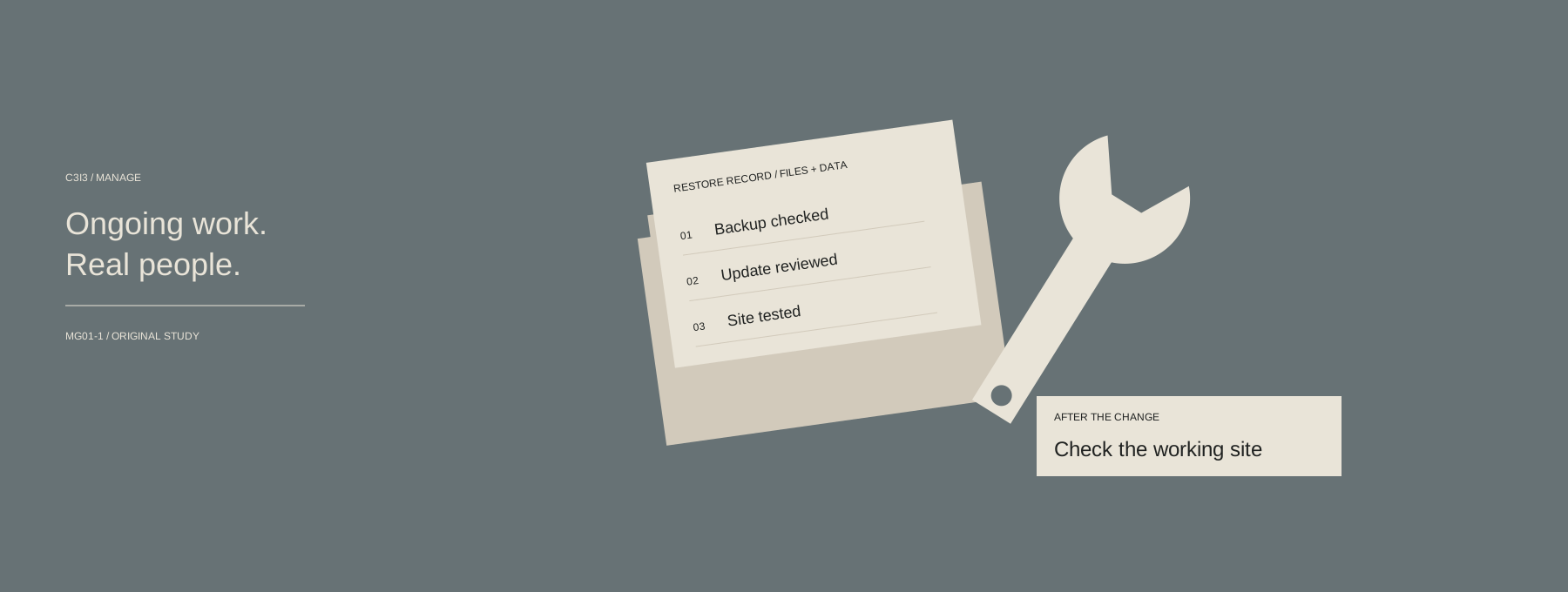
Check the selected page templates, navigation, forms and other functions affected by the update. For a contact route, review the agreed confirmation and delivery checks rather than treating a page that loads as proof that an enquiry reaches the team.
- 06Change record and next actions
Explain what changed, what was checked and what remains unresolved. Record any rollback or provider action, the approval needed and the next review point. Your team receives a useful handover rather than a list of update notifications without context.
Bring the right
specialist into the work.
This work connects to the related website, content, and operational support below. Explore the relevant service to see its distinct scope and deliverables.
Website Maintenance
Website maintenance handles the agreed technical upkeep of an existing site. We review its platform and dependencies, plan appropriate updates and checks, and document the recovery and provider responsibilities that support the work.
Explore website maintenanceWebsite Management
Website management gives the ongoing tasks on your site a clear owner and a practical plan. We coordinate the agreed updates, maintenance, checks, and improvements so you know what is being handled, what needs approval, and what comes next.
Explore website managementA clear process.
An accountable team.
The work follows the business priorities, agreed capacity, responsible people, and review process. Open each step to see what happens and what it produces.
01Review the installation.
We establish access, dependencies, custom work, business-critical functions and who controls hosting and recovery. An unfamiliar inherited site may need a separate initial assessment before recurring work is agreed.
An installation inventory and a defined maintenance boundary.
02Prepare the release.
We review the proposed changes, confirm the available recovery approach and choose checks suited to the affected functions. Your team approves any interruption or separate work identified during preparation.
An update sequence, recovery responsibilities and verification list.
03Update and verify.
We perform the approved changes and record the selected technical and customer-task checks. If an issue appears, the agreed response determines whether to investigate, pause the release or use the available recovery route.
A change record with the verification outcome and open issues.
04Review what comes next.
We explain deferred changes, recurring compatibility concerns and dependencies on licenses or providers. The next maintenance period follows those findings and the workload your business has commissioned.
A readable review and a prioritized next-action list.
A form plugin update is more than an update notice.
Consider an illustrative service website with a form plugin, a page builder and an email-delivery integration. The maintenance task begins by identifying their relationship and the available recovery point. The team checks an appropriate test environment, applies the approved change and verifies the agreed enquiry route. The example describes a working method, not a client result or a promise that every installation can be updated without disruption.
| The question or stage | What we examine | Why it matters |
|---|---|---|
| Before the change | Plugin, builder and mail dependency | Choose checks based on what the business needs to keep working. |
| Recovery | Available files, database and restore responsibility | Know the practical route back before changing the live installation. |
| Verification | Form, confirmation and agreed delivery route | A green update message does not establish that the complete task works. |
| Handover | Change record, exceptions and owner decisions | Keep the next maintenance task understandable. |
To show how wordpress maintenance services can support a decision. Your support plan and priorities depend on the actual systems, workload, people, and constraints in your brief.
Agree the priorities.
Then scope the support.
The written scope names the installation, included components, review rhythm, release arrangements, checks and recovery responsibilities. Emergency response, malware cleanup, custom plugin development, major compatibility repairs, hosting changes and replacement of unsupported software are separate unless included. Response coverage is agreed explicitly; a maintenance engagement does not imply round-the-clock availability. Bring the site address, known issues and current host or developer details. Account access can be arranged through the appropriate private handover after we establish the work.
| Before we start | What we agree |
|---|---|
| The decision | The business priority, current systems, support need, and boundaries the work needs to address. |
| The deliverables | Management and delivery scope, format, review rounds, responsibilities, and handover. |
| The investment | Written fees, schedule, dependencies, and any separate third-party or implementation costs. |
We confirm the proposal before work begins. You can commission a focused improvement, agree an ongoing support plan, or connect specialist work to a broader service.
Discuss scope and timingUseful questions.
Straightforward answers.
How is this different from general website maintenance?
This service focuses on WordPress core, themes, plugins and their release dependencies. General website maintenance sets the broader upkeep responsibilities for any platform. We keep those roles connected without creating two competing maintenance owners.
Can you maintain a site built by another developer?
We can review an inherited installation and its access, licenses and custom work. Existing faults, missing source or unsupported components may need assessment or repair before a recurring update plan is practical. We explain those findings before treating the site as routine maintenance.
Do all updates happen automatically?
No single rule suits every installation. The agreed plan considers the component, business function, available checks and recovery route. We document which updates can follow an established process and which need review or explicit approval.
Does a backup notification mean the site can be restored?
No. We distinguish successful copy creation from the ability to recover the relevant files, database and configuration. The scope identifies restore access, provider responsibility and any agreed restoration checks, with limitations recorded clearly.
What if an update breaks a plugin or layout?
We follow the agreed release and recovery approach, record the affected function and explain the next decision. A larger compatibility repair or replacement may require separate approval. We do not describe unknown repair work as automatically included.
Will routine maintenance include new pages or a redesign?
Only when those tasks are included in the proposal. Page production, design changes and new integrations are different workloads. We can connect them to Content Updates or another appropriate service while preserving one understandable work queue.
How do we stay informed without managing every update?
We agree the point of contact, approval limits and a concise work record. Your team sees completed changes, checks, exceptions and decisions needed. Routine work should have clear ownership while important business decisions remain with your authorized contact.
What information do you need before maintenance starts?
Start with the website address, hosting contact, known problems and any information about custom development. We then establish access and review the installation through an appropriate private handover. Please do not place passwords, recovery codes or customer data in a public enquiry.
Keep the ongoing work
connected.
For a related perspective, explore how to update WordPress plugins without breaking the site. Or return to all Manage services.