








































In this article
Physical AI describes an important change in how software meets the world: an AI system must deal with objects, motion and consequences outside a screen. The Matter Compiler raises a complementary question about the hardware underneath that intelligence. Can manufacturing become more programmable as the machines being manufactured become more capable?
This guide helps founders, industrial designers and technical business teams distinguish those questions. It provides an original planning framework rather than a prediction that every robot will use one fabrication platform. Start with our Matter Compiler overview if the product name is new to you.
Independent C3i3 research and analysis. Sources checked November 18, 2026. Read the sources and editorial method.
Why does this topic matter now?
On March 16, 2026, NVIDIA announced physical AI developments with robotics companies, including simulation frameworks and models intended to support industrial applications. That is a dated signal of active development across the robotics ecosystem. It is not proof that every announced capability is available in every factory.
The interesting business issue is the connection between a digital instruction and a dependable physical outcome. An AI model may propose an action, but the mechanism must execute it. A manufacturing system may fabricate a component, but the finished machine still needs sensing, control and evaluation.
Our interpretation is that these developments deserve to be evaluated together without merging them into one product story. A startup can have an excellent control concept and an unresolved hardware problem. Another can have a novel component but no credible route to integration. Naming the missing layer makes the next conversation more useful.
What should a buyer do with an announcement?
Identify the specific capability described, the stage it has reached and the part of your problem it could address. Keep ecosystem partnerships attached to the companies named in the original source. This article does not claim that NVIDIA and Atomic Machines have a partnership.
What makes physical AI different from a chatbot or ordinary automation?
NVIDIA defines physical AI around perception, understanding and action by autonomous machines. For this guide, the useful distinction is the feedback between a decision and a physical environment. A robot must interpret what is around it and respond through an actual mechanism.
A chatbot that drafts a work instruction operates on information. A conventional automated station might repeat a predetermined motion under tightly specified conditions. A physical AI proposal may add learned perception or planning so a machine can respond to variation. Those categories can overlap within a factory, so a vendor's label is less useful than its description of the task.
Consider an illustrative sorting cell. The business needs an item placed in a particular destination. Perception identifies the item and its position. Planning selects an approach. A gripper contacts the item. The control system observes whether the movement succeeded. A weak link anywhere can defeat the business outcome even if the AI's initial classification was correct.
For product communication, describe that task before naming the model. A buyer can evaluate “recognizes this component under these conditions and places it here” more meaningfully than “powered by advanced intelligence.” The first statement invites a demonstration with boundaries.
Does physical AI always mean a humanoid robot?
No particular body shape is required by this discussion. The function might belong to a manipulator, a mobile platform or another controlled mechanism. Select the embodiment for the job rather than the visual appeal of a launch video.
Where does the Matter Compiler fit in the physical AI system?
Separate intelligence, physical function and production. Atomic Machines presents its platform as a way to make micro-machines. That manufacturing claim does not establish a complete robotic product, a particular control model or the integration of every sensor a system needs.
| Layer | Job | Question to resolve |
|---|---|---|
| Perception | Interpret relevant observations | What must be recognized and under which conditions? |
| Planning and control | Select and coordinate actions | Which decisions remain constrained or supervised? |
| Mechanism | Perform the physical function | What force, motion or flow is required? |
| Fabrication | Produce and assemble the hardware | Which process can deliver the accepted device? |
| Validation | Establish fitness for the task | What demonstrates successful system behavior? |
Use this map to assign responsibilities. The provider of a model may not own the gripper design. A fabricator may not define the installation environment. An integrator may depend on information from both. Write the interfaces and exclusions before comparing proposals.
This also prevents an interesting fabrication platform from becoming an assumed answer to an unrelated software problem. If the existing mechanism already performs the task, the first improvement may concern perception or workflow. If geometry blocks the concept, manufacturing research may be the appropriate next step.
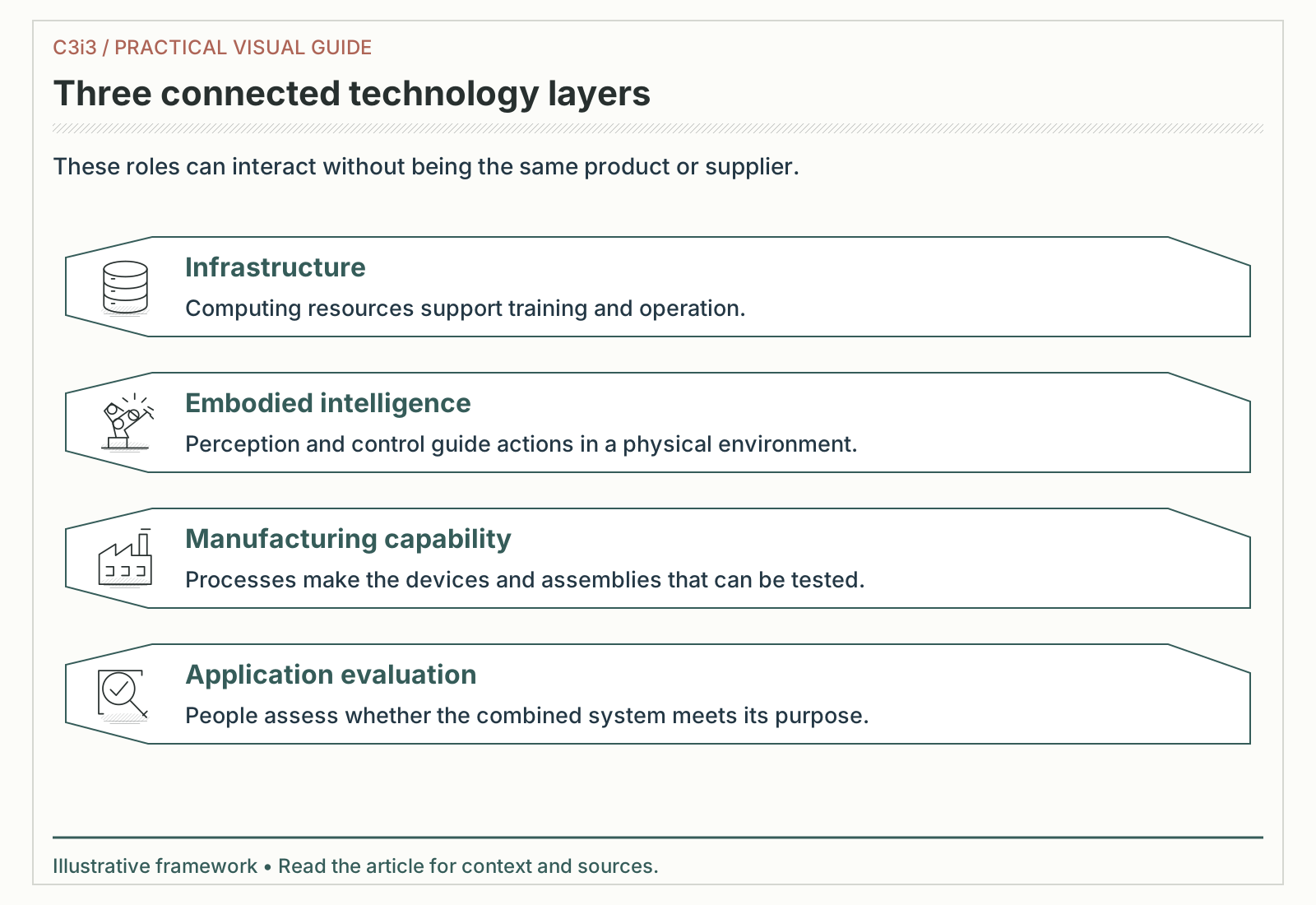
Infrastructure: Computing resources support training and operation. Embodied intelligence: Perception and control guide actions in a physical environment. Manufacturing capability: Processes make the devices and assemblies that can be tested. Application evaluation: People assess whether the combined system meets its purpose.
Why does simulation-to-reality remain a separate challenge?
A simulated success depends on what the model represents. For an illustrative handling task, the result can change if the actual object differs from the assumed geometry, its surface differs from the modeled contact or the available observation differs from the rendered camera view. The lesson is to identify the assumptions that matter most to the decision.
NVIDIA's physical AI explanation discusses simulation and synthetic data as development tools. Treat those as ways to explore and prepare, with real-world evaluation still attached to the deployment task. A realistic image and a validated behavioral model answer different questions.
How can a small team make this practical?
Create an assumption register with three columns: modeled condition, expected real variation and planned check. Keep the register short enough to use. Include only conditions that could change the next decision, such as variation in the object, observation or interface being studied.
For each assumption, identify who can establish a suitable check. The goal is not to recreate an entire factory in software before learning anything. It is to avoid taking a virtual outcome beyond the conditions that produced it.
Our manufacturing digital twin guide develops this distinction further. It explains why a model needs an intended use and an accountable relationship to observations before a team should rely on it for a decision.
Could smaller mechanisms expand what physical AI can do?
Potentially, but the useful question is which physical limitation a different mechanism would remove. Miniaturization can be relevant when a device must fit within a constrained assembly or interact with a very small feature. A smaller component is valuable only if its function, interfaces and operating requirements fit the application.
Imagine a research team considering a compact actuator. Its current question could concern travel within an envelope. A later question might concern how position is sensed or how the actuator connects to the surrounding assembly. Those are distinct experiments, not one promise that a smaller mechanism solves the full system.
The Matter Compiler page describes a broad ambition across micro-machine domains. We treat those application areas as research directions unless a specific device and access route are documented. The confirmed relevance to a proposed project must be established individually.
An application brief should therefore begin with the physical bottleneck. Describe what cannot currently be achieved and why. Include the required connection to sensing and control. A provider can then assess whether fabrication is the limiting factor or whether the problem lies elsewhere.
What should stay out of the first brief?
Avoid assuming a particular future product, manufacturing price or control integration that has not been confirmed. A focused question about a function is more actionable than a specification built from several unrelated announcement slides.
How should a business scope its first physical AI pilot?
Choose one bounded task and state the decision the pilot will support. Define the input situation, the desired physical outcome and the operating conditions that belong in the trial. Include what the system should do when it cannot complete the task confidently.
For the illustrative sorting cell, the first pilot might examine whether the perception approach distinguishes the relevant object variants. It could keep the mechanism fixed. A later pilot might examine handling variation. Changing both layers simultaneously can make a failure harder to interpret.
Assign a technical reviewer and an operational owner. The reviewer decides what constitutes an adequate evaluation. The operational owner explains whether the resulting behavior fits the real workflow. Their questions overlap, but they are not interchangeable.
- Write one specific task and its boundary.
- Identify the unresolved layer in the system map.
- Define observations that would support the next decision.
- Record the configuration used for the trial.
- Document a useful response to incomplete or uncertain outcomes.
Keep commercial conclusions proportional to the trial. A controlled demonstration can justify another evaluation without establishing production readiness, general autonomy or a return on investment. Record what was learned and what remains outside the tested conditions.
How does a pilot distinguish a model issue from a mechanism issue?
Use observations that make the failure understandable. In the hypothetical sorting cell, the team can record whether the item was identified correctly before examining whether the selected motion succeeded. If the item was recognized but slipped during handling, the investigation differs from a case in which the system selected the wrong object.
Agree on that distinction before demonstrating the system to management. Otherwise, every unsuccessful outcome may be described as an AI problem even when the relevant issue concerns fixture geometry, observation conditions or a misunderstood requirement.
Keep one stable reference configuration while examining a change. Record what changed and what remained fixed. This makes the resulting comparison easier to interpret and creates a useful explanation for the next reviewer. The technical team should determine the appropriate experimental method.
A business-facing pilot report can then state the task, tested conditions, observed outcome and next decision. It should also preserve examples of uncertain behavior that reveal the boundary of the current system. Those examples are often more informative than a highlight reel containing only successful movements.
This approach keeps the project connected to an operational purpose. The goal is a clearer decision about a defined task, not a declaration that the machine has acquired general physical intelligence.
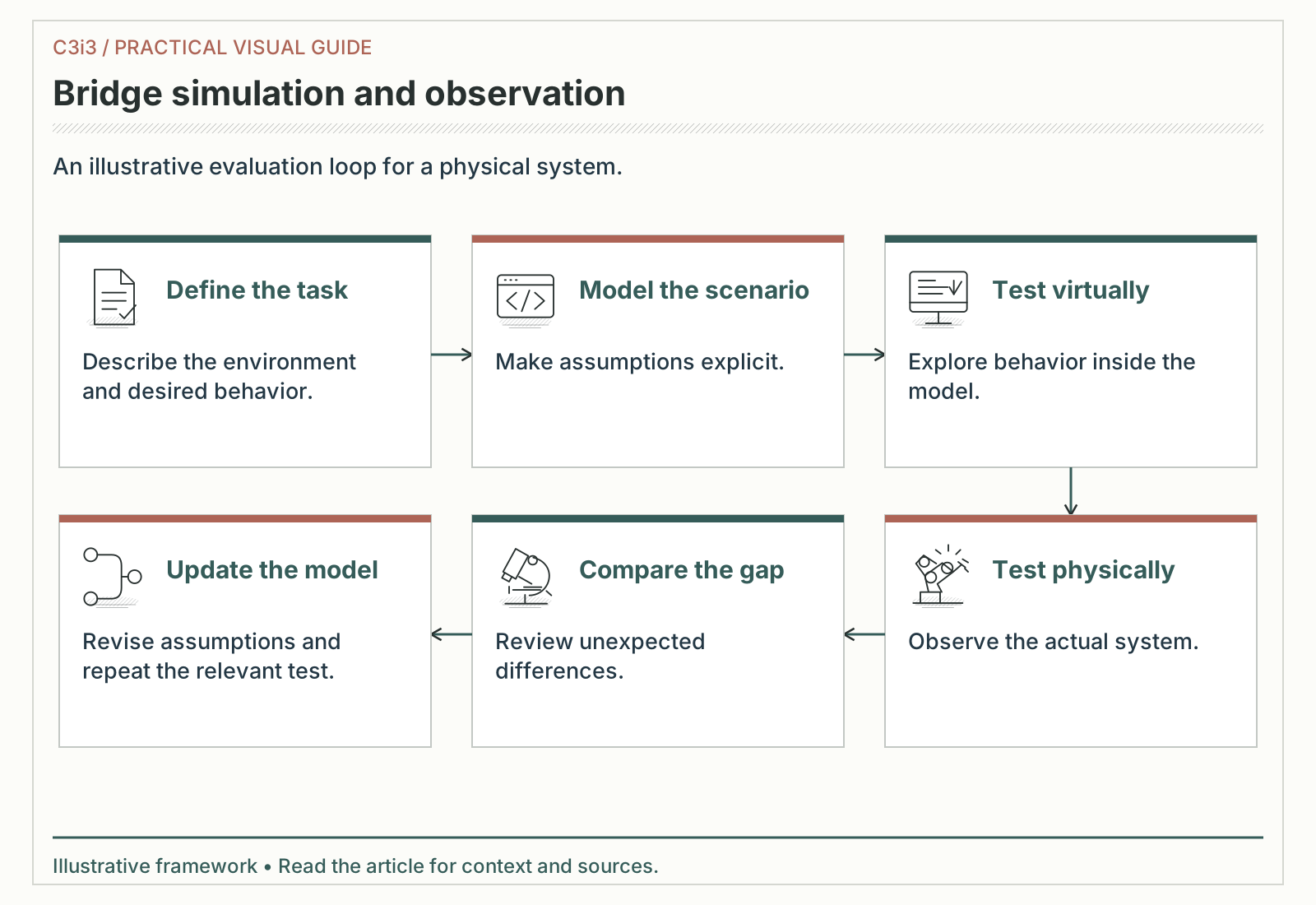
Define the task: Describe the environment and desired behavior. Model the scenario: Make assumptions explicit. Test virtually: Explore behavior inside the model. Test physically: Observe the actual system. Compare the gap: Review unexpected differences. Update the model: Revise assumptions and repeat the relevant test.
How should you explain a physical AI product to customers?
Organize the story around a visible task. Show the input, the machine's action and the resulting state. Explain which conditions are controlled and what the audience should observe. If the demonstration uses a simulation, label it beside the scene.
Separate capability from availability. An attractive demonstration can introduce a research direction while a current product offer remains narrower. The website should tell an engineer, a potential partner and a reporter how to begin the right conversation without implying that they can order an unannounced system.
Use a claim ledger to connect each public statement to its supporting material. A sentence about sensing should link to the relevant demonstration or documentation. A statement about fabrication should identify the device or process being discussed. A system-level claim needs system-level support.
Our analysis is that this clarity is especially useful for emerging technology businesses because unfamiliar terms can conceal the actual offer. A concise system map, a captioned demonstration and a focused next step can make a more persuasive launch than broad claims about replacing human work.
For the broader launch question, read how the Matter Compiler could affect product marketing. For the next technical planning step, distinguish a useful hardware prototype from a finished production system.
Key takeaways
- Physical AI and fabrication address related but different parts of a system.
- Start with the task and identify the unresolved layer.
- Keep simulation assumptions connected to physical evaluation.
- Investigate micro-machines where they address a specific physical constraint.
- Describe demonstrated behavior and present availability separately.
Key terms in this guide
- Physical AI
- AI used to perceive, reason about or act within a physical environment.
- Embodiment
- The sensors, mechanisms and operating context through which a system interacts with its surroundings.
- Simulation-to-reality gap
- Differences between a modeled environment and actual operating conditions.
Frequently asked questions
Is physical AI the same as the Matter Compiler?
No. Physical AI describes intelligence that interacts with the physical world. The Matter Compiler is a manufacturing platform being developed by Atomic Machines. A project could involve both categories without making them the same product.
Can a manufacturing platform make a robot intelligent?
Fabrication can provide hardware for a proposed system. Perception, planning, control and validation remain separate system responsibilities. The complete architecture determines what the robot can do.
Do NVIDIA announcements prove a connection to Atomic Machines?
No connection is asserted here. Partnerships must be supported by announcements naming the relevant parties.
What is the best first deliverable?
A bounded task brief and system map are useful starting points. They identify which question needs a prototype, simulation, software evaluation or supplier discussion.
Primary sources and editorial method
- NVIDIA physical AI glossary
Vendor documentation or a dated announcement. Plans and targets remain attributed to the source.
- NVIDIA March 16, 2026 robotics announcement
Vendor documentation or a dated announcement. Plans and targets remain attributed to the source.
- Matter Compiler platform description
Manufacturer description of the platform and its stated ambitions.
- NIST industrial AI management and metrology
Primary measurement, manufacturing or research context for the concepts discussed above.
Help people understand your technical product.

C3i3 helps technical businesses explain their products through manufacturing marketing strategy, technical content, websites and product demonstrations and creative campaigns.
Tell us what you are developing and who needs to understand it. For Matter Compiler access or PrimeSwitch evaluation, use Atomic Machines’ official contact route.