








































In this article
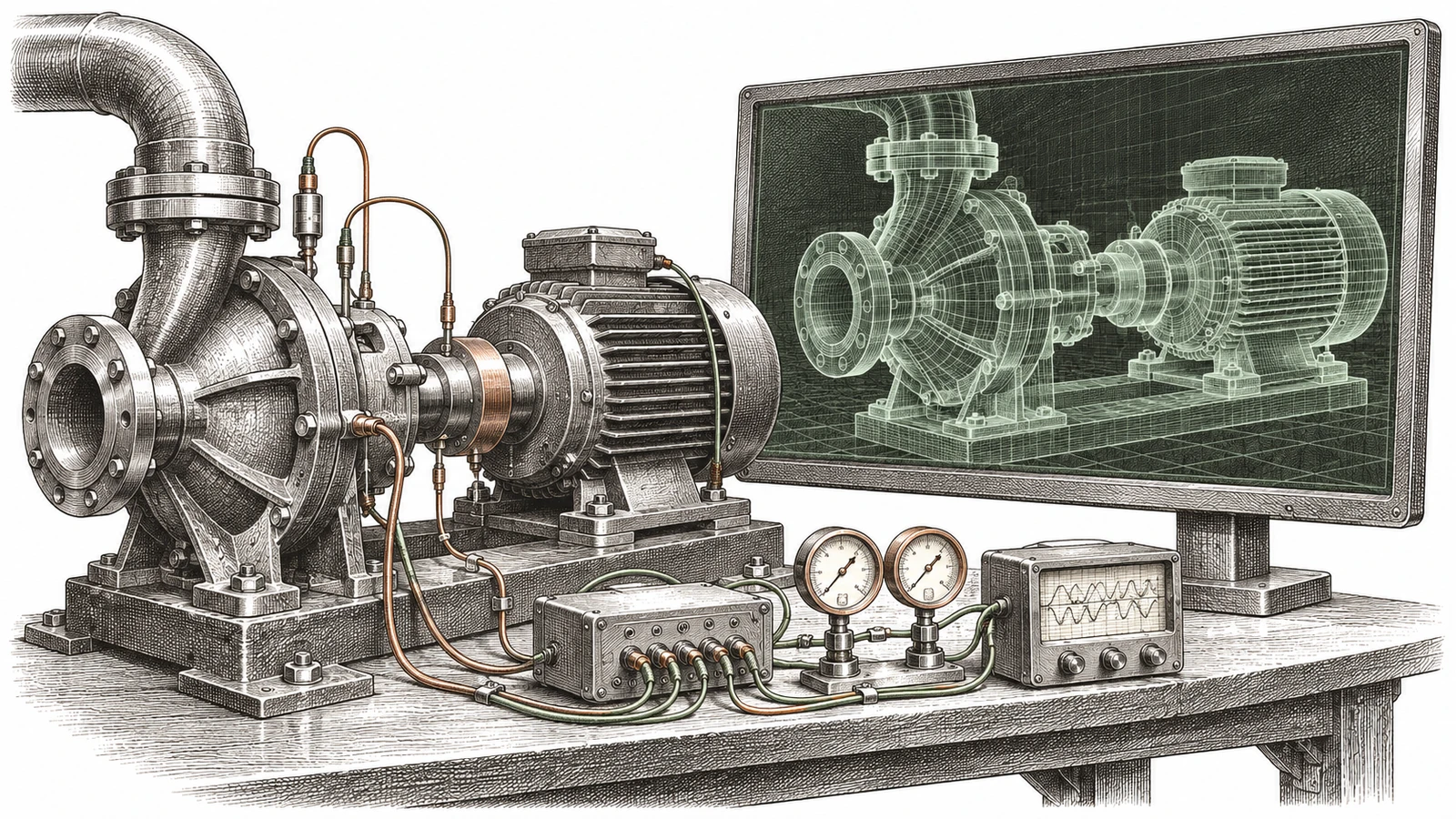
A detailed digital factory can look authoritative. It may show moving machines, colorful heat maps and a perfectly organized production line. Yet visual detail does not tell a business which decisions the model can support.
This guide explains manufacturing digital twins through an original “model contract” framework. The contract is a concise agreement about purpose, inputs, observations and limits. It helps a team discuss emerging fabrication platforms without assuming that every simulation is a validated twin or that Atomic Machines implements a particular digital-twin standard.
Independent C3i3 research and analysis. Sources checked November 18, 2026. Read the sources and editorial method.
Why does this topic matter now?
On July 21, 2026, NIST published its Digital Twins Workshops Summary Report. It identified manufacturing priorities including interoperability, verification, validation and uncertainty quantification. That is a useful current signal that dependable twins require more than impressive visualization.
The issue becomes especially relevant when a business imagines a digitally driven manufacturing loop. Decisions may pass from design to simulation, then into fabrication and measurement. A misunderstanding about what a model represents can travel through that entire sequence.
Our interpretation is that a small team should establish a model's purpose before investing in its breadth. A narrow representation that supports one important decision can be more useful than a highly detailed scene with no agreed relationship to observations.
What has the report established?
It reports workshop findings and research priorities. It should not be described as a universal product certification or a mandatory standard for every supplier. Use the issues it raises to improve a project brief and ask better integration questions.
This distinction matters for public content too. When a vendor announces a twin-based workflow, explain what is being represented and what has been demonstrated rather than treating the term itself as evidence of completeness.
How does a digital twin differ from CAD and simulation?
A CAD model describes geometry and design relationships. A simulation uses a model to examine behavior under chosen conditions. A digital twin adds an accountable connection to an identified physical system and relevant data for its intended use. The categories can work together without being interchangeable.
Consider an illustrative micro-pump project. CAD could describe a proposed channel and its interfaces. A simulation could explore a behavior under specified assumptions. A twin proposal would need to explain which real device or process it represents, which observations maintain that relationship and what decisions the representation supports.
| Artifact | Typical question | Additional issue before relying on it |
|---|---|---|
| CAD geometry | What is the design? | Which revision and interfaces apply? |
| Simulation model | What does this model predict? | Which assumptions and conditions produce the result? |
| Digital twin | What does the representation tell us about the identified system? | How is its connection to observations maintained and checked? |
| Visualization | How can people understand the system? | Which elements are illustrative rather than measured? |
These are practical distinctions for scoping, not an attempt to impose one vendor's terminology. Ask a provider to explain its own use of the term and identify the relevant system, data and decision.
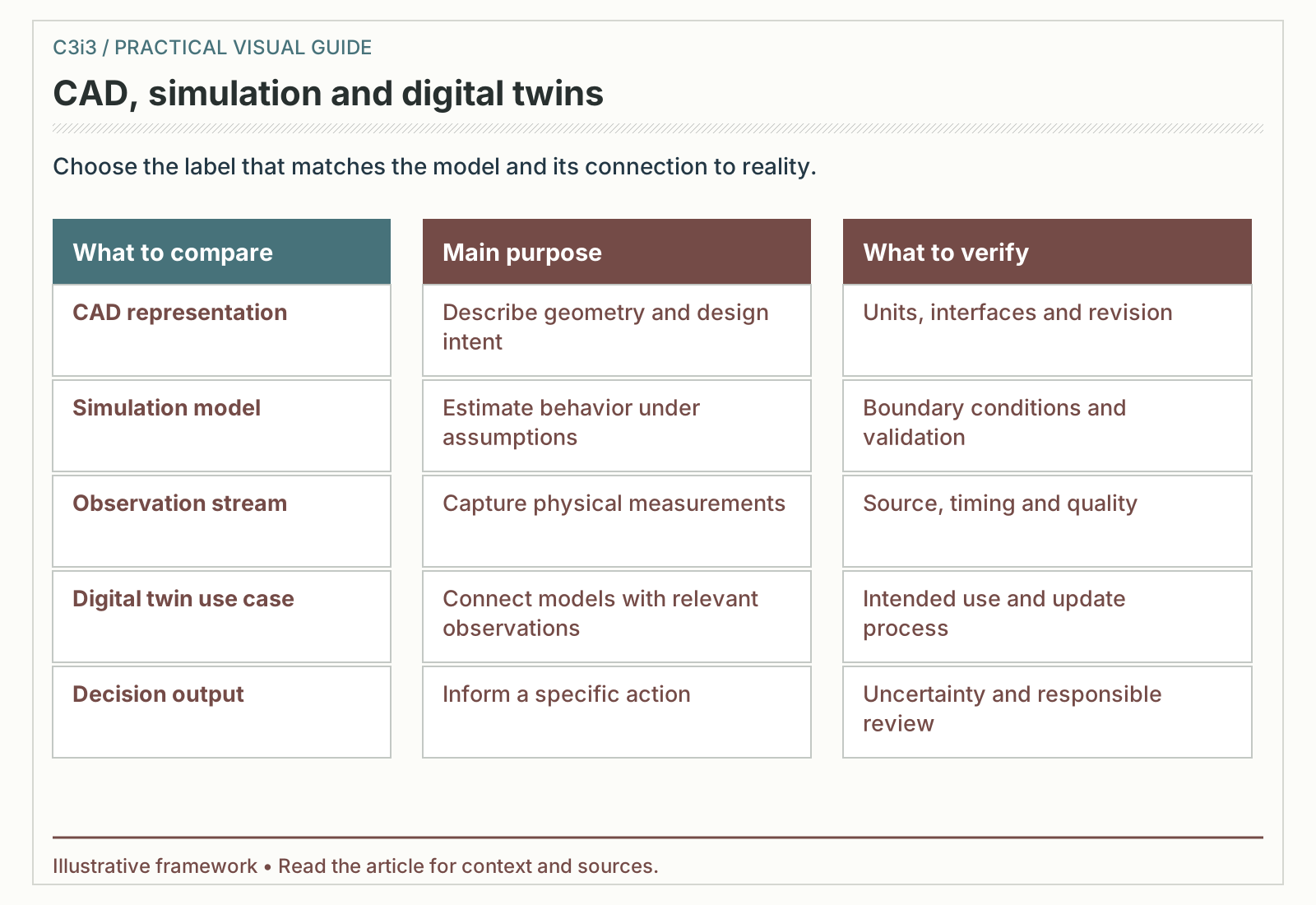
CAD representation: Describe geometry and design intent / Units, interfaces and revision. Simulation model: Estimate behavior under assumptions / Boundary conditions and validation. Observation stream: Capture physical measurements / Source, timing and quality. Digital twin use case: Connect models with relevant observations / Intended use and update process. Decision output: Inform a specific action / Uncertainty and responsible review.
What should the model contract say about intended use?
Start with one decision. Examples might include comparing proposed configurations, reviewing an operating condition or interpreting a measured result. These are illustrative purposes; the responsible technical team must determine what is suitable for the actual project.
Then identify the object of representation. A model of one component is different from a model of a manufacturing process, inspection station or entire production line. Write the boundary so that an apparent success at one level does not silently become a claim about another.
What should the first page contain?
A useful model contract names the physical referent, decision owner, intended question, input sources, output interpretation and known limits. It also identifies the revision and the conditions under which the model should be revisited.
For the hypothetical pump, a team might initially want to compare two proposed configurations under a shared set of assumptions. That can be a legitimate simulation task without claiming a continuously synchronized digital twin. Accurate labeling keeps the project proportionate to its maturity.
The contract should say what the model is not being used to decide. A representation prepared for layout discussion should not quietly authorize production changes. A model used to interpret one operating state should not automatically establish lifetime performance.
These boundaries are useful for management. They turn a broad technology purchase into a reviewable deliverable with an accountable owner and a reason to exist.
Which data and observations need to stay connected?
Record the meaning of an input as carefully as its value. A file called “latest measurement” is not enough to establish which part, process revision or observation method it represents. Connect the record with the relevant configuration and conditions.
In its June 18, 2026 paper on a coordinate measuring machine twin, NIST describes using open standards to organize inspection and motion data, then comparing the twin's data with the physical machine. The specific implementation is a research case, not a prescription for Atomic Machines or every manufacturing project.
The general planning lesson is to preserve context. Units, timestamps, part identifiers and method revisions can change the interpretation of a number. A model should not ingest an observation simply because a connector can transfer the file.
How can a team begin without a large data platform?
Create a short data dictionary for the first use case. State each field's meaning, source, units and responsible owner. Include how missing, stale or conflicting observations will be handled. Resolve those questions before promising a real-time dashboard.
For a supplier discussion, ask what data can actually be provided and in what form. An internal feedback loop described in an announcement does not automatically establish a customer-facing stream, integration API or right to reuse the information.
How should verification, validation and uncertainty be discussed?
Use the terms to ask distinct questions. Verification concerns whether the model or implementation behaves as specified. Validation concerns whether it is adequate for its intended purpose. Uncertainty concerns how limitations in inputs, measurements and modeling affect interpretation. A project needs the appropriate specialists to define the actual methods.
For a business reviewer, the useful deliverable is an explanation of what supports the decision. Which comparisons were made? Which conditions were covered? What conclusion is permitted and what remains unresolved?
NIST's 2026 work on uncertainty in computational modeling and simulation addresses the relationship between predictions and measurement. It reinforces why a visually precise result should not be mistaken for complete certainty.
What does an inconclusive result mean?
It may mean the model is not yet suitable for the intended decision, the input information is insufficient or the proposed question is too broad. Record which issue applies. Treating every inconclusive outcome as a reason to collect more data can hide a poorly scoped model.
Use a review note that separates prediction, observation, difference and interpretation. Do not compress the whole discussion into a green status icon. A decision-maker should be able to understand why the team considers the model useful under its stated conditions.
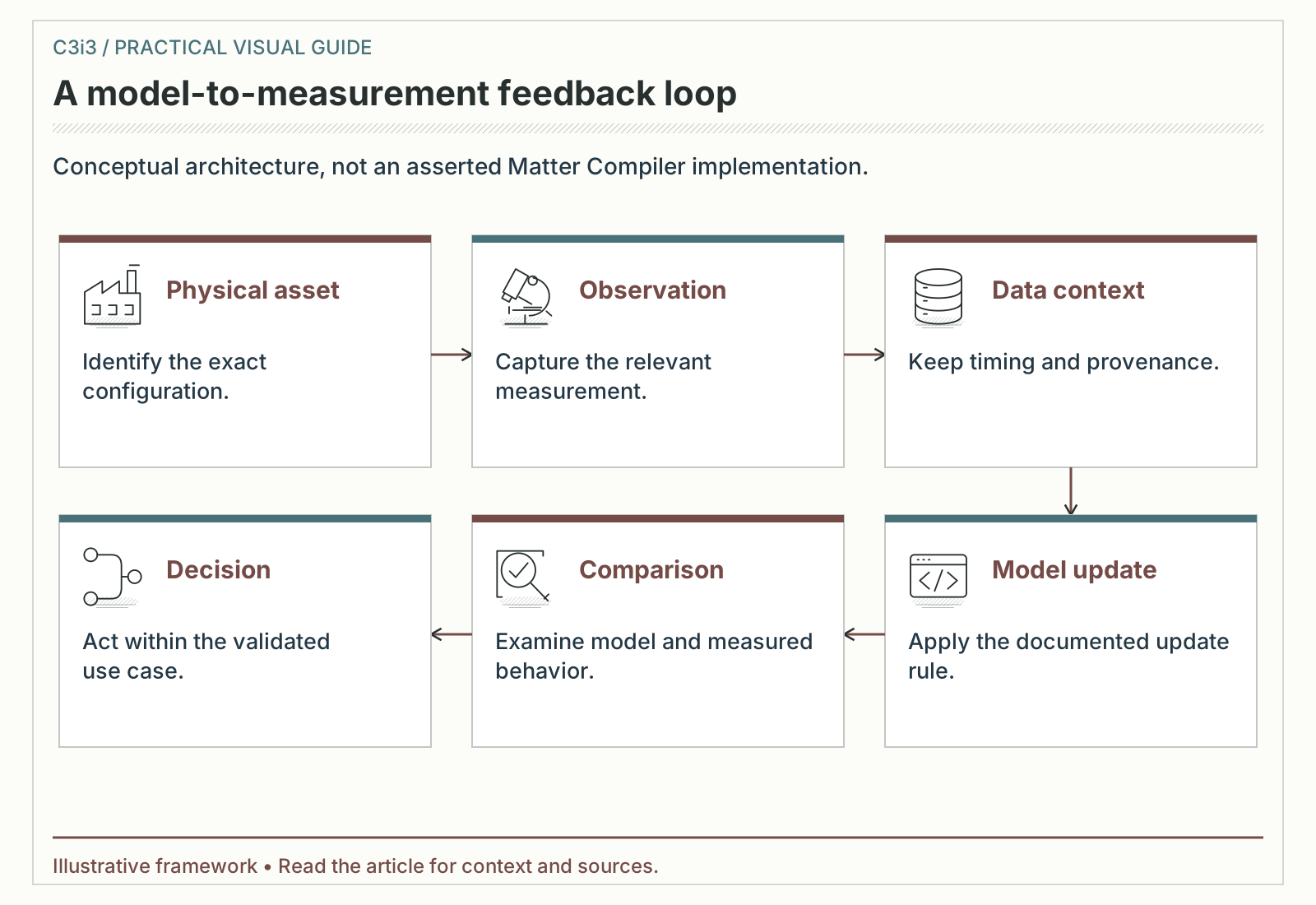
Physical asset: Identify the exact configuration. Observation: Capture the relevant measurement. Data context: Keep timing and provenance. Model update: Apply the documented update rule. Comparison: Examine model and measured behavior. Decision: Act within the validated use case.
What should Matter Compiler buyers ask about a feedback loop?
The Matter Compiler description links design, manufacturing and measurement. A prospective customer should distinguish that manufacturer's platform description from the particular information and deliverables available within an engagement.
Ask which physical function is being modeled, which measurements inform a revision and what the customer will receive. The answer may be a design package, an evaluation report or another defined deliverable. Do not infer access to an internal manufacturing twin.
For an illustrative device evaluation, useful questions include whether the tested configuration can be identified, whether the measurement conditions are documented and how changes will be communicated. These questions help the team interpret a result without requiring the supplier to disclose proprietary process details.
- Which specific device or process does the model represent?
- What decision does its output support?
- Which observations are connected to that representation?
- What information is supplied to the customer?
- Which changes require another review?
Our AI quality-control guide explains why identifying a feature, measuring it and accepting a device are separate decisions. That distinction should remain clear inside any proposed feedback loop.
How do you scope a useful digital-twin pilot?
Choose an existing decision that currently depends on slow, incomplete or difficult-to-interpret information. State how a digital representation could improve that decision. A pilot should produce a clearer basis for action, not merely a more sophisticated display.
Keep the boundary small enough to evaluate. A single identified device, process step or inspection task gives the team a manageable connection between model and observation. Expanding the represented system before resolving that connection can create more interfaces without improving confidence.
What belongs in the pilot record?
Include the intended use, configuration, source data, evaluation method, responsible reviewers and resulting decision. Record the work required to maintain the representation. A pilot can appear attractive while depending on manual updates that nobody has agreed to perform after the demonstration.
Review how the team responds when the physical system changes. A new material, configuration or observation method may require a model update or a narrower interpretation. The owner should understand that maintenance obligation before calling the pilot a production capability.
For public communication, show the representation with a plain-language caption: what it depicts, which information is observed and which elements are illustrative. That makes the visual more useful to customers and helps preserve the distinction between a conceptual future factory and a demonstrated current workflow.
What would make the pilot's outcome useful to a manager?
The report should connect the representation with a decision that the manager recognizes. State what information was difficult to obtain before the pilot, what the model made easier to interpret and which uncertainty remains. A smoother animation is an interface improvement; it is not, by itself, evidence of a better production decision.
For an illustrative inspection-station twin, the team might demonstrate that records from a defined configuration can be assembled and compared in a coherent view. The next question could concern updating or interpretation. Do not present the initial integration result as proof that every future production state is represented correctly.
Include the maintenance effort in the review. Who identifies a changed input source? Who updates the representation when the physical configuration changes? Who checks that the decision owner understands the new limits? A pilot that depends on an expert's undocumented manual work may need a clearer operating process before expansion.
Separate the continuation decision from the broad technology narrative. The team may decide to expand the represented boundary, improve one input, narrow the intended use or stop. Each can be a reasonable response to what the pilot revealed. The useful result is an informed next step rather than an automatic commitment to a larger twin.
For a public case study, preserve that learning structure. Explain the initial question, the defined scope, the observations and the actual decision. It gives readers a reproducible way to think about their own problem without inventing a return on investment.
Key takeaways
- Begin with the decision the model should support.
- Distinguish geometry, simulation, observation and visualization.
- Preserve input meaning and configuration context.
- Discuss validation and uncertainty with the intended use in view.
- Do not infer customer access to a supplier's internal digital system.
Key terms in this guide
- Digital twin
- A virtual representation connected to observations of the system it represents.
- Validation
- Assessing whether a model is adequate for an intended use.
- Uncertainty
- The limits on what a measurement or model result can establish.
Frequently asked questions
Does every 3D factory model count as a digital twin?
The visual alone does not establish a meaningful connection to an identified physical system. Ask about intended use, observations, updating and validation.
Does the Matter Compiler implement a specific digital-twin standard?
This guide does not establish that. A prospective buyer should request relevant documentation for the actual engagement.
Can a digital twin eliminate physical testing?
This guide does not support that claim. The responsible technical team determines which observations and tests are needed for the intended decision.
What is a model contract?
It is C3i3’s practical planning term for a concise record of purpose, inputs, observations, ownership and limits. It is not an industry certification.
Primary sources and editorial method
- NIST July 21, 2026 twin workshop report
Primary measurement, manufacturing or research context for the concepts discussed above.
- NIST June 18, 2026 CMM twin paper
Primary measurement, manufacturing or research context for the concepts discussed above.
- NIST 2026 modeling and metrology uncertainty work
Primary measurement, manufacturing or research context for the concepts discussed above.
- Matter Compiler platform
Manufacturer description of the platform and its stated ambitions.
Help people understand your technical product.

C3i3 helps technical businesses explain their products through manufacturing marketing strategy, technical content, websites and product demonstrations and creative campaigns.
Tell us what you are developing and who needs to understand it. For Matter Compiler access or PrimeSwitch evaluation, use Atomic Machines’ official contact route.