








































In this article
A generated shape can look convincing before anyone knows whether it can be made, assembled or used. That makes generative design both exciting and easy to misunderstand. The value comes from exploring a defined design problem, then reviewing the resulting tradeoffs.
This guide explains how to prepare that problem and connect it with a manufacturing conversation. It uses a hypothetical mounting component as an illustrative example. It does not assert a software integration between Autodesk and Atomic Machines or claim that the Matter Compiler accepts the example project.
Independent C3i3 research and analysis. Sources checked November 18, 2026. Read the sources and editorial method.
Why does this topic matter now?
Autodesk's March 2026 Fusion update described new assistant capabilities alongside changes to design, simulation and manufacturing workflows. The company explicitly preserved engineering judgment in its description of the assistant. That combination is a useful current example: interfaces are changing while responsibility for design decisions remains.
At the same time, the Matter Compiler story invites businesses to imagine more programmable fabrication. Those developments make the connection between a design objective and an accepted physical output worth examining. A conversational interface can make it easier to begin a task without making the task itself fully specified.
The practical opportunity is to improve the brief before improving the rendering. When a team documents its constraints well, generated alternatives can expose choices it might not have considered. When the brief is weak, a larger selection of attractive outcomes can simply multiply uncertainty.
What is the immediate business question?
Ask which design decision needs exploration and what evidence would help resolve it. A request to minimize mass is different from a request to reduce assembly complexity. A manufacturing partner needs to understand that distinction before proposing a route.
What does generative design actually generate?
Autodesk's design-criteria documentation describes objectives, limits and manufacturing constraints for its solver. This is more specific than asking an image model to visualize a futuristic object. The output is explored in relation to a defined engineering problem.
Three categories are helpful in a business discussion. An image concept communicates an appearance or direction. A parametric CAD model represents geometry through editable relationships. A generative study explores alternatives against chosen criteria. The same project may use all three, but each artifact needs an accurate label.
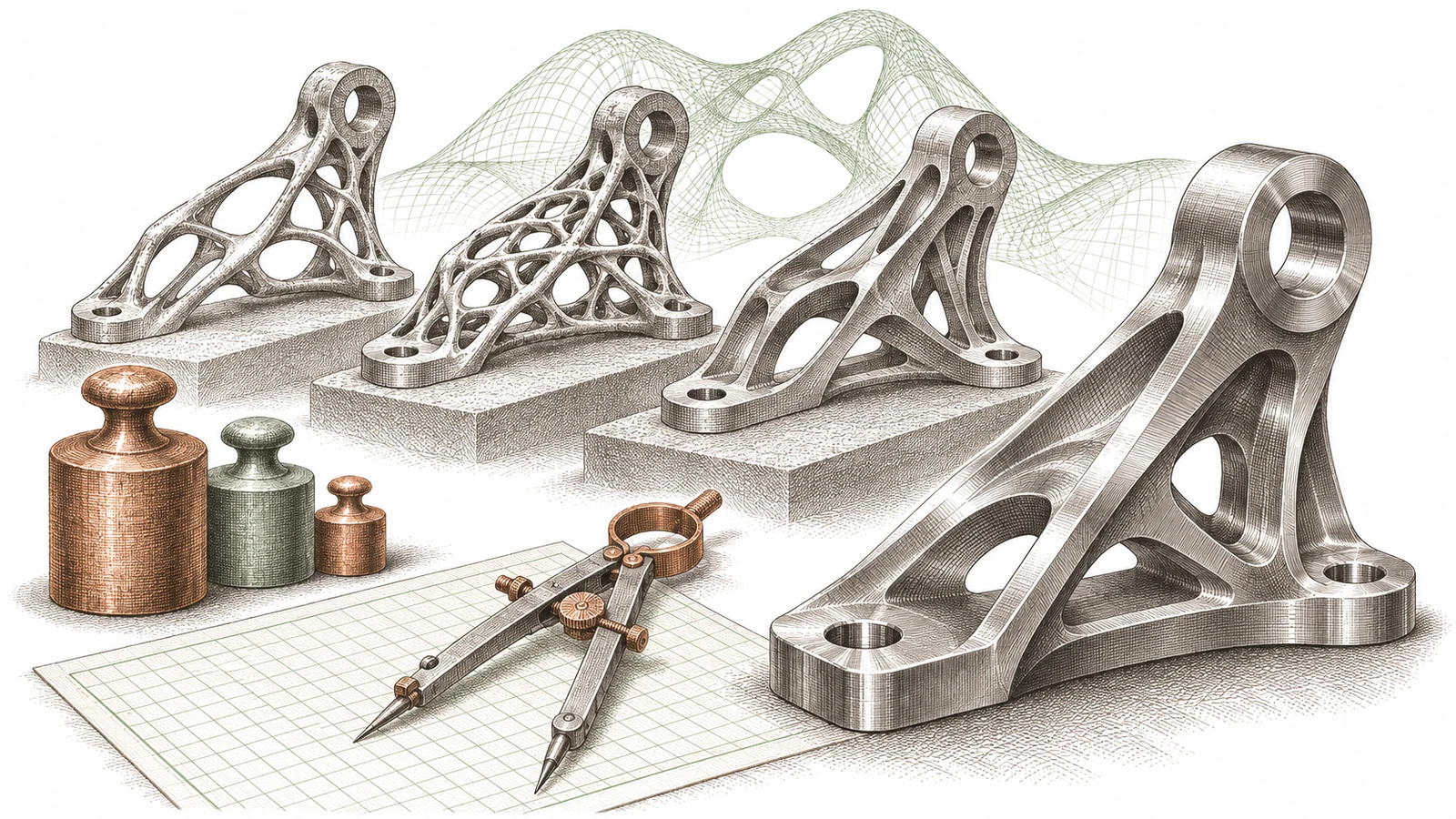
For a hypothetical bracket, a rendering might help people discuss visual integration. A CAD model can establish interfaces. A generative study might explore how material is arranged around those interfaces under stated assumptions. The study's useful output is not merely a striking shape; it is a set of alternatives with reasons to compare them.
Is generative design identical to topology optimization?
The terms are sometimes used together, but they should not be treated as universal synonyms. Topology optimization generally concerns the distribution of material within a design region for defined objectives and constraints. A broader generative workflow can include multiple candidate studies, manufacturing methods and human selection. Ask a software provider what its particular function does.
Use the narrowest accurate product description in public copy. It helps a potential buyer understand the deliverable and avoids suggesting that every visually generated concept has been structurally evaluated.
Which constraints belong in the brief before a study begins?
Start with the parts of the problem that should not change. For the illustrative bracket, these might include mounting interfaces, reserved clearance and the way the component connects to the surrounding assembly. The responsible designer must establish the actual values and conditions.
Then separate the objective from limits. An objective describes what the study tries to improve. A limit defines an unacceptable outcome. Reducing material could be an objective; a required clearance is a boundary. Confusing them can produce a candidate that optimizes a number while failing the product's purpose.
| Brief item | Question | Owner |
|---|---|---|
| Function | What must the component accomplish? | Product owner and engineer |
| Preserved interfaces | Which connections cannot move? | Assembly designer |
| Reserved space | Where must material stay out? | System designer |
| Objective | What should alternatives improve? | Project team |
| Manufacturing route | Which process assumptions apply? | Manufacturing specialist |
| Acceptance | What will be reviewed or measured? | Responsible technical reviewer |
Record uncertain requirements as questions to resolve rather than convenient guesses. A study can still be useful for exploration, provided its assumptions remain visible. The team should be able to explain which conclusions would change if an assumption changed.
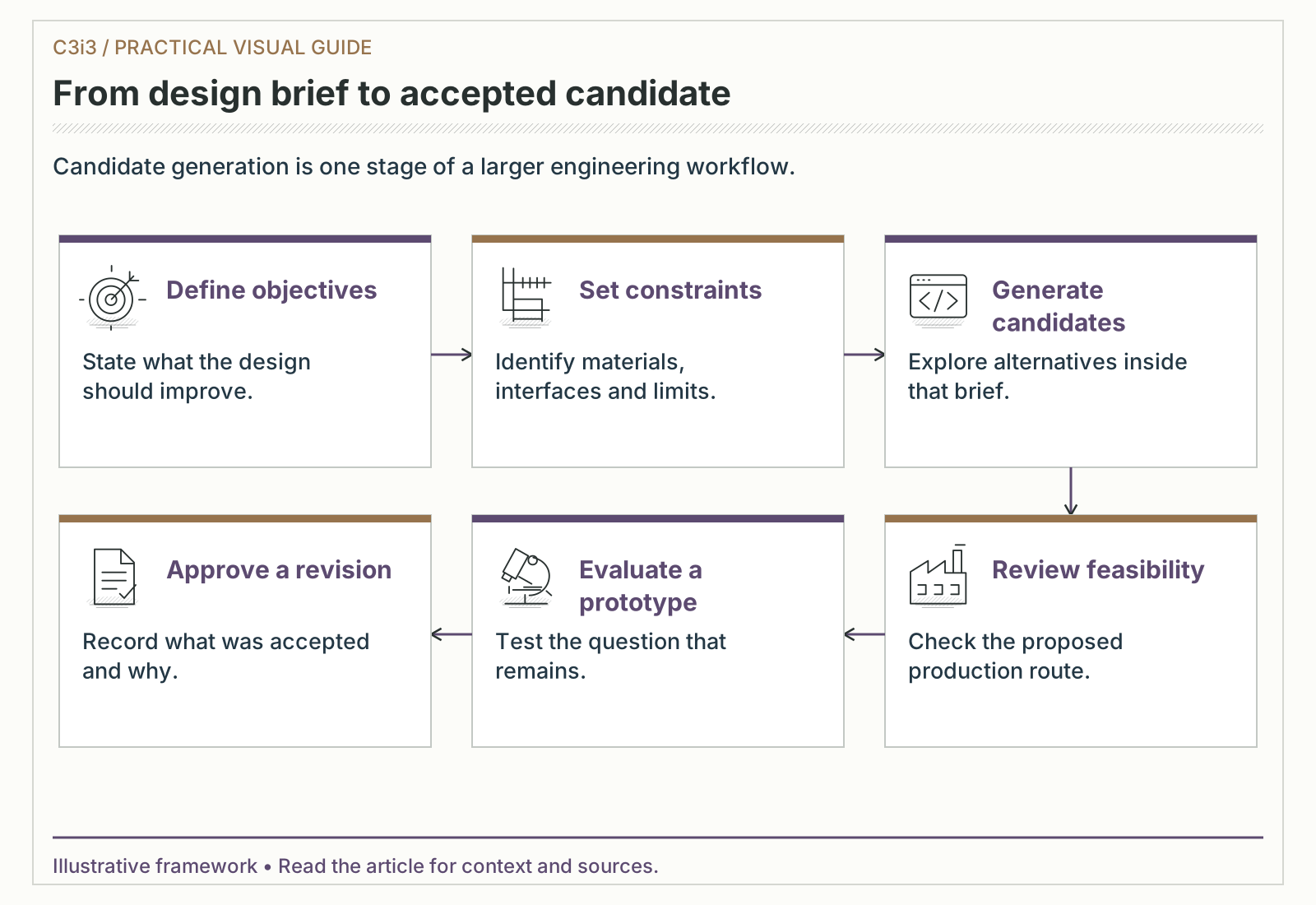
Define objectives: State what the design should improve. Set constraints: Identify materials, interfaces and limits. Generate candidates: Explore alternatives inside that brief. Review feasibility: Check the proposed production route. Evaluate a prototype: Test the question that remains. Approve a revision: Record what was accepted and why.
Why should manufacturing constraints enter the design process early?
A shape that performs well in a study may create a difficult production problem. Manufacturing constraints help a team explore outcomes with a proposed process in mind. They do not replace the review of the actual supplier that will make the part.
Autodesk documents method-specific constraints for generative studies, including additive processes, milling, cutting and casting. The documentation also distinguishes unconstrained exploration. That is a useful reminder to identify which mode produced an outcome before showing it as a buildable proposal.
In the illustrative bracket study, the team could compare a freer exploratory candidate with a candidate constrained for a selected route. The review should consider the whole production sequence: preparing the job, fabricating the part, accessing critical features, finishing and checking the result.
What about assembly and inspection?
These deserve explicit consideration. A component can be feasible to fabricate but inconvenient to join to the system. A critical feature can be difficult to measure after assembly. Neither issue is resolved by the attractiveness of the geometry.
Ask the manufacturing specialist to review the features that drive uncertainty. The goal is a clear transition from an exploratory design to a fabrication brief. It is not to turn a software label such as “manufacturing-ready” into a promise that no downstream work remains.
How should a team choose between generated alternatives?
Compare candidates using the same objective and assumptions. Keep the study configuration beside the result so a reviewer can understand what was being optimized. Avoid comparing the best-looking screenshot from one study with a numerical result from another.
For the hypothetical bracket, a team might compare the relative tradeoffs in mass, available clearance, assembly access and the proposed manufacturing process. It should explain which criteria are modeled and which are reviewer judgments. A qualitative concern can be important without being presented as a calculated metric.
Use a shortlist rather than pushing every candidate into detailed review. For each retained option, record why it survived and what question it raises. One might deserve another analysis because it changes the load path. Another might be useful because it simplifies an interface. These are reasons to investigate, not completed acceptance decisions.
What would make a comparison misleading?
A candidate should not win simply because its illustration is more polished. Nor should a result based on a favorable assumption be presented alongside another result without disclosing the difference. The public version of the story should preserve the essential comparison conditions.
A review note can be short: selected candidate, relevant tradeoff, unresolved issue and next check. That creates a traceable decision without burying a small team in a document that nobody maintains.
How can a review avoid optimizing the wrong number?
Translate each metric into the decision it represents. If the hypothetical bracket study emphasizes mass, ask why mass matters to the assembly. If the real project constraint is difficult installation, a lighter part that complicates installation may not improve the product's overall value.
Keep an objective hierarchy visible. Some conditions are mandatory, some are preferences and others are useful observations. A candidate that violates a mandatory interface should not remain in the shortlist simply because it performs well on a preferred metric.
The same principle applies to manufacturing comparisons. A candidate optimized for one process should not be described as generally easier to manufacture. It has been explored within a particular set of process assumptions. Another supplier or production quantity may change which tradeoff deserves attention.
For a small team, the review can be a structured conversation rather than a large scoring model. Ask the product owner to identify the business reason, the designer to explain the candidate and the manufacturing specialist to identify the next practical uncertainty. Record disagreements instead of hiding them inside a single weighted score.
That record also supplies useful launch material later. It explains why the chosen solution exists, which constraint shaped it and what the team learned. A substantive design story can make a technical product easier to understand without exposing proprietary calculations or presenting an exploratory rendering as a finished device.
How could generative design connect with the Matter Compiler?
Conceptually, a design workflow proposes a device and a fabrication workflow determines how to make it. The Matter Compiler platform page describes an ambition to connect design, simulation and manufacturing. It does not establish a public connector from every CAD tool or a general guarantee for generated designs.
Prepare a supplier discussion around the device's required function and interfaces. Ask which representation is useful, which assumptions need review and what part of the process the supplier can currently support. Do not make a launch dependency out of a presumed file format or software connection.
For a micro-machine, candidate geometry may be only one part of the brief. Materials, moving elements and integration conditions can define whether a design makes sense. A shape-focused study and a complete device proposal can therefore be different levels of work.
Our MEMS comparison explains the importance of device function and process maturity. Our 3D printing comparison provides a separate way to compare proposed deliverables.
What should the team avoid assuming?
Avoid assuming that an exported model has been accepted for production, that a platform can use a particular material combination or that generating more candidates lowers the cost of the next physical trial. Confirm each question within the engagement being discussed.
What should accompany a design when it moves toward a prototype?
Deliver the intent with the geometry. A useful handoff includes the study revision, preserved interfaces, selected candidate, intended manufacturing route and the issue the prototype should resolve. State what remains outside the test.
In the illustrative bracket project, the first prototype might examine fit and assembly access. A different trial could address another requirement. The technical team should choose the sequence and acceptance conditions. Calling an object a prototype does not communicate which conclusion it can support.
Keep visual material synchronized with the chosen revision. If marketing produces an animation from an earlier candidate, label it as a concept rather than allowing it to stand for the accepted design. The same discipline helps sales teams explain what is available without accidentally offering an obsolete configuration.
- Identify the revision and the decision it represents.
- Explain the function and preserved interfaces.
- Distinguish modeled criteria from reviewer judgments.
- Record manufacturing assumptions and open questions.
- State what the proposed prototype should establish.
The result is a useful design story: a problem, a set of alternatives, a reasoned selection and a planned physical evaluation. That story gives customers and partners something substantive to discuss while avoiding unsupported claims about universal automated design.
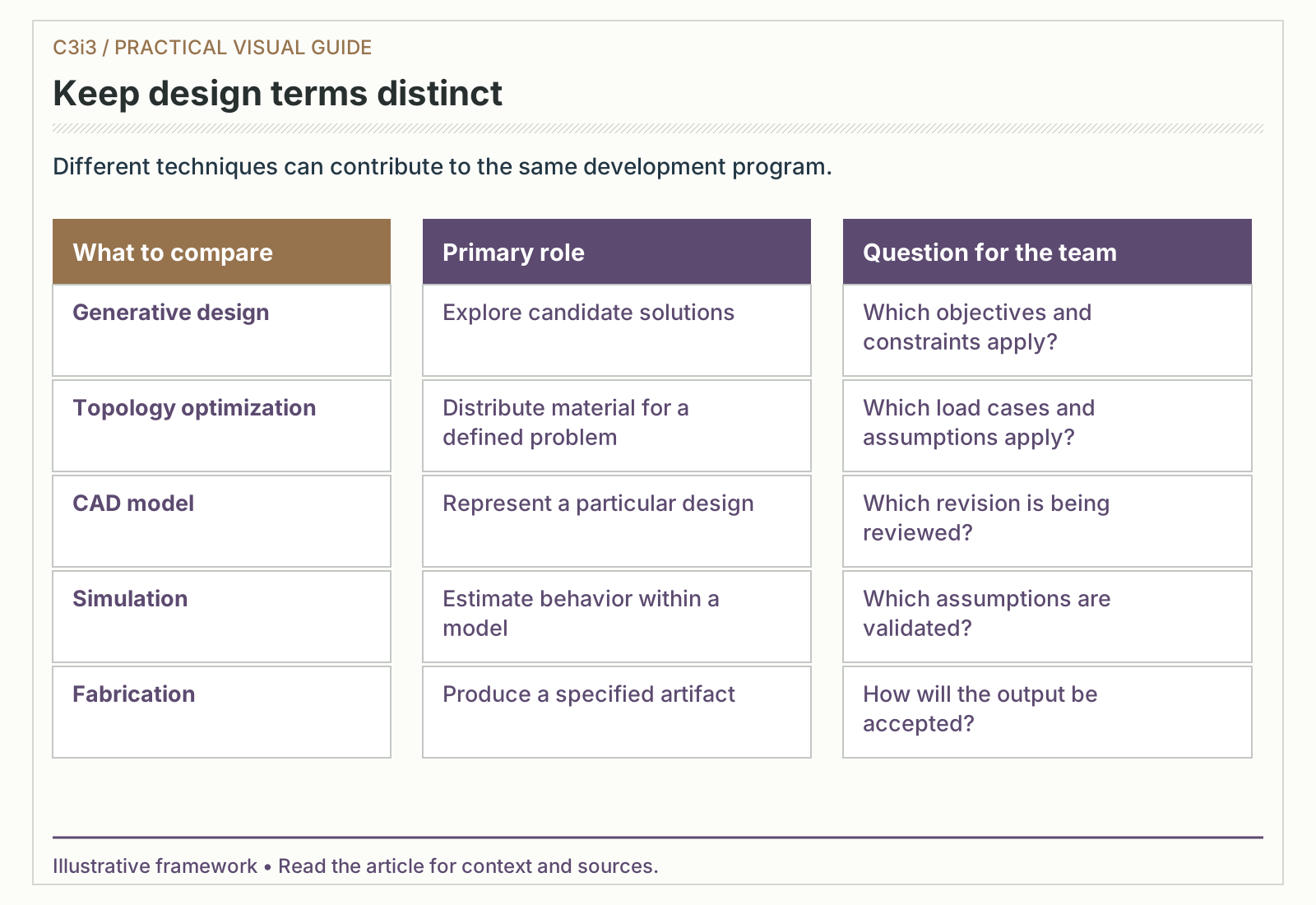
Generative design: Explore candidate solutions / Which objectives and constraints apply?. Topology optimization: Distribute material for a defined problem / Which load cases and assumptions apply?. CAD model: Represent a particular design / Which revision is being reviewed?. Simulation: Estimate behavior within a model / Which assumptions are validated?. Fabrication: Produce a specified artifact / How will the output be accepted?.
Key takeaways
- Generative design starts with a defined objective and constraints.
- Image concepts, CAD models and solver studies serve different purposes.
- Manufacturing assumptions should travel with each candidate.
- Compare alternatives under consistent conditions.
- Connect a selected design with a specific prototype question.
Key terms in this guide
- Design constraint
- A requirement or boundary a candidate design must satisfy.
- Objective
- The property a design study attempts to improve, such as mass or stiffness.
- Manufacturability
- Whether a proposed design can be made through the selected processes and accepted conditions.
Frequently asked questions
Can generative design produce a finished product automatically?
A study can help generate and compare design candidates. A finished product also needs integration, evaluation and an accepted production process appropriate to its purpose.
Does a solver result replace engineering review?
No. The team remains responsible for requirements, assumptions, interpretation and the acceptance process.
Is there a verified Autodesk-to-Matter Compiler integration?
No integration is asserted in this guide. Ask the relevant providers about current interfaces and accepted input formats.
Should marketing show an unrestricted candidate?
It can be useful as a clearly labeled exploration. Do not present it as an accepted or available product unless that status is supported.
Primary sources and editorial method
- Autodesk March 2026 Fusion update
Vendor documentation or a dated announcement. Plans and targets remain attributed to the source.
- Autodesk generative design criteria
Vendor documentation or a dated announcement. Plans and targets remain attributed to the source.
- Autodesk manufacturing constraints
Vendor documentation or a dated announcement. Plans and targets remain attributed to the source.
- Matter Compiler platform
Manufacturer description of the platform and its stated ambitions.
Help people understand your technical product.

C3i3 helps technical businesses explain their products through manufacturing marketing strategy, technical content, websites and product demonstrations and creative campaigns.
Tell us what you are developing and who needs to understand it. For Matter Compiler access or PrimeSwitch evaluation, use Atomic Machines’ official contact route.