








































In this article
MEMS devices already help phones sense motion, systems measure pressure and optical products control light. A new micro-manufacturing story should begin by acknowledging that substantial existing achievement.
The Matter Compiler raises a different question about how additional device designs might be made. This guide compares the established field with the newer platform's manufacturing proposition. It helps a product team identify a relevant function and evaluate available routes without assuming that every MEMS process has the same materials, geometry or limitations.
Independent C3i3 research and analysis. Sources checked November 18, 2026. Read the sources and editorial method.
Why does this topic matter now?
On January 5, 2026, Bosch Sensortec introduced its BMI5 inertial-sensor platform for applications including robotics and extended reality. The announcement illustrates continued development in commercial MEMS, rather than a field waiting for AI to make it useful.
Alongside that progress, Atomic Machines presents a manufacturing architecture intended to broaden micro-machine design possibilities. These are different kinds of developments: a supplier announcing a sensor platform and a company describing a fabrication platform. A fair comparison keeps that difference visible.
For a founder, the interesting question is which route addresses the proposed device. An available component may already solve the sensing task. A new mechanism may justify custom fabrication research. A smaller or more unusual design is not automatically a better product if integration or qualification remains unresolved.
Why avoid a simple old-versus-new story?
It can mislead both readers and the project team. Established technologies can continue to improve, while a newer platform can be promising without having demonstrated every proposed application. Evaluate current offers and documented capabilities at the level relevant to the job.
What are MEMS and what do they do?
MEMS stands for micro-electro-mechanical systems. The field covers small integrated devices with mechanical structures and related functions. NIST's MEMS and NEMS program identifies applications in sensing, timing, signal processing and biomedical diagnostics, along with research in measurement and device behavior.
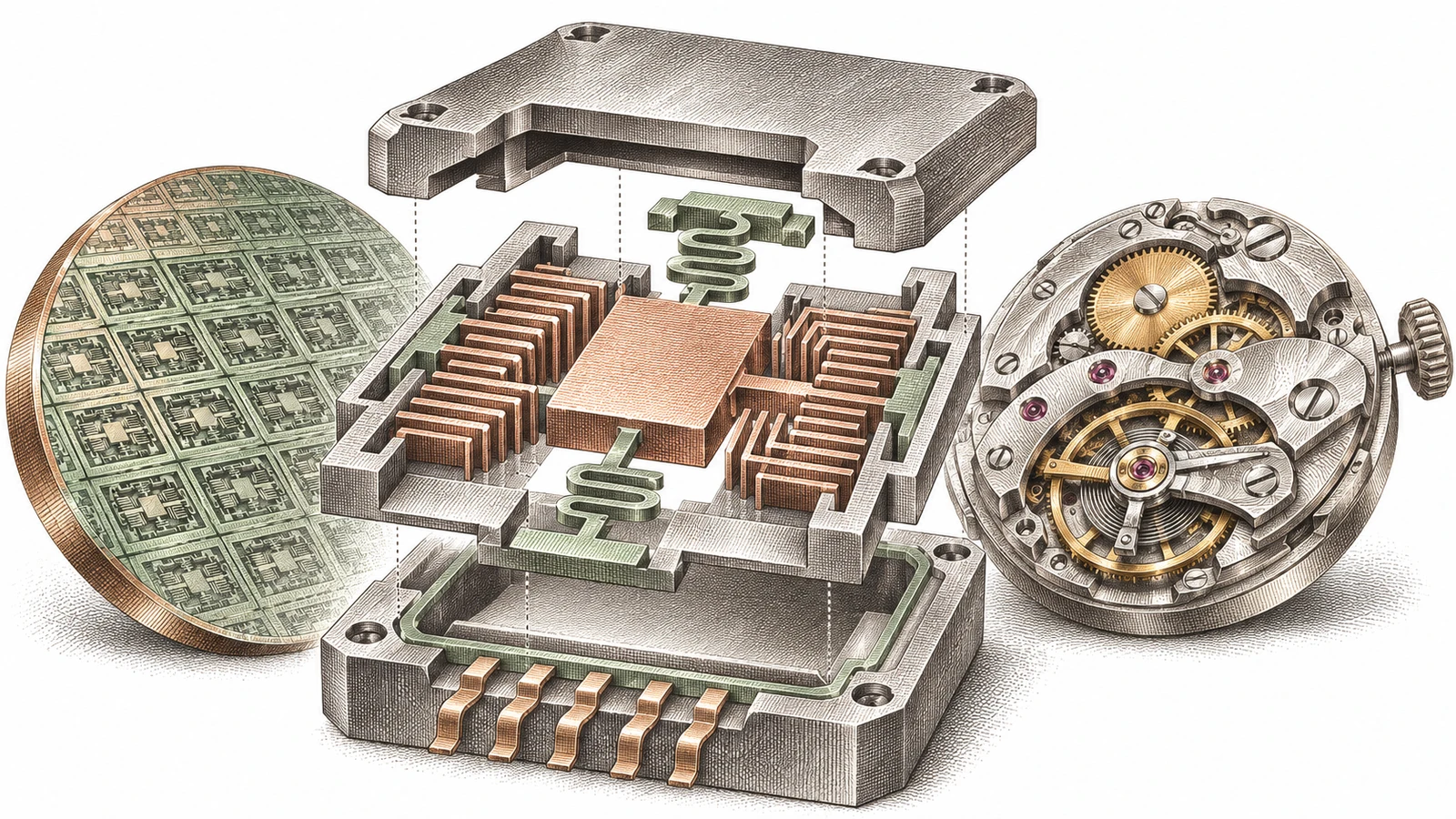
For a business reader, it helps to begin with function. A motion sensor reports information about movement. A pressure sensor responds to a physical condition. A microscopic moving element can also control an optical path. These examples show why “tiny machine” is broader than a miniature gear.
Texas Instruments describes DLP products that control light through microscopic mirror arrays. This is a useful counterexample to the idea that micro-machines are purely a future possibility. The specific product category has documented application resources and an established supplier.
Are all MEMS made in one way?
No single process description should stand for the entire field. Device requirements, fabrication methods, material systems and packaging differ. A claim about the limits of one process should not silently become a claim about every MEMS device or supplier.
Ask what a particular device does, how it connects to the larger system and what documentation supports its use. That creates a meaningful basis for investigating either an existing component or a new fabrication approach.
How is a manufacturing platform different from a MEMS product?
A MEMS component is a specific device with a defined function and offer. A manufacturing platform is a proposed way to produce devices. Comparing the two without naming the output is like comparing a machine shop with a finished instrument.
| Question | Existing component route | New fabrication-platform discussion |
|---|---|---|
| Output | Identify a particular device | Define the device to be evaluated |
| Function | Review the current product documentation | Agree on required behavior and acceptance |
| Materials | Review documented product limits | Confirm supported materials and interfaces |
| Integration | Assess package and system fit | Establish package, assembly and handoff scope |
| Production | Confirm availability and lifecycle terms | Distinguish evaluation from production readiness |
This framework does not declare either route superior. It reveals where the work sits. Selecting an existing part may shift attention to integration. Pursuing a custom device may require a different development and acceptance process.
The same distinction matters in a comparison article. A platform's broad ambition should not be evaluated against one component's narrow datasheet as though they were competing offers at the same level.
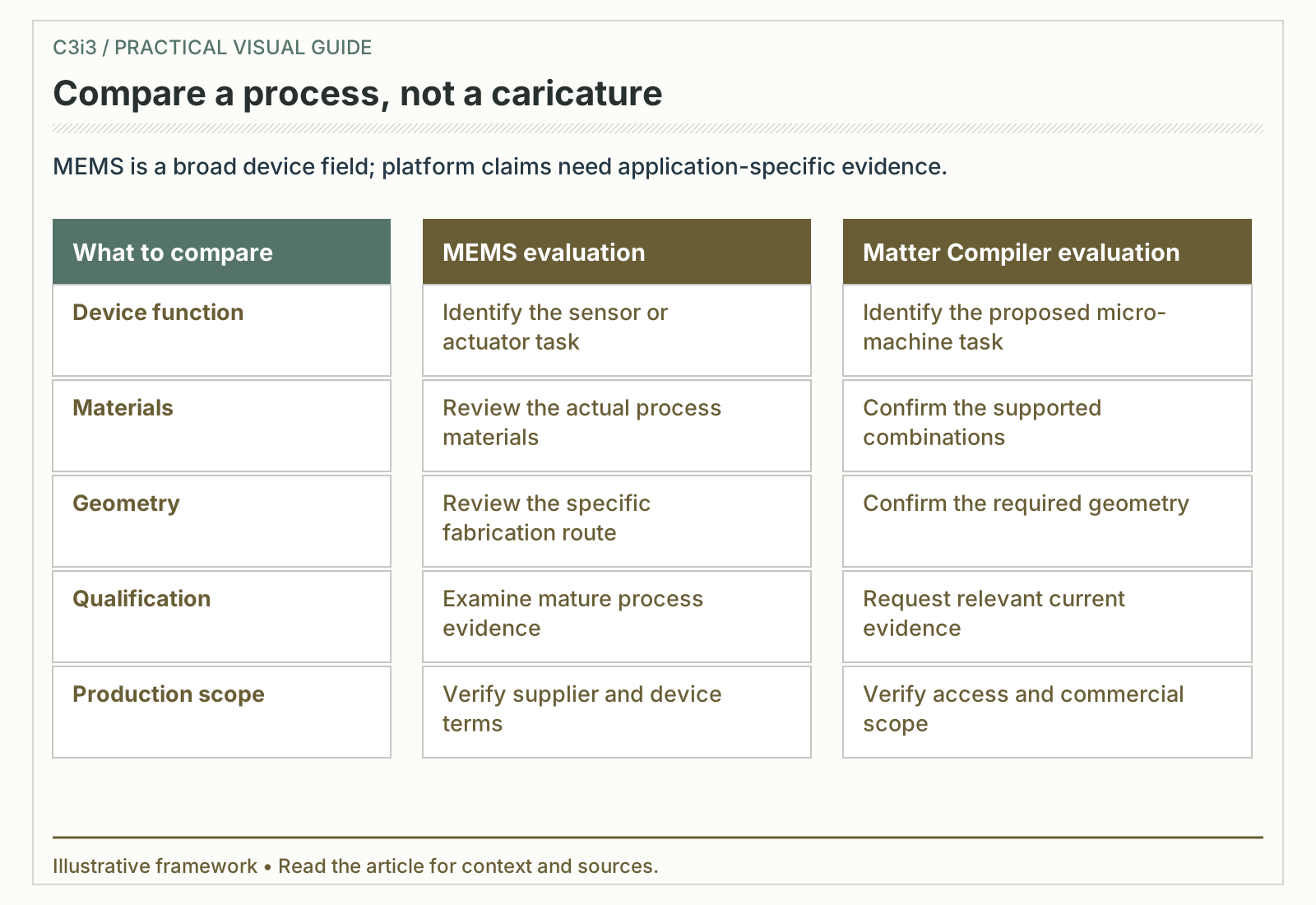
Device function: Identify the sensor or actuator task / Identify the proposed micro-machine task. Materials: Review the actual process materials / Confirm the supported combinations. Geometry: Review the specific fabrication route / Confirm the required geometry. Qualification: Examine mature process evidence / Request relevant current evidence. Production scope: Verify supplier and device terms / Verify access and commercial scope.
Which physical requirements should define the comparison?
Write the required function before selecting a process. Does the device sense, move, direct light, control a flow or perform another task? What must connect to it? Which conditions matter to its operation? The responsible technical team should establish the actual requirements.
For an illustrative compact product, a motion-sensing requirement could potentially be met by an existing integrated sensor. A different project could require a new mechanical action inside a constrained assembly. Those situations lead to different supplier conversations even if both projects use the phrase micro-machine.
Why do materials and interfaces need separate attention?
The material that suits a mechanical function may create a packaging, joining or observation question elsewhere. Treat the complete device as a set of connected requirements. Do not assume that access to one material proves that every combination can be made and used successfully.
Identify the interface at the system boundary. An available part may have a package, electrical interface and documented operating range. A custom device proposal needs an agreed equivalent description before another team can design around it.
This is also where a good pictogram can help: show the device's input, physical function and output. Keep decorative imagery separate from the technical relationship. A reader should understand what the device contributes even before learning the details of fabrication.
What should a buyer ask about fabrication and process maturity?
A successful artifact answers one question: something was made. The next questions concern repeatability, accepted variation, inspection and the work needed for the intended application. A buyer should examine those questions for the specific supplier and device rather than assume them from the age of a technology.
Bosch's account of its MEMS manufacturing describes a substantial production process. That is one supplier's example, not a universal duration or process flow for every MEMS device. It illustrates why manufacturing knowledge extends beyond a design file.
For a new platform discussion, ask which stage the proposed device has reached. A design exploration, experimental build, evaluation sample and accepted production process are distinct states. Identify the deliverable that moves the project from one state to the next.
How should the Matter Compiler claim be interpreted?
Atomic Machines describes flexible, digitally driven fabrication across materials and three-dimensional device structures. Its broader prompt-to-product description includes an aim. Our analysis is that the platform proposition should be evaluated through documented devices and engagements, not accepted as proof that every desired machine can already be ordered.
See what the Matter Compiler can build today for the distinction between its named product and prospective application areas. This guide does not establish a current custom foundry service or manufacturing price.
Why can packaging determine whether a micro-device is useful?
The device must interact with its surroundings. Packaging can provide an interface, support handling and preserve relevant operating conditions. Its role depends on the function, so it belongs in the early brief rather than being treated as a decorative enclosure.
For an illustrative sensor selection, the team might need to consider how the part is mounted and how observations are interpreted in the assembly. For a hypothetical micro-fluidic device, connections and sealing may define a different set of questions. Neither example establishes a Matter Compiler product.
Include assembly and inspection access in the discussion. A characteristic that can be examined before packaging may become harder to observe later. The technical reviewer should determine when the appropriate evaluations occur and how their results stay connected to the item being delivered.
What does this mean for a startup's schedule?
Do not equate fabrication completion with integration completion. Identify who supplies the package, who checks the assembly and which interface information the next team needs. A clear handoff can prevent an attractive early component from becoming a late system problem.
For related explanation, our microfluidics guide focuses on channels, connections and evaluation questions. The broader lesson applies across different micro-machine domains: the surrounding system helps define whether the small device is useful.
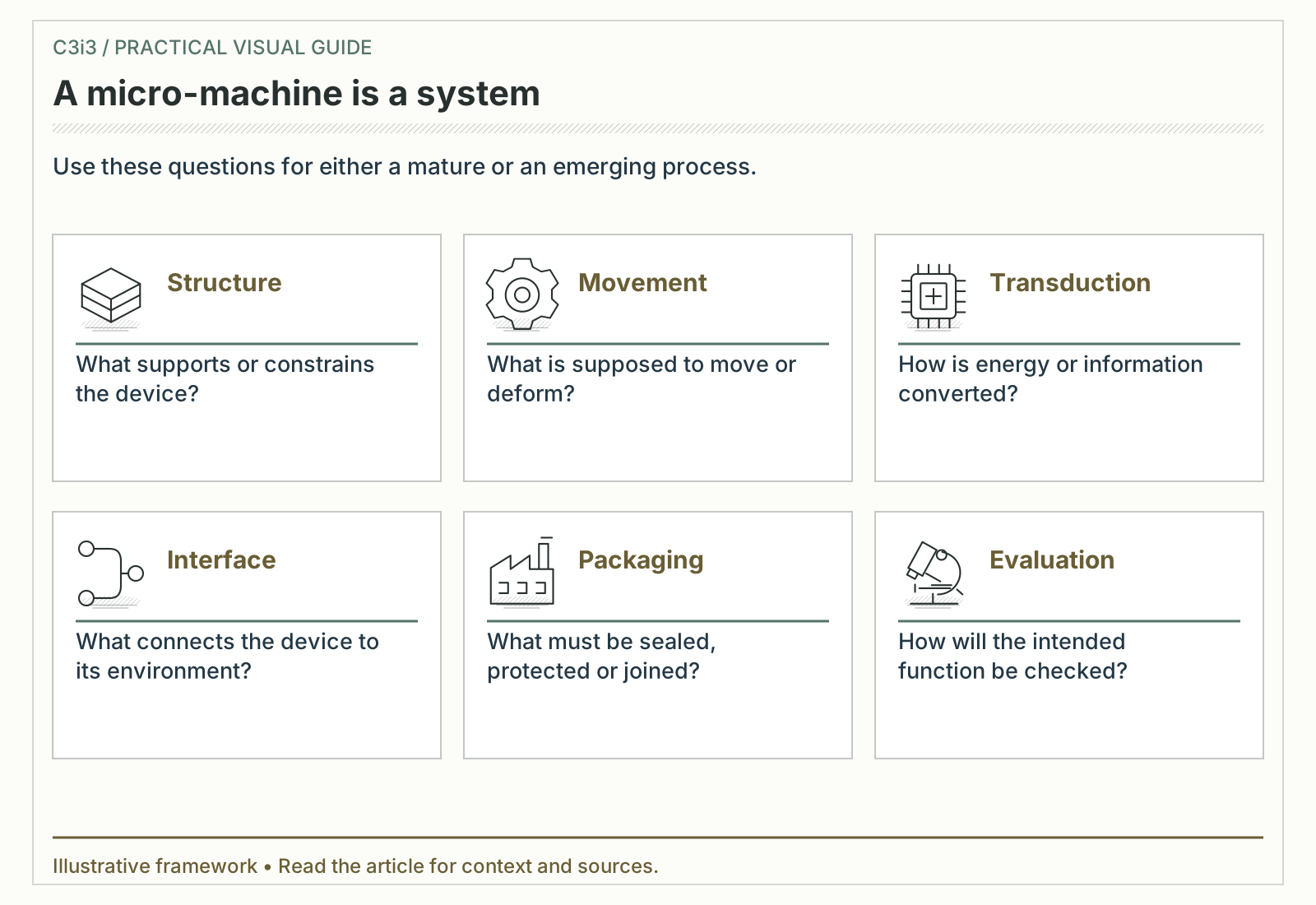
Structure: What supports or constrains the device?. Movement: What is supposed to move or deform?. Transduction: How is energy or information converted?. Interface: What connects the device to its environment?. Packaging: What must be sealed, protected or joined?. Evaluation: How will the intended function be checked?.
When should a team use an existing device or investigate custom fabrication?
Begin with the available route that could answer the current requirement. If a documented component fits the function and system constraints, investigate that fit before assuming a custom solution is necessary. If a meaningful requirement remains unmet, describe the gap clearly.
A custom fabrication discussion is strongest when the team can explain what an available approach cannot do for its application. “We want something innovative” is a weak brief. “This interface and function cannot fit the current assembly” gives a specialist a specific issue to assess.
Use a decision record with four elements: required function, alternatives considered, unresolved constraint and next evidence. That record helps management understand why the team is evaluating a newer platform without claiming that it has already selected or qualified one.
- Identify the physical function and system boundary.
- Review documented existing components or processes.
- Describe the specific gap that remains.
- Choose an evaluation capable of resolving the next question.
- Keep production commitments separate from exploratory results.
For product communication, show the relevant device and explain its task fairly. A mature component and an emerging manufacturing platform can both deserve attention. The useful story is which problem each addresses and what a reader can investigate next.
What would a fair device-selection note look like?
Use a short comparison tied to the same required function. For the illustrative sensing project, one option could be an existing documented sensor. Another could be a custom-development discussion if the team has identified a requirement the available part cannot satisfy. Record that requirement explicitly rather than assigning a broad innovation score.
Compare the deliverables that each route actually offers. An existing component can be evaluated through its current documentation and sample process. A custom proposal may begin with feasibility work. Their initial milestones, costs and unknowns may differ, so they should not be compared as if both were ready-to-ship alternatives.
Preserve the reasons for rejecting an option. A part could be technically promising but unsuitable for the current interface. A fabrication proposal could merit further research while being too early for the planned launch. Those are different conclusions and should lead to different follow-up actions.
Include the person responsible for each unresolved question. The system designer may own the interface, the supplier may need to assess a process and the product owner may need to revisit a launch assumption. Clear ownership prevents every open issue from returning to the same general research meeting.
After an evaluation, update the note with the observation and the resulting decision. Keep the original requirement visible so enthusiasm for a prototype does not replace the reason the project began. If the requirement changes, identify that change as part of the history.
A useful selection note can also improve an emerging-technology article. It shows readers how to compare a mature component and a promising platform without diminishing either. The quality of the decision comes from matching a real requirement to an appropriate route.
Key takeaways
- MEMS is a mature and diverse field with important current products.
- A component and a fabrication platform are different kinds of offers.
- Define the function, interfaces and acceptance question first.
- Include packaging and integration in the development brief.
- Evaluate platform claims through specific documented devices and engagements.
Key terms in this guide
- MEMS
- Micro-electro-mechanical systems that combine small mechanical structures with electrical functions.
- Packaging
- The structures and interfaces that connect and protect a device within its intended system.
- Qualification
- Evaluation against the requirements applicable to a particular device and use.
Frequently asked questions
Is MEMS limited to tiny gears?
No. The field includes sensing, timing, optical control and other functions. Describe a specific device rather than relying on a miniature-machine image.
Does the Matter Compiler replace all MEMS fabrication?
The reviewed evidence does not establish that. The relevant comparison concerns a particular device, process and available offer.
Are all MEMS devices flat silicon structures?
That description is too broad. Device families, processes, material systems and packages differ. Evaluate the relevant technology and supplier documentation.
Should a startup choose a new platform to differentiate its product?
Differentiation should address a useful customer and technical requirement. Establish the unmet need and evaluate the available routes before making a platform commitment.
Primary sources and editorial method
- Bosch January 5, 2026 BMI5 announcement
Vendor documentation or a dated announcement. Plans and targets remain attributed to the source.
- NIST micro- and nanoelectromechanical systems
Primary measurement, manufacturing or research context for the concepts discussed above.
- TI DLP device applications
Vendor documentation or a dated announcement. Plans and targets remain attributed to the source.
- Bosch MEMS manufacturing account
Vendor documentation or a dated announcement. Plans and targets remain attributed to the source.
- Matter Compiler platform
Manufacturer description of the platform and its stated ambitions.
Help people understand your technical product.

C3i3 helps technical businesses explain their products through manufacturing marketing strategy, technical content, websites and product demonstrations and creative campaigns.
Tell us what you are developing and who needs to understand it. For Matter Compiler access or PrimeSwitch evaluation, use Atomic Machines’ official contact route.