








































In this article
Higher-density AI computing is bringing power delivery into technology headlines. The number “800V” sounds like a product specification, but it describes an architectural direction with many layers: conversion, distribution, protection and the final loads.
PrimeSwitch makes the Matter Compiler relevant to this discussion because switching is a specific physical function. This guide explains the business and engineering context for readers evaluating emerging products. It does not provide construction instructions, select protection settings or establish that Atomic Machines is approved by NVIDIA or the Open Compute Project.
Independent C3i3 research and analysis. Sources checked November 18, 2026. Read the sources and editorial method.
Why does this topic matter now?
In an August 11, 2026 update, NVIDIA described its 800 VDC architecture roadmap, including a hybrid power-rack approach and a row power center expected in 2027. The release presents a transition strategy, not evidence that every data center has already moved to this distribution voltage.
The Open Compute Project's related announcement discusses collaborative specifications and ecosystem development. Open interface work helps establish a common direction, while actual facility adoption still depends on equipment, project timing and qualified integration.
Why does a roadmap matter to a component business?
A new architecture can create different requirements for the companies supplying its parts. Those requirements may affect packaging, interfaces, evaluation and the evidence an integrator needs. The commercial opportunity is specific to a role in the system; it should not be inferred merely from appearing in the same news cycle.
For an emerging supplier, the first task is to explain where its component belongs and which application requirements it can support. That is more credible than using the architectural headline as a blanket endorsement.
What changes when power is distributed at a higher DC voltage?
A power architecture determines how energy reaches the computing equipment. It includes where conversion occurs, how distribution is arranged and how the system is monitored and protected. A named bus voltage does not describe all those choices.
NVIDIA frames 800 VDC around reducing conversion stages and supporting denser compute infrastructure. Treat that explanation as the vendor's architecture rationale. A particular operator still needs to evaluate its own existing infrastructure, equipment choices and implementation plan.
Why separate conversion, distribution and protection?
Conversion changes the form or level of electrical power. Distribution carries it to the relevant loads. Protection detects and responds to conditions outside the intended operating state. A component can contribute to one function without supplying the others.
Draw those functions separately in an educational system map. Put the switching device at its proposed boundary rather than drawing it as the whole power system. Then identify which other functions must be addressed by the surrounding design.
This distinction is useful during supplier selection. A buyer looking for a qualified complete subsystem needs a different offer from a buyer investigating a component for its own subsystem. Similar voltage terminology can hide that difference unless the scope is made explicit.
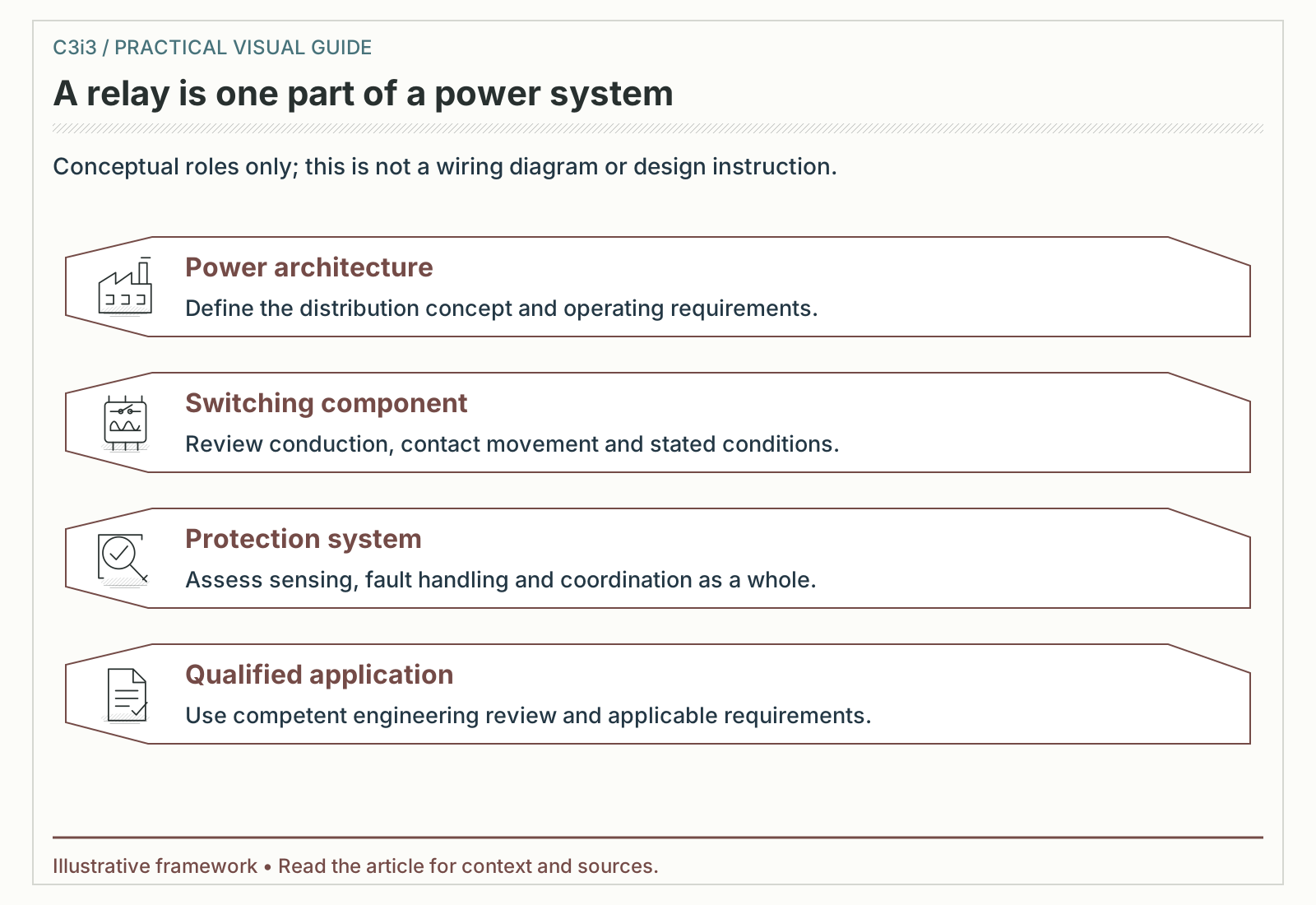
Power architecture: Define the distribution concept and operating requirements. Switching component: Review conduction, contact movement and stated conditions. Protection system: Assess sensing, fault handling and coordination as a whole. Qualified application: Use competent engineering review and applicable requirements.
What is PrimeSwitch’s role in this conversation?
Atomic Machines describes PrimeSwitch as an electromechanical relay and lists a 50 microsecond opening time. The page also presents current, resistance, isolation and packaging information. Those are manufacturer-stated characteristics, not independent test results from C3i3.
A relay is an electrically controlled switching component. Its usefulness depends on the required function and the surrounding system. A fast mechanical operation can be relevant to a protection architecture without, by itself, defining the complete interruption process.
Why must component and system claims stay separate?
The product page is a starting point for a technical discussion. It does not replace the complete documentation an integrator needs to assess the intended electrical conditions. Different ratings describe different aspects of behavior and cannot be combined into an unsupported maximum-performance claim.
For example, a statement about a contact opening, a statement about isolation and a statement about carrying current do not automatically establish interruption under every combination of voltage and fault current. The relevant documentation and qualified evaluation must address the actual use case.
Our interpretation is that PrimeSwitch gives the Matter Compiler story a concrete component to investigate. It does not prove that every prospective power-distribution application has been qualified or that a complete breaker can be assembled from the public headline alone.
How is opening time different from fault-clearing time?
Opening time concerns a defined switching action. Fault clearing concerns the system's response to a fault, including the events needed to detect the condition, make the protection decision and interrupt or otherwise manage the fault according to the architecture.
Those intervals may involve different sensors, logic, drivers and power devices. A published time for one component should be labeled with its actual definition. Do not place it at the end of a simplified diagram and call it the response time of the entire installation.
What should an educational timing graphic show?
Use separate labeled stages for detection, decision, actuation and the confirmed system outcome. Keep stages without verified values unnumbered. Such a graphic helps readers understand why a fast device can be valuable without claiming that every other stage disappears.
Texas Instruments' circuit-breaker resources identify sensing and high-speed comparison alongside switching components. This illustrates the broader functional context; it is not a design recommendation for an 800 V system or evidence of compatibility with PrimeSwitch.
A commercial comparison should therefore state the tested object and outcome. Was the result measured on a relay, a prototype protection assembly or a qualified subsystem? That difference determines what the figure can reasonably support.
Which questions belong in a component evaluation brief?
Compare ratings, operating conditions, test methods and availability separately. A system designer needs the complete application context before a component specification can support a selection.
| Claim category | Clarification needed | Document to request |
|---|---|---|
| Carrying current | Under which thermal and assembly conditions? | Current product specification |
| Switching time | Which event starts and ends the interval? | Test definition and conditions |
| Isolation | Which isolation characteristic is stated? | Applicable rating and test basis |
| Interruption | Which device or assembly performs it? | System evaluation evidence |
| Availability | Evaluation or production scope? | Current commercial terms |
The worksheet prevents a set of impressive numbers from becoming a claim the supplier never made. It also makes unanswered questions visible without treating an unknown as a product failure.
Who should own acceptance?
The responsible technical team defines the intended use and the evidence required for it. Procurement can coordinate documentation and terms, but a marketing article should not substitute for that assessment. The same applies to a comparison calculator or an AI-generated component recommendation.
Retain revision dates with the documents used in the decision. Early products and architecture specifications can develop over time. A favorable evaluation should identify the actual component, supporting information and system configuration it addressed.
Which ratings are most easily confused in a short article?
A continuous-current statement concerns the specified carrying condition. A switching statement concerns an operation under defined conditions. An isolation statement concerns a particular separation characteristic. A complete protection claim adds the behavior of the relevant assembly during the event it is intended to manage.
Preserve those categories in a specification summary. If the full documentation does not resolve a question, write “not established in the material reviewed” rather than combining adjacent numbers into a new rating. A comparison chart should also avoid giving an unspecified competitor an invented performance value.
Use the supplier's terminology and ask the technical reviewer to explain what each value permits the buyer to conclude. The aim is comprehension. It is not appropriate for a general business article to convert selected headline figures into construction guidance or a recommendation for a specific installation.
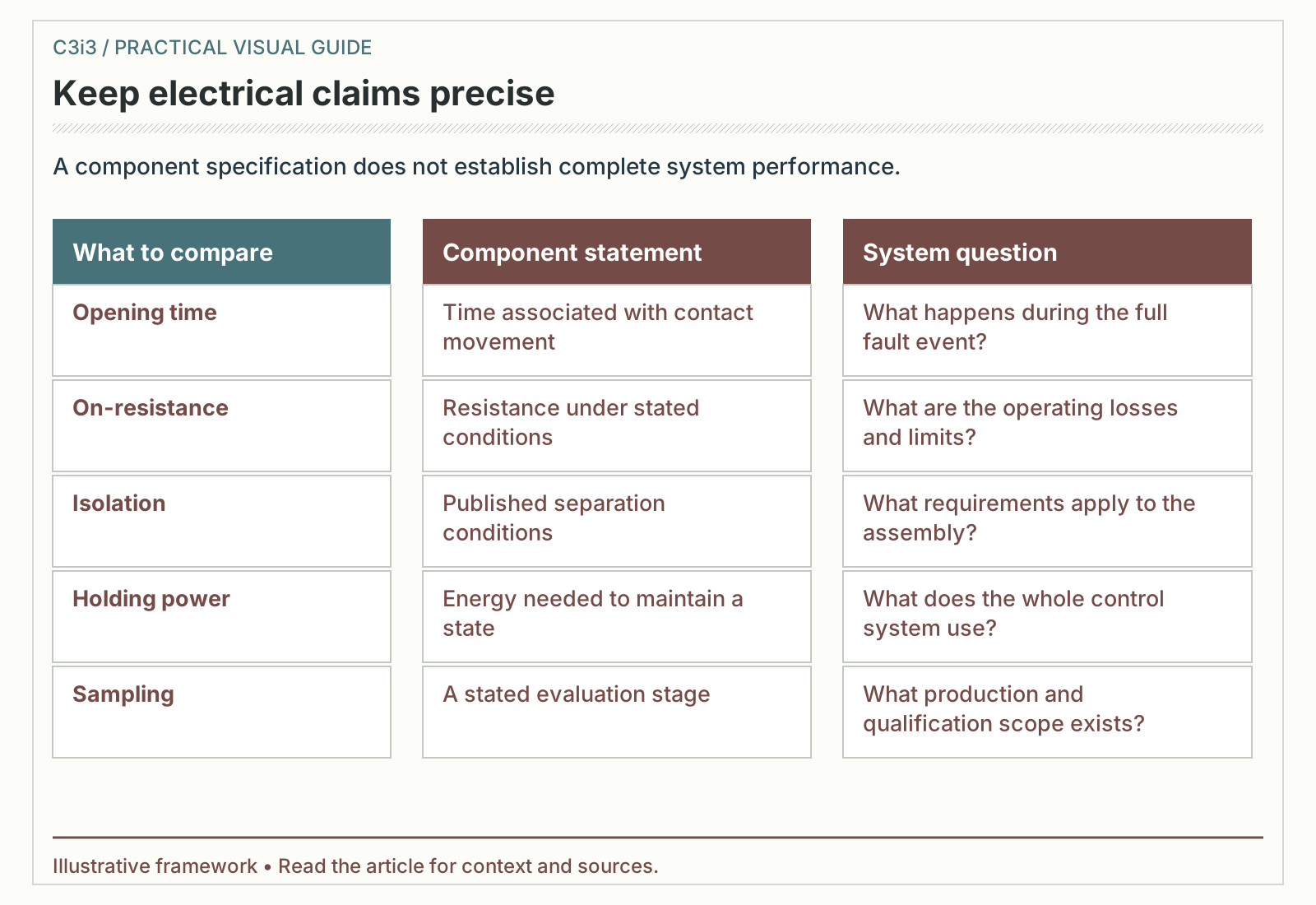
Opening time: Time associated with contact movement / What happens during the full fault event?. On-resistance: Resistance under stated conditions / What are the operating losses and limits?. Isolation: Published separation conditions / What requirements apply to the assembly?. Holding power: Energy needed to maintain a state / What does the whole control system use?. Sampling: A stated evaluation stage / What production and qualification scope exists?.
How do you distinguish an ecosystem announcement from a buying opportunity?
Separate four states: a concept described, a component available for evaluation, a subsystem offered for a defined application and an installed deployment with documented results. Each can be meaningful news, but each answers a different buyer question.
A roadmap date should remain an expected date until the relevant party confirms availability. Similarly, participation in a broad industry transition does not imply that every component bearing the same voltage language has been approved for every implementation.
What can a business do before broad deployment?
It can identify its proposed place in the value chain, learn the relevant interface requirements and prepare a focused evaluation conversation. It can also create technical content that explains the problem without claiming a finished offer before one exists.
An illustrative supplier brief might say: “We are assessing whether our component could support a particular switching function in a future distribution subsystem. We need to confirm the operating scope and evaluation requirements.” This is a clearer starting point than announcing that the component powers the next generation of AI factories.
For a reader following the Matter Compiler, this provides a useful research sequence: understand the architecture, identify the function, review the component and then assess the specific integration. It preserves the excitement of the development without skipping the work that makes it usable.
What would a well-scoped evaluation opportunity look like?
In a fictional procurement scenario, an integrator wants to learn whether a new relay merits a deeper application review. The first deliverable could be a documentation package and a technical discussion with the manufacturer. That is a legitimate milestone even before the organization requests a physical sample.
The receiving team can identify which questions are answered, which need confidential application details and which would require further evaluation. The resulting action might be to continue, postpone the inquiry until another product revision or conclude that the current offer does not match the proposed role.
This sequence keeps commercial enthusiasm connected to an actual decision. It also avoids asking a startup to provide an unconditional statement about a system it has not assessed. A supplier and an integrator can have a useful early conversation without pretending the full qualification work has already happened.
How should an emerging power product be explained on its website?
State the component category and intended audience early. An engineer, a system integrator and a business reporter should be able to distinguish a relay from a complete breaker or a facility power architecture before reading a specification table.
Link technical claims to the appropriate documentation. Give a concise definition of unfamiliar terms and preserve conditions beside the values they qualify. A chart should label its axes, comparison basis and measured object rather than relying on an unexplained “faster” annotation.
Which conversion should a product page invite?
An evaluation-stage product can invite an application discussion or a sample inquiry through the manufacturer's confirmed process. A documentation request should explain what information the applicant needs to provide and what the next conversation is intended to establish.
Keep editorial relationships accurate. This guide does not claim a commercial connection among Atomic Machines, NVIDIA, OCP or TI. It uses their public materials to explain a shared technical context and the differences between architecture-level and component-level evidence.
The strongest early product story helps the right reader ask a better question. It should make a promising device easier to assess, not suggest that reading a general article establishes suitability for an electrical installation.
Key takeaways
- Read 800 VDC announcements as architecture and ecosystem developments.
- Identify the specific function a component contributes.
- Keep relay opening time separate from full fault-clearing performance.
- Review ratings, conditions and revisions with qualified technical staff.
- Distinguish evaluation availability from a qualified production subsystem.
Key terms in this guide
- VDC
- Volts of direct-current electrical potential.
- Galvanic isolation
- Electrical separation without a direct conductive path.
- Fault clearing
- The overall system process of detecting, interrupting and isolating an abnormal electrical condition.
Frequently asked questions
Is PrimeSwitch a complete 800V data center circuit breaker?
The reviewed product page describes a relay. This article does not establish that it is a complete qualified protection subsystem for an arbitrary data center application.
Does 50 microseconds mean every fault is cleared in that time?
No. The manufacturer’s opening-time statement must not be substituted for the response of an entire sensing, control and interruption system.
Are all AI data centers already using 800V DC?
No universal migration is established here. The linked announcements describe a transition roadmap, interfaces and products at different stages.
Can this guide tell me which component is safe for my installation?
No. The intended application needs qualified engineering assessment and current documentation appropriate to its actual electrical and operating conditions.
Primary sources and editorial method
- NVIDIA: 800 VDC roadmap, August 2026
Vendor documentation or a dated announcement. Plans and targets remain attributed to the source.
- OCP: ecosystem and specification direction
Vendor documentation or a dated announcement. Plans and targets remain attributed to the source.
- Atomic Machines: PrimeSwitch specifications
Manufacturer product specifications and sampling status; consult complete application documentation.
- Texas Instruments: circuit-breaker functional resources
Vendor documentation or a dated announcement. Plans and targets remain attributed to the source.
Help people understand your technical product.

C3i3 helps technical businesses explain their products through manufacturing marketing strategy, technical content, websites and product demonstrations and creative campaigns.
Tell us what you are developing and who needs to understand it. For Matter Compiler access or PrimeSwitch evaluation, use Atomic Machines’ official contact route.