








































In this article
A future technology story can move quickly from “this could become possible” to “you can buy this now.” The difference matters when someone is budgeting, designing a product or preparing a launch.
This article is a dated evidence guide, checked November 18, 2026. It identifies the named product and supplies an original framework for evaluating additional claims. It is not an exhaustive inventory of private development work.
Product evidence becomes more useful when the terms are interpreted correctly. A small package, a fast movement and a current rating describe different properties. Combining them into one headline can conceal the application questions that an engineer or procurement team still needs answered.
Independent C3i3 research and analysis. Sources checked November 18, 2026. Read the sources and editorial method.
What is PrimeSwitch?
Atomic Machines’ product page describes PrimeSwitch as an electromechanical relay. The published specifications include 150 A continuous current, a 50 μs opening time, 200 μΩ on-resistance and a 9.5 mm diameter by 3 mm package. Availability is listed as sampling.
These are manufacturer statements. C3i3 has not independently measured them. A buyer should request the current datasheet and conditions associated with each specification before deciding whether to evaluate it.
Do not interpret a brief marketing table as a complete application design. The component’s intended role, integration requirements and evaluation procedure belong in a conversation with qualified technical staff. This article explains how to assess public evidence; it does not provide electrical design instructions.
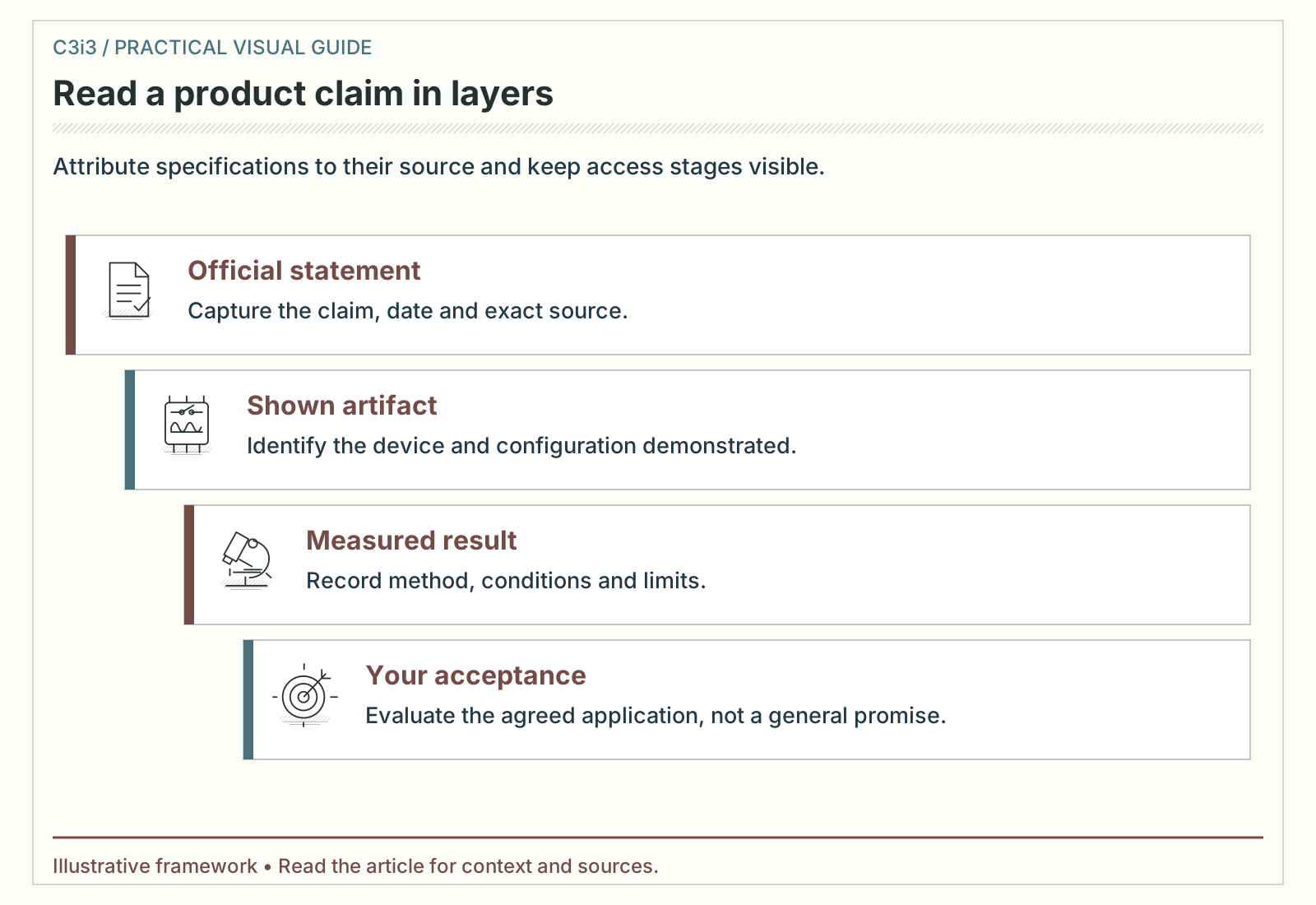
Official statement: Capture the claim, date and exact source. Shown artifact: Identify the device and configuration demonstrated. Measured result: Record method, conditions and limits. Your acceptance: Evaluate the agreed application, not a general promise.
What do the published relay specifications actually tell you?
Read a relay's ratings as separate statements, each with its own conditions. Continuous current concerns carrying current. Switching capability concerns making or breaking a connection under a specified load. Opening time describes a timing event. An isolation statement concerns separation, not every possible interruption scenario.
The product page's compact table is a starting point for reading a datasheet, not a complete application assessment. OMRON's general relay guidance explains that switching capability and durability depend on the load, ambient conditions and switching conditions. That general principle should inform the questions asked of any relay supplier.
| Category | Useful follow-up question |
|---|---|
| Continuous current | Under which stated thermal and connection conditions? |
| Opening time | Which timing definition and evaluation conditions apply? |
| On-resistance | How is it measured and how is change over use addressed? |
| Isolation | What separation and test conditions does the statement cover? |
| Switching duty | Which load and operating-life evidence supports the application? |
For example, do not treat a voltage associated with isolation as automatic proof of fault interruption at that voltage. Likewise, a no-holding-power statement does not by itself describe every energy requirement of operating the device. The responsible technical team should resolve these distinctions using current supplier documentation.
These are interpretation questions, not electrical design instructions. They make the research article more useful while leaving application approval with the people responsible for the equipment.
What does sampling tell a potential customer?
Sampling indicates a route to evaluating a product, but the label alone leaves important questions open. Who can participate? What documentation accompanies the device? What terms apply? What production commitment, if any, follows?
Ask the supplier to identify the next concrete step. It might be a technical discussion, an application review or another process it chooses. Confirm that process directly rather than assuming that a website label establishes eligibility or delivery.
A research article should preserve those distinctions. Reporting a sample program as general retail availability can mislead readers, even if the underlying product is real. The accurate answer may simply be that an interested team needs to ask about evaluation access.
How should a team record product readiness?
Keep the access stage and the intended use in the same record. A sample might be appropriate for an exploratory evaluation while production ordering, qualification or support arrangements remain unresolved. That is a normal distinction to investigate rather than a contradiction to hide.
Create a short product record with the exact name, document revision, stated availability and the question your team is assessing. Add what the supplier has agreed to provide and what your team must do after receiving it. Update the record when the configuration or documentation changes.
A useful next step should produce something reviewable: a clarified specification, an agreed evaluation scope or an explanation that the proposed application falls outside the current offer. Each outcome improves the decision. A meeting without any recorded clarification may create activity without reducing uncertainty.
The same approach works for later Matter Compiler announcements. Add a new device when a source identifies it, then describe the evidence associated with that device. Do not use a future application illustration to fill a missing product record.
Which applications remain possibilities?
In its company overview, Atomic Machines discusses prospective applications including tiny pumps, motors, medical devices and other mechanisms. We treat those examples as its vision for the platform, not as a verified current catalog.
A useful editorial label tells the reader which stage is being discussed. “Application idea” signals a possible use. “Prototype shown” requires evidence of a specific artifact. “Evaluation available” requires a stated access route. “Production available” needs a defined commercial offer.
Those labels are an original reporting framework, not terminology imposed by the company. Their purpose is to keep an exciting story understandable as new announcements arrive.
When a new application appears, ask what changed. Is there a new device, new performance evidence, a customer evaluation or an updated roadmap? The answer determines whether the old article needs a substantive revision.
How can you track evidence without mixing it with expectations?
| Record | What to capture | What it cannot establish alone |
|---|---|---|
| Official announcement | Claim, date and exact source | Independent verification |
| Demonstration | Device, conditions and observed result | Performance in every application |
| Technical documentation | Revision and stated limits | Your project’s acceptance |
| Evaluation discussion | Scope and unresolved questions | A production order |
| Your test | Method and measured outcome | Results outside the test conditions |
Assign someone to maintain the ledger. If a claim has no retrievable source, keep it out of customer-facing copy until it is resolved. If a source changes, retain the old note privately so the team understands why the public explanation changed.
The same discipline is useful for a startup evaluating any emerging technology. It lets engineering, management and marketing discuss the same evidence without making every person repeat the entire research process.
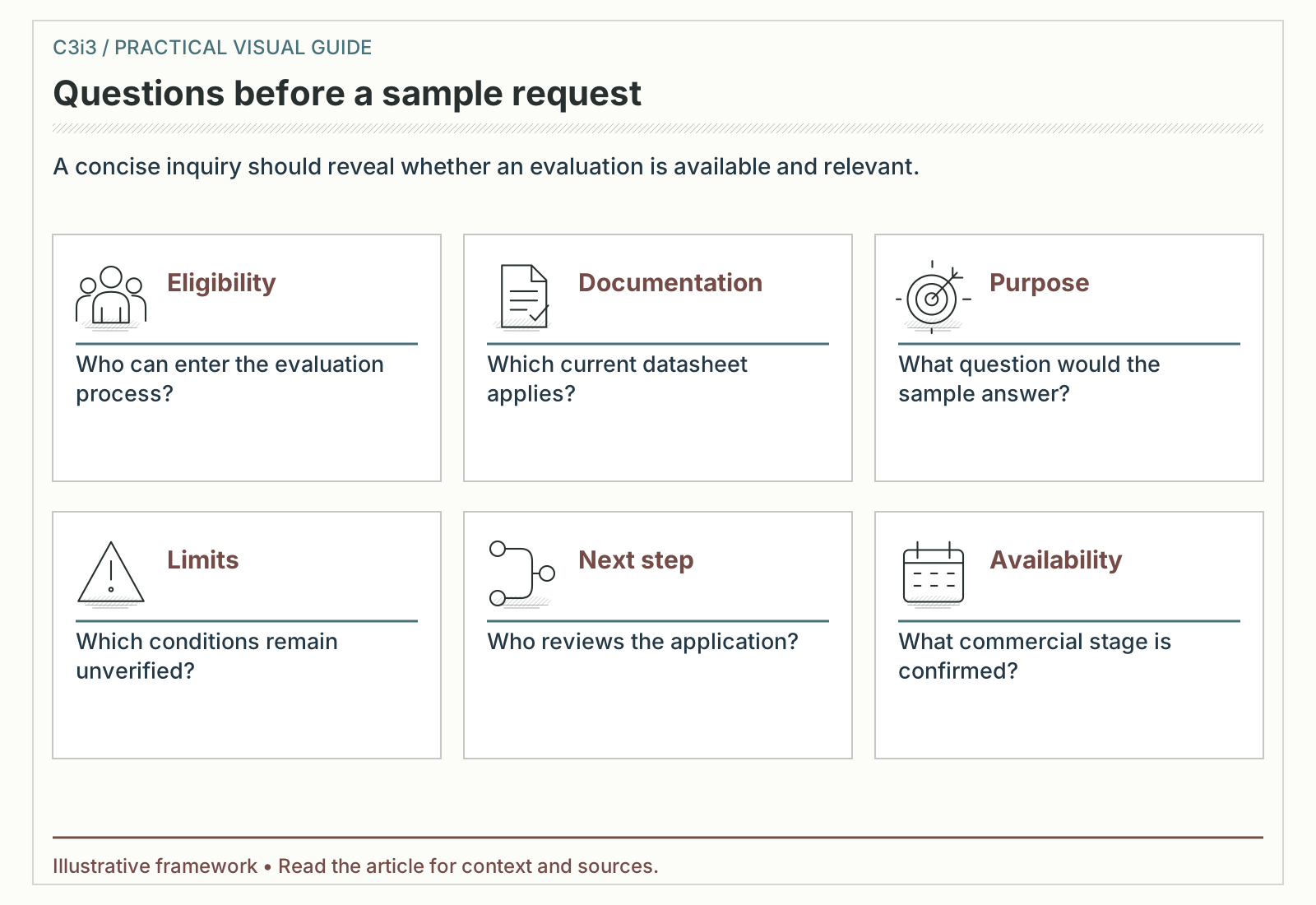
Eligibility: Who can enter the evaluation process?. Documentation: Which current datasheet applies?. Purpose: What question would the sample answer?. Limits: Which conditions remain unverified?. Next step: Who reviews the application?. Availability: What commercial stage is confirmed?.
How do you keep a current-product page accurate over time?
Use a dated source record for each product claim. Keep the relevant page or document revision, identify the wording your article relies on and note which part of the article would need attention if that information changed.
A useful correction explains the change rather than silently replacing a number. For example, if a manufacturer clarifies a measurement condition, update the description so readers understand which conclusion remains supported. If an access stage changes, revise the availability section and inquiry wording together.
Separate an editorial check date from a product release date. Checking a page today does not mean the device launched today. Likewise, an updated company vision is not automatically a new product announcement.
When a claim cannot be resolved, state the open question and link the reader to the responsible source. This keeps the page useful without filling the gap with an estimate. It also makes future additions easier: new evidence can replace a clearly identified uncertainty rather than being added to an increasingly confusing stack of announcements.
What should you ask before requesting a demonstration?
Start with your purpose. A press interview, an engineering evaluation and a partnership proposal need different information. Choose the route that fits what you actually want to learn.
- Which product or capability can be demonstrated today?
- What has been measured and under which conditions?
- What remains experimental or outside the current offer?
- What materials can be shared or reproduced publicly?
- What is the appropriate next step for this specific inquiry?
Use the official contact route. Prepare a concise question list and avoid sending a long speculative proposal before you know whether there is a suitable conversation.
After the discussion, write an accurate account of what was shown. A clear description of one demonstrated device is more useful than a sweeping statement that the platform can manufacture anything.
Key takeaways
- Start with the named product and its current official documentation.
- Attribute specifications to the manufacturer.
- Distinguish sampling, project suitability and production availability.
- Label future applications according to their actual evidence.
- Date updates and explain what new information changed the article.
Key terms in this guide
- Continuous current
- A current-carrying specification interpreted under the conditions stated by the manufacturer.
- On-resistance
- Resistance associated with the conducting path while the device is in its on state.
- Bistable
- Having two stable states. The term alone does not define every operating-energy requirement.
- Qualification
- Evaluation against the requirements and conditions relevant to an intended application.
Frequently asked questions
Does the website prove that every proposed device is available?
No. An illustrated application needs its own product, demonstration or access evidence before it can be described as currently available.
Can C3i3 provide a PrimeSwitch sample?
No. Product evaluation inquiries belong with Atomic Machines. C3i3 provides independent coverage and marketing services.
Why include open questions in a product article?
Open questions help readers decide what to verify next. They also keep an emerging technology story useful while its commercial offer develops.
Primary sources and editorial method
- PrimeSwitch official specifications
Primary source for the named product, published specification categories and sampling status.
- Atomic Machines company vision
Explains the company's larger mission and prospective applications. It is not a current product catalog.
- Contact Atomic Machines
Appropriate destination for technical documentation and evaluation access questions.
- OMRON: relay ratings and operating-condition context
Primary technical context supporting the linked discussion in this guide.
- OMRON: contact resistance terminology and measurement context
Primary technical context supporting the linked discussion in this guide.
Help people understand your technical product.

C3i3 helps technical businesses explain their products through manufacturing marketing strategy, technical content, websites and product demonstrations and creative campaigns.
Tell us what you are developing and who needs to understand it. For Matter Compiler access or PrimeSwitch evaluation, use Atomic Machines’ official contact route.