








































In this article
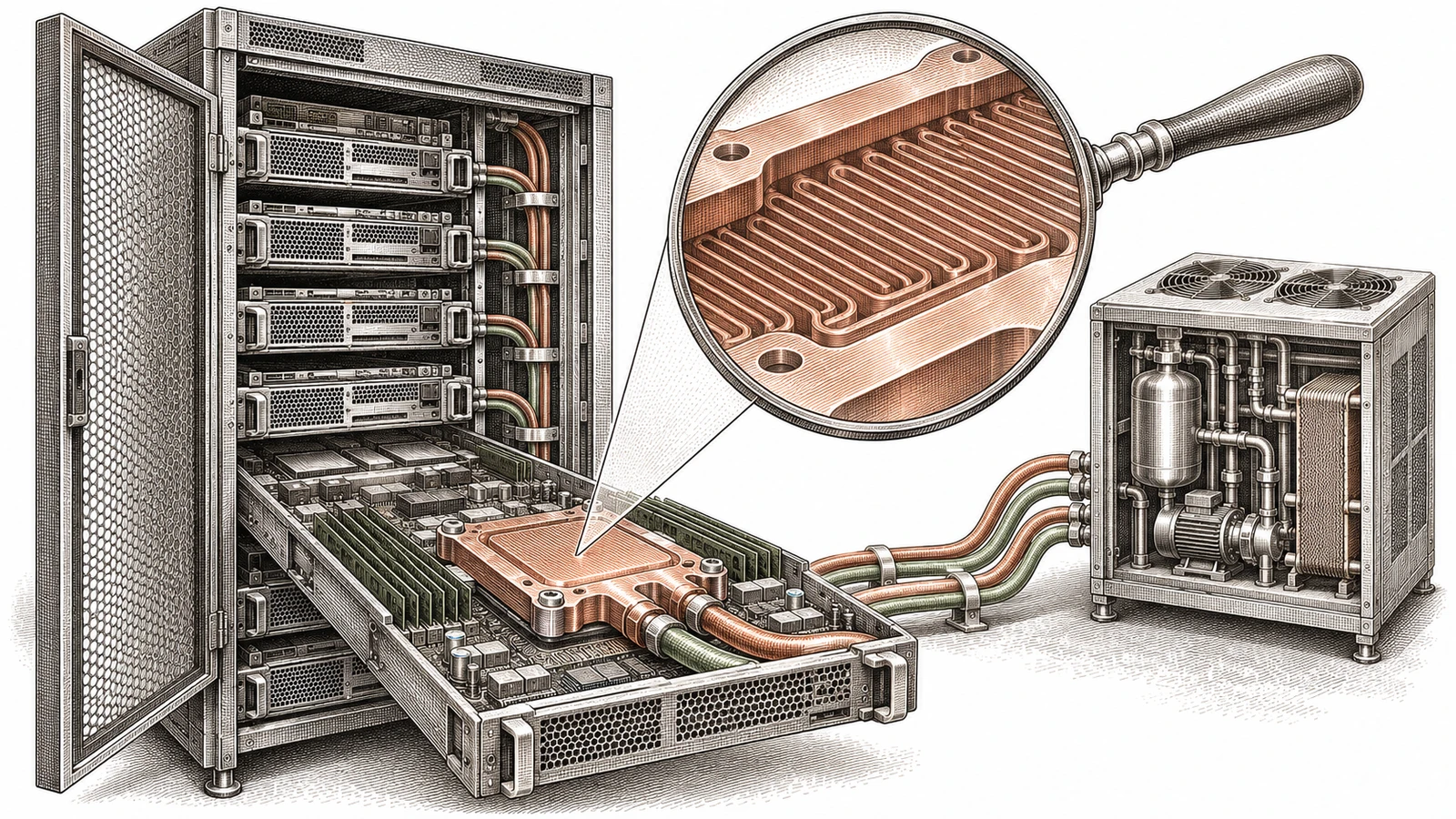
“Liquid cooling” can describe a cold plate mounted on a processor, a rack distribution system or research that brings fluid inside an electronic package. These are related approaches to moving heat, but their interfaces and commercial maturity differ.
This guide helps technical business readers understand those layers before evaluating an emerging product. It links current research with a practical system map. The Matter Compiler connection is a manufacturing question, not a claim that Atomic Machines supplies a cooling system or has partnered with the organizations cited here.
Independent C3i3 research and analysis. Sources checked November 18, 2026. Read the sources and editorial method.
Why does this topic matter now?
On October 7, 2026, researchers published a Nature Electronics study of embedded microfluidic chip cooling using a dielectric fluid. Their manifold design addressed how liquid replenishes heated areas and how vapor leaves the structure. The reported result belongs to a specific research apparatus and its test conditions.
Another 2026 study investigated direct-to-package cooling, placing microchannels in a package substrate. Together, the papers illustrate two different integration choices. They do not establish that the demonstrated architectures can be substituted into an arbitrary server.
What makes this a useful niche to follow?
The interesting question is where a cooling function moves closer to the source of heat and what that change demands from manufacturing, packaging and maintenance. Those questions are more precise than a broad claim that smaller pumps will solve data center cooling.
For a business evaluating an early technology, identify the layer being changed before comparing its performance. A chip-level research result and a facility cooling energy claim need different boundaries, methods and evidence. Keeping those levels distinct makes emerging developments easier to explain accurately.
How do facility loops, CDUs and cold plates fit together?
Begin with the route taken by heat. A cold plate collects heat from an electronic component into a fluid path. The technology cooling system connects IT equipment through tubing, connectors and manifolds. A coolant distribution unit, or CDU, manages an appropriate boundary with the rest of the cooling arrangement.
The Open Compute Project cold-plate work covers the technology cooling system from the cold plate to the CDU. Its CDU project focuses on integrating liquid distribution with data center facilities. These are useful resources for understanding the surrounding ecosystem.
Does every installation have the same arrangement?
No. “Liquid cooled” does not identify a complete architecture. An operator may be evaluating a particular rack, a retrofit or a wider facility design. The manufacturer must explain the actual interfaces and heat-rejection arrangement proposed for that installation.
In an illustrative diagram, draw the IT component, its local heat-transfer device, the equipment loop and the external destination of heat. Label the connection between each stage. Avoid a single blue arrow leaving a processor and disappearing off the page, because that conceals the system that must carry the heat away.
A product may improve one stage while depending on the capacity and controls of every other stage. A buyer therefore needs both the component specification and an explanation of how the component fits the system.
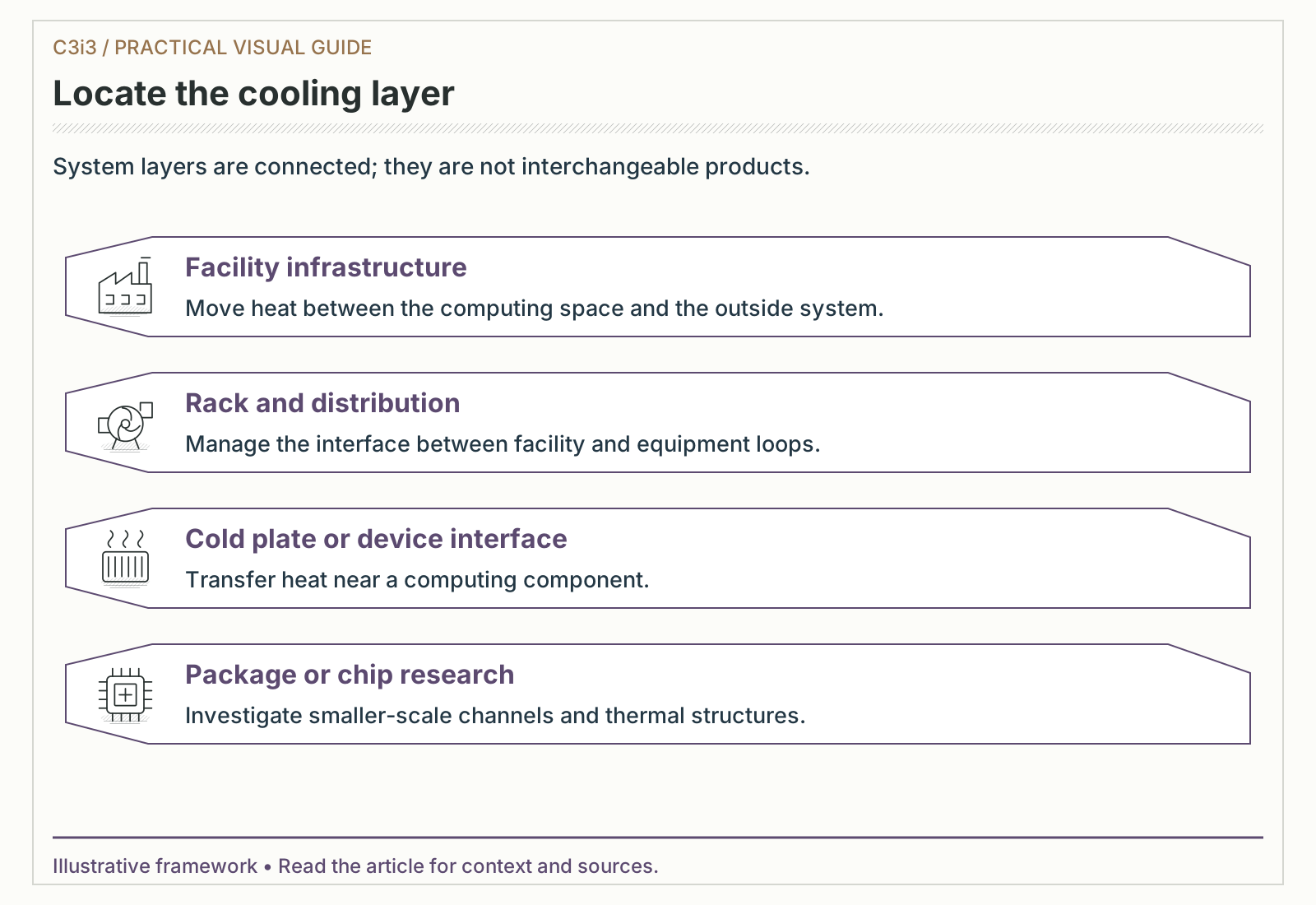
Facility infrastructure: Move heat between the computing space and the outside system. Rack and distribution: Manage the interface between facility and equipment loops. Cold plate or device interface: Transfer heat near a computing component. Package or chip research: Investigate smaller-scale channels and thermal structures.
How is embedded microfluidic cooling different from a cold plate?
A cold plate is a heat-transfer component associated with the electronic device. Embedded or co-packaged microfluidic approaches change where the channels are integrated. Their purpose is not simply to make the surrounding plumbing smaller; they alter the path between a heat source and the coolant.
That distinction creates different manufacturing and service questions. Which organization produces the channel structure? When does it become part of the assembly? Which interfaces can be inspected or replaced? What changes would require a package redesign instead of an ordinary equipment swap?
| Layer | Main question | Integration boundary |
|---|---|---|
| Facility | Where does the collected heat go? | Building infrastructure and operating plan |
| Rack or equipment loop | How is coolant distributed and controlled? | CDU, manifolds, connectors and equipment |
| Cold plate | How is component heat transferred locally? | Mounting, interface and fluid connection |
| Package microchannels | How is cooling integrated with packaging? | Package fabrication and assembly |
| Embedded chip channels | How is fluid brought into the chip structure? | Semiconductor processing and device design |
The table is an editorial organizing framework. It should not be read as a sequence every installation contains or as a product compatibility guide.
Why does the distinction matter commercially?
A supplier selling a replaceable cooling module and a company changing semiconductor packaging have different customers, qualification paths and service obligations. Their websites may use similar thermal imagery while describing fundamentally different offers.
Which thermal measurements belong beside a performance claim?
Start with the measured quantity and its boundary. Heat flux describes heat transfer per area. Temperature describes a state at a specified location. Thermal resistance relates a temperature difference to a heat flow under defined conditions. System energy use concerns a wider collection of equipment and operating assumptions.
These quantities cannot be swapped as marketing shorthand. A favorable local temperature result does not directly establish a proportional reduction in whole-facility electricity. A quoted maximum also needs its test configuration, coolant conditions and definition of an acceptable operating state.
What should a reader preserve from a research paper?
Record the apparatus, the comparison baseline and the conditions that define the result. Identify whether the device was a research test structure or a deployed production system. Then explain which design problem the experiment addressed without extending the result to untested applications.
For example, the direct-to-package paper reports laboratory thermal performance for its specific demonstration. A product team investigating that approach still needs to consider its own assembly, operating conditions and evaluation method. The paper is a research resource, not a quotation for the team's future product.
IBM's 2026 ARPA-E showcase description offers another example of careful reading: it describes cooling development goals and prototypes. A development target should remain labeled as a target when a third-party article summarizes it.
Why do inlet conditions belong in a comparison?
A heat-transfer device does not operate independently of the fluid entering it. A comparison must identify the relevant inlet state and the way the apparatus establishes it. Otherwise, two temperatures may look comparable on a chart while reflecting different starting conditions.
The same issue applies to the measured location. A reported fluid temperature, a case temperature and a junction-temperature estimate concern different points in the thermal path. Label the point and method in the figure caption. If one value is calculated from a model, identify it as a model-derived result rather than a direct sensor reading.
For an illustrative buyer review, place the test boundary on the system diagram and mark the observations taken inside it. Keep equipment outside the boundary visible enough to understand the setup. This helps the technical reviewer recognize which part of the larger operating story the experiment can answer.
Where could micro-machines help without replacing the whole system?
Potential micro-machine roles include local flow control, pumping or sensing where miniaturization has a defined purpose. The engineering value would depend on the function, the surrounding interfaces and the cost of incorporating the device. Smaller size alone does not establish a better cooling system.
Ask what the proposed mechanism changes. Does it control a local flow condition, create movement or provide a measurement that was previously impractical? Which part of the existing system would remain, and which new failure or maintenance question would appear?
What is the Matter Compiler connection?
Atomic Machines' platform materials identify thermal and fluidic possibilities. That makes manufacturing flexibility relevant to the discussion. The reviewed materials do not establish an available chip pump or data center cooling product, so application statements here remain possibilities.
A useful supplier inquiry would specify a function and an integration boundary. “We are investigating a flow-control function at this point in an assembly” is more actionable than “Can you make a better data center?” The answer may show that a mature component already fits the task or that the concept requires additional research.
Document the exact boundary in the commercial brief. A micro-device cannot be evaluated independently of the system it must serve, yet its supplier should not be described as delivering the whole system unless that is the confirmed offer.
What integration and maintenance questions should buyers ask?
Review the proposed product with the people responsible for thermal design, equipment integration and operation. Each sees a different part of the lifecycle. A feature that is attractive in a laboratory may introduce work elsewhere in the deployed system.
- Which coolant, interfaces and operating conditions are supported?
- How is compatibility with connected materials established?
- What can be inspected, monitored or replaced?
- How does the system identify an abnormal condition?
- Which organization owns commissioning and ongoing support?
These are planning questions, not installation instructions. The relevant specialists determine the required technical and safety assessment for the actual equipment.
How should a pilot preserve a fair comparison?
Choose a baseline and an operating scenario before comparing two approaches. Define where measurements will be taken and which changes are allowed between trials. If the surrounding apparatus changes, record that change rather than attributing every difference to the new component.
Include the maintenance scenario in the review. Ask how a fault is investigated and what must be removed to inspect the part. A sophisticated integrated structure may change the practical repair boundary, which should be understood before a business describes it as a drop-in replacement.
The first evaluation should conclude with a specific recommendation about the next development step, rather than a generalized declaration that liquid cooling has been solved.
How should service responsibility be recorded?
Imagine a prototype cooling assembly that combines a new local flow device with an existing loop. The team should record who supplies the local device, who assembles the connections and who evaluates the complete configuration. If an unexpected condition occurs, those boundaries determine which information each party needs to investigate it.
A commercial service plan should eventually address the same boundaries, but the pilot does not have to solve every future support question. It should identify them as open work. That is preferable to describing a component as maintenance-free simply because the experiment did not run long enough to encounter a service event.
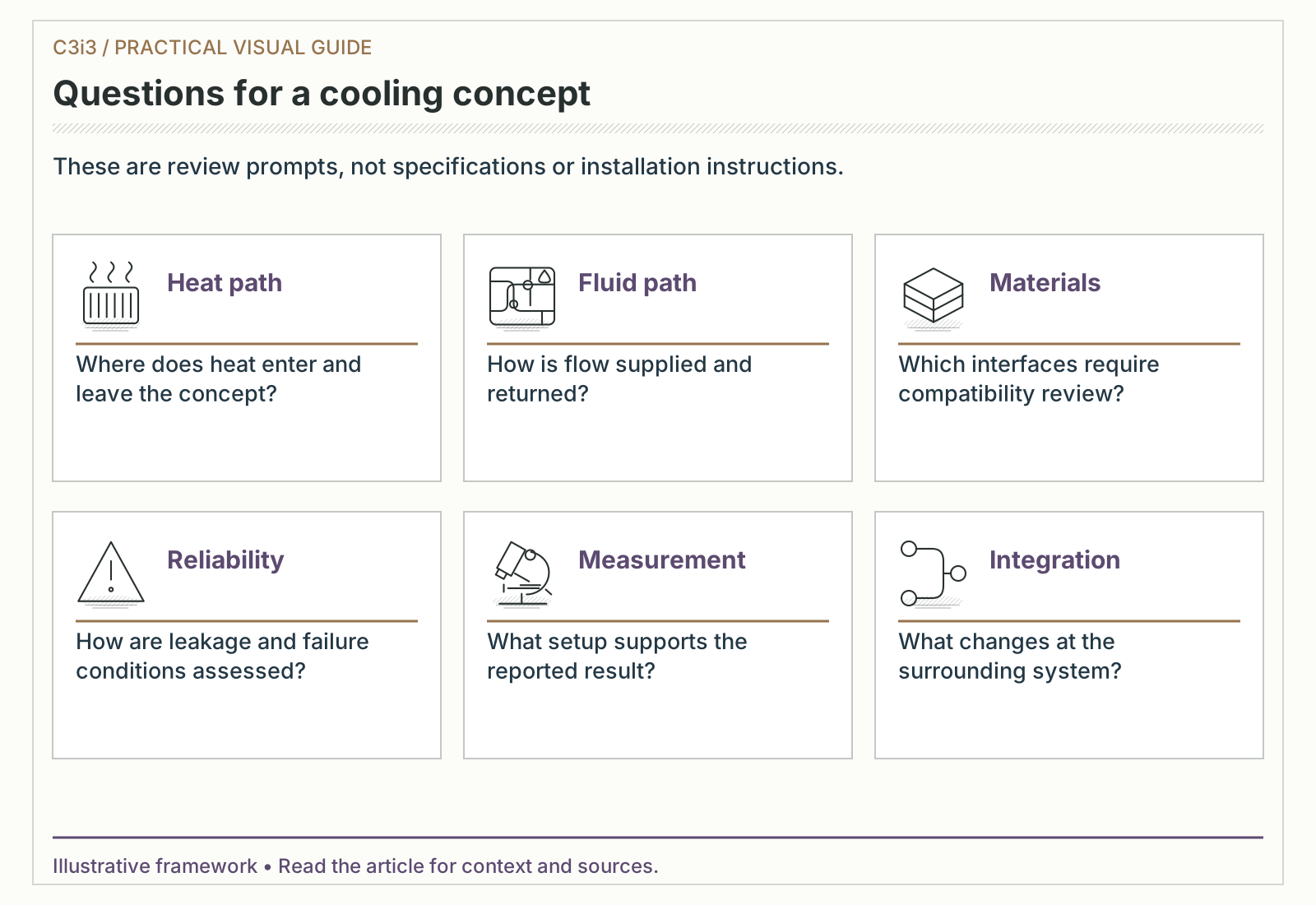
Heat path: Where does heat enter and leave the concept?. Fluid path: How is flow supplied and returned?. Materials: Which interfaces require compatibility review?. Reliability: How are leakage and failure conditions assessed?. Measurement: What setup supports the reported result?. Integration: What changes at the surrounding system?.
How should an emerging cooling company explain its offer?
Lead with the layer served and the buyer's decision. A page about a cold plate should explain the relevant component and its interfaces. A research platform page should identify the class of experiments it enables. A facility service page should describe the scope the operator can actually request.
Pair an understandable system diagram with technical resources. Keep units, conditions and limitations beside the claims they qualify. A reader should not have to locate a distant footnote to learn that a prominent percentage was a future development target.
What evidence is useful before a launch?
An original demonstration can show where heat enters and leaves a device, what was measured and why the configuration matters. A comparison table can help an integrator recognize the correct category. A technical interview can clarify availability and the next step for a specific application.
Separate independent research coverage from a vendor relationship. This article does not claim that Atomic Machines participates in the papers or products linked here. It examines a related manufacturing frontier and the questions that would make a future application meaningful.
A coherent product story lets the visitor decide whether to read, evaluate or inquire. It does not turn every promising cooling experiment into a claim that an orderable system is ready for their facility.
Key takeaways
- Identify the cooling layer before comparing technology claims.
- Separate component thermal results from facility energy use.
- Preserve research conditions and development targets in summaries.
- Evaluate interfaces and maintenance alongside thermal behavior.
- Investigate Matter Compiler applications without assuming a current cooling product.
Key terms in this guide
- Cold plate
- A component that transfers heat from electronics into a circulating coolant.
- CDU
- A coolant distribution unit that interfaces and manages parts of a liquid-cooling system.
- Embedded cooling
- Cooling structures integrated closer to or within a chip or package.
Frequently asked questions
Does liquid cooling mean the same thing as microfluidic cooling?
No. Liquid cooling covers multiple system architectures. Microfluidic approaches use small fluidic structures and may be integrated at different chip or package boundaries.
Can a laboratory heat-flux result predict an entire data center’s energy savings?
Not by itself. The measured quantity, baseline, operating conditions and system boundary must support the specific conclusion.
Does Atomic Machines sell the cooling products discussed here?
No such offer was verified in the reviewed sources. The research examples and the Matter Compiler are discussed as distinct developments.
What should a first cooling pilot compare?
Compare an agreed baseline and a specific proposed change under documented conditions, with qualified reviewers defining the measurements and acceptance criteria.
Primary sources and editorial method
- Nature Electronics: embedded cooling research, October 2026
Original research. Results apply to the paper’s apparatus and stated conditions.
- Communications Engineering: direct-to-package cooling, March 2026
Original research. Results apply to the paper’s apparatus and stated conditions.
- OCP: cold-plate ecosystem
Primary technical context supporting the linked discussion in this guide.
- OCP: CDU integration
Primary technical context supporting the linked discussion in this guide.
- IBM Research: 2026 cooling showcase and goals
Primary technical context supporting the linked discussion in this guide.
- Atomic Machines: platform application map
Manufacturer description of the platform and its stated ambitions.
Help people understand your technical product.

C3i3 helps technical businesses explain their products through manufacturing marketing strategy, technical content, websites and product demonstrations and creative campaigns.
Tell us what you are developing and who needs to understand it. For Matter Compiler access or PrimeSwitch evaluation, use Atomic Machines’ official contact route.