









































In this article
A remarkable technology does not automatically become an understandable offer. Potential buyers still need to know what it does, whether it is relevant to them and how to take the next step.
The Matter Compiler offers a timely case for exploring that communication problem. This article is C3i3’s analysis of potential launch practices, not a prediction of Atomic Machines’ business model or a claim that C3i3 represents the company.
A technical launch needs several kinds of proof because readers make several kinds of decisions. A founder may need the platform story, an engineer may need an application boundary and a purchaser may need an access process. The content plan should connect those decisions without asking one oversized page to answer everything equally.
Independent C3i3 research and analysis. Sources checked November 18, 2026. Read the sources and editorial method.
How could a working prototype change the product story?
A functioning demonstration can organize a story around a visible task. Begin with the customer’s problem, show what the device does and explain the evidence associated with that demonstration. The audience should understand why the observed behavior matters.
For a hypothetical new mechanism, the story might explain the constraint that prompted development and the question the prototype answered. That is more useful than a montage of impressive machinery without a buyer context.
Keep the limits beside the claim. If a demonstration concerns one configuration, say so. If a scene is a concept animation, label it. Marketing gains credibility when viewers can distinguish what was imagined, built and evaluated.
The founder’s origin essay provides context for Atomic Machines’ ambition. A company narrative and application evidence serve different purposes; a good launch gives readers a route to both.
What should you capture when recording a product demonstration?
Prepare a short proof brief before recording. State the question the demonstration addresses, identify the device version and list the conditions needed to interpret what viewers will see. Agree on which materials can be shared and who approves the technical explanation.
Record the context around the visible action. A close-up can show movement but conceal how the device is connected or what triggers the action. A wide view can establish the setup but hide the relevant detail. Plan complementary views and captions so the audience can understand both.
Keep an unambiguous relationship between the recording and the claim. If an animation explains an intended operation, label it as an animation. If a sequence combines footage from different configurations, explain the distinction. Do not allow an edit made for visual continuity to imply one uninterrupted test.
After recording, preserve the approved description with the asset. Include the source, version and review date in the working record. This makes later reuse in articles, short videos and sales presentations more reliable. It also reduces the chance that a useful demonstration is separated from the conditions that made it meaningful.
The result is a reusable communication asset with a clear purpose. Its value comes from helping a reader understand a specific result, not from making the broadest possible claim about the technology.
What should an emerging technology launch website explain?
- Audience: identify who should investigate the offer.
- Problem: explain the obstacle in the audience’s language.
- Evidence: link the relevant documentation or demonstration.
- Availability: state the access stage accurately.
- Next step: explain what happens after an inquiry.
Give each page a job. A platform introduction can orient readers. A product page can explain a specific device. A technical resource can preserve details that would overwhelm the introduction. A contact route can identify the type of conversation being requested.
A founder, an engineer and a reporter may arrive with different questions. Navigation should let each find relevant information without forcing everyone through the same sales narrative. That is an information design problem as much as a copywriting problem.
C3i3’s manufacturing marketing strategy work begins with those audiences and decisions.
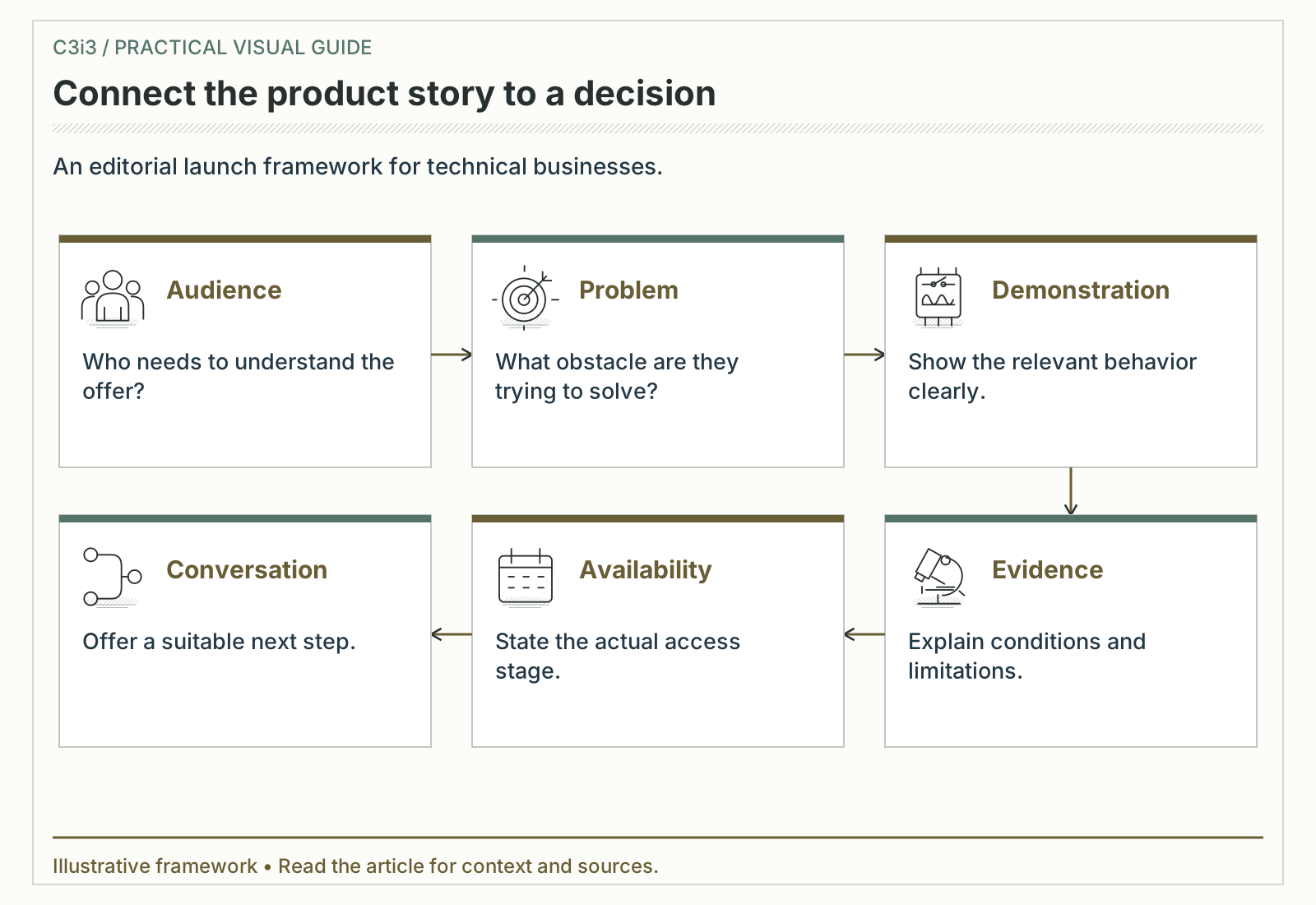
Audience: Who needs to understand the offer?. Problem: What obstacle are they trying to solve?. Demonstration: Show the relevant behavior clearly. Evidence: Explain conditions and limitations. Availability: State the actual access stage. Conversation: Offer a suitable next step.
Which content should support the launch?
Build a compact set around distinct decisions. An explainer introduces the subject. A comparison helps a reader evaluate alternatives. An evidence guide identifies what is available. A technical interview can resolve questions that public summaries leave open.
Link those pieces according to the reader’s next question. Someone learning the term may need the overview. Someone preparing an evaluation needs current documentation and access information. Repeating the same introduction across several keyword variations adds little.
For the Matter Compiler, our current capabilities guide and vibe manufacturing workflow serve different purposes. One organizes evidence; the other helps a team prepare a useful brief.
A launch library can also include a captioned demonstration, an application interview and a concise terminology page when those formats answer real questions. Choose the format after identifying what the reader needs to understand.
How should a launch content matrix connect questions with evidence?
Start with the audience's decision, then choose the page or asset that can support it. This keeps the plan organized around usefulness rather than a target number of articles.
| Reader question | Content element | Evidence or context |
|---|---|---|
| What is the idea? | Platform explainer | Defined scope and terminology |
| What can I evaluate? | Product or capabilities page | Current documentation and availability |
| Why choose this approach? | Comparison guide | Equivalent requirements and exclusions |
| What was demonstrated? | Captioned video or case account | Configuration, conditions and observed result |
| What happens next? | Inquiry page | Recipient, process and realistic expectation |
Give each asset an owner and a source record. If the product documentation changes, identify which explainer, comparison and demonstration caption must be reviewed. That connection is especially useful when a technical offer is developing quickly.
A good matrix also shows gaps. The team may have an excellent platform explanation but no clear description of evaluation access. Publishing more thought leadership would not resolve that missing buyer step. Conversely, a detailed product specification may still need an accessible explanation of the problem it addresses.
For independent coverage such as this C3i3 series, the matrix has a different commercial destination. The product inquiry belongs with Atomic Machines, while an agency inquiry concerns C3i3's communication services. Keeping those routes explicit helps the reader choose the right conversation.
How does this become lead generation?
A useful article can attract someone with a relevant problem. Lead generation begins when that person knowingly asks an appropriate business for help and the business can respond.
For C3i3, the relevant offer is strategy, websites, technical content and launch communication for emerging technology businesses. Product evaluation questions about Atomic Machines should go to its official contact page. This site is not an authorized supplier or sample-request intermediary.
A suitable agency invitation might ask: “Launching a technical product? Tell us who needs to understand it and what you need them to do next.” That invitation matches the article and the service the reader can actually request.
Rank and rent would be a separate commercial arrangement in which an owned website or its leads are leased to a business. Publishing independent coverage does not create that arrangement. Any future referral program would need a real partner, clear scope and an accurate explanation to visitors.
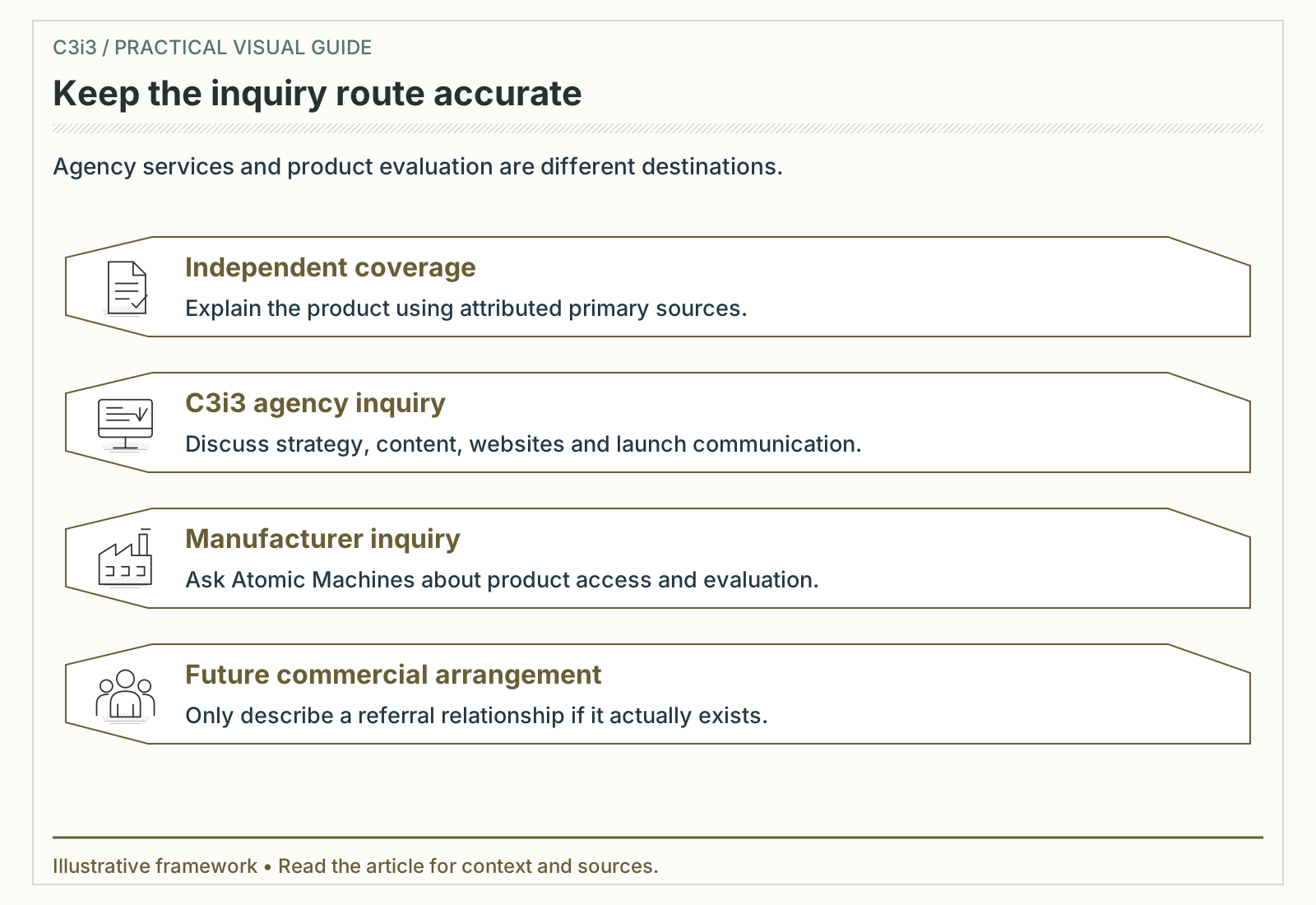
Independent coverage: Explain the product using attributed primary sources. C3i3 agency inquiry: Discuss strategy, content, websites and launch communication. Manufacturer inquiry: Ask Atomic Machines about product access and evaluation. Future commercial arrangement: Only describe a referral relationship if it actually exists.
What should a team measure after publishing?
Track discovery, engagement and inquiries as separate stages. A page can earn visits without producing relevant conversations. A lower-volume technical article can still be useful if it reaches people with the right problem.
Record which page introduced an inquiry, what help the visitor requested and whether that request matched the available service. Review the reasons behind mismatches. They may reveal confusing availability language, an unclear audience or a call to action that promises the wrong next step.
For search visibility, Google’s AI search guidance emphasizes existing SEO fundamentals, discoverable text and internal links. It does not promise indexing or inclusion. No article can guarantee a citation simply by covering a new product early.
Use observed questions to improve the library. Add a substantive update when new evidence arrives, then explain what changed. Avoid changing the displayed date merely to make an old article appear newly researched.
Which launch elements need review when the product changes?
Maintain a short dependency list for each important claim. A change to product scope can affect the overview, comparison table, demonstration caption, FAQ and inquiry page. Reviewing those elements together helps keep the visitor journey coherent.
Give updates an identifiable reason. A new demonstration, revised document or clarified access process can justify a substantive revision. State what changed and retain the original publication date so readers can distinguish the article's history from its latest research check.
Review reused media too. A video excerpt may continue to circulate after the surrounding article is updated. Its caption and destination should still help the viewer understand the configuration and current offer.
This turns launch publishing into a maintained body of useful information. Each improvement strengthens the connection between a reader's question, the available evidence and the business conversation the website invites.
Key takeaways
- Build the launch story around a buyer’s problem and visible evidence.
- Make the product’s access stage and next step explicit.
- Give each article a distinct reader decision.
- Connect agency inquiries to services the agency actually provides.
- Judge publishing by relevant conversations as well as discovery.
Key terms in this guide
- Content matrix
- A map connecting reader questions with the content and evidence needed to answer them.
- Proof brief
- A working note describing the claim, context and material required for an accurate demonstration account.
- Availability stage
- The current access status of an offer, such as research, evaluation or a defined commercial service.
- Qualified inquiry
- An inquiry whose need and requested next step fit the receiving business's actual offer.
Frequently asked questions
Can this category generate C3i3 leads?
It can support that goal by reaching technical businesses that need launch communication. Actual results depend on the audience, content, offer and follow-up; no volume is promised.
Is the category already a rank-and-rent business?
No. It is currently an editorial category on the C3i3 website. Leasing a site or leads would require a separate defined arrangement.
Does C3i3 have a partnership with Atomic Machines?
No commercial relationship is claimed. This coverage is independent and based on publicly available primary sources.
Primary sources and editorial method
- Atomic Machines origin story
Primary company narrative that explains the founder's ambition. It is different from application performance evidence.
- Official product inquiry route
Official product and access inquiry route, separate from C3i3 agency inquiries.
- Google: AI features and websites
Google's guidance on ordinary SEO fundamentals, accessible text, internal links and matching structured data for AI search features. Inclusion is not guaranteed.
Help people understand your technical product.

C3i3 helps technical businesses explain their products through manufacturing marketing strategy, technical content, websites and product demonstrations and creative campaigns.
Tell us what you are developing and who needs to understand it. For Matter Compiler access or PrimeSwitch evaluation, use Atomic Machines’ official contact route.