








































In this article
Writing a sentence and receiving a working object is an appealing idea. It makes manufacturing feel closer to creating a document or a piece of software. Yet a physical device must meet conditions outside the conversation that described it.
In this article we use “vibe manufacturing” as an informal editorial term for that shift toward intent-driven creation. The practical question is what a team must specify and verify as AI takes on more of the design workflow.
A useful prompt starts a conversation; a useful specification preserves what the team agreed. The second document matters because fabrication, integration and evaluation may involve different people at different times. They need a shared description that can be checked rather than a remembered impression of the original idea.
Independent C3i3 research and analysis. Sources checked November 18, 2026. Read the sources and editorial method.
How does the Matter Compiler connect to intent-driven manufacturing?
The official platform description links design, simulation, fabrication and measurement, with prompt-to-product as its ambition. That creates a useful way to discuss the Matter Compiler without treating the imagined end state as a public self-service feature.
A prompt can communicate an intention: make a mechanism smaller, reduce the effort of an operation or explore a different geometry. A requirements brief explains what the result must do and how someone will judge it.
Those are different kinds of information. A team can use conversational tools to explore its intention, then convert the discussion into requirements that are specific enough for expert review. The value of the first conversation depends partly on the quality of that transition.
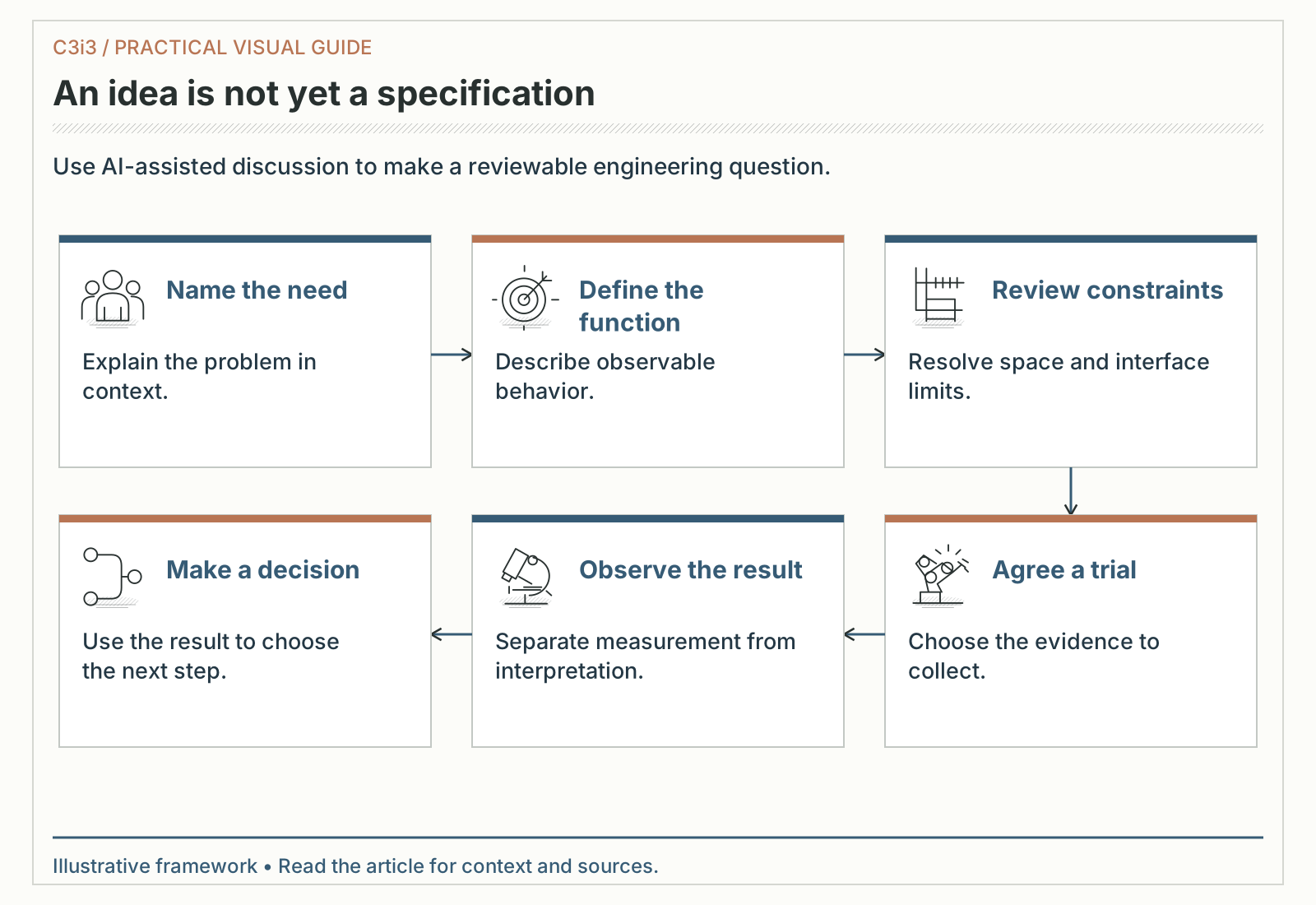
Name the need: Explain the problem in context. Define the function: Describe observable behavior. Review constraints: Resolve space and interface limits. Agree a trial: Choose the evidence to collect. Observe the result: Separate measurement from interpretation. Make a decision: Use the result to choose the next step.
What should a useful manufacturing brief contain?
Start with function. Describe the action the device must perform and the situation in which it will operate. Explain the constraint that makes the existing approach inadequate. Include the context needed to assess the problem without assuming a particular solution.
Then describe interfaces, scale and acceptance. What connects to the device? Which space must it occupy? What result would justify another development step? Keep an unknown visible instead of filling it with an invented requirement.
An illustrative brief might read: “We want to evaluate a compact mechanism for a constrained assembly. Our first question is whether the required movement is feasible within the proposed envelope. We need a technical discussion before selecting materials or a fabrication route.” This is a hypothetical research request, not a claim that the platform accepts that job.
The brief should also identify a responsible reviewer. A fluent explanation does not establish that the proposed device makes engineering sense. The reviewer determines what evidence is needed next.
How do you turn a vague idea into a reviewable specification?
Consider this illustrative request: “Make a tiny mechanism that moves a marker.” It communicates a concept, but it leaves the purpose and acceptance unclear. A better next step is to ask what the marker must show, where the assembly fits and how someone will tell whether it worked.
A reviewable early specification might say: “We are investigating a compact mechanism for a noncommercial demonstration. Its purpose is to move a visible marker between two defined positions within the proposed assembly. The first review will assess the movement and fit. Material selection, manufacturing route and production use remain unresolved.” This is a hypothetical brief, not a claim of an available Matter Compiler service.
| Brief element | Question to resolve |
|---|---|
| Purpose | What decision should the demonstration support? |
| Function | What observable action must occur? |
| Interface | What attaches to or interacts with the mechanism? |
| Context | Which conditions matter to this first evaluation? |
| Acceptance | Who will review the result and what will they examine? |
The improvement is not simply more detail. The brief now separates a known purpose from unresolved design choices. It allows a specialist to identify the next useful question without pretending the customer has already solved the engineering problem.
AI can help organize these questions and identify contradictions in the draft. The responsible team still needs to decide which requirements are justified and which assumptions need investigation.
What would a responsible idea-to-evidence workflow look like?
- Define the question. State the uncertainty that prevents a decision.
- Review the requirements. Resolve obvious ambiguities with the responsible specialists.
- Select an experiment. Choose a deliverable that could answer the question.
- Agree on evaluation. Identify the method, reviewer and acceptance condition.
- Record the result. Keep observations separate from interpretation.
- Decide the next step. Continue, revise the brief or stop based on the evidence.
This is C3i3’s planning framework, not a description of Atomic Machines’ internal operations. It is useful because it gives the human team an accountable role throughout an increasingly automated process.
Notice that the workflow starts with a question and ends with a decision. The manufactured artifact sits between them. That keeps a team focused on learning rather than accumulating prototypes that have no agreed purpose.
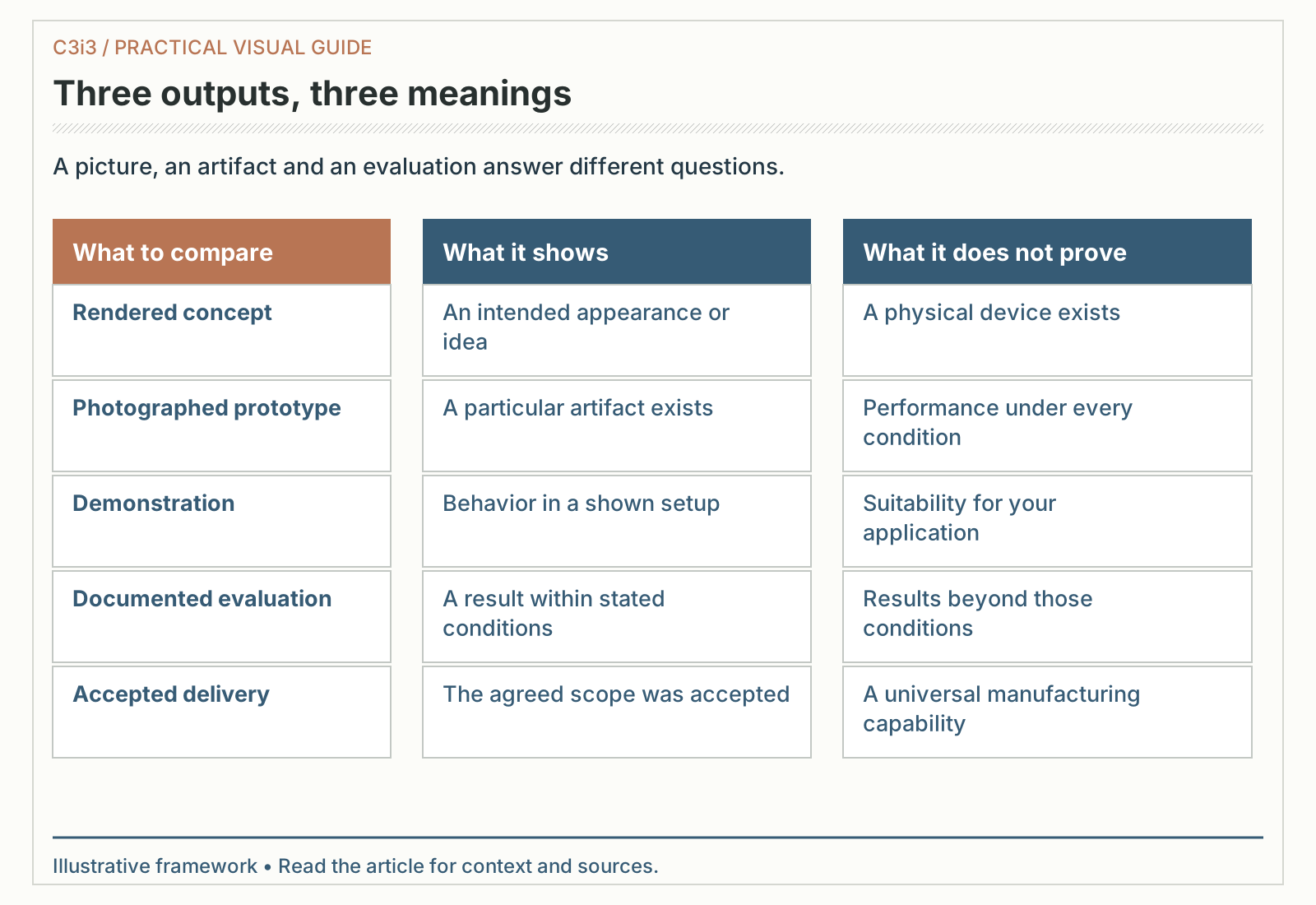
Rendered concept: An intended appearance or idea / A physical device exists. Photographed prototype: A particular artifact exists / Performance under every condition. Demonstration: Behavior in a shown setup / Suitability for your application. Documented evaluation: A result within stated conditions / Results beyond those conditions. Accepted delivery: The agreed scope was accepted / A universal manufacturing capability.
What should stay in the record as the idea changes?
Keep three records connected: the requirement, the design version and the observation. The requirement explains the intended result. The design version identifies what was evaluated. The observation records what happened under the stated conditions.
Then add an interpretation separately. “The marker reached the second position during this trial” is an observation. “The mechanism is ready for every planned use” is a broader conclusion that the observation may not support. Separating the two prevents an enthusiastic summary from erasing the limits of the experiment.
When a change is proposed, identify which requirement it serves. A modification that improves appearance may not address a functional problem. A change that resolves fit may alter another interface. Recording the reason for the revision helps the team decide which earlier results remain relevant.
This is also a useful bridge to future automation. A clear record gives a human reviewer or software tool context about what changed and why. A collection of disconnected prompts, images and files is much harder to interpret reliably after the original conversation has ended.
What changes when the output becomes physical?
A digital preview can be revised while a meeting is still underway. A physical experiment introduces a different relationship between proposal and observation. The team needs to know what was made, which version it represents and how it behaved.
Maintain a revision identifier across the brief, design files, evaluation notes and public images. If a later configuration changes, the earlier result should not automatically travel with it. This is a practical communication recommendation rather than a claim about any one manufacturing system.
Separate an image from an artifact and an artifact from a test result. A rendered concept communicates appearance. A photographed prototype shows an object. A documented evaluation supports a defined conclusion. All can be useful, provided the caption tells the reader what they are seeing.
For more on comparing the deliverables themselves, see Matter Compiler vs. 3D printing.
What can founders and small teams do now?
Prepare the problem before committing to a process. List the assumptions that would make the idea commercially useful, then identify which require customer research and which require technical evaluation.
A manufacturing experiment cannot establish that buyers want the product. A positive customer interview cannot establish that the mechanism can be built. Keep these research tracks connected without treating them as substitutes.
A small team can make progress by writing a clear use case, preparing an evidence list and asking a focused access question. It can also document its learning publicly, provided it has permission to share the material and accurately identifies what remains uncertain.
That is a constructive way to participate early. It creates a foundation for a later product decision while keeping the next step proportionate to what is actually known.
How should a small team handle assumptions it cannot yet resolve?
Keep an assumption register alongside the brief. For each uncertain statement, record why it matters, who can help resolve it and which decision depends on the answer. Avoid giving an assumption the same status as an agreed requirement.
In the illustrative marker mechanism, available space might be a fixed condition while material choice remains open. A team that records both as settled could unnecessarily narrow the design. A team that records both as optional could ask for something that never fits the intended assembly.
Review the register before the next experiment. Resolve the assumptions that could make its result irrelevant, then identify the uncertainty the experiment is actually intended to reduce. This gives limited time and resources a clearer purpose.
The register also improves a conversational AI workflow. Instead of asking a tool to infer missing facts, provide the known constraints and ask it to preserve the unresolved questions. The resulting draft can support expert review without disguising uncertainty behind confident prose.
Key takeaways
- Use conversational AI to clarify intent, then create a reviewable brief.
- Define acceptance before requesting a physical experiment.
- Keep revision, observation and interpretation connected.
- Label renderings, prototypes and tested results accurately.
- Evaluate customer demand and technical feasibility as related questions.
Key terms in this guide
- Design intent
- The purpose and reasoning behind a proposed design, including what it is meant to accomplish.
- Interface
- A connection or interaction between the device and another part of its environment.
- Observation
- What was recorded during an evaluation, distinguished from the conclusion drawn from it.
- Requirement traceability
- The ability to connect a design choice or evaluation result to the requirement it addresses.
Frequently asked questions
Is vibe manufacturing an industry certification?
No certification is asserted here. We use the phrase as informal shorthand for an emerging direction in AI-assisted physical creation.
Does this mean engineers are no longer needed?
This guide does not support that conclusion. Requirements, evaluation and accountability still need responsible people with relevant expertise.
Can I start with an idea instead of a finished design?
You can prepare an idea brief and ask a prospective partner what it needs. Whether a particular provider can accept that stage of work must be confirmed directly.
Primary sources and editorial method
- Matter Compiler platform and stated goal
Official source for the manufacturer's prompt-to-product ambition. The worked brief is C3i3's illustrative framework.
- Atomic Machines’ explanation of its micro-machine focus
Explains the manufacturer's micro-machine focus and identifies its application grid as illustrative rather than a catalog.
- Autodesk: objectives and manufacturing constraints in generative design
Vendor documentation or a dated announcement. Plans and targets remain attributed to the source.
Help people understand your technical product.

C3i3 helps technical businesses explain their products through manufacturing marketing strategy, technical content, websites and product demonstrations and creative campaigns.
Tell us what you are developing and who needs to understand it. For Matter Compiler access or PrimeSwitch evaluation, use Atomic Machines’ official contact route.