









































In this article
“Is this the next 3D printer?” is a natural question about the Matter Compiler. It is also too broad to guide a purchase. A tabletop concept model, a metal component and an integrated device create different requirements.
This comparison helps founders, product designers and marketing teams prepare a useful supplier conversation. It is a research framework, not a performance benchmark. For the platform introduction and access overview, start with our Matter Compiler guide.
Keep both the input and the output consistent when comparing proposals. A supplier receiving a finished design is taking on a different task from one being asked to develop the design. A quote for a bare part is different from a quote for an evaluated assembly. Making those boundaries visible is the beginning of a fair comparison.
Independent C3i3 research and analysis. Sources checked November 18, 2026. Read the sources and editorial method.
What should you compare first: a part or a working device?
NIST describes additive manufacturing as building parts layer by layer. Atomic Machines presents the Matter Compiler around producing functional micro-machines through multiple processes. That framing explains the comparison without proving that either is better for your job.
Define the deliverable first. “A prototype” could mean a visual model for a presentation, an object that checks packaging dimensions or a mechanism that operates under specified conditions. Each version answers a different question.
If the purpose is to test how customers understand an enclosure, a functional internal mechanism may add little to that study. If the purpose is to verify movement inside a constrained space, a beautiful nonworking model may answer almost nothing. Match the artifact to the uncertainty you need to resolve.
What belongs in a fair comparison worksheet?
| Decision | Question | Evidence to request |
|---|---|---|
| Output | What exactly arrives? | Delivery specification and exclusions |
| Function | What must it do? | Agreed acceptance method |
| Materials | Which combinations are supported? | Current material and process documentation |
| Integration | What work follows fabrication? | Assembly, inspection and interface requirements |
| Access | Can this job be accepted now? | Written scope, terms and timing |
| Change | What happens after a revision? | Updated quote and revalidation requirements |
Send the same requirements to each candidate. If one proposal includes inspection and another excludes it, compare them after making that difference explicit. A technology label cannot normalize unequal scopes.
Mark an unanswered item as unknown. Giving an unknown a favorable score merely converts enthusiasm into a spreadsheet number. The purpose of the worksheet is to identify what must be learned before a decision.
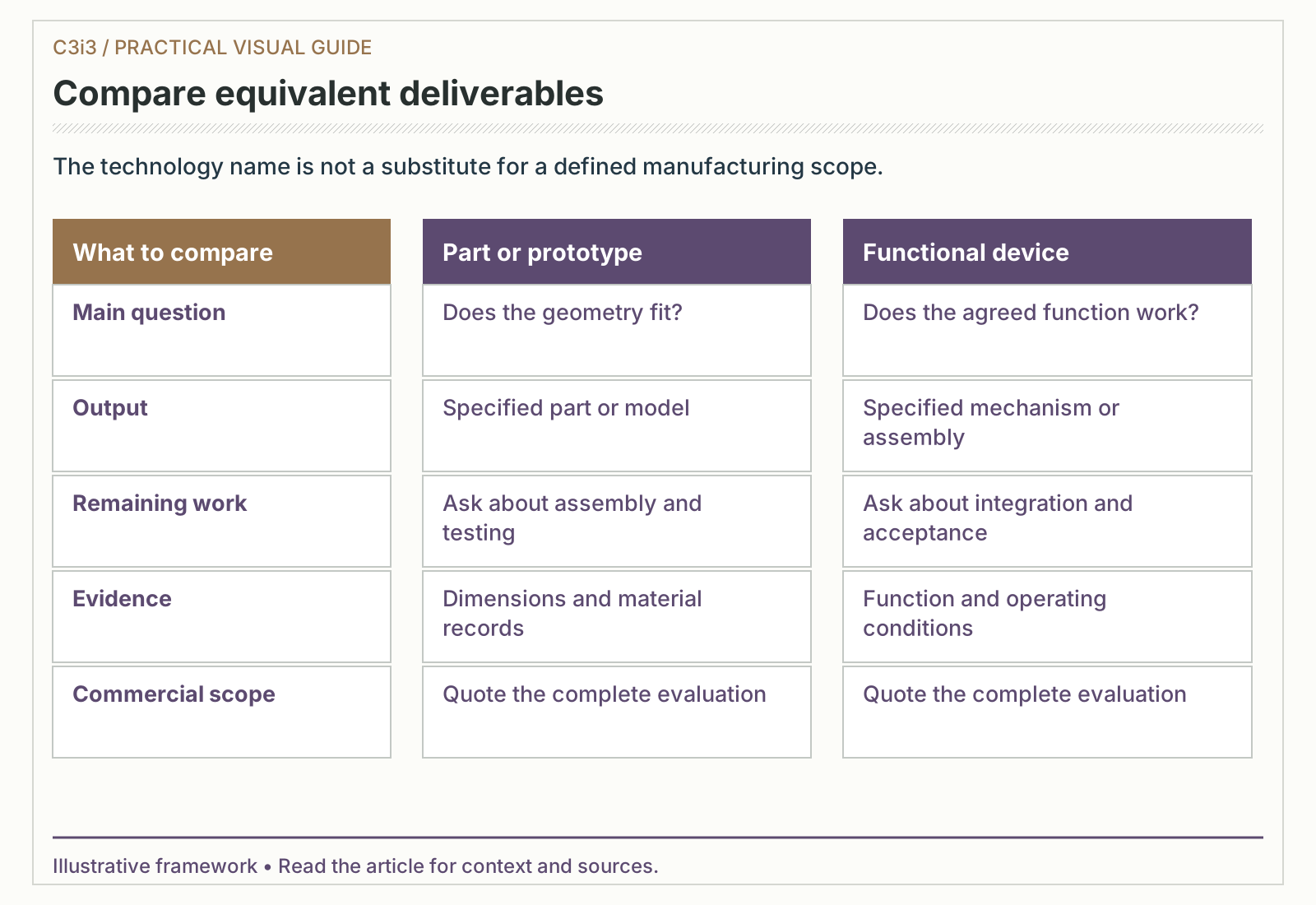
Main question: Does the geometry fit? / Does the agreed function work?. Output: Specified part or model / Specified mechanism or assembly. Remaining work: Ask about assembly and testing / Ask about integration and acceptance. Evidence: Dimensions and material records / Function and operating conditions. Commercial scope: Quote the complete evaluation / Quote the complete evaluation.
How do you compare quotes that include different amounts of work?
Separate the proposal into scope bundles before comparing the totals. The design bundle explains who prepares or changes the files. The fabrication bundle describes the physical output. The integration bundle identifies assembly and interfaces. The evaluation bundle explains how the deliverable will be assessed.
For an illustrative moving device, one supplier might quote an enclosure while another proposes a complete mechanism. The enclosure quote could be appropriate for an appearance study, but it should not be scored as an equivalent substitute for the mechanism. The right comparison depends on the experiment you need to conduct.
| Bundle | Make the boundary explicit |
|---|---|
| Design | Customer-supplied files or supplier development? |
| Fabrication | Part, subassembly or complete device? |
| Integration | Which connections and assembly work are included? |
| Evaluation | Inspection report, functional trial or customer testing? |
Record exclusions beside the included work. A missing report or interface component may create an additional task rather than a supplier defect. Normalize the scope first, then compare cost, timing and responsibility. This makes the procurement decision understandable to people who did not attend the initial supplier conversations.
Does multi-material capability settle the comparison?
No. A list of supported materials does not establish that a particular combination can satisfy your device’s requirements. Interfaces, tolerances, operating conditions and inspection remain part of the question.
Nor should a comparison reduce the whole additive industry to a single desktop process. NIST describes several additive technologies. Ask about the specific process being proposed rather than substituting a familiar image of a printer for technical evidence.
For a hypothetical moving assembly, separate the structural component, the moving interface and any electrical function in the brief. Ask the supplier which elements it produces, which it integrates and which must come from elsewhere. The useful distinction is responsibility for the finished function.
This also helps the marketing team write accurately. A component supplier, an assembly service and a complete device manufacturer have different offers, even when their websites use similar images.
How should you compare cost and lead time?
Build a cost comparison around the whole evaluation cycle. Include design preparation, fabrication, post-processing, assembly, inspection, delivery and the work needed when a revision occurs. Use supplier-confirmed amounts rather than hypothetical savings percentages.
Separate first delivery from usable evidence. A part can arrive quickly while integration or testing remains unfinished. Conversely, a slower delivery that includes the required evidence may answer the business question earlier.
Record assumptions beside the figures. State what quantity the quote covers, which revision it applies to and what would trigger a new quote. Keep preliminary estimates separate from agreed commercial terms.
For a launch team, this prevents a manufacturing estimate from quietly turning into a customer delivery promise. Publish availability only after the responsible teams have approved what the website says.
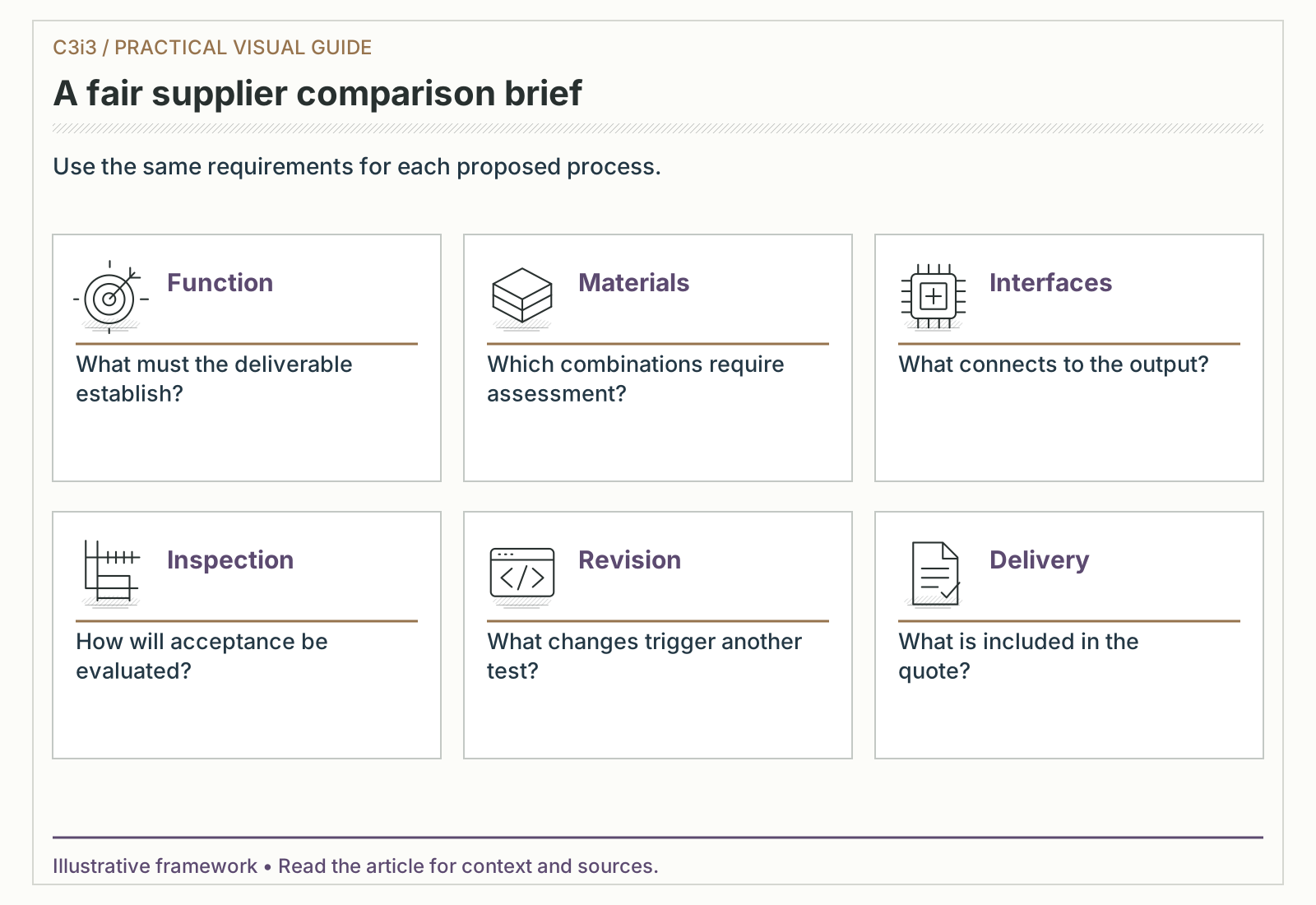
Function: What must the deliverable establish?. Materials: Which combinations require assessment?. Interfaces: What connects to the output?. Inspection: How will acceptance be evaluated?. Revision: What changes trigger another test?. Delivery: What is included in the quote?.
What changes when the design is revised?
A revision can affect more than the fabrication file. It may change the intended function, the interface with another component or the conditions under which earlier evidence was collected. Ask the supplier which parts of the proposal remain valid after the change.
In a hypothetical enclosure project, moving a mounting point could leave the appearance study largely intact but require another fit check. In a hypothetical functional mechanism, changing a moving interface could reopen the evaluation question. Neither example assumes that the Matter Compiler or a particular additive process accepts the job.
Use a short revision record: identify the change, explain why it was made and list the evidence that must be reconsidered. Keep the accepted version of the brief connected to the accepted design. Otherwise, a team can accidentally compare a quote for one configuration with test results from another.
This also helps when an early experiment succeeds. The next decision may concern repeatability, integration or a different quantity. Define that decision explicitly rather than treating the first result as permission to skip the remaining work. A method that answered the prototype question can still need further evaluation before production.
NIST's manufacturing guidance discusses both prototyping and production opportunities. It supports evaluating the particular business case rather than confining additive manufacturing to a single stereotype.
What is a sensible first evaluation?
Choose one question whose answer could change the project. For example, a team might need to know whether its proposed mechanism fits within a target envelope. That example is a planning scenario, not a confirmed Matter Compiler service.
Write the acceptance condition before requesting the sample. Identify who will evaluate it, what they need and what happens if the result is inconclusive. This keeps the trial from becoming an expensive demonstration with no decision attached.
Then compare the practical alternatives. An existing qualified process may answer the immediate question. A new platform may deserve a separate exploratory conversation. Those can be different workstreams with different budgets and expectations.
Our guide to current Matter Compiler evidence helps organize what to ask before choosing either route.
What should the comparison help you decide?
End the comparison with an action that follows from the information available. The outcome might be selecting a fabrication route, asking for a missing scope item or deciding that the requirements need more work before either proposal can be evaluated fairly.
In an illustrative concept study, a team may choose a familiar process to examine appearance while keeping a separate technical conversation open about a future functional device. That is a coherent decision because the two activities answer different questions.
Write the reason for the decision in plain language: the chosen deliverable addresses the current uncertainty, the team understands the exclusions and the next review has a defined purpose. This is more useful than a single composite score whose assumptions nobody can explain.
Keep the comparison record available for the next stage. When the project changes from a concept model to an evaluated mechanism, revisit the scope rather than assuming the earlier ranking still applies. The strongest procurement record explains both the choice and the circumstances under which it should be reconsidered.
Key takeaways
- Define what the output needs to prove before comparing technologies.
- Compare equivalent scopes and documented acceptance criteria.
- Request evidence for specific materials and interfaces.
- Include downstream work in cost and timing discussions.
- Keep unknowns visible until suppliers answer them.
Key terms in this guide
- Scope bundle
- A defined portion of the proposed work, such as design, fabrication, integration or evaluation.
- Post-processing
- Work performed after a fabrication step to prepare the output for its intended use.
- Revision baseline
- The agreed version of a design and brief used to interpret a quote or result.
- Functional prototype
- A prototype intended to evaluate a defined behavior, rather than appearance alone.
Frequently asked questions
Will the Matter Compiler replace 3D printing?
The reviewed evidence does not establish that outcome. A useful decision compares a specific job with specific available processes.
Which approach is cheaper?
There is no verified universal price comparison in this guide. Obtain comparable quotes that include the work required to reach an accepted result.
Is this a hands-on comparison?
No. It is an independently prepared buyer’s framework based on public primary sources, with no laboratory testing by C3i3.
Primary sources and editorial method
- NIST: what additive manufacturing is
Independent federal explanation of additive manufacturing's basic process.
- NIST: additive technologies
Explains why additive manufacturing contains multiple processes rather than one universal printer type.
- Matter Compiler platform
Manufacturer's description of the proposed platform scope. Not a comparative benchmark.
- NIST MEP: evaluating additive manufacturing applications
Primary measurement, manufacturing or research context for the concepts discussed above.
Help people understand your technical product.

C3i3 helps technical businesses explain their products through manufacturing marketing strategy, technical content, websites and product demonstrations and creative campaigns.
Tell us what you are developing and who needs to understand it. For Matter Compiler access or PrimeSwitch evaluation, use Atomic Machines’ official contact route.