








































In this article
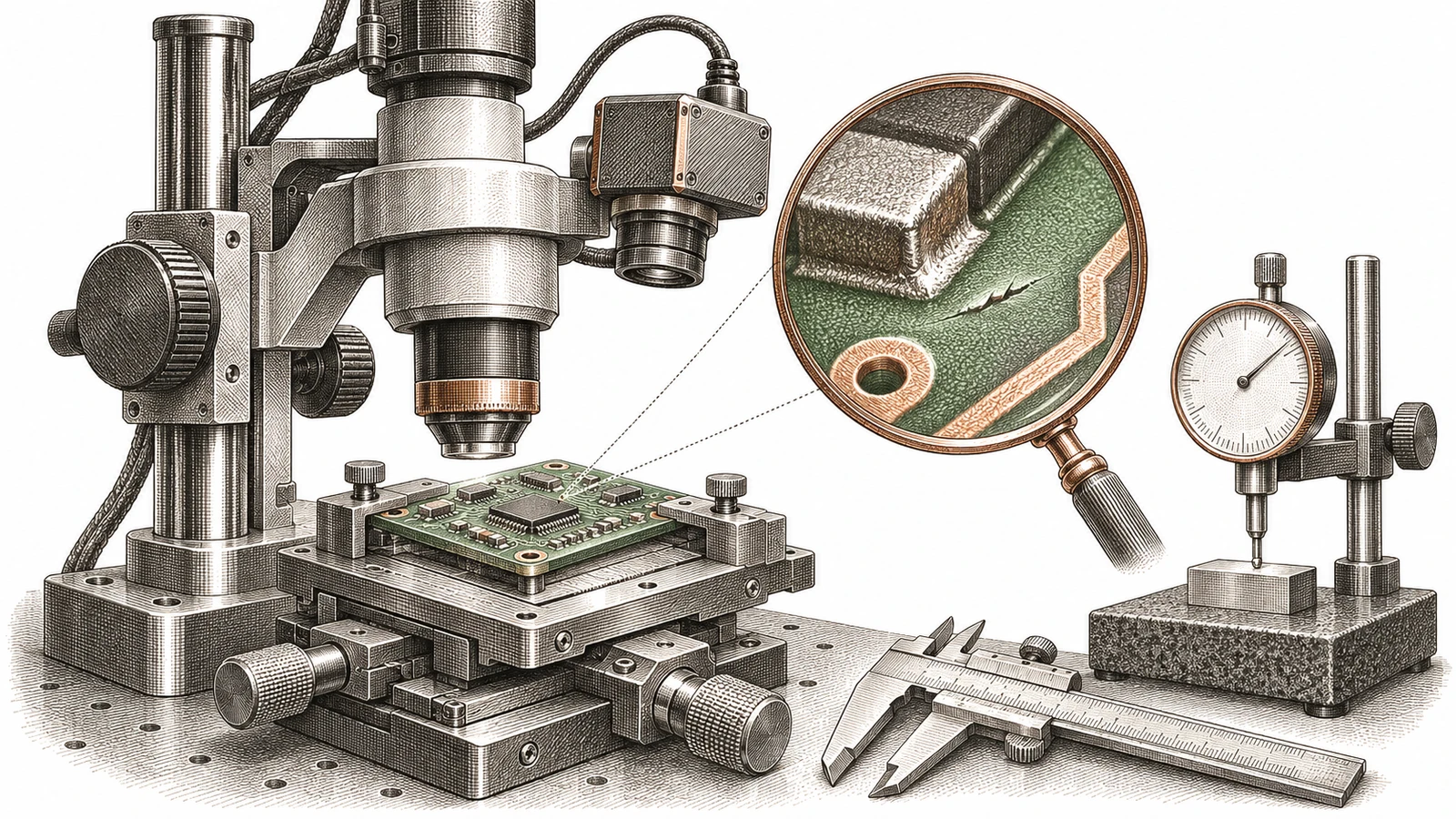
A camera flags a tiny mark on a component. Is it a defect, a normal surface variation or a problem with the image? The answer depends on the feature, the observation conditions and the acceptance rule. Adding AI does not make those questions disappear.
This guide gives technical business teams an original framework for evaluating inspection claims. It uses hypothetical micro-manufacturing scenarios to separate detection, measurement and disposition. It does not describe Atomic Machines’ internal inspection equipment or provide a process qualification for any device.
Independent C3i3 research and analysis. Sources checked November 18, 2026. Read the sources and editorial method.
Why does this topic matter now?
On October 21, 2026, Siemens announced an AI-supported PCB inspection workflow with NVIDIA, including virtual preparation and a factory demonstration. The release describes improvement targets, which should not be reported as achieved results across production environments.
The development is useful because it connects several stages that marketing language often combines: preparing reference information, generating or collecting images, flagging potential defects and reviewing uncertain calls. Those stages require different inputs and support different conclusions.
For micro-manufacturing, this distinction is particularly important to the buyer's question. A feature may be difficult to observe consistently, a dimensional requirement may need a measurement method and a complete device may need functional evaluation. Calling all of that “AI quality control” can conceal what a proposed service actually includes.
What should a business take from the announcement?
Use it as a reason to examine the inspection workflow, not as a universal savings benchmark. Ask which task is being automated, which decisions remain reviewed and what conditions support the stated performance. Keep any project targets attached to their source and stage.
How do detection, metrology and acceptance differ?
Detection identifies a possible feature or condition. Classification assigns it to a defined category. Metrology concerns measurement and its interpretation. Acceptance applies the relevant criteria to decide what happens to the item. These stages may share data, but they are not equivalent.
Consider an illustrative small channel. An image could suggest an obstruction. A measurement could characterize a relevant dimension. A functional evaluation could examine whether the device performs its intended role. One result does not automatically establish the others.
| Stage | Useful output | Question that remains |
|---|---|---|
| Detection | A location or anomaly flag | Is the observed condition meaningful? |
| Classification | A defined condition label | How was the label established? |
| Measurement | A value with method and context | Is the result adequate for the requirement? |
| Disposition | Accept, reject or review | Who owns the rule and exception handling? |
| Functional evaluation | Behavior under specified conditions | What conclusion does the test support? |
Ask the provider to name the deliverable at each relevant stage. A heat map that highlights an anomaly can be valuable without being a dimensional report. A dimensional report can be useful without establishing every function of the assembly.
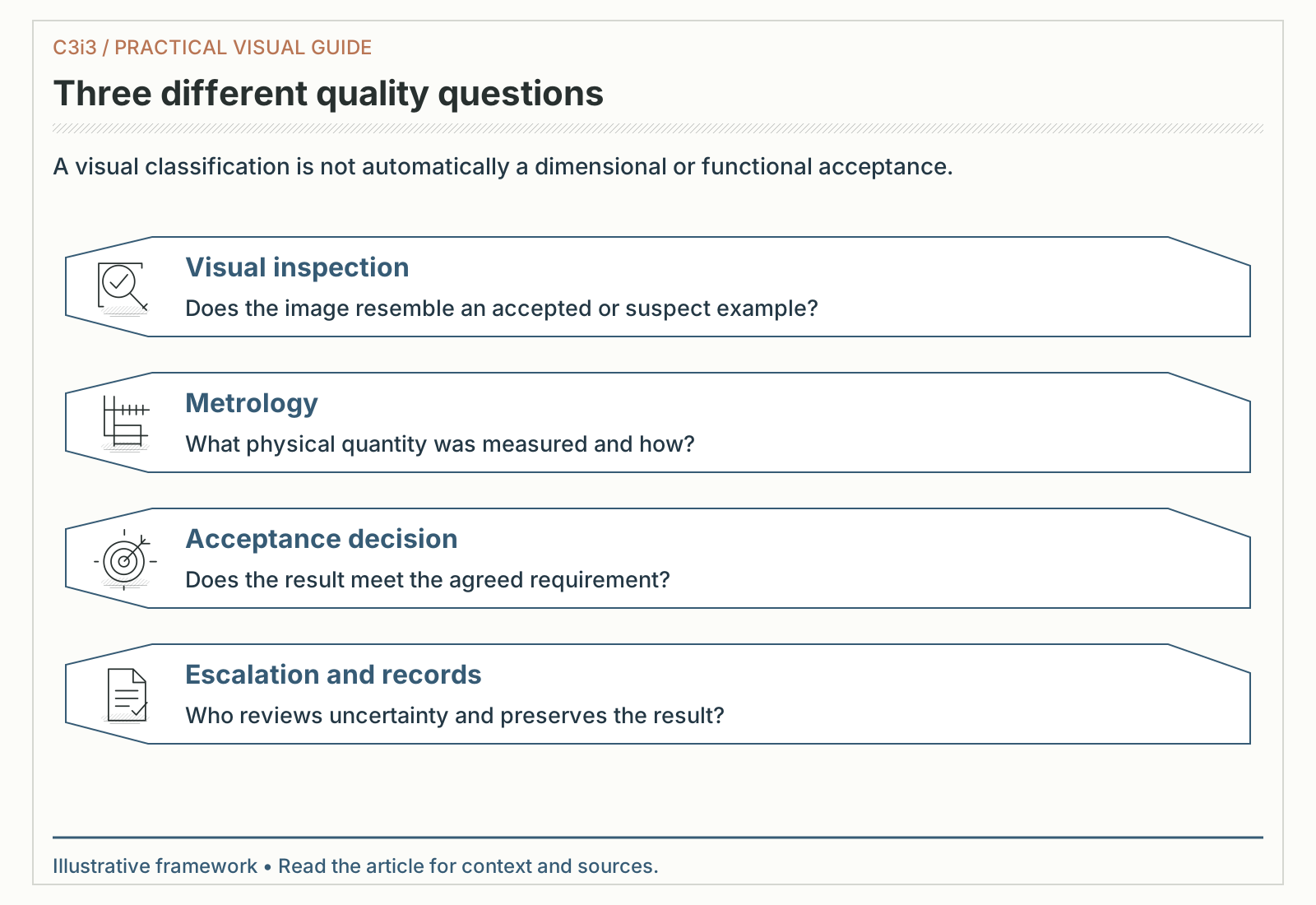
Visual inspection: Does the image resemble an accepted or suspect example?. Metrology: What physical quantity was measured and how?. Acceptance decision: Does the result meet the agreed requirement?. Escalation and records: Who reviews uncertainty and preserves the result?.
What makes an inspection dataset relevant to the actual line?
Texas Instruments’ defect-detection guidance emphasizes matching image collection with the intended camera, optics and lighting, along with relevant good and defective examples. This is a concrete reminder that the observation setup belongs in the model's scope.
For a proposed micro-component inspection task, define which conditions will appear in production. Include ordinary variation that should not trigger rejection. If the dataset contains only conspicuous defects, it may tell the team little about difficult boundaries between acceptable variation and a meaningful problem.
Who should establish reference labels?
The team responsible for product quality should define the categories and the process for resolving disagreements. A collection of images does not become ground truth merely because filenames contain “good” and “bad.” Preserve the rule behind each label and identify cases requiring expert review.
Keep training and evaluation records distinct. The reviewer needs to understand what the model encountered during development and what was used to examine its performance. A polished demo on familiar examples can be useful for explanation while being inadequate for an acceptance decision.
Document the dataset revision, capture configuration and labeling method. These records make later changes interpretable. Without them, a performance difference could come from the device, the camera setup, the examples or the model itself.
Why can a single accuracy percentage hide the important failures?
A headline score can conceal different kinds of error. A false acceptance lets a problematic item pass. A false rejection sends an acceptable item into rework or review. An uncertain call may require another observation. The business consequences depend on the application and the subsequent workflow.
For an illustrative cosmetic inspection, a false rejection may consume review time. For a different task, a missed condition could matter much more. The responsible team must define the consequences and suitable evaluation methods for the actual product.
A useful report therefore separates outcomes by relevant condition and operating context. Ask how many observations were included, which categories were represented and where the system struggled. Do not allow a strong average to hide a weak result for the feature driving the purchasing decision.
What about rare defects?
State how they were represented and what can be concluded from that representation. Synthetic examples may support development, but their presence does not establish that the system recognizes every real defect. The review must connect the evaluation set with the intended use.
Include the manual-review burden in the business discussion. A system that creates many ambiguous flags may move effort rather than remove it. Record who resolves those cases and whether the proposed workflow makes the task easier to perform consistently.
How should a buyer review a confusion matrix?
A confusion matrix organizes predicted categories against reference categories. Its usefulness depends on how those categories and references were established. The business reviewer should be able to identify which cells represent the failures that matter to the proposed workflow.
In a hypothetical two-category inspection, accepting an item labeled defective by the reference process is a different outcome from rejecting an item labeled acceptable. Do not combine their costs casually. The responsible quality team should determine the practical consequences and appropriate evaluation.
Also ask about observations that are left out of the matrix. Were uncertain labels excluded? Were some product variants absent? Were capture conditions narrower than the planned deployment? These questions do not invalidate a report automatically. They define the scope within which the report can be interpreted.
Review the unit of analysis. A model can flag several regions within one item, while the production team makes one disposition decision about that item. Counts of regions, images and completed parts can therefore describe different things. The report should identify which unit each metric uses.
Finally, ask how the result changes when a decision threshold changes. A threshold is part of an operating choice, not merely a presentation setting. It can affect which cases pass automatically and which enter human review. Document the chosen configuration so later results can be compared meaningfully.
This is a reading framework, not a prescribed statistical acceptance test. It helps a purchasing team understand what technical reviewers need to establish before a percentage becomes a business promise.
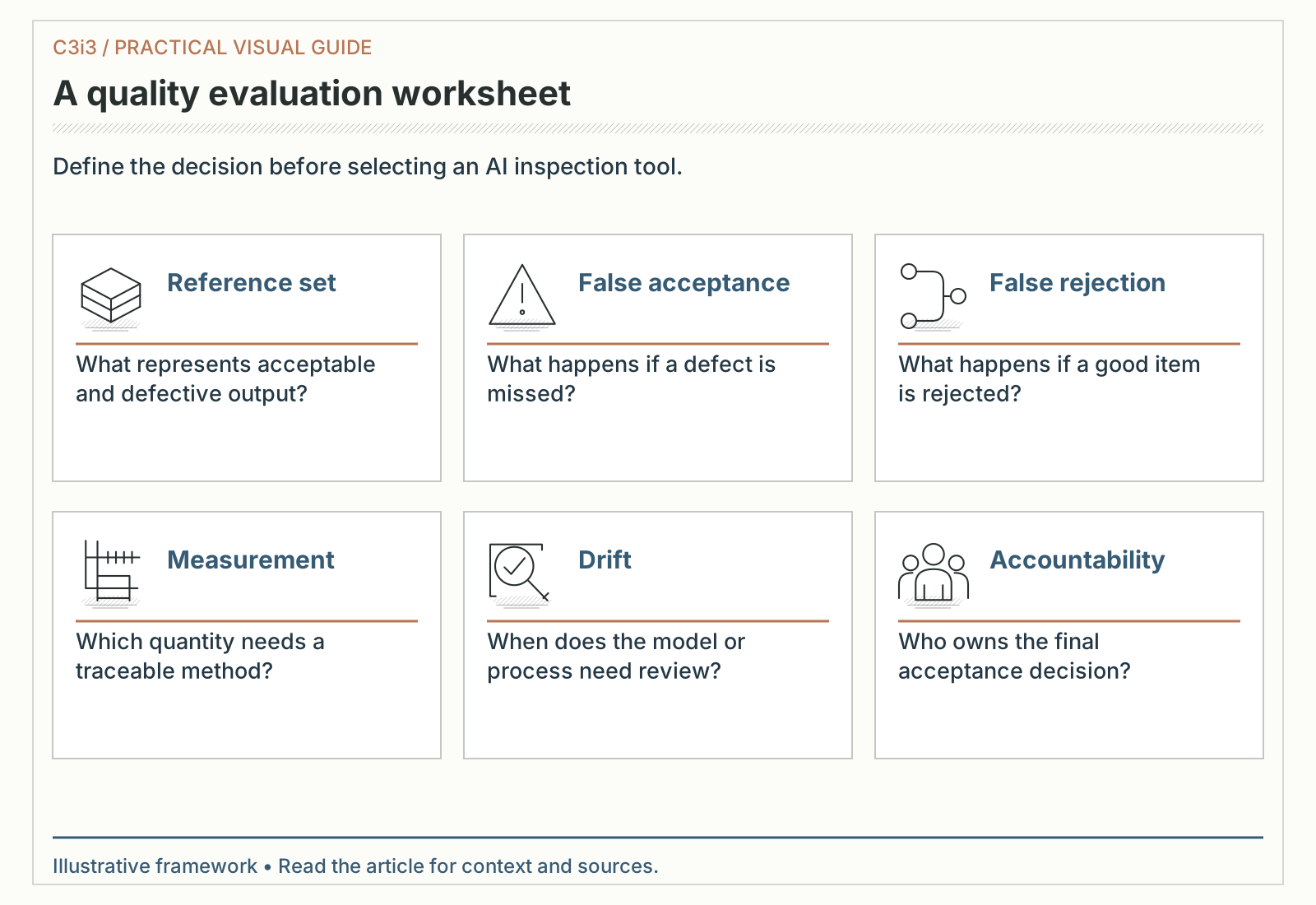
Reference set: What represents acceptable and defective output?. False acceptance: What happens if a defect is missed?. False rejection: What happens if a good item is rejected?. Measurement: Which quantity needs a traceable method?. Drift: When does the model or process need review?. Accountability: Who owns the final acceptance decision?.
When does a visual result need another measurement?
When the decision depends on a property the image does not establish adequately, another method may be needed. The responsible technical specialist should choose the method and explain the limits of the result. A visually small feature is not automatically a measured feature.
NIST’s work on AI-assisted scanning electron microscopy describes a research effort combining physical modeling, imaging and measurement. It illustrates how much method development can sit behind a precise-looking output. It is not a description of the Matter Compiler's equipment.
For an illustrative micro-channel project, the buyer might need to distinguish a visible anomaly from a dimensional requirement or a performance requirement. The inspection plan should say which evidence addresses each one. It should also identify when access to the feature changes after assembly.
What should the report preserve?
Identify the item and revision, method, relevant conditions and interpretation. Where measurement uncertainty is material to the decision, the responsible reviewer should explain how it is handled. A business audience needs to understand the decision basis, even when it does not need every technical detail.
Link the report to the requirement being evaluated. That prevents a precise value for one feature from becoming a general statement that the entire device is qualified.
How should a team handle drift, revisions and uncertain calls?
Decide what happens when the observation setup, product or model changes. A new surface finish, camera adjustment or component revision may affect how an image is interpreted. Treat the change as a review trigger rather than assuming the old result carries over unchanged.
Establish an escalation route for ambiguous cases. The person reviewing a flag should see the relevant image, category, configuration and reason for escalation. A queue of unexplained red boxes is not a complete quality process.
NIST's industrial AI management project frames evaluation in relation to the system and its users. Our practical application is to review the effect of inspection decisions on the whole workflow, including the people handling exceptions.
What belongs in the change record?
Capture what changed, why it changed, which evaluation was repeated and who approved the next use. Keep the previous revision identifiable. If the team cannot reconstruct which model and setup produced a decision, investigation becomes harder.
- Identify the changed product, model or observation condition.
- Review the relevant acceptance and escalation rules.
- Repeat the checks appropriate to the change.
- Document the decision and responsible reviewer.
- Update public claims when their supporting scope changes.
What should Matter Compiler buyers include in an inspection brief?
Begin with the function and requirements of the proposed device. Identify which characteristics need observation, measurement or functional evaluation. Ask which deliverables are currently available within the engagement and which are outside its scope.
Do not infer an inspection architecture from the broad claim that a manufacturing platform learns from its builds. That description does not identify a customer's report format, a specific measurement method or a qualification agreement. The supplier discussion should establish the relevant details.
For an illustrative evaluation, a concise brief could list the device revision, feature of interest, proposed acceptance question and required record. The technical team then reviews whether the suggested evidence is adequate. This sequence keeps purchasing language connected with the engineering task.
How should the public product story use inspection evidence?
Show what the evidence actually supports. A labeled example image can explain a defect category. A measurement summary can support a defined characteristic. A functional demonstration can show a behavior under stated conditions. Keep those claims separate in captions and copy.
Our digital twin guide explains the relationship between observations and a model. Our current capabilities guide separates named product information from future applications. Together they help a buyer move from a broad announcement to a specific evaluation question.
Key takeaways
- Separate anomaly detection, measurement and acceptance.
- Match evaluation data with the intended observation conditions.
- Review false acceptances, false rejections and uncertain calls separately.
- Preserve revision context and an escalation route.
- Use inspection evidence only for the claims it actually supports.
Key terms in this guide
- False accept
- An unsuitable item incorrectly classified as acceptable.
- False reject
- An acceptable item incorrectly flagged as unsuitable.
- Metrology
- The science of measurement, including how measurements are related to defined references.
Frequently asked questions
Does an AI defect flag prove that a part should be rejected?
No. It identifies a condition for the defined decision process. Acceptance rules and exception handling need responsible technical ownership.
Is a camera image a dimensional measurement?
An image can support a measurement method, but the image alone does not establish that a dimensional requirement has been evaluated adequately.
Can synthetic defect images replace real evaluation?
They can support development in a defined workflow. Their use does not by itself establish performance on the real product and observation conditions.
Does Atomic Machines use the Siemens inspection workflow?
No such connection is asserted. The Siemens example illustrates a distinct publicly described development in industrial inspection.
Primary sources and editorial method
- Siemens October 21, 2026 PCB inspection announcement
Vendor documentation or a dated announcement. Plans and targets remain attributed to the source.
- TI visual defect-detection guidance
Vendor documentation or a dated announcement. Plans and targets remain attributed to the source.
- NIST industrial AI management and metrology
Primary measurement, manufacturing or research context for the concepts discussed above.
- NIST physics and AI microscopy metrology research
Primary measurement, manufacturing or research context for the concepts discussed above.
Help people understand your technical product.

C3i3 helps technical businesses explain their products through manufacturing marketing strategy, technical content, websites and product demonstrations and creative campaigns.
Tell us what you are developing and who needs to understand it. For Matter Compiler access or PrimeSwitch evaluation, use Atomic Machines’ official contact route.