






































In this article
Your website looks respectable. The agency report contains activity. Someone is producing content, someone else is running ads and your sales team still says the enquiries are wrong. When you ask what to fix, each supplier recommends more of the work they already sell.
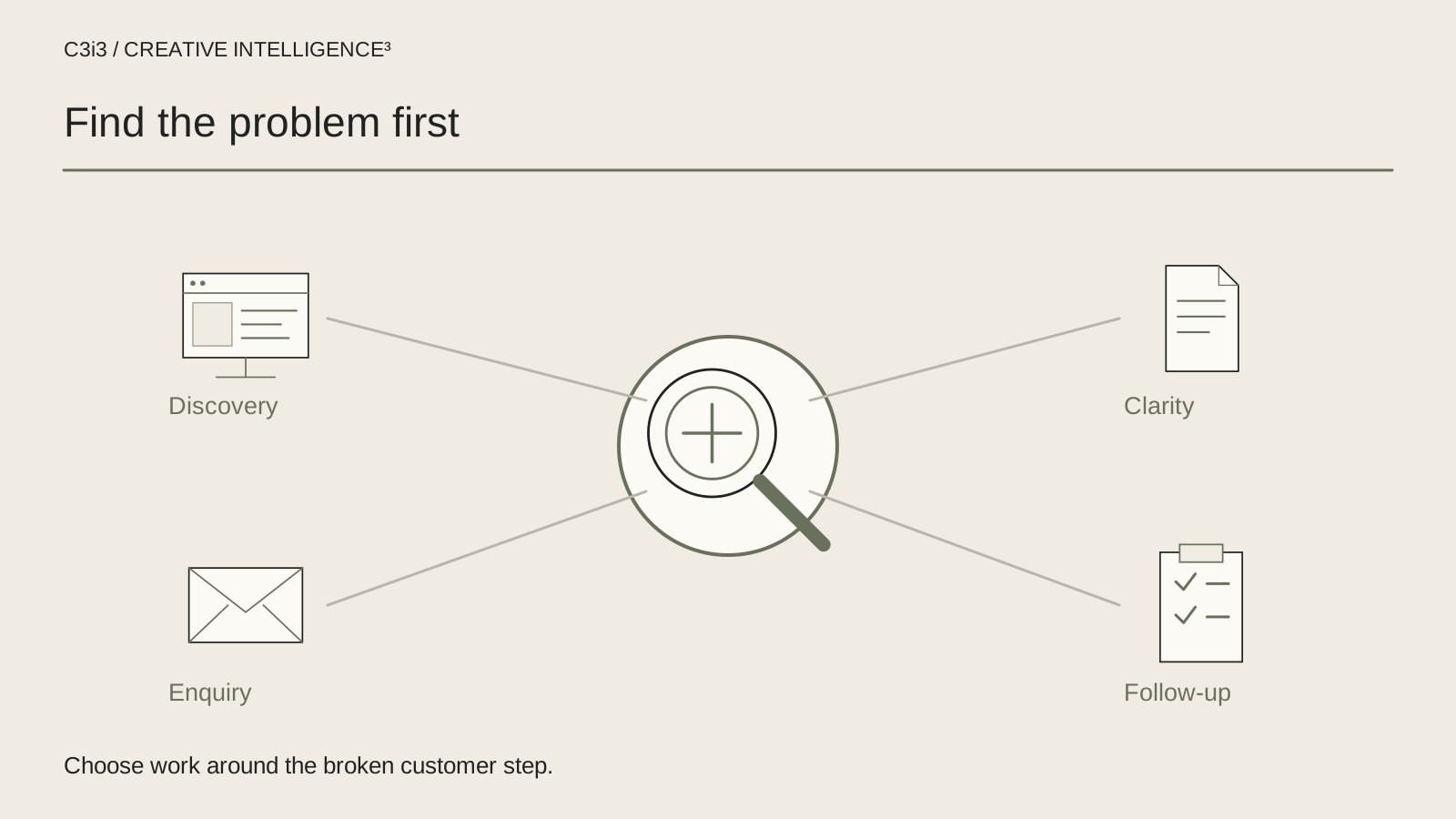
A Bay Area digital marketing agency should help untangle that problem before presenting a larger list of services. The first useful question is not whether you need SEO, web design or a commercial. It is where a real customer loses the ability, confidence or reason to take the next step.
This guide offers a working diagnosis for business owners and marketing teams in San Francisco, San Jose and the East Bay. It also applies when an enterprise buying group has several departments involved. The situations below are illustrative, not client case studies. Use your own pages, enquiries and records to identify the first problem worth investigating.
What is the customer trying to get done?
Start with a specific buying situation. “We need more business” cannot tell a designer, advertising specialist or sales manager what to change. “An operations manager needs to decide whether our equipment can fit an existing process” gives the team a customer, a task and an information gap.
Write that situation in one sentence. Include what the customer needs to understand before contacting you and what makes an enquiry useful to your business. A service company may need to confirm the type of project. A product business may need application details. An enterprise team may need to route a request to the right division before anyone can respond.
Now follow the task yourself. Search, open the relevant page, look for evidence, try the form and inspect the message received by the intended team. Record what you observed instead of summarizing the site as good or bad.
Keep the starting point narrow enough to investigate. One business can have several customer journeys, but combining all of them immediately makes it difficult to identify a cause. Choose an important service or product line first. Expand the diagnosis after the team agrees what the first journey actually requires.
Are the right buyers finding the right page?
A discovery problem occurs before the customer can judge your offer. The business may appear for its own name while its service pages remain difficult to find. An advertising campaign may reach the wrong audience. A search result may describe a page that no longer answers the question.
Use the available evidence to distinguish these situations. Review the search queries and landing pages you can see, the campaign destination and the source of recent enquiries. Do not assume low traffic proves that the design is wrong. Do not assume a large visitor count proves that the audience is useful.
Google’s Search Essentials emphasizes useful content, words people use when searching and links that can be crawled. Those are foundations for investigation, not a promise that publishing another page will produce rankings.
If a supplier offers an audit, ask for the affected pages and the evidence behind the findings. Our guide to turning an SEO audit into an actionable fix list explains the difference between a diagnosis and a score. Record what cannot yet be established as an open question rather than inventing an explanation.
Can the buyer understand the service without a sales call?
Once the right person arrives, the page must help them decide whether the business is relevant. A broad statement about excellence rarely settles that decision. Customers may need to know what you do, which situations you serve, what a project involves and what evidence supports your claims.
Choose an important page and highlight statements a competitor could use unchanged. Then highlight concrete information a buyer could use in a comparison. If the first group dominates, the page may need clearer explanation rather than a complete visual rebuild.
For an enterprise supplier, useful detail might include supported applications, the review process and the information required to assess a request. A professional service business might explain the boundary of an engagement. These details should be accurate and appropriate for public use; confidential project information is not required.
The homepage clarity test is a quick starting point, while the detailed service page usually carries the buying decision further. Keep the wording specific enough to exclude an unsuitable task. A page that appeals to everyone can leave the right customer unsure whether the company understands their actual problem.
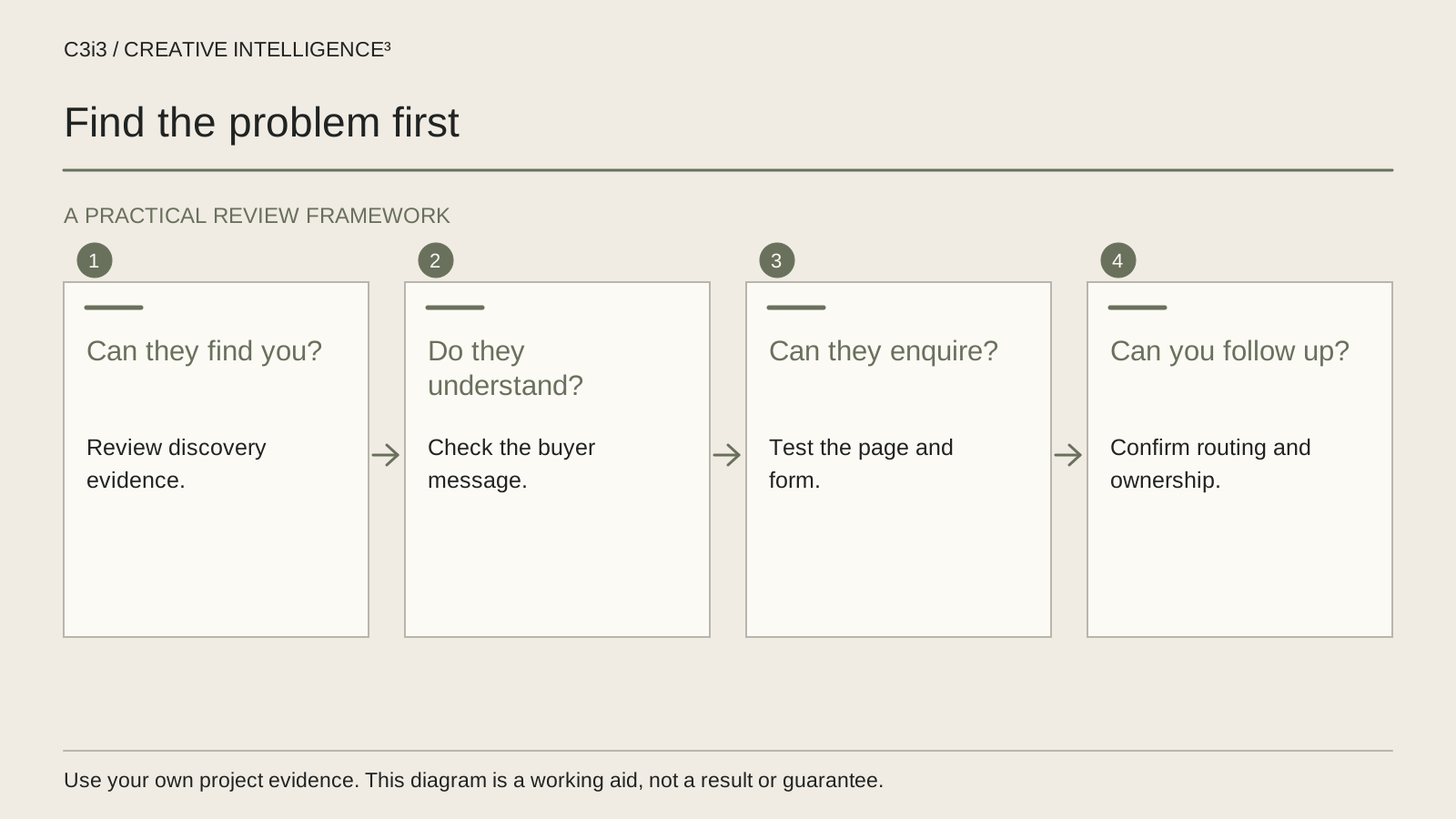
Is the enquiry route collecting useful information?
A customer can understand the service and still abandon the next step. The form may ask for details they do not know, require an unnecessary account or provide no clear indication that the request was received. In another case the visitor completes the form, but the message never reaches the right person.
Review the public experience and the internal delivery separately. For each required field, ask which decision becomes possible because that answer exists. If nobody uses it before the first conversation, consider whether it belongs later in the process. This is a decision to test against your workflow, not a rule that every form must be short.
The W3C forms tutorial recommends asking for information needed for the process and making forms understandable. Accessibility and qualification belong in the same review: a useful answer is difficult to collect if the label or error message is unclear.
Read the mobile enquiry form guide for a field-by-field approach. If the request disappears after submission, use the separate form delivery incident guide. Changing the wording cannot repair a broken delivery route.
Does the campaign promise match the destination?
An ad, video or social post sets an expectation. The destination should help the customer continue the same task. A commercial about a particular product that leads to a general homepage may leave the visitor searching again. A service ad can create a similar problem if the landing page describes a different scope.
Put the campaign and its destination beside one another. Compare the named customer, problem, service, evidence and requested action. Note every point where the reader has to reinterpret the message. Fix the mismatch before treating a disappointing response as proof that the whole channel is unsuitable.
Writing matters here when it changes what the audience expects. An agency should be able to explain why a claim or call to action belongs in the campaign and how the page supports it. The ad copy guide shows how vague language can attract unsuitable enquiries without requiring a new brand identity.
If video is the entry point, begin with the commercial views-versus-enquiries diagnosis. Production quality, audience selection and the destination are connected, but they remain different things to investigate.
Who can approve the work before it stalls?
Some marketing problems live inside the business. A page waits for a product fact. A video waits for someone to approve a demonstration. Sales asks for a stronger claim while another department cannot verify it. Work accumulates because “the team” is expected to decide.
Name the person responsible for each decision and the evidence that person needs. Separate factual approval from design preference and technical acceptance. This reduces the temptation to ask everyone to review every detail at once.
Use a simple decision register. It is an editorial working method rather than a formal compliance framework. The register should preserve the question, decision, reason and unresolved condition so a later reviewer can understand why the work changed.
| Decision | Evidence to review | Person to name |
|---|---|---|
| Which customer problem comes first? | Recent enquiry examples and service priorities | Business decision owner |
| Is the product statement accurate? | Approved product information and demonstration | Product reviewer |
| Can this page go live? | Content approval and completed technical checks | Publication owner |
| Where does an enquiry go? | Test submission and agreed routing | Receiving team owner |
The Sales and IT approval guide develops this approach for enterprise websites. An approval route should make difficult decisions visible, not create another meeting with no decision owner.
Can your team control the website after launch?
A finished page is only useful if the business can maintain the information it depends on. Before a redesign, identify ordinary updates: changing a service description, replacing an image, retiring an offer or correcting a contact detail. Ask who can perform them and how a mistake is reversed.
Access should follow responsibilities. Giving every editor full administrative control is different from giving them a reliable way to update approved content. Equally, a business should understand when a template or integration requires specialist support rather than assuming every change belongs in a simple editor.
For a practical handover review, see whether your team can update the site after launch. Ecommerce businesses should also inspect store and customer-data control; content access and operational ownership are not the same question.
Document the accounts, approval route and support responsibilities using business-controlled records. Do not place credentials in a shared marketing brief. The useful outcome of this review is a clear task boundary, not an assumption that every owner needs to become a developer.

Which problem should be fixed first?
Compare candidate work using customer impact, available evidence, dependencies and the ability to verify a change. A failure that prevents an important task can deserve attention before a visually prominent annoyance. A suspected issue with no supporting evidence may need investigation before implementation.
Avoid an oversized score that hides those distinctions. A small working table can expose the assumptions better than a single total. The point is to choose a defensible next action, not to make the decision appear mathematically certain.
| Observed situation | Question before buying more work | Possible first action |
|---|---|---|
| Relevant visitors reach the service page but ask what the company does | Does the page explain the task and scope? | Review service explanation and evidence |
| The form reports success but the receiving team finds no message | Was the request accepted and delivered? | Trace one controlled test submission |
| Several departments reject a page for different reasons | Which decision does each reviewer own? | Agree approval boundaries and evidence |
| Nobody can establish how a campaign enquiry was counted | What action is the campaign intended to produce? | Define the event and test its implementation |
Where a dependency exists, address it explicitly. Launching more ads while the receiving process remains broken makes the diagnosis harder. Conversely, waiting for a complete rebrand before fixing an unusable contact field may postpone an independent repair.
What should you ask a Bay Area digital marketing agency to deliver?
Give the agency the problem statement and the evidence you have collected. Ask for a proposed scope that names the affected pages or campaign assets, the work to be produced, required business inputs and the acceptance checks. Ask what remains outside that scope.
A practical proposal should distinguish investigation from implementation. If the cause is uncertain, it is reasonable to define a discovery task. It is less useful to hide uncertainty behind a large bundle of channels that may or may not address the problem.
The marketing strategy consultant guide explains when wider research is necessary. The outsourced marketing guide addresses ongoing team support. Use those when the issue is strategy or capacity; do not confuse them with a specific page defect.
For businesses assessing AEO, ask how the work will be checked without treating inclusion in an AI answer as guaranteed. Our answer engine optimization deliverables guide and Perplexity citation-gap guide separate verifiable website work from observations about changing answers.
How should San Francisco, San Jose and East Bay coverage fit the plan?
Use geography where it helps the customer decide whether you can serve them and how the engagement works. A business looking for a Bay Area partner may care about availability for a project meeting, knowledge of its market or coordination across departments. A city name alone does not establish that expertise.
The Bay Area service hub connects the local overview with San Francisco services and San Jose services. Those pages should explain genuine service coverage. Supporting articles should answer distinct business questions rather than repeat the same text with another place name.
For an East Bay team, the first practical step may be reviewing a mobile enquiry route. For an enterprise team in San Jose it may be agreeing who can approve technical claims. For a San Francisco product business it may be checking store handover. These are examples of different tasks, not assumptions that every business in an area has the same need.
Choose one task, a responsible person and an acceptance check. That gives the next conversation with a marketing strategy team a useful starting point and gives your business a way to assess the work after it is delivered.
Keep this checklist beside you
Questions before the next step
Should I hire a digital marketing agency before redesigning my website?
Investigate the problem first. A redesign may be appropriate when the structure or editing system blocks important tasks, but a specific content, form or routing problem might have a narrower solution. Ask for evidence connecting the proposed work to the customer task rather than assuming that a new appearance will resolve every marketing issue.
Can one agency handle both enterprise websites and local marketing?
It can, but the scope and responsibilities need to be explicit. Review how the proposed team manages product facts, technical checks, multiple reviewers and local service information. Ask who will coordinate specialist work and who in your business retains approval. The size of the service list is less informative than a clear process for the work you need.
Does adding city names help a business get found locally?
Relevant service and location information can help customers understand coverage, but repeating place names does not replace useful pages or accurate business information. Use the existing location hierarchy and link supporting guides where they answer another question. Search visibility also depends on factors beyond any one article, so geography in a heading is not a ranking promise.

How C3i3 Can Help
C3i3 helps Bay Area businesses connect marketing strategy, website design, commercial production and ongoing support around a specific customer task. Bring the page, campaign or enquiry problem you are trying to resolve. We can help identify what needs investigation, what needs implementation and who should own the next decision.