






































In this article
Someone asks Perplexity for help choosing a business service. Another company appears in the answer, and your team wants to know why your business is missing. It is tempting to copy the competitor’s headings or ask the same question repeatedly until your name appears. Neither approach establishes what the system used or what your website actually lacks.
For a San Francisco business, Perplexity SEO should start with a controlled citation-gap review. The goal is to learn which customer questions matter, what sources are being used and whether your public pages provide useful evidence for those questions. A single generated answer is an observation, not a permanent ranking table.
Which Perplexity questions are worth testing?
Choose questions a prospective customer could plausibly ask while evaluating your actual service. A broad request for the “best agency” may produce a different kind of answer from a question about handling a specific enterprise project. Include the decision, service and geographic context when those details would matter to the customer.
Separate discovery questions from evaluation questions. “Who can help us plan a product commercial in San Francisco?” looks for possible providers. “What should we ask before choosing a production team?” asks for decision support. Your business may have different pages that are useful for those tasks. Do not expect one company overview to answer every variation.
Keep the wording and reason for inclusion in a simple test set. Use the marketing problem guide to connect each question to a real buying need. A phrase generated by a tool is not proof that customers frequently search it. Record whether the question came from a sales conversation, verified search data or an exploratory idea.
Do not insert your company name into every test. Branded questions can help check factual accuracy, but they do not test whether a customer discovering providers would encounter the business.
How should you record an answer without turning it into a ranking claim?
Save the date, exact question, visible mode or context and cited pages. Where the interface makes it possible, retain an appropriate reference to the answer for internal review. Avoid publishing screenshots that expose private account information or confidential prompts. The team needs a reproducible record, not a public gallery of personal searches.
Distinguish the types of evidence before counting anything. A business name in the answer is a mention. A link to a business-controlled page is a citation. A link to a directory entry discussing the business is a different citation source. None of those alone establishes a visit or a lead.
| Field | What to record | Do not infer |
|---|---|---|
| Question and context | Exact wording, date and relevant session conditions | That every user receives the same answer. |
| Business mention | Name and the claim made about it | That the system endorses the business permanently. |
| Cited source | Exact page and the information it supports | That the linked company supplied all answer content. |
| Website observation | Available referral and enquiry evidence | That every later visitor came from the saved answer. |
Keep unchanged questions in the next review so you can compare like with like. If the question set changes, state that explicitly.
What can competing citations teach you about the missing evidence?
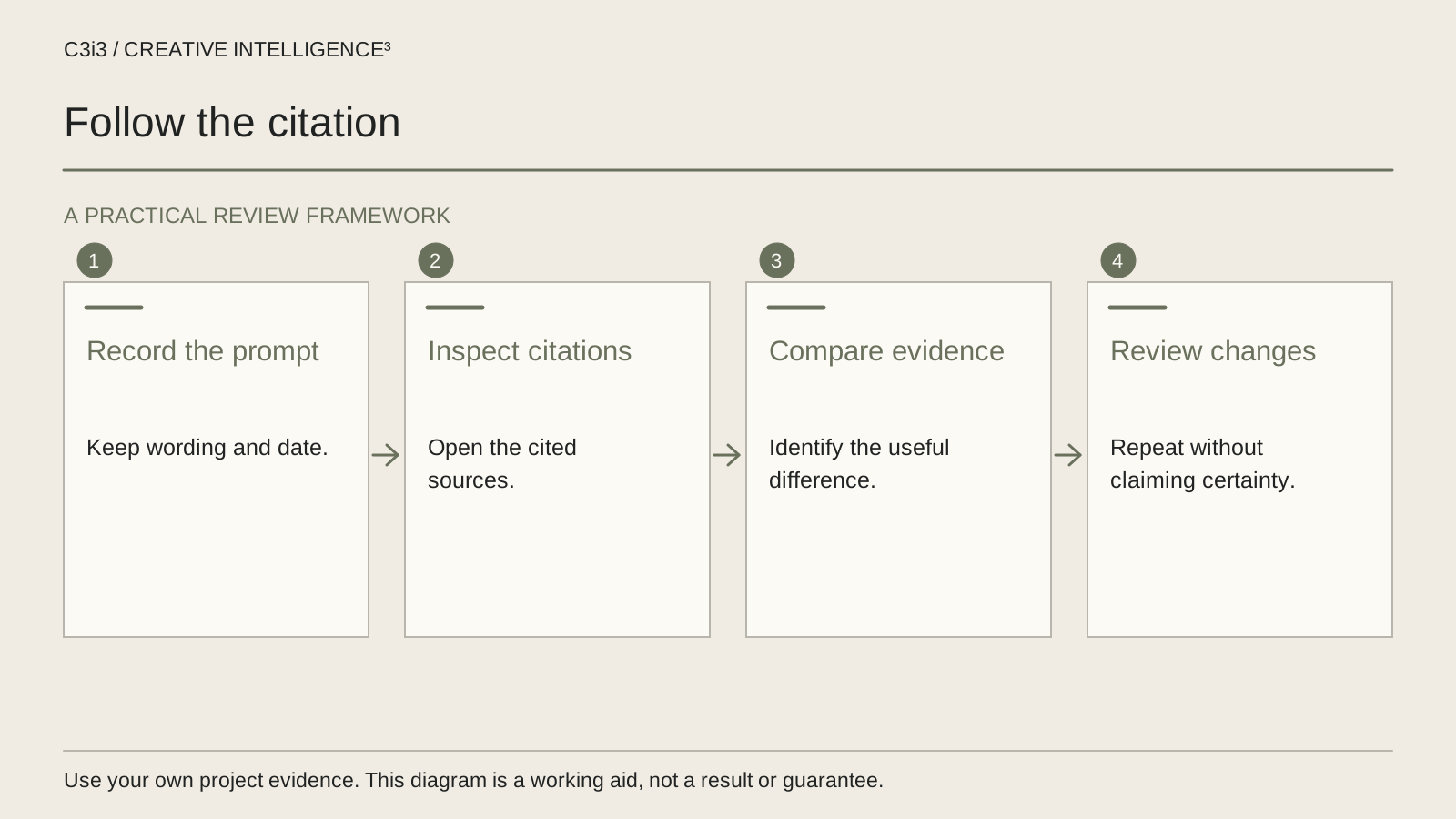
Open the cited page and identify the specific information that appears useful to the answer. It may explain a service scope, show a credible example, describe a process or provide a comparison. Record the role of the source rather than merely copying its headline. A citation to an independent resource is not the same as a citation to an agency’s sales page.
Compare that evidence with the best existing page on your website. Can a reader find the same kind of necessary information? Does your page describe who the service is for, what work is included and how the business supports its statements? A generic claim that you provide excellent service may leave the actual buying question unanswered.
Do not manufacture a customer story, award or review to close a perceived gap. If you cannot publish client details, use an honestly labeled illustrative workflow or explain your process without pretending it is a completed case. For relevant regional context, connect to the existing San Francisco service information.
The useful output is a short evidence gap: which question is unanswered, which page should address it and who can supply accurate support. That is more actionable than a list of competitor names.
How do you check Perplexity access without weakening site security?
Ask the website team to review the current official documentation before changing access rules. Perplexity’s crawler documentation distinguishes PerplexityBot, used for its search results, from Perplexity-User, associated with user-requested visits. It also publishes current address lists and firewall guidance. Those are separate behaviors, not one universal bot setting.
Use verified requests and the intended public pages when investigating a block. A user-agent label alone is not sufficient proof of a legitimate request. Keep private portals, account pages and confidential material protected. The objective is to make approved public information accessible, not to remove security controls from the whole site.
Record whether the issue is a site response, an intentional restriction or an unresolved infrastructure question. If the team changes a rule, document its scope and retest the public page. Do not treat an allowed request as evidence that the page must appear in an answer.
The documentation describes access mechanisms; it does not provide a guaranteed recipe for citations. Keeping that distinction clear prevents the technical work from becoming an exaggerated placement promise.

Which page changes are useful after the citation review?
Prefer a precise improvement to an existing page over a new page that repeats it. Clarify the service boundary, add an accurate answer to a customer question and connect it to supporting material. Keep important explanations in ordinary readable text rather than only inside a diagram or an image.
Add contextual internal links where they help a person continue the decision. An article about a specific AI citation problem can lead to AI search optimization services and a practical guide to measuring AI visibility and enquiries. Those links serve different purposes; the surrounding sentence should make that clear.
Review facts that appear across several pages, including the business name, service coverage and current ways to contact the team. Inconsistency can confuse customers even before it becomes a search problem. Do not imply a physical office in every location mentioned on a service-area page.
Give each edit a completion test. A subject expert can verify a technical answer; the site team can verify the public page and links. The content should remain useful even if it is not cited in the next generated response.
How do you know whether the work is helping?
Repeat the documented questions over time and record the results without selecting only favorable answers. Generated responses and their sources can vary. A new citation is worth noting, but it does not prove that one edit caused the change or that the same answer will appear for every future customer.
Compare answer observations with the evidence available on your own site. Analytics may identify some referrals, while incomplete attribution can leave other visits uncertain. Use the marketing reporting guide to keep visits, qualified enquiries and business outcomes separate. Do not manufacture missing attribution to make the report look complete.
Review factual accuracy as well as visibility. If an answer cites the business but describes the service incorrectly, record the error and inspect the public sources that could be contributing to it. A mention is not automatically a useful outcome.
Close each review with a practical decision: correct a fact, improve a relevant page, investigate access or continue observing. This keeps Perplexity SEO connected to customer clarity and verifiable work instead of a race to collect screenshots of your name.
Keep this checklist beside you
Questions before the next step
Why does Perplexity mention a competitor one day and not the next?
Generated answers and their cited sources can vary with the question, context and system behavior. Preserve the exact test conditions and compare a stable question set. One changed answer is not enough evidence to diagnose a site problem or establish a lasting ranking change.
Does allowing PerplexityBot guarantee a citation?
No. Public access and answer selection are separate matters. The website team can investigate and correct unintended restrictions on approved public pages, but the system still decides which sources to use. Keep the completed access test separate from later citation observations.
Should we publish a page for every Perplexity question?
No. Map related questions to useful existing pages first. Create a new guide only when it serves a distinct customer task and adds substantive information. Several near-identical pages can make the site harder to maintain without giving readers a better answer.

How C3i3 Can Help
C3i3 can help review the questions buyers ask, the evidence available on your website and the practical work needed to improve public service information. We connect citation observations with content, access checks and enquiry measurement without promising a particular generated recommendation.