



































In this article
A small business can collect plenty of search screenshots and still struggle to answer a basic question: is this work helping us attract suitable customers? The difficulty often comes from mixing different observations into one impressive-looking score.
A useful measurement system does not need dozens of tools. It needs a clear question for each tool, a repeatable method and an honest distinction between what was observed and what remains unavailable.
What should you decide before choosing an AI-search tool?
Decide what you need to learn and what action would follow the answer. “Are we visible?” is too broad on its own. You may need to know whether the right service page is discoverable, whether selected answers cite your website or whether inquiries match your market.
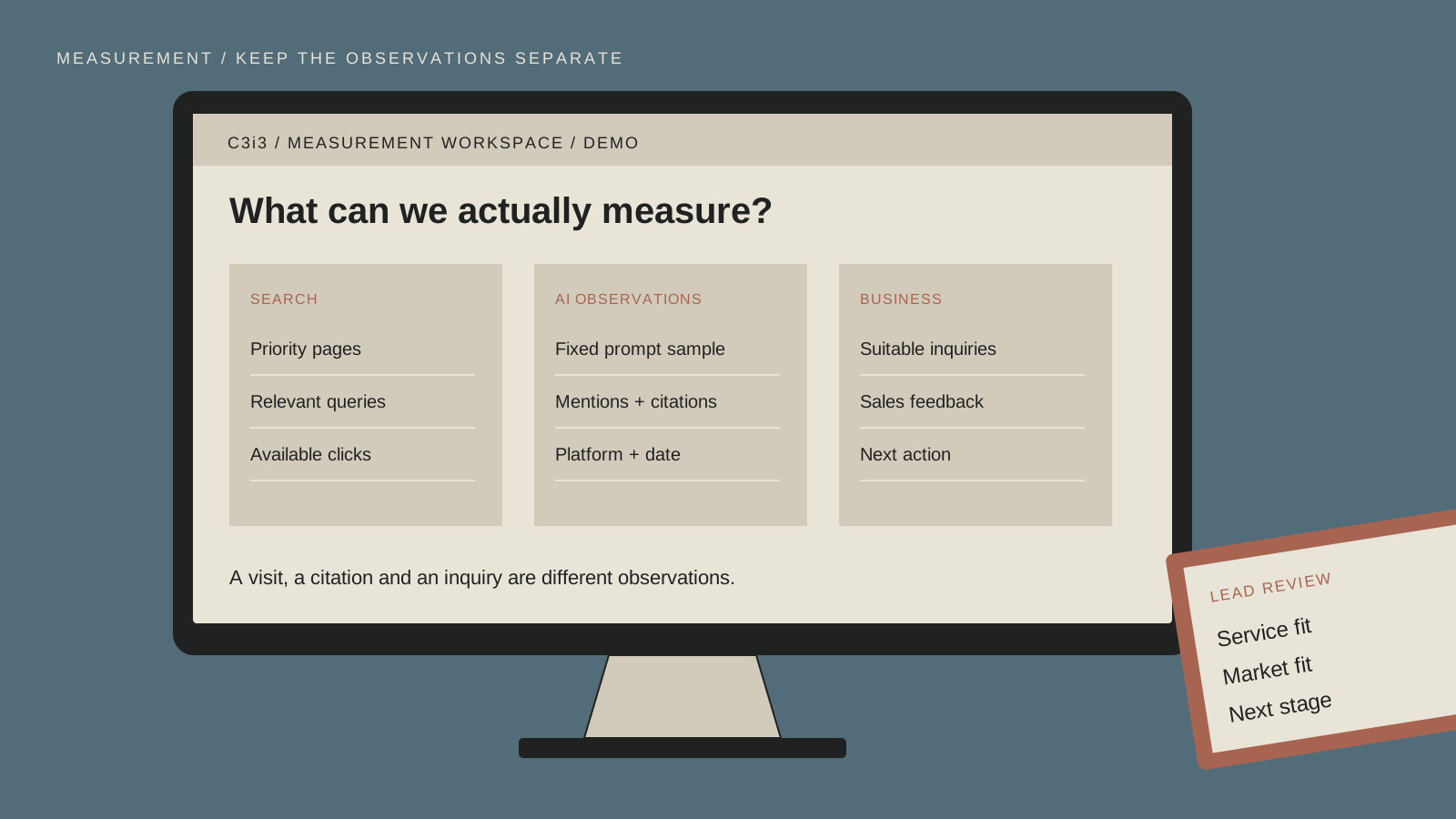
Write a small measurement plan with four columns: question, observation, source and decision. For example, “Do visitors understand this service?” might use relevant page behavior, repeated sales questions and inquiry quality. A ranking screenshot alone would not answer it.
Choose one definition for a qualified inquiry. Include the relevant service, geography or market, plausible scope and a reachable contact when those are important to your business. Keep spam, internal tests and existing-customer support requests separate.
Practical tip: Record the baseline before implementing a major change. Save the page URL, the change date, the relevant search period and the prompt set. That context becomes valuable when you later interpret a shift. Our AIO agency guide explains what to require from a provider’s reporting.
What can Google Search Console tell you about AI-search performance?
Search Console provides available information about how your site performs in Google Search. It can help you examine queries, pages and changes in search clicks or impressions, subject to the reporting available for your property.
Google states that traffic from AI features is included within the overall Web search reporting. Do not treat a change in a page’s total Google clicks as separately proven AI Overview traffic. A report should use the label the data actually supports. See Google’s explanation of AI-feature measurement.
Use page-level comparisons to investigate practical questions. Did the improved service page become more visible for relevant searches? Did the search mix shift toward the intended topic? Did a technical change coincide with an unexpected decline? Record other changes that could affect interpretation.
Search performance is one part of the evidence. It does not identify the quality of every inquiry or the source of every sale. Combine it with the pages changed and the business team’s observations.
Try this: Review a meaningful date range and the comparable prior period, then note seasonal factors or campaigns. Avoid treating a few days of movement as proof of a lasting effect.
What can website analytics show about AI referrals and conversions?
Analytics can help you review visits from identifiable sources, page engagement and recorded website actions. It is useful for understanding what happened on your website, within the limits of the implementation and data collected.
An identifiable referral from an AI service is evidence of that visit source. Missing referral information is not proof that AI played no role. A person may read an answer, remember your name and return another way. Privacy settings, browser behavior and the journey itself can affect what is observable.
Define actions carefully. A form submission, a phone-link click and a document download should not all be reported as the same business result. A phone-link click shows intent to call; it does not prove that a call connected or became a customer.
Test the implementation using a controlled visit and clearly labeled test action, then confirm the expected event is recorded. Do not create fake client inquiries merely to inflate a dashboard. Exclude test activity where the reporting process allows it.
C3i3’s analytics setup support can be scoped around the actions that matter to your business, rather than a generic list of events.
How do you build a repeatable AI visibility prompt test?
Use a manageable set of questions that reflect actual customer decisions. Separate general discovery questions, service evaluation questions and prompts that name your brand. A named-brand question tests something different from an open request for a provider.
Record the exact prompt, platform, mode, date, result and source URL. Mark whether the business was mentioned, whether a clickable citation appeared and whether the cited page answered the question. Keep “not observed” separate from “test failed” or “data unavailable.”
Do not quietly replace poorly performing prompts with easier ones. If the business changes its offer or you add a new topic, document the new version of the sample. Comparisons should make clear whether they use the same set of questions.
A third-party tool may automate parts of this process. Ask which platforms it checks, how often, what region or language it uses and how it counts a mention. A score without its denominator is difficult to interpret.
Practical tip: Manually inspect a few recorded answers each reporting cycle. Check that the tool identified the correct business and that a citation was not confused with an unrelated company that has a similar name.
How should you evaluate third-party AI-search visibility tools?
Evaluate coverage, transparency and exportability before you evaluate the dashboard’s appearance. A tool should help you understand its sample and reproduce the observations that matter.
- Which platforms and search modes are included?
- Can you inspect the underlying prompt and answer?
- Are mention, citation and referral clearly distinguished?
- Can you export the observations and keep your history?
- How are failed checks and unavailable answers handled?
- Does the price include the number of prompts and checks you need?
If you use Ubersuggest for keyword research or AI visibility, keep those datasets separate in your interpretation. A keyword’s estimated search volume does not tell you how often your brand appears in AI answers. Likewise, a sampled visibility result does not establish Google ranking or lead attribution.
You do not need to purchase every tool before improving the website. Start with a clear reporting question and a small, documented process. Add automation when the volume of checks or the need for consistency makes it useful. Keep current pricing and feature details out of a long-term plan until they have been checked for the package you intend to buy.
What should your monthly AI-search report actually show?
A useful report connects the completed work to the available observations and the next decision. Keep the structure simple enough that an owner can review it without learning a new reporting language.
Show the URLs changed, the reasons for the changes and any outstanding approvals. Summarize the available search and referral information. Present the prompt sample with its scope and limitations. Then review suitable inquiries, common misunderstandings and the action proposed for the next period.
For an illustrative month, a business might improve two service pages and receive several relevant inquiries. The report can state those facts. Unless the evidence supports the connection, it should not claim that every inquiry was caused by the new content or an AI citation.
Ask the team handling sales which conversations were useful. Record the service requested, whether the buyer fit the business and the next stage reached. That feedback often reveals a content gap the analytics dashboard cannot explain.
For a broader performance discussion, read how to tell whether your SEO agency is working. Search and AI measurement should help you choose the next useful improvement, not simply accumulate screenshots.
What else should you know about AI-search measurement tools?
Can a tool show every time an AI assistant recommends us?
Treat a tool’s result as the coverage it documents. A sample of platforms, prompts and dates is not a complete record of every user’s answer.
Should we track only prompts with our company name?
No. Keep brand prompts separate from discovery questions that do not name you. They answer different questions and should not be blended into one unexplained score.
What is the simplest starting setup?
A documented prompt sample, available search reports, correctly tested website actions and a short lead-quality log can provide a useful foundation. Add paid tooling when it solves a defined need.
How can C3i3 help you build useful AI-search reporting?
We can help define what to measure, check the website actions and connect the report to page improvements and sales feedback. Bring the tools you already use so the first scope addresses gaps rather than adding unnecessary software.
Explore analytics and optimization services, AI-search support or contact C3i3 to discuss the reporting questions.