



































In this article
Your SEO agency sends a report full of charts, but you still do not know what changed on the website or whether the inquiries fit your business. The problem may be the work, the measurement or simply the way the report is organized.
A useful review begins with three questions: what did we agree to do, what was completed, and what can the evidence actually tell us? These questions help you evaluate the engagement without expecting a provider to control every search result or sales outcome.
What should your SEO agency show it completed?
Ask for a brief change log tied to URLs and defined tasks. It should identify the reason for the work, the person responsible and the implementation status. Recommendations, drafts and published corrections are different stages.
A useful entry might explain that a service page was rewritten to clarify suitability, that supporting links were added and that the contact path was tested. “Content optimized” is less useful when you cannot see what changed or why.
Compare the log with the agreed scope. Were expert interviews, technical fixes or page updates completed? Were approvals delayed? Did an urgent site issue replace planned work? Those tradeoffs should be visible so the discussion stays fair to both teams.
Practical tip: Pick two completed items and open the pages during the review. Ask how each change helps a customer or addresses a verified problem. That makes the conversation concrete without requiring you to inspect every technical detail.
Use the SEO company selection guide if the original scope is too vague to assess.
Which search performance changes deserve attention?
Focus on the pages and queries related to the business you want. Total traffic can provide context, but it may hide a shift toward irrelevant topics or away from a priority service.
Ask which pages gained or lost visibility, what changed in their search mix and whether the reporting periods are comparable. Note seasonality, a new service, a migration, advertising or changes in tracking. A useful analysis explains uncertainty rather than selecting only the chart that looks favorable.
If a page improves for an easy but low-relevance phrase, ask how that phrase connects to a customer decision. If overall traffic declines but relevant inquiries improve, examine the reasons before concluding that the program failed. Different measures can move in different directions.
Google’s guidance on hiring an SEO emphasizes realistic expectations and understandable recommendations. Use that standard when reviewing the explanation behind performance changes.
Try this: Agree on a small group of priority pages for the next reporting period. The report should show their purpose, work completed and available evidence, rather than changing the focus whenever a different chart improves.
How do you know whether SEO inquiries are actually qualified?
Define qualification with the people who handle the requests. A useful definition may include the relevant service, market, project scope, timing and ability to reach the prospect. It should fit your business rather than a generic dashboard label.
Keep spam, internal tests, existing-customer support and new sales requests separate. A higher form count can be misleading if it includes more of the first three. A document download may be valuable, but it is not automatically a sales inquiry.
Review the next stage where the information exists. Did the request lead to an appointment, technical discussion, quote or booked work? Avoid expecting every early interaction to become a sale, especially in a longer B2B cycle. Record why a request did not progress when the team can determine it.
If attribution is incomplete, keep the uncertainty visible. A prospect’s self-reported discovery source is useful evidence but not a full record of every touchpoint. A search visit followed by a later direct visit can be difficult to connect reliably.
Practical tip: Discuss a small sample of suitable and unsuitable inquiries each month. Their questions can reveal a page improvement that the traffic report does not explain.
How should you assess an agency’s AI-search claims?
Ask what was observed, where it was observed and how the observation was recorded. A brand mention, linked citation, referral and qualified inquiry are different events.
For a prompt sample, request the exact questions, platform, mode, dates and cited URLs. Keep brand-naming prompts separate from open discovery questions. If the agency reports a percentage, ask for the denominator and how failed or unavailable checks were handled.
Google says AI-feature traffic is included in overall Search Console Web reporting. Do not accept an overall change in Google clicks as separately established AI Overview traffic. See Google’s AI-feature guidance.
A useful agency explains both favorable and unfavorable observations. It should not imply that one screenshot proves a stable recommendation for every customer or that a third-party tool sees the whole market.
Read the AI-search measurement tools guide to evaluate the method. The goal is an interpretable record that helps choose the next improvement, not a new certainty label for incomplete information.
What should you ask in your monthly SEO review?
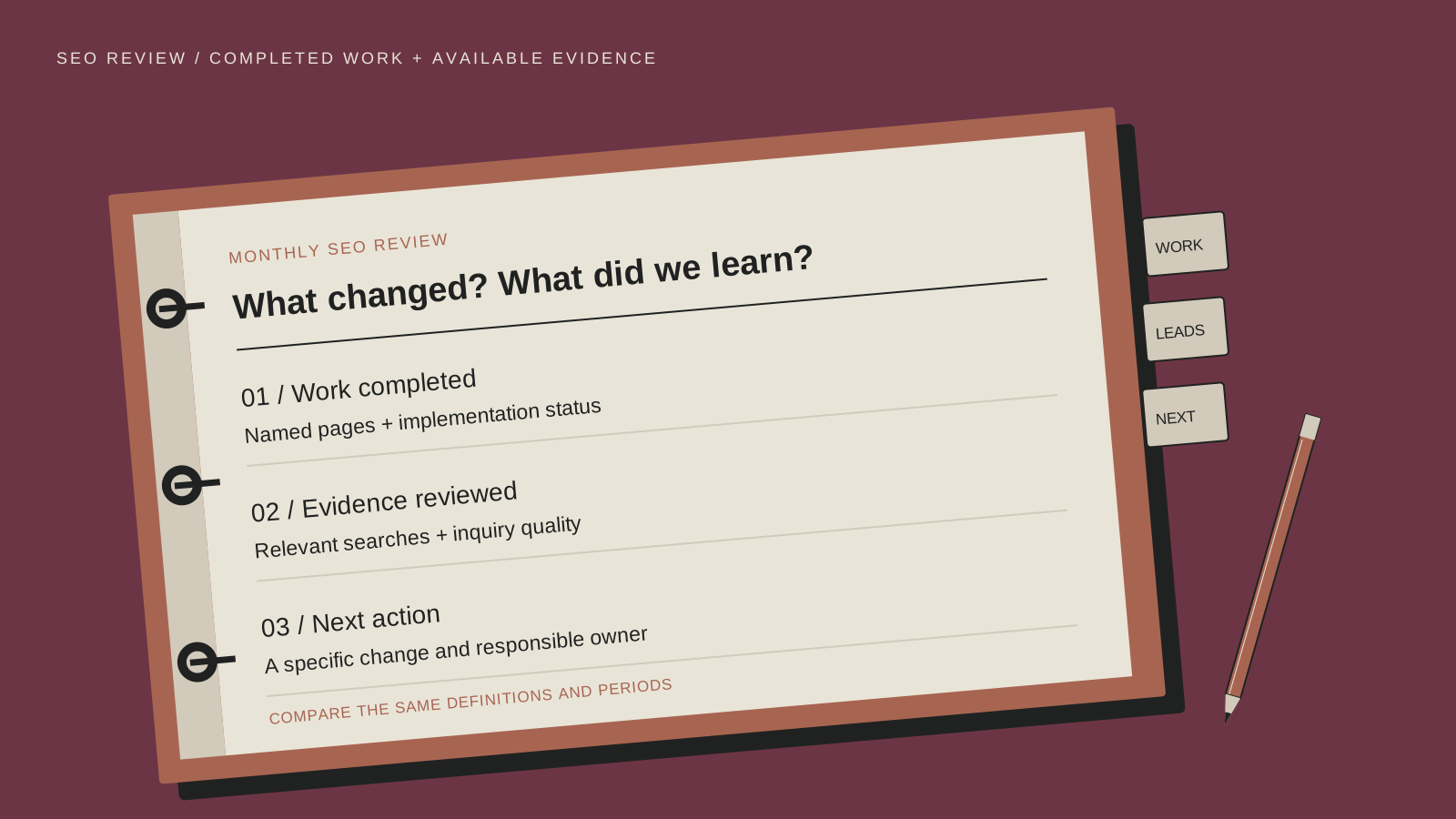
Use a repeatable review that connects scope, evidence and action. The following questions work for a local service business or a B2B company when adapted to its buying cycle.
- Which agreed tasks were completed, implemented or delayed?
- Which priority pages changed, and why?
- What happened to relevant search visibility and website actions?
- How many requests met our qualification definition?
- What did the sales team learn from those requests?
- Which other campaigns or operational changes affect interpretation?
- What remains unknown or unavailable?
- What should we change next, and who owns it?
Agree on the decision at the end. You may continue the plan, clarify the audience, adjust the page priorities or resolve an approval bottleneck. A report should not end with a vague promise to monitor performance if there is an identified issue to address.
For budgeting questions, read how to compare SEO costs and scopes. The value discussion becomes clearer when you can connect the fee to completed responsibilities and relevant observations.
When should you change the SEO plan or reconsider the agency?
Change the plan when the evidence identifies a different priority, the business changes its offer or the current scope cannot address the problem. Reconsider the relationship when the provider will not explain the work, repeatedly misses agreed responsibilities or makes unsupported claims.
Start by asking for a specific correction. If implementation is delayed, agree who will resolve it. If the content attracts unsuitable requests, revisit the brief and page. If reporting blends unrelated measures, ask for clearer definitions and a comparable view.
Allow for dependencies and the time needed to observe outcomes. A completed technical correction is not proof of a future ranking, but it can still be necessary work. Conversely, a claim that “SEO takes time” does not excuse the absence of agreed deliverables or a coherent method.
Be cautious with guaranteed rankings, invented results or unexplained practices that conflict with Google’s spam policies. Ask for the rationale and official reference before approving the tactic.
Practical tip: Document the issue, requested change and review date. That creates a fair basis for deciding whether the agency is responding effectively or whether another provider would be a better fit.
What else should you ask when reviewing your SEO agency?
How long should I wait before reviewing SEO results?
Review completed work and implementation regularly from the start. Evaluate business outcomes over a period suited to your sales cycle and the changes made. Do not substitute a universal deadline for that context.
Is declining traffic always a sign that the agency is failing?
No. Investigate which pages and searches changed, whether tracking changed and what happened to suitable inquiries. A decline can be important without telling the whole story on its own.
What if the agency will not share its change log?
Ask what alternative evidence shows the completed work. You should be able to understand the recommendations, implementation and reporting covered by the engagement.
How can C3i3 help you make SEO reporting easier to evaluate?
We can help connect page priorities, implementation and reporting with the services and inquiries that matter to your business. Bring your current scope and the questions the report leaves unanswered.
Explore ongoing SEO management or contact C3i3. If you are choosing a new provider, use the Bay Area SEO buyer’s guide.