








































In this article
An SEO quote can be difficult to evaluate when the price is clear but the work is vague. One agency may include writing and development; another may provide recommendations for your team to implement. Comparing the monthly fee alone misses that difference.
For a San Francisco business, the useful budget begins with the website’s condition, the services you want to grow and the responsibilities you need someone to own. This guide explains how to build that comparison without presenting hypothetical numbers as a market-rate survey.
What determines the cost of an SEO agency engagement?
The main driver is the work required and who performs it. A small service website with clear content and a few technical issues can need a different scope from a large catalog with overlapping pages, incomplete product data and complex approvals.
Research depth also matters. An agency writing about a specialized B2B application may need interviews and technical review. A service-page update may require design or development to implement properly. A proposal should identify those requirements rather than hide them inside “optimization.”
Implementation is a common source of confusion. Does the agency fix the issue, give your developer a recommendation or coordinate another provider? Ask who tests the result. The same apparent task can involve very different responsibilities.
How do monthly retainers, projects and hourly SEO support differ?
A retainer reserves an ongoing scope or capacity for agreed priorities. A project defines a bounded deliverable, such as an audit and a set of page updates. Hourly support prices time spent on approved tasks. Each can be useful when the responsibilities and limits are clear.
For a retainer, ask how unused capacity, urgent issues and changing priorities are handled. Does the fee promise a fixed number of deliverables, a time allowance or a broader service? Avoid assuming these are interchangeable.
For a project, define the starting materials, review rounds, implementation and completion criteria. An audit delivered as a document is different from an audit followed by corrections and testing. For hourly work, agree how estimates and approvals operate before the work expands.
How can you build an illustrative SEO budget without guessing market rates?
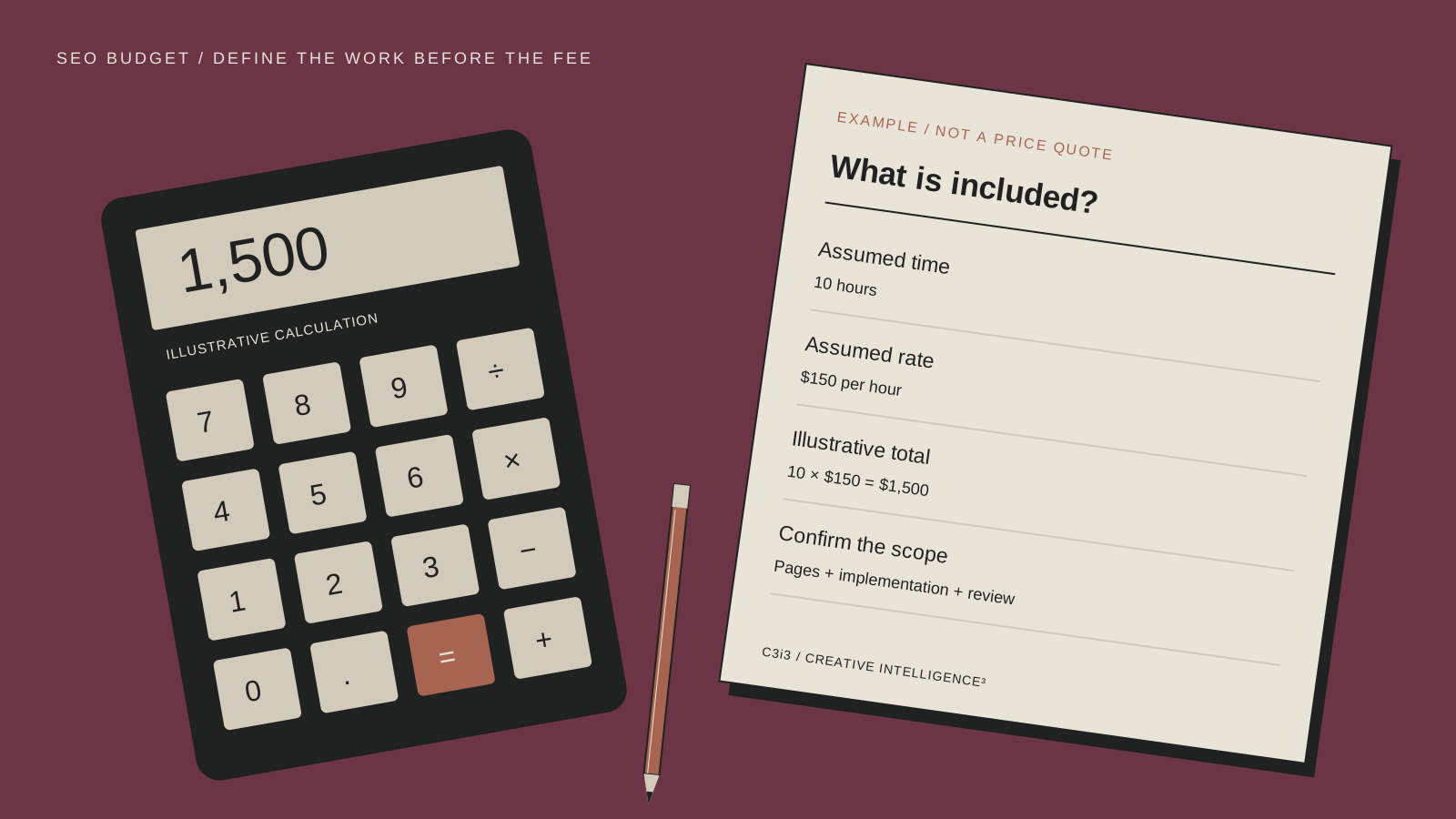
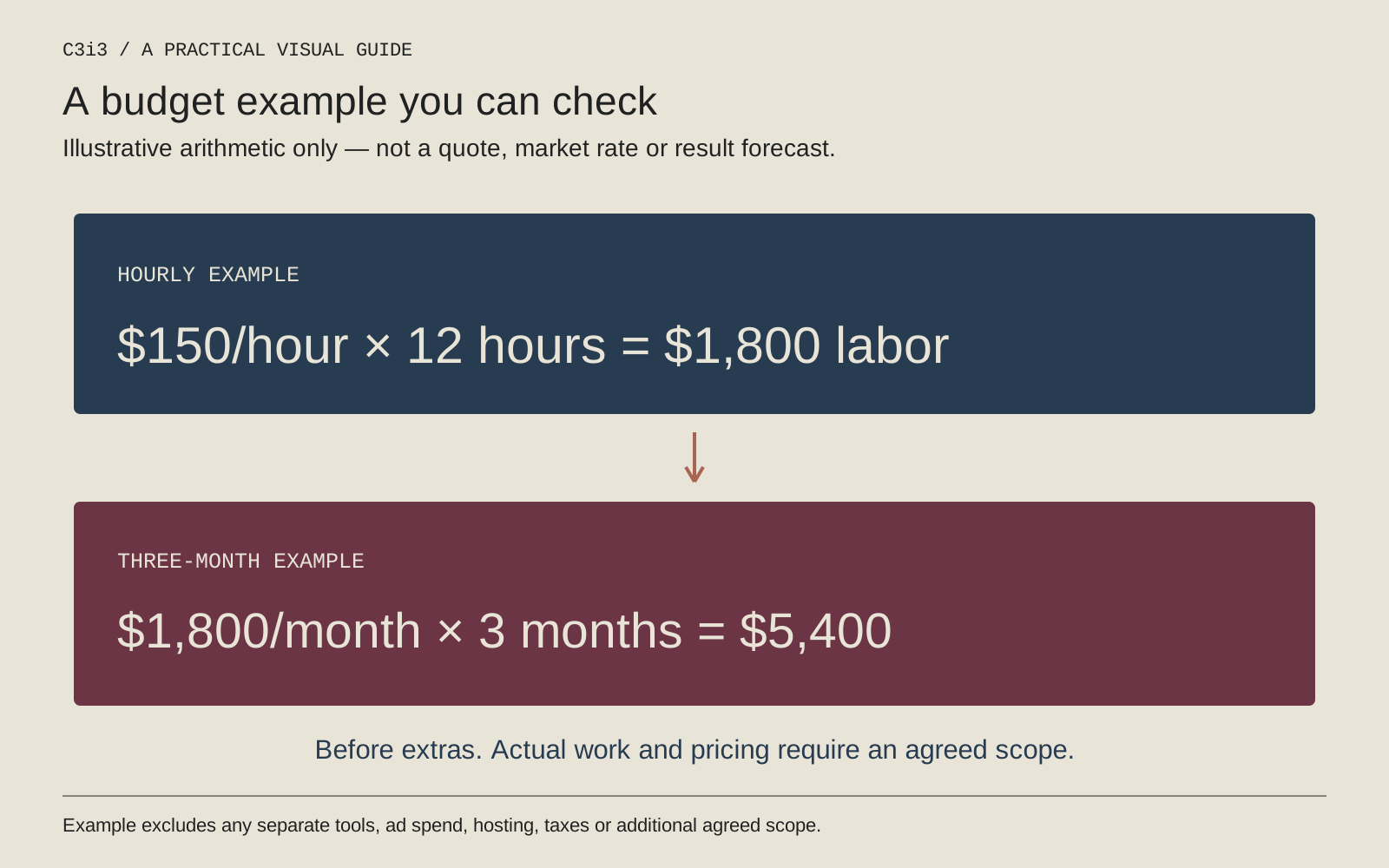
Use a transparent planning assumption to check the arithmetic, then replace it with a real quote. An assumed rate of $150 per hour multiplied by 12 hours produces $1,800 of labor. Three identical months would produce $5,400 before extras. These are illustrative numbers, not a market-rate survey, typical San Francisco prices or a C3i3 quote.
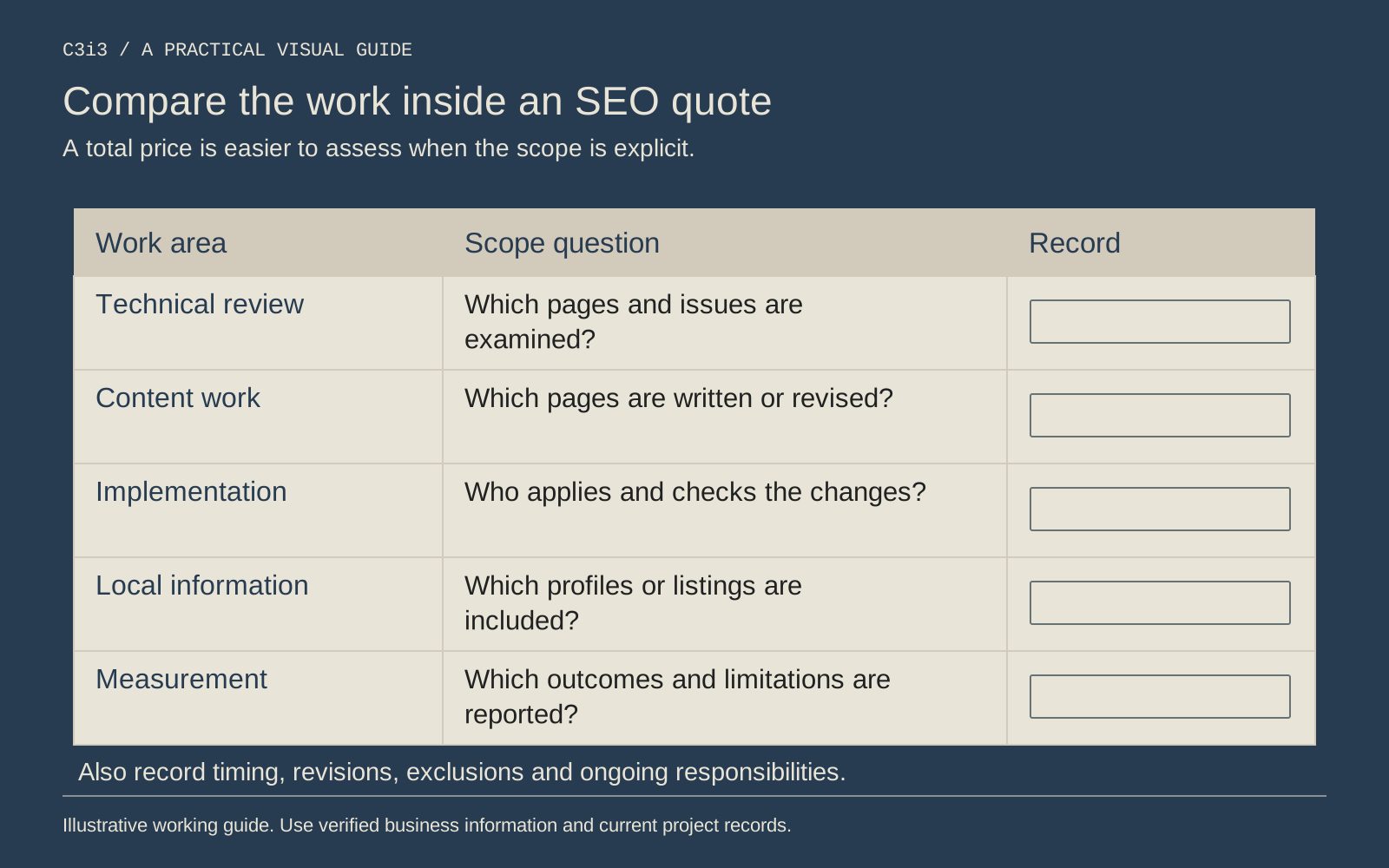
The useful question is what work the proposed capacity buys. Ask which pages, research, implementation and review stages are included. Project-based providers may price deliverables instead of hours; those boundaries still need to be explicit.
Which SEO work should a San Francisco business fund first?
Fund the work that addresses the most important verified obstacle. That might be a service page people cannot find, an unclear offer, missing evidence or a broken contact journey. A large publishing schedule should not automatically come first.
For an illustrative consultation business, the first phase could review the main service page, clarify project suitability, improve the route from related articles and test the inquiry form. For a company with a migration problem, URL and indexing work may take priority.
Ask the agency to explain the expected benefit and dependency for each task. Some work makes the website usable or measurable before broader outcomes can be evaluated. That is a legitimate reason for the task, but it should be described honestly.
Agency fees pay for the provider’s work. Google states that it does not sell inclusion or ranking in organic results, and buying Google advertising does not improve organic placement. Keep ad spend and organic SEO charges distinct.
What should you ask when comparing SEO agency quotes?
Ask every provider to explain the same six areas: research, page changes, content, implementation, reporting and your team’s responsibilities. A comparison becomes useful when the gaps are visible.
Find out whether original artwork, expert interviews, revisions and publication are included. Ask how the agency handles a page that requires additional development. Clarify the tools you must purchase and whether accounts and content remain under your ownership.
Review the cancellation and handover process before signing. A business should understand what it can keep, which recurring charges continue and how access is transferred. If you are evaluating contracts, resolve the specific terms with the people responsible for that agreement.
How do you decide whether the SEO budget is producing useful value?
Compare the completed scope, available performance evidence and quality of sales opportunities. Keep the observation period realistic for your business and note other changes that may affect the result.
For a service business, suitable inquiries and booked work may be relevant outcomes. For a B2B company, a qualified application discussion or quote request may be an important intermediate stage. Avoid treating every form submission or download as a sale.
Discuss whether the next period should continue, narrow or shift the scope. If the website still lacks essential service information, improving it may remain the priority. If the content attracts the wrong inquiries, revisit the audience and offer before increasing production.
Compare the total commitment before comparing monthly fees
Use the same time period for every proposal. Enter actual quoted amounts in your own copy of this worksheet; leave unpriced items marked “not quoted.” Do not treat an unknown cost as zero.
| Cost or responsibility | What to record for each quote |
|---|---|
| Initial phase | Audit, baseline, interviews and setup: fee and completion criteria. |
| Recurring work | Exact period, deliverables or capacity, revisions and reporting. |
| Implementation | Included, done by your team, or separately quoted; name the owner. |
| Extras | Software, artwork, development and other approved expenses. |
| Media | Advertising budget and management, shown separately from organic SEO. |
| Total and exit | Initial + recurring + known extras; note taxes, cancellation and handover terms. |
Illustrative arithmetic only: at an assumed $150 per hour, 12 hours would cost $1,800 in labor; three identical months would total $5,400 before extras. These are not typical San Francisco rates or C3i3 prices. Replace every assumption with the provider’s quote. Then ask what deliverable that capacity realistically buys and which dependency could change the total.
Keep the essentials in view
What else should you know about San Francisco SEO agency costs?
Are the example fees in this guide actual agency prices?
No. They are transparent arithmetic examples using an assumed rate. Obtain a written quote for your actual website, deliverables and responsibilities.
Does a higher SEO fee guarantee stronger rankings?
No. Price can reflect scope and expertise, but search platforms choose rankings. Evaluate the work, evidence and fit rather than treating the fee as a guarantee.

How C3i3 Can Help
C3i3 can help clarify the pages, tasks and implementation responsibilities your project needs. Share your website, priority service and the work your own team can handle. We can discuss a bounded first phase and the information needed to prepare an appropriate scope.