








































In this article
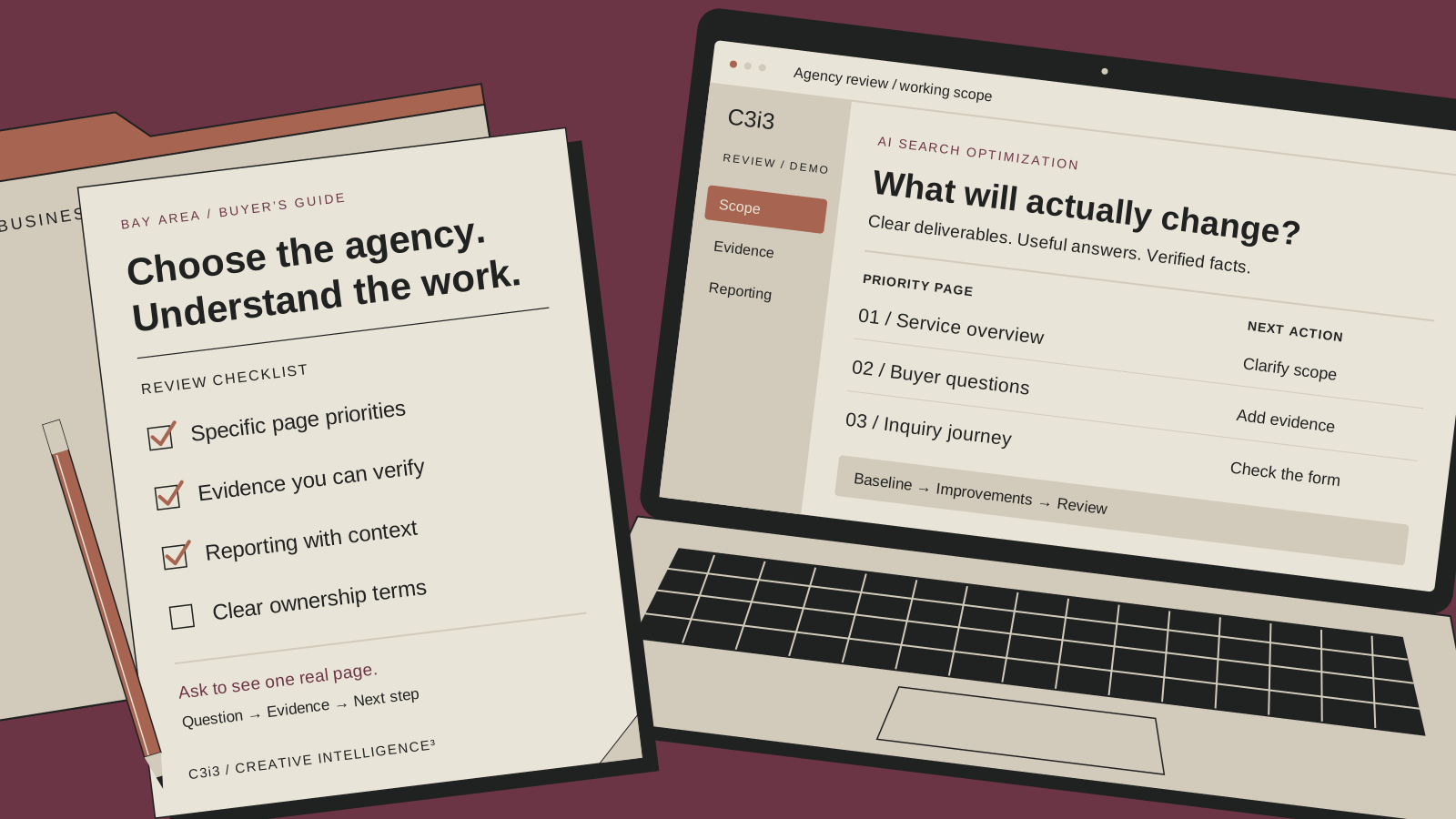
Choosing an AI search optimization agency is easier when you ask to see the work. Which customer questions will the team research? Which pages will it improve? What evidence will support your claims? How will you know whether the changes help people find, understand and contact your business?
For a Bay Area small business, compare how each agency connects your actual buyers, website evidence and inquiry process to a specific scope of work.
What is an AIO agency, and how is it different from an SEO agency?
An AIO agency helps a business make its online information accessible, understandable and useful in AI-assisted search. That can include improving existing pages, researching buyer questions, checking business facts and monitoring how a business appears in selected search experiences.
The terminology is inconsistent. AIO can mean AI optimization or refer to Google AI Overviews. AEO means answer engine optimization; GEO means generative engine optimization. Providers sometimes use these labels for overlapping services. Ask what each term means in the proposal and which platforms the work covers.
SEO supplies much of the foundation: discoverable pages, clear site structure, useful content and a website people can use. Google states that its established SEO practices apply to AI Overviews and AI Mode, with no additional requirements or special optimization needed. That is guidance about Google, not a universal specification for every AI service. Read Google’s AI features guidance alongside an agency’s recommendations.
Practical tip: Ask the agency to rewrite its offer without acronyms. “We will improve these four service pages, interview your technical lead and document these buyer questions” tells you more than “We will activate your GEO ecosystem.” For a broader explanation, start with what AI search optimization means.
For a closer comparison of the overlapping services, read AEO vs. SEO vs. AIO.
What should a small business expect an AI search optimization agency to do?
Expect a coordinated plan that connects customer research, website improvements, evidence and measurement. An article quota alone does not describe an AI search strategy.
A useful scope begins with your services, profitable customer types, service area and sales process. It reviews what people need to know before they inquire, then identifies where the website fails to answer those questions. The team should distinguish a technical obstacle from a missing explanation or an unsupported claim.
- Research: Gather actual sales questions, available search data and a repeatable set of relevant AI-search prompts.
- Prioritize: Identify existing pages to improve, gaps worth filling and work that can wait.
- Implement: Assign writing, development, fact checking and approval responsibilities.
- Measure: Record the baseline, completed changes, observable visibility and inquiry quality.
Ask this: “Which page would you improve first, what would you change, and why would that help a prospective customer?” The answer reveals whether the agency understands your offer.
What technical checks should an AIO agency perform before writing content?
The initial review should examine crawl access, indexing signals, canonical URLs, internal links, mobile usability and important content rendered as readable text. It should also test the contact journey. Ask the team to document the affected URLs and the proposed remedy rather than sending an unexplained audit score.
Check each platform’s controls separately
For Google’s AI features, Google says a supporting page must be indexed and eligible for a search snippet. Eligibility does not guarantee inclusion. For ChatGPT search, OpenAI identifies OAI-SearchBot as its search crawler and distinguishes it from GPTBot, which concerns potential model-training use. Those controls are independent; allowing search access does not require allowing GPTBot. An agency should explain the decision and obtain your approval before changing it. See OpenAI’s crawler documentation.
Require a reason for proposed files and markup
Google does not require special AI text files or special AI schema for AI Overviews or AI Mode. Relevant structured data should describe what visitors can actually read. It does not purchase or guarantee an AI citation. Use Google’s structured data policies to assess markup claims.
Practical tip: Request a short change log: URL, issue, recommended fix, responsible person and approval status. That makes technical work reviewable.
Also check the property’s Search generative AI setting in Search Console. Excluding the site prevents its content and links from participating in the covered AI features. This choice is separate from ordinary Search inclusion and model-training controls; inclusion does not guarantee selection.
For ChatGPT search, check both OAI-SearchBot permissions and hosting or CDN access for OpenAI’s published searchbot IP ranges. GPTBot concerns potential training use. ChatGPT-User handles user-triggered visits and is not the search-inclusion control. A permitted request still does not guarantee a citation.
How should a Bay Area AIO agency support San Francisco, San Jose and East Bay businesses?
It should use local information when that information changes the customer’s decision. Replacing one city name with another does not create a useful local strategy.
San Francisco service businesses
A service firm might need consultation scope, project-fit answers and real coverage information. Use the San Francisco service-business guide to test whether the agency's proposed page work fits that brief.
San Jose B2B companies
A technical supplier may need application evidence, documentation and a route to specialist sales. The San Jose B2B services guide turns that brief into reviewable deliverables.
East Bay service-area businesses
A visiting contractor needs truthful coverage and scheduling information without invented city offices. Use the East Bay lead-quality guide to evaluate that customer path.
These are planning examples, not C3i3 client results. Ask an agency to show how its recommendations change for your actual audience. If its advice remains identical after you change the city, industry and sales process, the brief needs more work.
How can you tell whether an agency’s content will help customers and AI search?
Look for clear answers supported by facts your business can verify. The content should help a visitor decide whether your service fits, what happens next and which limitations matter.
Ask for one sample section based on a real question from your sales team. A useful answer starts directly, then explains the conditions, process and supporting evidence. It does not hide the answer beneath a long introduction or repeat the same keyword in every paragraph.
For example, “Can you replace our website without changing our domain?” deserves an explanation of migration scope, URL mapping, testing and launch responsibilities. “We deliver innovative digital transformations” does not answer it. Link the answer to the relevant service and any deeper guide that helps the buyer evaluate the work.
Evidence can include approved project examples, product specifications, original diagrams, process details and named expert review. The agency should distinguish documented results from hypothetical examples. If it proposes a case study, ask who validates the outcome and whether the client has approved publication.
Practical tip: Have a staff member who handles inquiries read the sample. Ask, “Would this answer our customer’s next question?” That is a useful editorial test even before visibility data exists. C3i3’s content marketing services connect this kind of writing with the pages and actions it supports.
What proof should you ask an AIO agency to show before hiring?
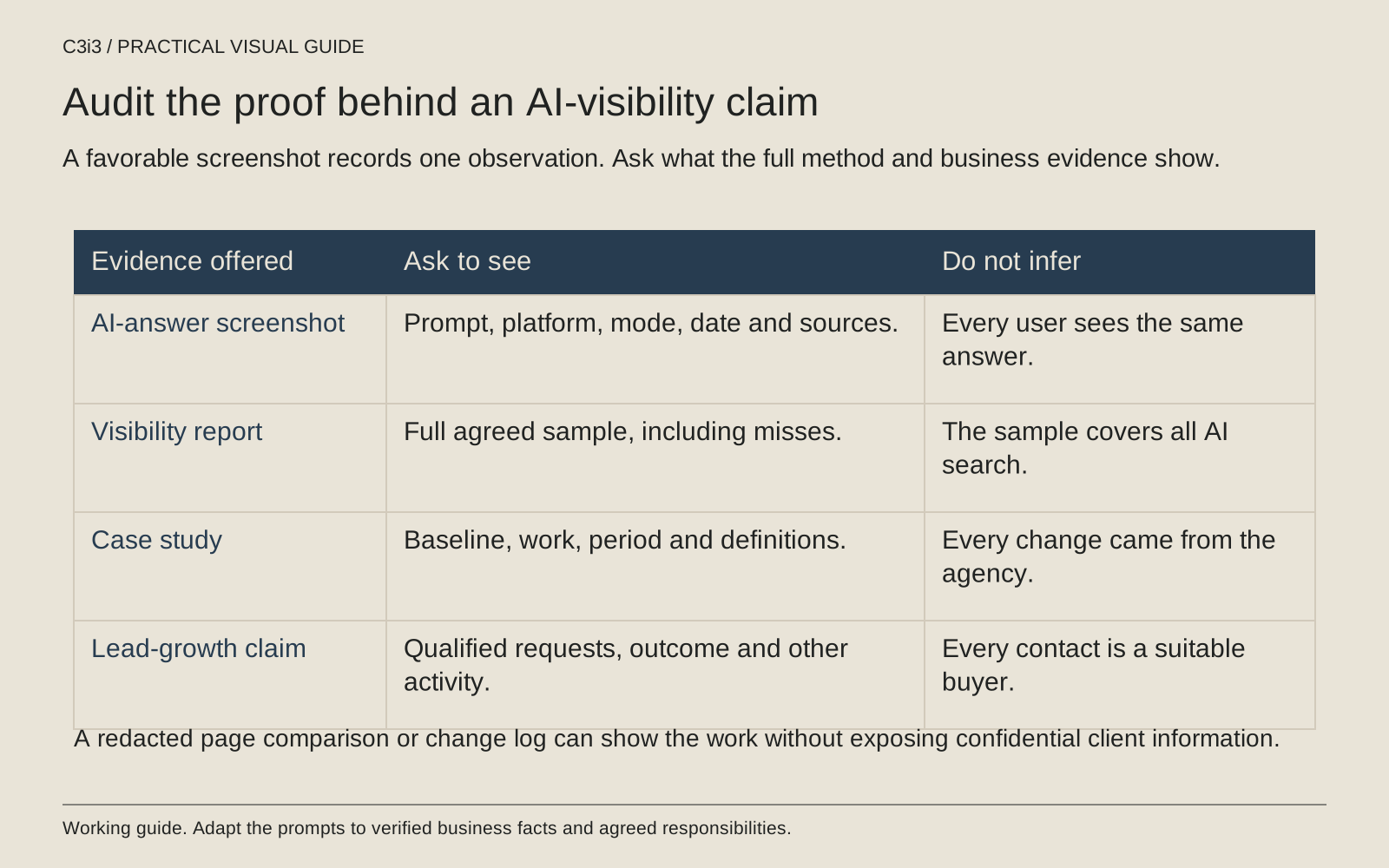
Ask for examples of its work, the context behind reported outcomes and an explanation of what it can reasonably attribute to its changes. A screenshot of a favorable AI answer is a record of one observation.
For a case study, request the starting situation, work completed, timeframe, measurement method and business outcome. If the provider reports more leads, ask how it defines a lead, whether the leads were qualified and whether other campaigns changed during the same period.
For an AI visibility demonstration, ask which prompt was used, which platform and mode produced the answer, when it was checked and whether the result was repeated. Separate a brand mention from a linked citation. Also ask to see missed prompts and unfavorable results; a useful reporting method should record both.
An agency may protect client confidentiality. It can still show a redacted page comparison, a sample change log or a report with its limitations explained. If it cannot establish an outcome, it should describe the work without converting it into a performance claim.
Google’s guidance on hiring an SEO recommends checking references, discussing the work and being wary of ranking guarantees. Apply the same scrutiny to an agency selling AEO or AIO.
How do you compare AIO agency proposals and pricing fairly?
Compare responsibility, depth and implementation before comparing the monthly fee. Two proposals with the same price can purchase very different amounts of useful work.
One provider may deliver recommendations for your developer to implement. Another may handle research, writing, development, quality assurance and reporting. Ask each to identify what is included, what requires your team’s time and what creates an additional charge.
- Which existing pages will be reviewed, and how are priorities chosen?
- How many substantive updates are included, and what does an update contain?
- Are expert interviews, original artwork and fact checking included?
- Who implements technical fixes and tests forms or tracking?
- Are research tools and reporting fees included?
- What are the revision limits, approval steps and cancellation terms?
There is no single price that proves quality. A business with a few local services has different needs from a manufacturer with a large catalog and multiple buying audiences. Ask for a written scope that fits your site and resources rather than accepting an unsupported market-average price.
Practical tip: Separate one-time discovery and setup from recurring work. Then compare the same defined period and deliverables. A lower fee may be reasonable for a smaller scope; the important question is whether that scope addresses your priority problem.
How should an AIO agency measure AI visibility, website visits and leads?
It should report these as different observations and explain the connection it can establish between them. Visibility is useful context; qualified inquiries and sales conversations tell you more about business value.
Record visibility consistently
Use a fixed set of relevant prompts, including questions that do not name your business. Record the platform, mode, date, exact prompt, brand mention and cited URL. Keep separate results for each platform. If the prompt set changes, document the change so the comparison remains interpretable.
Separate search traffic from AI-specific observations
Google also provides a separate AI-search impressions report. Keep those impressions distinct from visits and inquiries. The measurement guide explains the sources and their limits.
Connect inquiries to business quality
Agree on what makes an inquiry qualified: a suitable service, relevant geography, plausible scope and a reachable contact, for example. Review form submissions and calls with your sales team. Add an optional “How did you hear about us?” question where appropriate, while treating responses as self-reported evidence.
A useful report says what changed, what was observed, what remains unknown and what happens next. It should keep “no data available” separate from “zero results.” It should also explain whether the agency is measuring a sample of prompts or something broader. A tool’s coverage is not the entire AI-search market.
What should an AIO agency deliver in the first 90 days?
Use the first phase to establish a baseline, improve priority pages and review early evidence. Treat the schedule below as an example of accountable work, not a promise of rankings or a universal delivery timetable.
Days 1–30: research and prioritize
Confirm your audience, offers, service areas and available evidence. Review technical access and inquiry tracking. Select the first pages and buyer questions, record the baseline and agree on approval responsibilities. The useful output is a ranked work plan with reasons and named owners.
Days 31–60: implement and check
Improve the agreed pages, connect them with relevant internal links and resolve approved technical issues. Review claims with your team. Test the pages on mobile and verify the contact path. Publish new supporting material only when it answers a distinct question that existing content cannot cover well.
Days 61–90: review and refine
Repeat the documented visibility checks, review available search and referral data, and discuss inquiry quality with the people handling leads. Explain what the evidence supports and where the sample is still too small. Set the next priorities from those findings.
Practical tip: Agree on your own response deadlines. If a technical expert needs two weeks to approve a specification or case study, include that dependency in the schedule. An achievable plan makes both sides accountable without inventing a date when an AI system must cite you.
How can you score and shortlist the best AIO agency for your business?
Use the same questions for each provider and score the evidence behind its answers. The following scorecard is an editorial decision aid, not a validated performance prediction.
| Criterion | What a strong answer shows |
|---|---|
| Business understanding | Your actual buyers, offer, service area and sales process. |
| Page priorities | Specific URLs, clear problems and reasons for the sequence. |
| Content and evidence | Useful writing, expert review and verifiable claims. |
| Technical capability | Named implementation responsibilities and documented checks. |
| Measurement | A baseline, repeatable method and clear attribution limits. |
| Scope and communication | Deliverables, owners, reviews, fees and dependencies. |
| Ownership and exit | Your access to accounts, content, source files and reporting. |
For each criterion, assign zero when no evidence is provided, one for a plausible but incomplete answer, and two for a specific answer supported by an example. The maximum is 14. Use the total to organize your discussion, not to ignore a serious weakness. An unclear ownership clause can matter more than a high overall score.
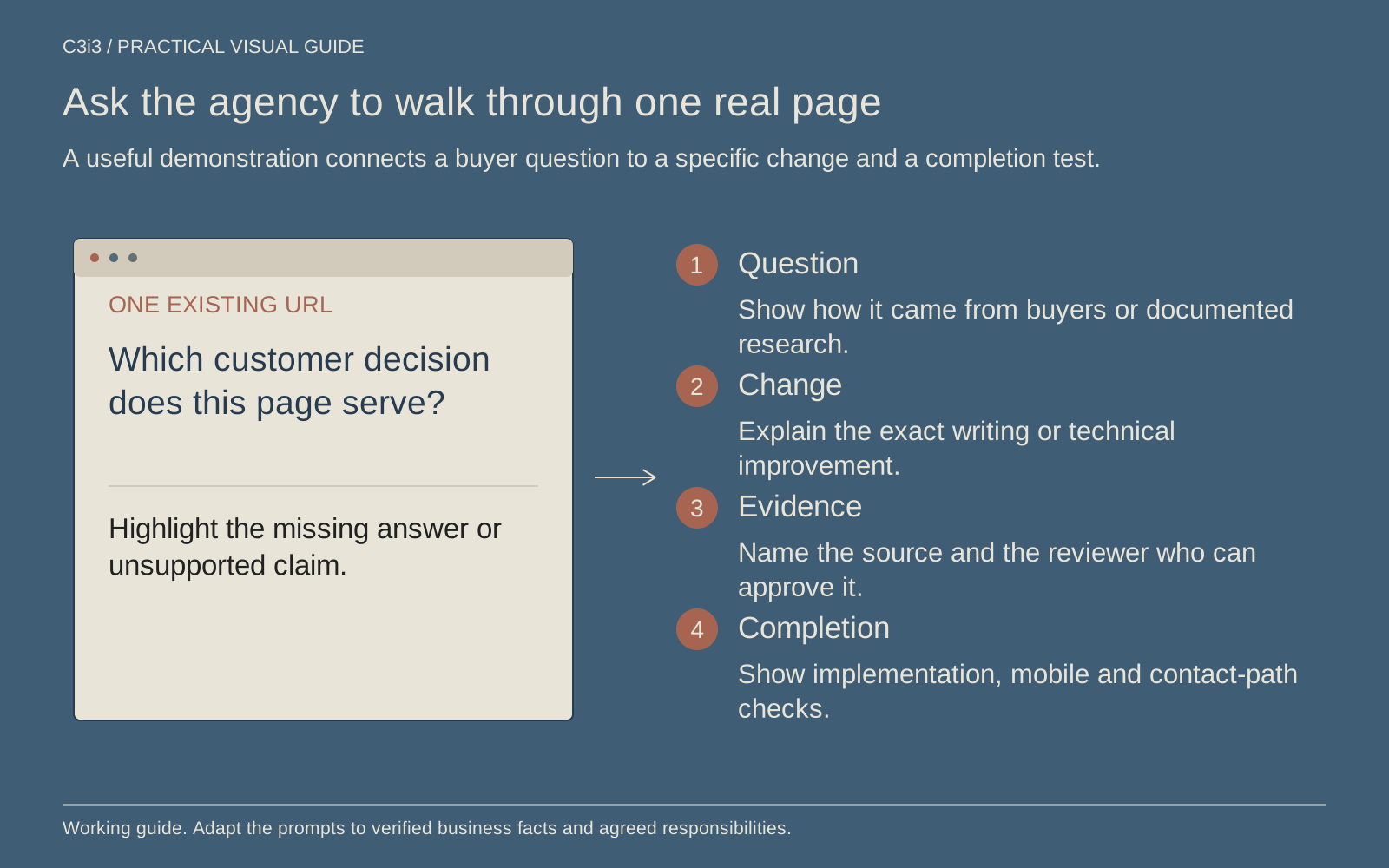
Then ask your preferred agency to walk through one real page. The meeting should connect a customer question, a recommended change, supporting evidence and a measurable next step. That exercise often reveals fit more clearly than a polished sales presentation.
What AIO agency promises should make you cautious?
Be cautious when a provider promises an outcome it cannot control or will not explain its method. A sound proposal identifies the work, the evidence and the limitations.
- Guaranteed Google or ChatGPT recommendations: A provider can commit to deliverables, not another platform’s selection decisions.
- A required “AI certification” or special file: Ask which platform requires it and request the official documentation.
- Large batches of near-identical city pages: Ask what distinct customer need each page answers.
- Invented reviews, client outcomes or credentials: Your business should approve factual claims before publication.
- Reporting based only on favorable screenshots: Require the full agreed prompt set and an explanation of the sample.
- Accounts or content you cannot take with you: Set ownership and handover terms before the engagement starts.
Google’s spam policies address practices including doorway abuse and scaled content abuse. Producing many pages is not a substitute for giving people something useful. Ask how the provider checks originality, accuracy and purpose before expanding production.
Practical tip: Ask, “What would make you recommend that we publish fewer pages?” A thoughtful agency should be able to explain when consolidating or improving content is the better choice.
What else should Bay Area business owners ask before hiring an AIO agency?
Can one agency handle SEO, AEO and AIO?
Yes, if it has the relevant skills and a coordinated scope. Ask how shared research, technical work and writing are billed so you do not pay several times for the same activity. Review its SEO services and AEO approach together.
Does the agency need to be physically in the Bay Area?
Physical proximity can help with interviews and collaboration, but assess local understanding, availability and the quality of the work. Ask how the team learns your service area and buyer needs. Do not assume a local address proves industry expertise.
Should a Korean business entering the U.S. use a different strategy?
U.S. market-entry work may need English buyer research, bilingual technical review and accurate sales arrangements. Use the Korean business agency guide for that distinct brief.
How soon should we expect results?
Ask for a timeline for the work and a separate plan for evaluating outcomes. Technical conditions, search demand, competition and the sales cycle affect what can be observed. An early page improvement is a completed deliverable; it is not proof that an AI recommendation or a new customer will follow on a fixed schedule.
Should we replace our website before starting?
Only if an assessment identifies a reason. Many improvements can be made within an existing site. If a rebuild is recommended, request the specific constraints, migration plan, URL preservation and testing responsibilities. AIO terminology alone does not justify a replacement.

How C3i3 Can Help
Bring the pages, buyer questions and proposal claims you want to evaluate. C3i3 can help define useful work, ownership and reporting limits.