






































In this article
Your social ad is getting clicks. The sales team is getting requests for work you do not provide, questions from people outside your service area or enquiries from buyers who expected something entirely different. The tempting response is to rewrite the headline to make it more exciting. A more useful response is to find the sentence that invited the wrong expectation.
Social media ad copy should help the right person recognize a relevant situation and understand the next step. For an East Bay professional-services firm or a larger business selling a specialized product, broad appeal can create unnecessary sorting work. The examples below are illustrative writing exercises, not client campaigns or claims about measured performance.
Which sentence is inviting the wrong customer?
Start with the actual enquiries. Remove identifying details and group the misunderstandings: wrong service, wrong location, wrong buying stage or wrong expectation about the next step. You are looking for patterns in language, not a reason to blame the visitor. If several people ask for an individual training course when the business provides company-wide implementation support, the wording may be presenting the wrong product.
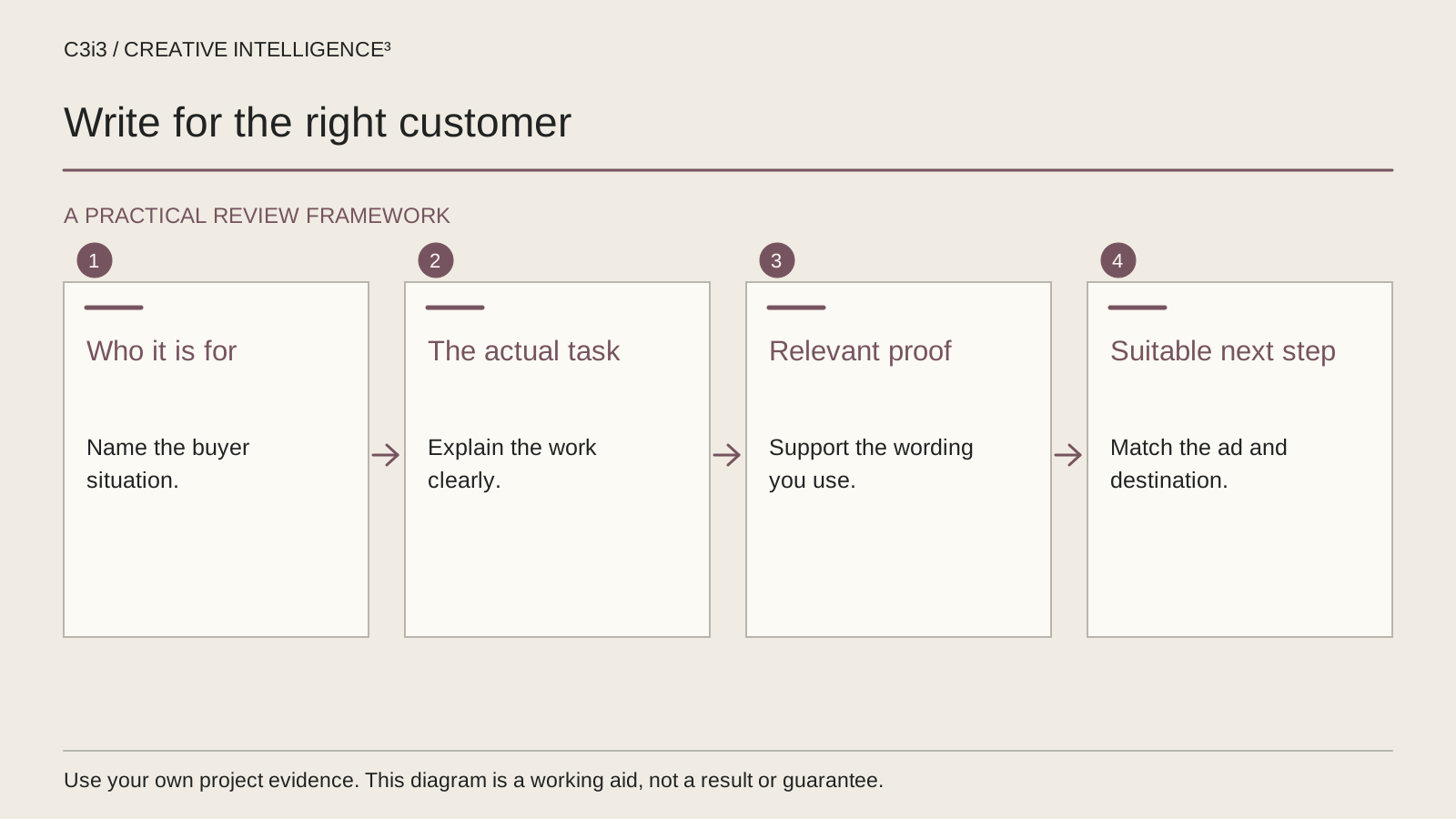
Compare those requests with the ad as a first-time viewer sees it. Include the image, headline, main text and button. A line saying “Help your team use AI” could describe software, workshops, consulting or an outsourced service. The image might suggest another interpretation again. Write the likely interpretation beside each element before changing anything.
Use the broader Bay Area marketing problem checklist to separate a copy problem from a targeting or follow-up problem. The words cannot fix a campaign shown to an unsuitable audience, and precise targeting cannot rescue a message that describes the wrong service. Record both possibilities rather than assuming the latest headline caused every poor enquiry.
How do you make the offer specific without filling the ad with jargon?
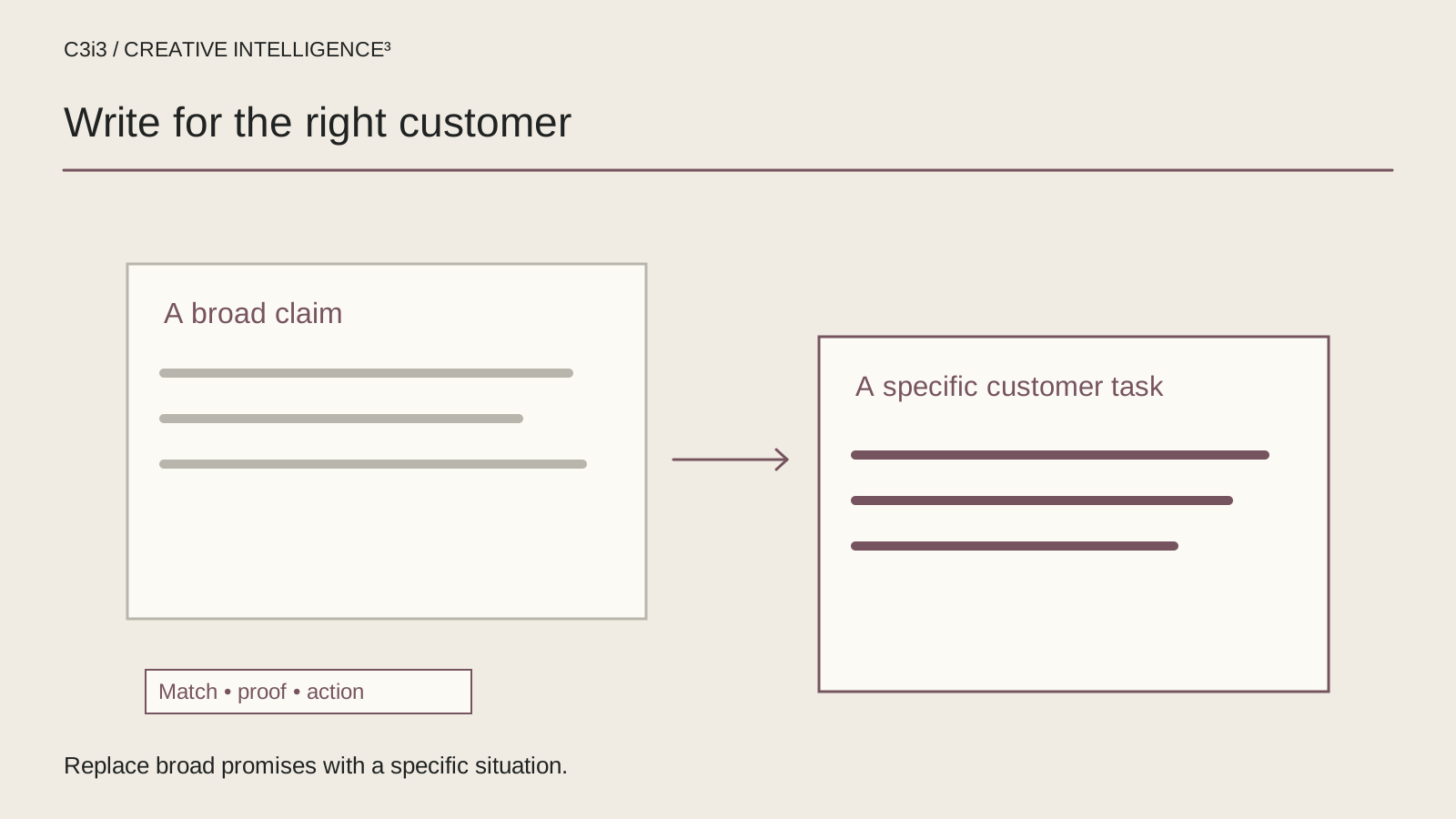
Describe an ordinary business task. “Integrated solutions for growth” does not tell an owner what will happen. “We organize your website service pages, ad landing pages and enquiry handoff” gives the reader something concrete to assess. Specificity comes from the work and its limits, not from stacking service names into one sentence.
The following examples illustrate different customer expectations. They are starting points for editing, not tested advertising recommendations for every business.
| Vague version | More specific version | Expectation clarified |
|---|---|---|
| Transform your business with AI. | Need a clear process for checking AI-written product content before your team publishes it? | A content-review task rather than an unspecified technology purchase. |
| We build websites that work. | Planning a business website your team can update after launch? Start by mapping the pages and approval process. | A website planning conversation rather than immediate technical support. |
| Get more from your videos. | Have a product commercial but no landing-page or campaign plan? Review the next steps before promoting it again. | Campaign coordination rather than video editing alone. |
Read the revision aloud. If it requires an explanation of your agency terminology, simplify it again. Your sales copywriting should make the work easier to understand before it tries to make the brand sound impressive.
What belongs in a useful problem hook?
A useful hook identifies a recognizable difficulty without pretending to know private facts about the reader. “Are enquiries being lost between your website and your sales team?” describes a business process. “Your marketing team is failing” makes an accusation the ad cannot establish. The first opens a practical question; the second creates friction without explaining the service.
Choose a problem the destination can help investigate. If the ad asks why a commercial gets views but no enquiries, the page should discuss audience fit, message clarity, the destination and measurement. Sending that visitor to a general company history page breaks the promise made by the question. Compare the ad with your website explanation of what customers should know before contacting you.
Keep the claim within the available evidence. The FTC’s advertising guidance emphasizes truthful, evidence-based claims. For a writing review, that means asking what a reasonable reader could take from the whole message, including what the visuals imply. If the team cannot substantiate a performance statement, replace it with an accurate description of the work or a question the page genuinely addresses.
How should East Bay coverage appear in the message?
Use geography when it helps the buyer understand availability. An ad for a business that visits client sites can state that it serves East Bay businesses, provided that is accurate. A remote service may need the regional context in the supporting copy rather than in every headline. The point is to clarify the working arrangement, not to make the same sentence carry a list of cities.
Check the destination too. A visitor who sees East Bay messaging should be able to confirm what the business does, how a project starts and whether in-person coordination is available when relevant. The existing Bay Area services overview can give that regional context without creating another near-identical location page.
Do not imply that the business has offices throughout the region. Service coverage and physical premises are different facts. Similarly, do not add local scenery merely to create a sense of proximity if it distracts from a specialized product or business task. A clear service example often tells the buyer more than a skyline. Keep the location wording aligned across the ad, page and reply from the team.

What should the button and landing page ask people to do?
Name the next action before selecting the button. Is the visitor requesting a project discussion, reading a checklist or submitting a brief? Those are different commitments. A message that invites someone to “see the process” should open the process, while a project enquiry should explain the information needed for a useful conversation.
A B2B example might ask for the product, intended audience and existing website. An ordinary introductory form rarely needs the entire project specification at this point. Ask only for details that someone will use to route or prepare the response. More fields do not automatically create better enquiries; sometimes they create unfinished forms or made-up answers.
Review the language after submission as part of the copy. A visitor should know that the request was received and what to expect next, without a fabricated response-time promise. If the marketing team cannot explain who receives the enquiry, the remaining problem belongs in the enquiry follow-up process. Rewriting the ad again will not resolve an unowned inbox.
How do you test the copy without mistaking clicks for success?
Keep a simple review record with the message, audience, destination and dates. If you change all four together, the results may describe a different campaign rather than a better sentence. Make a deliberate comparison and record other changes that could influence it. Do not label a variation the winner merely because it produces the most clicks.
Decide what a useful enquiry looks like before reviewing the campaign. For example, a relevant request may identify the business task, fit the service and reach the right team. A click is a different observation. Keep the measures separate so the owner can see where the journey is working and where the evidence remains incomplete.
Read actual responses with the people handling them. Did visitors understand the service? Were they expecting a different deliverable? Did the ad attract research questions when the team expected project enquiries? Add those observations to the next writing brief. This makes the review a feedback loop grounded in customer language rather than a series of increasingly dramatic hooks. Keep examples anonymous and remove personal information before sharing them with outside contributors.
Keep this checklist beside you
Questions before the next step
Should every social ad mention the East Bay?
Only when the location helps clarify availability or the customer situation. Use accurate service-area language and a relevant destination. Repeating a location in every line makes the message harder to read and does not establish that the business is the best match for a buyer.
Is a fear hook appropriate for business advertising?
A problem hook can be useful when it describes a real, relevant situation and leads to practical help. Avoid accusations, exaggerated consequences or statements the business cannot support. The reader should recognize the task and understand the proposed next step rather than feel manipulated.
Do fewer clicks mean the new copy failed?
Not necessarily. A more specific message may change who responds. Compare relevant enquiries, misunderstandings and the visitor journey using a defined review period. Without that context, click totals alone do not show whether the copy is attracting more suitable customers.

How C3i3 Can Help
C3i3 can help connect your ad wording, creative and landing page around a clear customer task. Bring the message, destination and anonymized examples of the enquiries you are receiving. We can review where expectations diverge and prepare copy that describes your actual service.