






































In this article
Your commercial opens with a moving logo, a wide office shot and a sentence about innovation. The product appears later. Everyone inside the company understands the connection, but a person meeting the business for the first time has to wait to discover what is being advertised.
A San Jose video ad production project can stall when the team treats an attractive opening as evidence of a clear opening. These are different judgements. This guide offers a practical way to review the first sequence, using an original storyboard example rather than invented retention figures. Start with the wider video views and enquiries diagnostic if you have not yet separated a creative problem from a distribution or website problem.
What does the viewer understand before your main message arrives?
Watch the opening without explaining it. Write down only the information that is actually visible or audible. A technical team may read meaning into an interface screen that a new buyer sees as a collection of boxes. A familiar product silhouette may not identify its purpose to someone outside your industry.
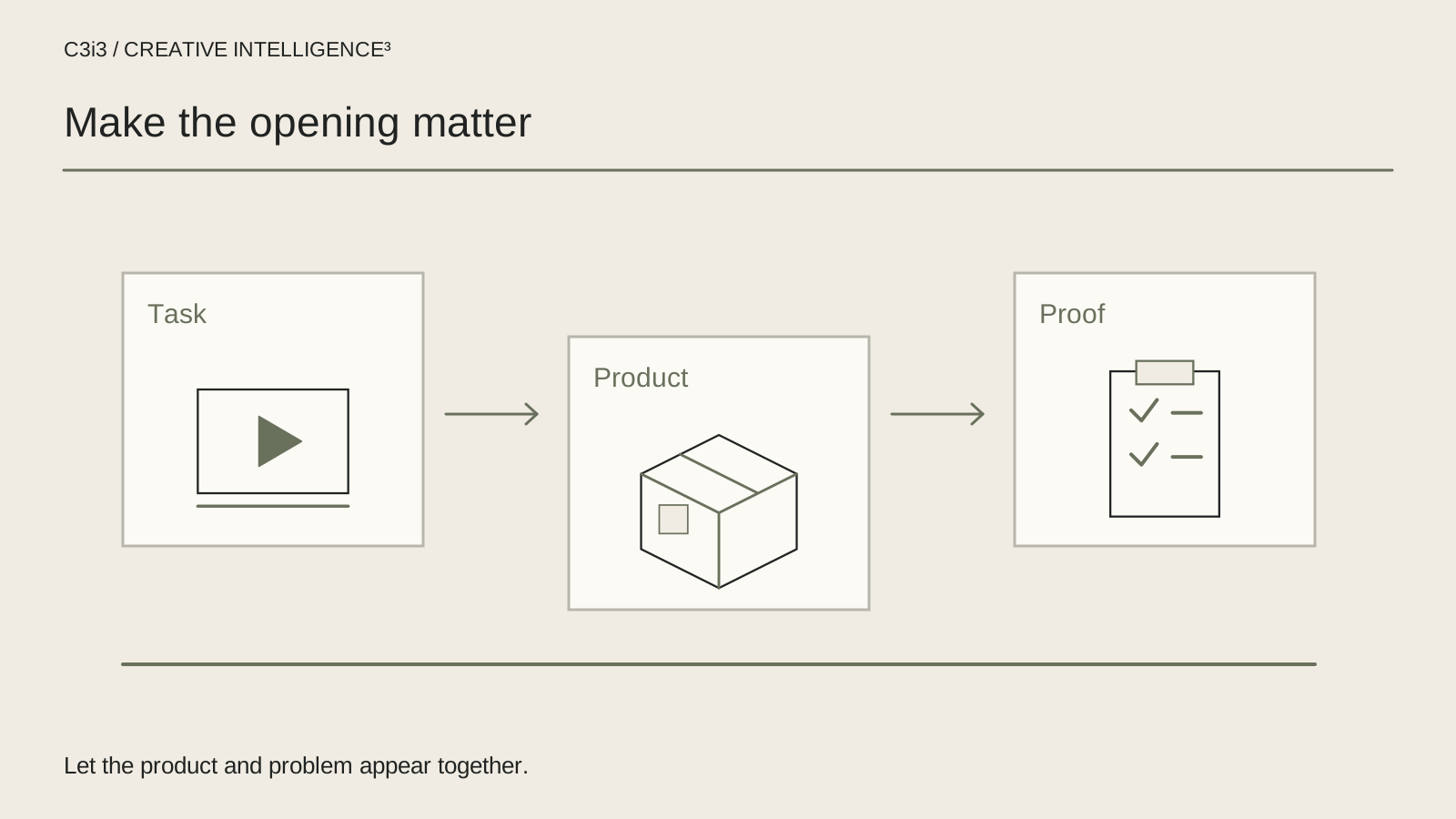
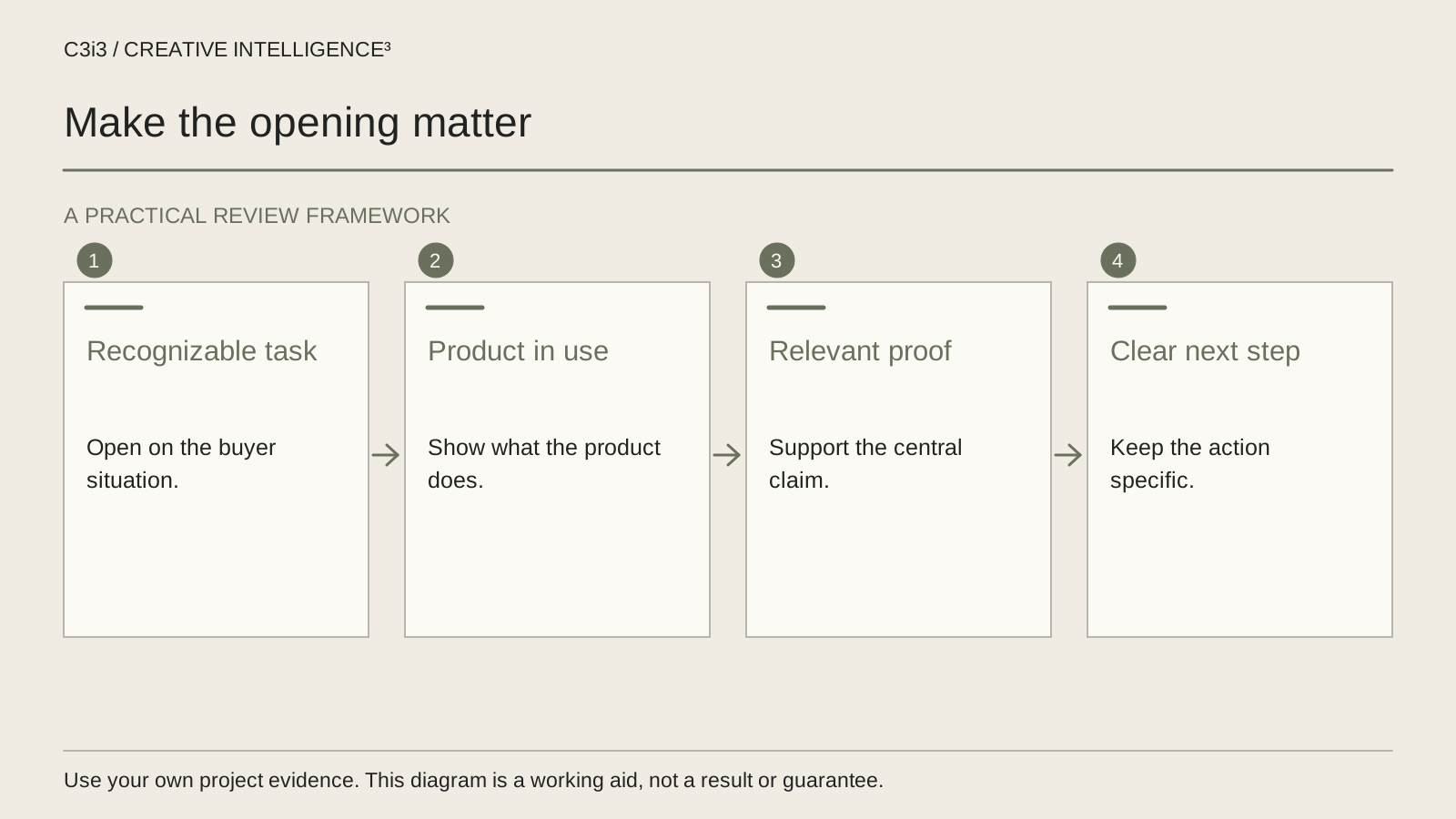
Use three separate notes: what is shown, what is said and what the viewer must infer. If the essential proposition appears only in the third column, the opening is relying on prior knowledge. Consider moving a recognizable product action or buyer problem earlier rather than adding another line of abstract narration.
The review should account for the placement and viewing conditions. Sound, captions, cropping and surrounding content affect what can be understood. Do not assume that every viewer experiences the commercial as your team did on a large monitor in a meeting room.
For an enterprise product, clarity does not require explaining the entire system immediately. It means giving the viewer a useful foothold: the task being performed, the person the product supports or the decision the demonstration will help them make. That foothold gives later detail a reason to exist.
Ask reviewers to describe what the opening means in their own words before discussing whether they like the design.
Which evidence suggests an opening problem rather than the wrong audience?
A weak commercial and an unsuitable audience can produce similar-looking symptoms. Review where the video was distributed, what format was used and what the available viewing report actually measures. Do not diagnose the edit from an overall view count alone.
Where the report is available, YouTube's audience retention guidance explains how different moments can show changes in viewing. A dip is a reason to inspect a sequence, not proof that a particular word caused people to leave. Check the report's eligibility and format limitations before expecting the same detail for every short advertisement.
Keep paid and organic traffic context visible. Viewers who actively selected a detailed product demonstration have a different starting point from people encountering an ad while watching unrelated content. Mixing those situations can hide the question you are trying to answer.
Create a small evidence note beside the proposed edit: relevant audience, distribution context, observed signal and alternative explanation. For example, a decline before the product demonstration may suggest delayed clarity, but it could also reflect a poor match between placement and intended buyer.
If the evidence is thin, label the edit as a hypothesis. That is more useful than presenting an uncertain creative preference as a proven retention fix.
How can you rewrite the opening without making a louder promise?
A stronger opening often involves showing the product's useful action sooner. It does not require exaggerated fear, a dramatic claim or a visual effect that the product cannot deliver. Keep the problem recognizable and the demonstration honest.
The following storyboard is an original editorial example for a hypothetical business software tool. It does not represent a client or measured performance.
| Sequence | Original approach | Clearer alternative to test |
|---|---|---|
| Opening image | Abstract network animation | A clearly labeled request waiting for approval |
| First spoken idea | “Built for the future of business” | “See which requests still need a decision” |
| Product evidence | Interface appears after several brand statements | Show the actual approval view with approved sample data |
| Next step | Several feature names compete | Demonstrate one request moving through the workflow |
The alternative is a testable creative direction, not a promise of higher conversions. The product owner must confirm that the interface and described action are accurate. If the software cannot show the proposed state, change the concept before production.
This is the detailed opening work that can sit inside a broader digital video ad production project.
Are branding, captions and narration competing with each other?
An opening can contain all the right ingredients and still demand too much attention at once. A logo animation, a changing interface, dense captions and narration describing a different feature force viewers to choose where to look.
Google's ABCD guidance for video ads treats attention, branding, connection and direction as related creative considerations. Use those principles as review prompts rather than a formula that guarantees performance. For this exercise, ask whether each element supports the same immediate idea.
Read the captions at the size they will appear on a phone. Confirm that the essential wording is legible against the actual moving background. A clear still frame is not enough if the next transition removes the contrast or changes the meaning before the viewer can follow it.
Listen to the narration without the picture, then inspect the picture without narration. This is an editorial diagnostic, not a substitute for accessibility testing. It helps expose a mismatch between the sentence and the shot that is supposed to explain it.
For the full production, plan suitable captions and other media accessibility needs. W3C's accessible media planning guidance explains why these decisions belong in the production process rather than being left to the final export.
What should stay constant when you compare two openings?
Change one meaningful creative proposition at a time when practical. If you replace the opening, audience, placement, destination and call to action together, the results may be useful for the new campaign but weak evidence about the opening itself.
Keep a version record identifying the footage, script, captions, duration and destination used. Record the dates and distribution conditions for the comparison. The aim is not to create a laboratory claim from an ordinary business campaign; it is to avoid forgetting what actually changed.
Agree what would make the test informative. A viewing signal can help assess whether people reach the demonstration, while an enquiry record answers a different business question. Neither should silently replace the other because one looks more encouraging.
The existing guide to video versions for different platforms covers adaptation across placements. Here, preserve the distinction between that delivery task and the question of which opening communicates the product more clearly.
Have an owner decide when the team has enough evidence to keep, revise or retire the tested opening. Where conditions are too different or observations too limited, record the result as inconclusive. Do not turn an uncertain comparison into a universal rule for future commercials.
When is a reshoot justified, and when is a re-edit enough?
Start by inventorying the footage you already have. Look for a usable product action, a clear interface view, a practical detail or a visual demonstration that has been buried later in the edit. A new sequence may be possible without a new shoot.
A reshoot becomes a concrete discussion when the required proof is missing or unusable. Perhaps the product action is out of frame, the screen shows outdated information or the demonstration cannot be understood at the intended size. Write the missing shot in plain language before discussing production arrangements.
Do not use stock footage or generated imagery to imply product capabilities that have not been demonstrated. An atmospheric image can support the mood, but it cannot replace evidence of how a business tool or physical product works.
San Jose teams can connect the creative review with their website and enquiry route so the revised message continues after the click. If the opening becomes clearer while the destination still describes a different service, the campaign has another unresolved problem.
Before approving the edit, make someone unfamiliar with the draft explain its first idea. Record the misunderstanding that remains, if any. That is a more productive final review than asking the whole room whether the commercial feels exciting enough.
Keep this checklist beside you
Questions before the next step
Should every video ad show the product immediately?
There is no universal opening that suits every objective and placement. The question is whether the sequence gives the intended viewer a clear reason to continue. A product action, recognizable problem or relevant outcome may establish that reason without showing every feature.
Does an audience retention dip prove the opening is bad?
No. Inspect the moment, audience and distribution context before deciding what it means. A decline can suggest a useful hypothesis, but the available report does not identify every viewer's reason for leaving. Avoid attributing the result to one frame without supporting evidence.
Can you improve an opening using existing footage?
Often the first task is to review what was already captured. A useful demonstration may be hidden later in the edit. If the missing proof was never filmed or no longer represents the product, a clearly scoped reshoot may be more appropriate than another cosmetic revision.

How C3i3 Can Help
C3i3 can help San Jose businesses review video ad scripts, storyboards and product evidence before another production round. Bring the current commercial, intended audience and available viewing reports. We can help turn a vague retention concern into a specific creative question and a workable revision brief.