






































In this article
Your commercial looks polished. The product is clear in the final frame, the music feels right and the view count keeps moving. Yet the sales team cannot identify many useful enquiries. It is tempting to blame the video or commission a more dramatic opening. Neither decision tells you where the customer journey actually broke.
Bay Area video production needs a clearer diagnostic question: what was the viewer supposed to do, and what evidence shows where that action stopped? A San Francisco professional-services campaign, a San Jose product launch and an East Bay business promotion can accumulate views while facing different problems. The explanation might sit in audience selection, product understanding, a difficult landing page or a form that never delivers.
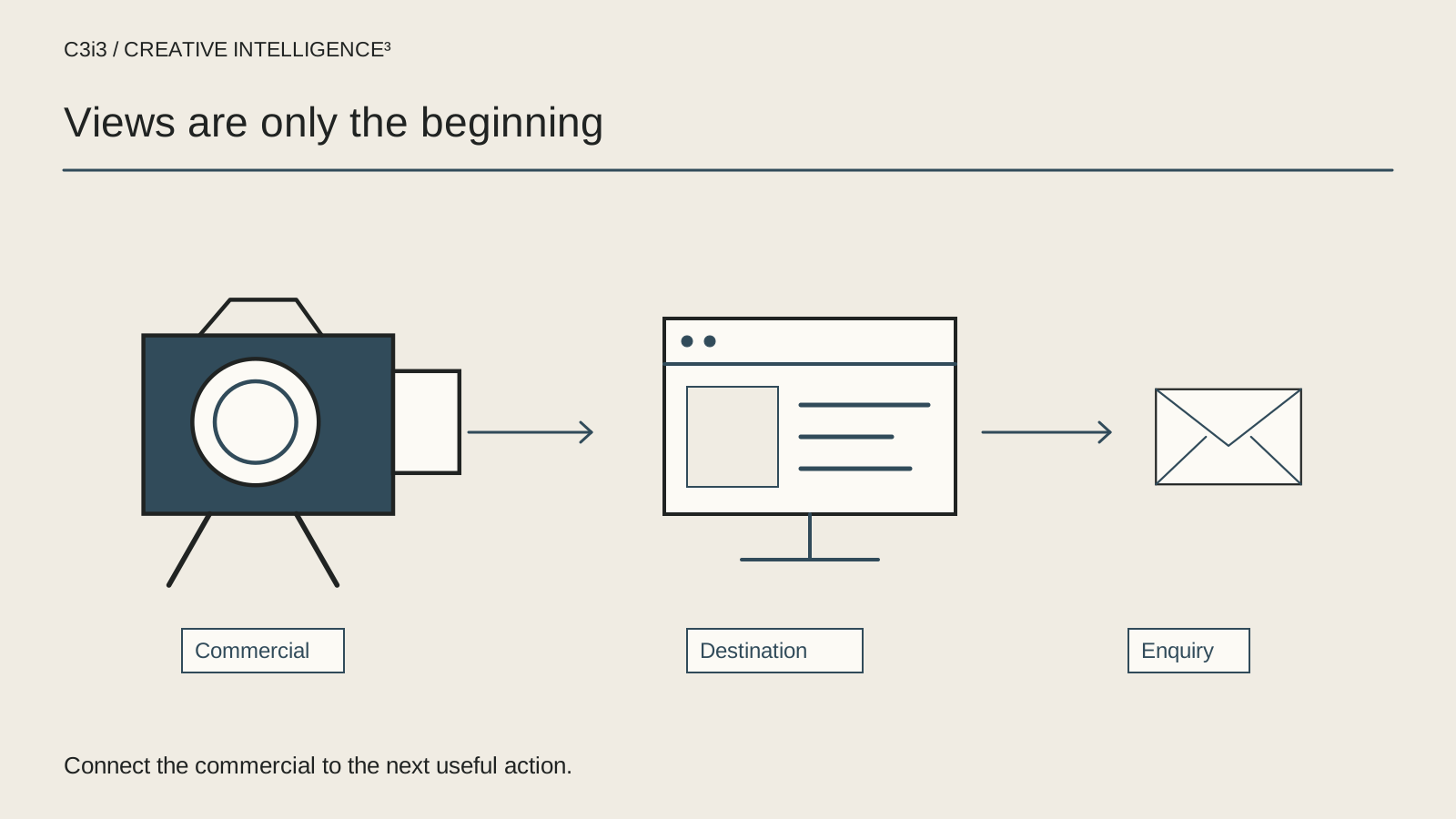
This guide follows one commercial from first impression to sales follow-up. Separate a creative problem from a website, distribution or measurement problem before changing everything at once.
What counts as a useful enquiry for this commercial?
Start by writing a sentence that your sales team would accept: a useful enquiry comes from a business with a relevant need, a serviceable location and a clear reason to continue the conversation. Change the details to fit your operation. An enterprise product demonstration and a local consultation should not share an undefined success label merely because both use video.
Choose one next action. It could be viewing a demonstration, requesting a conversation or asking about a specific service. Those actions carry different levels of commitment. A person researching a future purchase may reasonably watch without submitting a form. Calling that viewing a failed sale would hide the actual purpose of the asset.
Record what does not qualify. Recruitment questions, support requests and supplier introductions may be legitimate contacts without being campaign leads. Give the receiving team a classification list so marketing and sales describe the same events. The guide to marketing reporting and enquiries provides a wider framework for separating activity from outcomes.
Save the definition beside the approved commercial. When the report arrives, ask whether its evidence answers that definition. A dashboard label such as conversion is not enough on its own. Record who reviews contact quality and where disputed classifications are resolved.
Are attention, website activity and enquiries being counted separately?
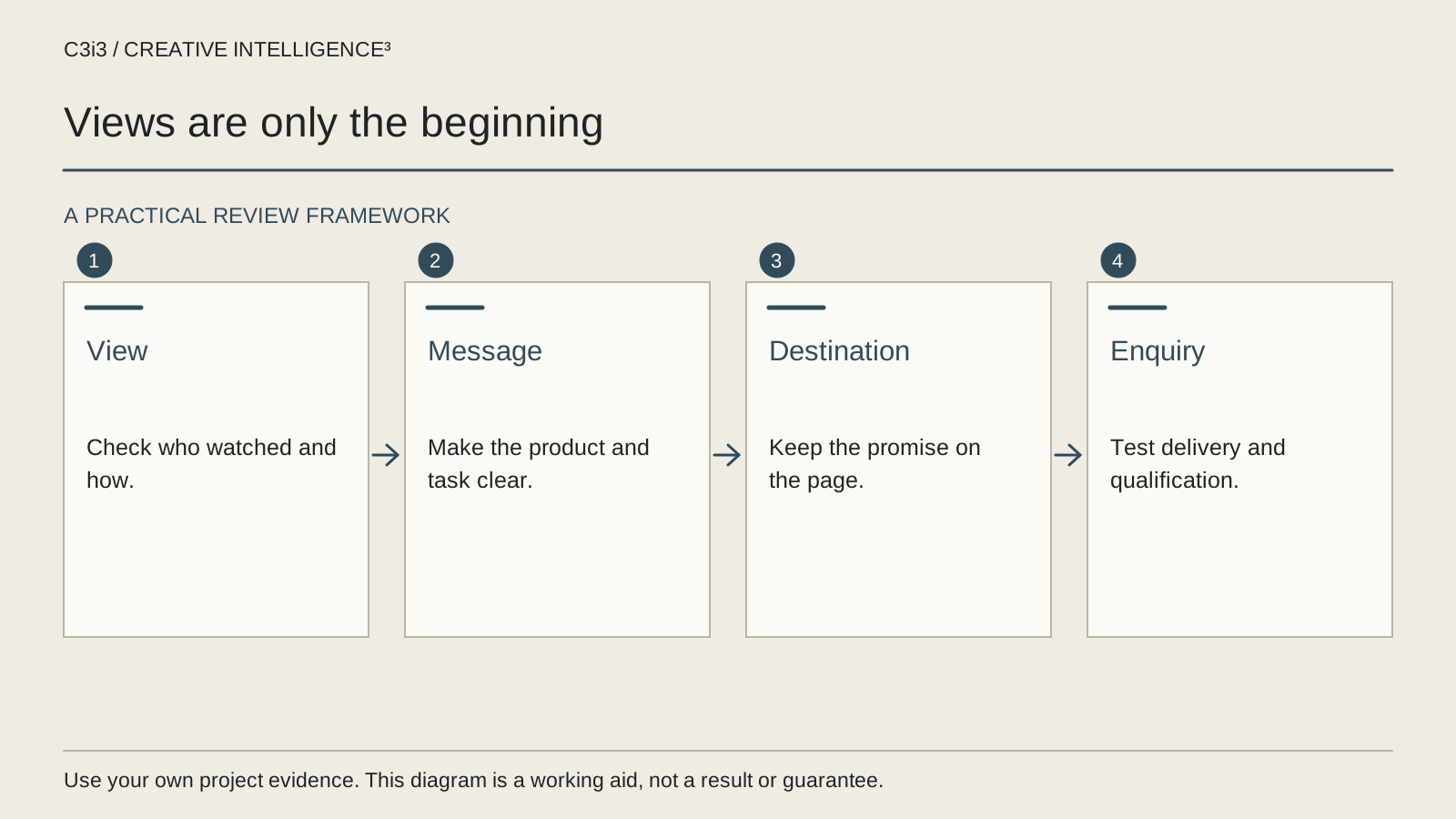
Build an evidence ladder rather than treating every metric as a substitute for every other one. Platform views describe activity within counting rules. Website visits describe arrivals. A form success event may describe an accepted submission, while the receiving inbox or customer system shows whether the team received something usable.
| Stage | Question | Evidence |
|---|---|---|
| Attention | Did people encounter or watch the commercial? | Platform report and metric definition |
| Arrival | Did people reach the intended page? | Campaign destination and website reporting |
| Enquiry | Did the site accept the intended action? | Submission event and delivery record |
| Qualification | Was the contact relevant? | The receiving team's disposition |
Google's engaged-view conversion documentation describes video attribution that can include later action without an immediate click. Read the account's current definitions before comparing its report with a last-click website report. A difference is a question to investigate, not automatic evidence that either system is false.
Keep the period, conversion definition and attribution assumptions visible. Do not add different systems' totals together as if they represented separate customers. Preserve uncertainty where the evidence cannot establish an individual path.
Is the commercial reaching someone who can use the offer?
Review the actual audience and placement setup with the person running distribution. A commercial intended for Bay Area decision-makers may attract viewers who enjoy the subject but cannot use the service. Creative quality cannot correct an audience definition that overlooks the customer's situation.
For a regional service, check the practical meaning of location settings and the places represented in available reporting. For a product business, ask whether the item is available to the audience seeing it. Do not infer a viewer's need, role or purchasing authority from an interest category. Treat targeting as a reasoned starting point that still requires evidence.
Consider a hypothetical San Jose software campaign for operations managers. The commercial explains an appealing interface, but the destination talks mainly about developer integrations. That mismatch may attract curiosity without helping the intended buyer evaluate the product. Technical detail is not inherently wrong; the campaign has not agreed whose decision comes first.
Write down the customer situation, excluded situations and placement reason. Inspect enquiry quality against those assumptions. If unsuitable people are arriving, adjust distribution and message together rather than making the opening louder. Ask sales to record the reason a contact was unsuitable instead of supplying only a blanket low-quality label.
Does the opening establish the buyer's problem before the decoration?
Watch the commercial once without pausing and describe its point in an ordinary sentence. If team members give different answers, the opening may be introducing mood without introducing the buying question. Beautiful footage can support a message, but cannot explain a product difference that the viewer has not been shown.
List the first visible object, first meaningful sentence and first piece of proof. Ask what each contributes. A slow logo reveal may suit one purpose and hinder another. Avoid universal rules about the correct number of seconds; the useful test is whether the sequence gives the intended viewer a reason to continue.
Where available, YouTube's audience-retention report helps locate moments deserving review. A dip or spike does not explain the cause by itself. Compare the moment with changes on screen, in narration or in the promised subject.
For a practical rewrite, move the problem and evidence ahead of a decorative transition, then review the whole sequence for clarity. The commercial-opening guide develops that task through a storyboard. A punchy line is only one part of an intelligible sequence. Check that the following shot actually answers the question the opening raises.
Does the product demonstration provide evidence for the message?
A commercial may name a benefit without showing what makes it believable. Review each claim beside its supporting footage. If the line says the product simplifies a task, the visual should make that task and its relevant steps understandable. A montage of screens can look active while concealing information a buyer needs.
Prepare a proof ledger: message, supporting shot, conditions shown and unanswered question. Label sample data appropriately. If the product requires setup or a particular configuration, preserve the context needed to understand the result. Do not edit separate events into a misleading impression of continuous operation.
An enterprise buyer may need to understand workflow fit before asking for a meeting. A product brand may need to show scale, handling or a limitation. Both deserve evidence specific to the question rather than another adjective in the voice-over. Record demonstrations the current production sample cannot support.
Use the existing B2B product-video guide and the focused shot-to-buyer-question framework. Keep the commercial concise by selecting proof relevant to this decision, not by deleting every qualification. If a necessary fact cannot fit honestly, give it a clear home on the destination page.
Does the destination continue the same conversation?
Follow the exact published ad link, including normal campaign parameters, rather than opening the homepage from memory. A visitor should recognize the product, problem and next step that led there. If a focused demonstration leads to six unrelated services, the visitor must restart the decision.
Compare the commercial's statement with the page heading, opening explanation and action label. They do not need identical words. They do need to describe the same task. Check that the promoted service is visible without a site search and that the action is available on a narrow screen.
In a hypothetical East Bay campaign, a commercial invites viewers to discuss a product-launch video. The destination opens a general portfolio with no explanation of how to begin. More portfolio images may not resolve that uncertainty. The page needs a relevant route into the conversation.
The ad-to-landing-page guide examines this handoff. For broader regional context, use the established Bay Area services hub rather than creating another set of location pages. For enterprise campaigns, also confirm that the page speaks to the same buying role as the video and explains how specialist questions will be handled.
Can a person complete the enquiry on a phone?
Test the path as a visitor. Read the page, choose the action, complete required fields and inspect the feedback. Do not stop when a button changes appearance. Confirm that the server accepts the intended submission and that the receiving team can find the message through the normal process.
Use a privacy-safe test message and a controlled test contact. Avoid placing real customer details into screenshots or production notes. Record the time, device type, page and observed result so the investigator can reproduce the issue without searching unrelated enquiries.
A form can create friction while functioning technically. Ask whether each required field helps the first conversation. An early demand for information the visitor does not know can prevent an otherwise suitable contact. Clear labels and useful error messages matter as much as button size.
The mobile enquiry-form guide covers qualification and usability. If an accepted message never reaches the team, use the form-delivery incident guide. Those problems need different investigations. A delivery fix should be retested from the public page, not only from an internal administration screen that bypasses the visitor's route.
Who responds after the enquiry reaches the business?
An enquiry can reach the correct system and still stall. Agree which role owns the first response, how that person recognizes the campaign and what happens when a question belongs to another team. Video does not replace the operational work of helping a potential customer continue.
Create a handoff note with the commercial's subject, intended customer, destination and expected request. Give sales enough context to recognize why someone contacted the business without scripting an answer to every question. Include where technical or service questions go when they require specialist review.
Review actual dispositions using information your team is authorized to access. Was the contact outside the service scope? Did someone need a different product? Was a question incomplete? Those observations can inform a revision. They are more useful than labeling every unclosed enquiry poor quality without a consistent definition.
Do not promise that a response process turns every contact into a customer. Make genuine interest observable and actionable. If a campaign promises one experience and follow-up delivers another, the commercial may be exposing a coordination problem. Bring that finding to the relevant manager with specific examples and an agreed next step, while keeping personal information out of public reports.
What should you change before replacing the whole campaign?
Choose the earliest failure supported by evidence. If the destination is broken, repair it before interpreting conversion performance. If unsuitable viewers are arriving, examine targeting and message. If appropriate people arrive but cannot understand the offer, review proof and page clarity. This keeps a creative revision from disguising a technical failure.
Write a change record with the observed problem, proposed change, responsible person and retest. Keep the approved commercial and destination so the team can distinguish an experiment from undocumented edits. Where practical, change one main assumption at a time and agree when the evidence will be reviewed.
There is no universal volume threshold that makes a campaign conclusive. Small samples, delayed decisions and incomplete attribution can leave uncertainty. State that limitation rather than inventing a benchmark or treating an early fluctuation as proof.
A useful meeting ends with an evidenced task. It does not need a dramatic declaration that the brand, platform or production partner has failed. The campaign-handover guide separates production from distribution and website responsibilities. Record whether the proposed change addresses a technical defect, an untested creative idea or a confirmed customer misunderstanding; those require different kinds of evidence.
Which specialist guide matches the handoff that failed?
Before production, review footage and music handover, product-demo approvals and product-shoot readiness. Resolve those questions before recording or licensing material.
For creative review, use the guides to demonstration evidence, commercial openings and script claims and proof. They cover different decisions: what to show, what to show first and what the business can responsibly say.
After delivery, review paid YouTube enquiry measurement, landing-page continuity and campaign ownership. Choose the guide that answers the current question rather than rebuilding the entire campaign checklist at every meeting.
These articles support the existing C3i3 web-commercial service. They are not city-name variations of one production overview. Use them to arrive at a clearer brief and an actionable review conversation. Keep a short record of what you learned so the next commercial starts with evidence from the current one.
Keep this checklist beside you
Questions before the next step
Does a high view count mean a commercial is working?
It means the platform recorded activity under its view definition. Whether that supports your goal depends on the intended audience and next action. Keep attention, website activity and qualified enquiries separate. An introductory commercial should not be assessed as if every viewer had been ready to request a meeting.
Should we remake the commercial before changing the landing page?
Inspect the journey first. A broken destination or missing delivery can undermine a suitable commercial. If the page works and appropriate people arrive, creative clarity or proof may deserve review. Choose a change from evidence, save the earlier version and define the retest before replacing several elements together.
Can a production company manage the campaign too?
It can when those responsibilities are explicitly included and the team has the appropriate access and capability. Clarify who owns distribution, landing-page work, measurement and follow-up. Production delivery alone does not establish that those tasks are covered. Ask for named contacts and a working handover.

How C3i3 Can Help
C3i3 helps Bay Area businesses connect commercial concepts, product evidence, landing pages and campaign measurement. Bring the published video, its destination and the business question you expected it to answer. We can help identify the handoff needing attention and plan the appropriate creative, website or marketing work.