






































In this article
Sales wants a more persuasive product page. IT wants to understand what the proposed feature will connect to. Leadership asks why the site is not ready. The design team receives several conflicting requests and is told that everyone needs to be happy before anything can move forward.
This is an approval problem as much as a web design problem. For a San Jose enterprise business, a website may involve product owners, commercial teams, technical reviewers and people responsible for public claims. They do not all need to approve the same things, but the project needs a clear way to resolve the decisions they do own.
The following method is an original working framework. It is not a claim about a named organization or a substitute for the technical and business review your project requires. Use it to decide who can answer a question, what evidence they need and when the project can move to the next step.
Which decision is the disagreement actually about?
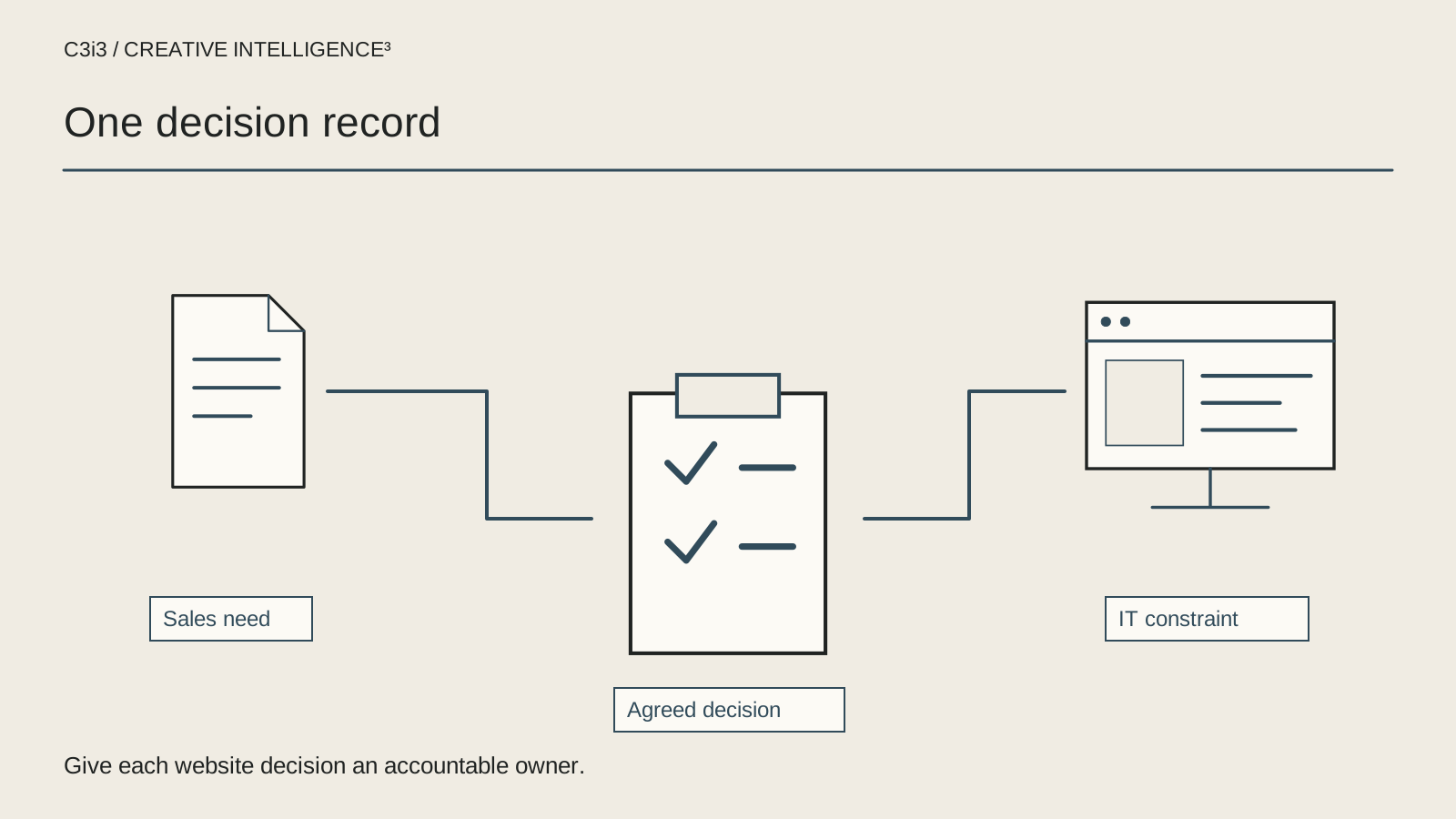
A request can sound like a design preference while concealing another concern. Sales may ask for a bigger button because prospects cannot find the next step. IT may object to the button because it launches an unreviewed third-party tool. The visible element is the same, but the underlying decisions are different.
Ask each reviewer to describe the risk or customer task behind the comment. Separate what must be true from the proposed solution. “The customer must be able to request a technical review” allows more design options than “use this exact widget.” “The request must reach an approved system” explains a technical boundary without dictating the page layout.
Record both requirements before choosing the implementation. If the requirements can coexist, the design team can explore a solution. If they conflict, the business needs a decision about the tradeoff. Endless visual revisions cannot answer a question about which system is approved to receive a customer request.
The website enquiry journey guide can help identify the customer task. Keep the diagnosis attached to that task so the discussion does not become a competition between departmental preferences.
Who owns facts, experience, technical acceptance and publication?
Create a small responsibility map around the actual decisions in the project. A product reviewer can confirm an application statement. A commercial owner can decide which customer task takes priority. Technical reviewers can assess the implementation within their scope. The publication owner confirms that the necessary decisions and checks have been completed.
One person can hold more than one responsibility, especially in a smaller team. The important point is to avoid treating every stakeholder as a general approver whose silence or preference can reopen any decision.
| Decision area | Evidence expected | Responsibility to assign |
|---|---|---|
| Product accuracy | Approved specification or reviewed demonstration | Product fact owner |
| Buyer task | Customer questions and intended next step | Business journey owner |
| Technical implementation | Documented requirements and test findings | Technical acceptance owner |
| Public release | Completed content and technical checks | Publication owner |
Name a backup where an unavailable reviewer would otherwise stop work. Also state who can accept an unresolved issue into a later scope. A project coordinator can collect comments, but should not automatically be expected to make technical or business decisions that belong elsewhere.
If the business is still choosing its delivery structure, enterprise web design services should be discussed alongside these responsibilities, not as a purely visual exercise.
How should conflicting comments be recorded?
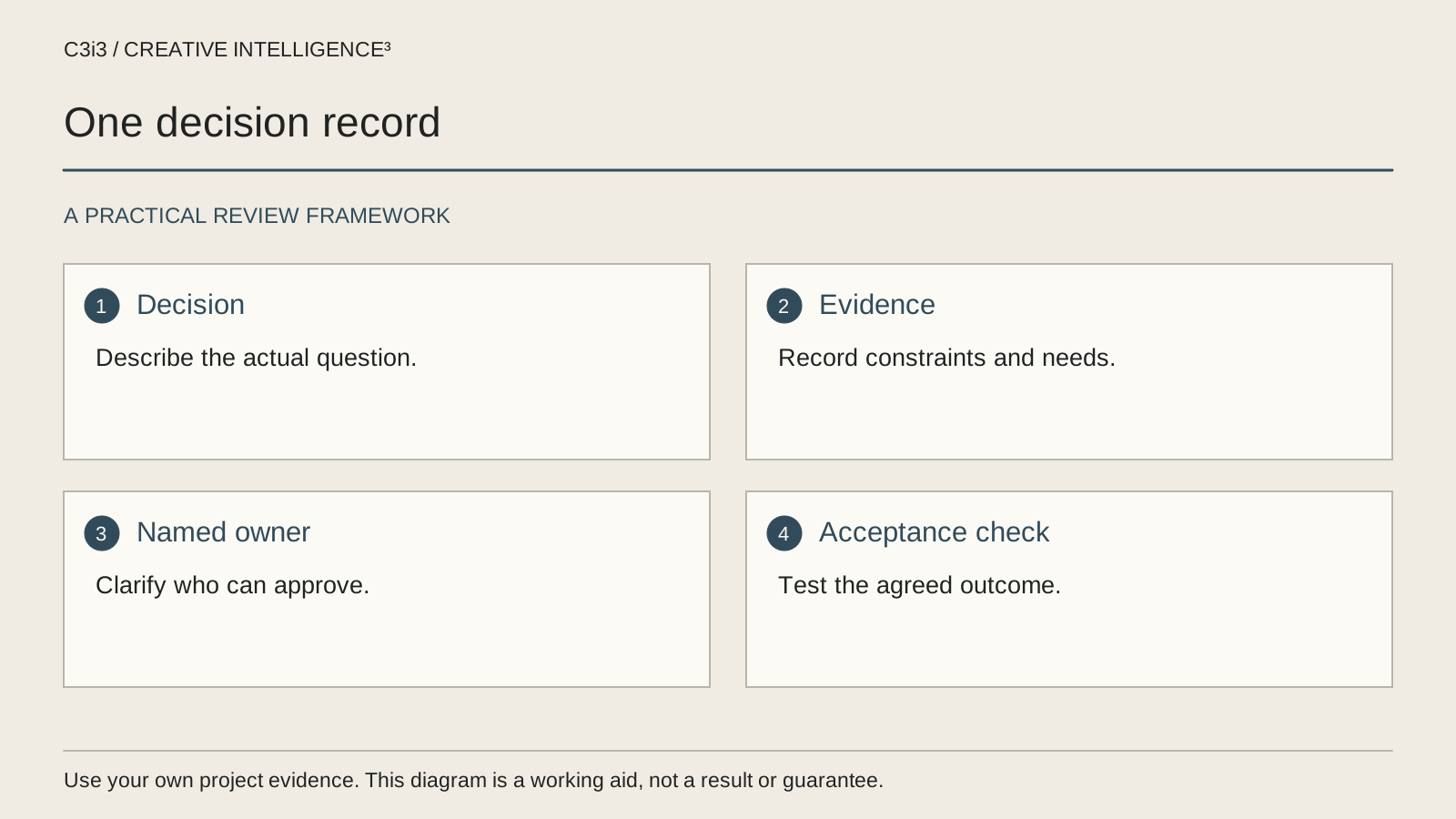
Use a decision register that preserves the question instead of a document full of disconnected edits. Each entry should describe the affected page or component, the customer task, the competing requirements and the person responsible for resolving them. Attach supporting evidence without copying confidential information into a public workspace.
For example, a sales team may want detailed project qualification on a form while another team wants to reduce required data. The decision is not simply “long form or short form.” It is which information must be collected at that point, how it will be used and whether the visitor can reasonably supply it.
Write down the options considered. One option might collect essential contact and project information first, then request specialized detail through an approved follow-up. Another might use a separate technical request route. The business should review the operational consequences before a designer turns either option into an interface.
Close the entry with a decision, a reason and any condition that remains. If new evidence later justifies reopening it, add that evidence to the record. This is more useful than treating every late preference as proof that the original team failed to listen.
A decision log is not bureaucracy for its own sake. Keep it short enough that the next reviewer can understand the issue without replaying an entire meeting.
What should reviewers test instead of debating screenshots?
Screenshots help evaluate hierarchy and appearance, but they cannot establish whether an interaction works for the customer. Choose representative tasks and test them on the implementation: identify the right service, find relevant evidence, complete a request and receive appropriate feedback.
Include accessibility in those tasks. The W3C development guidance emphasizes understandable instructions and help with errors. A form that appears neat in a review deck can still be difficult to complete if labels, focus or feedback are unclear.
When a technical reviewer identifies a problem, ask for the reproduction steps and the expected behavior. “It feels wrong” is not a test result. “Using the keyboard, the focus disappears when this panel opens” gives the team something specific to inspect. The responsible specialist should assess and retest the issue.
The business reviewer should test meaning as well as mechanics. Can someone distinguish a request for information from an order, or a product demonstration from a service consultation? These distinctions influence the quality of what reaches Sales.
For an enterprise site, preserve the agreed test tasks as part of acceptance. That makes a later review more reliable than asking stakeholders to remember what they thought they approved in an earlier screenshot.

How do you stop a late request from restarting the entire design?
A late request needs a decision about impact. Ask whether it corrects an error, responds to a newly discovered requirement or introduces a new preference. Those are different reasons for change, even when all three arrive in the same comment thread.
Identify the affected pages, dependencies and checks that would need to be repeated. A change to a global navigation label may affect several customer journeys. A replacement sentence on one page may have a smaller scope. Do not assume that a visually minor change is operationally minor, or that every revision requires the whole project to stop.
Agree where the request belongs: before launch, in a defined later release or outside the current scope. Name the person authorized to make that decision. Preserve unresolved concerns visibly rather than declaring a page approved while different teams expect incompatible outcomes.
The review before a website redesign is useful when a late request reveals that the original problem was never clearly defined. If the concern is future editing, use the content handover guide to test that requirement directly.
A controlled change process does not mean ignoring new evidence. It means showing what the new evidence changes and obtaining the right decision before related work is repeated.
What must be true before the website can go live?
Write a release record that names the version being reviewed, the agreed scope, completed checks and remaining issues. Each relevant owner should understand what they are approving. A content signoff does not establish that every integration has passed technical review, and a technical deployment does not verify that every product statement is accurate.
Include account and ongoing ownership in the record. The agency account handover guide helps frame access questions. The delivery team should not be left as the accidental owner of a business decision because the internal approval route was never finished.
The existing San Jose service page connects this work to the local service offering, while the Bay Area overview explains the wider scope. Use those pages as service destinations; this article addresses the narrower problem of making decisions on a complex project.
If the approval conflict is part of a broader marketing problem, return to which business problem to fix first. A clear approval record cannot guarantee a perfect launch. It can show the team what was decided, what was tested and who needs to act when an unresolved question returns.
Keep this checklist beside you
Questions before the next step
Should IT have the final say on an enterprise website?
IT should make decisions within its assigned technical and access responsibilities, while the relevant business owners decide customer priorities and approved claims. Some choices affect both areas and need a documented tradeoff. Establish the decision boundaries before reviews so one department is not expected to approve matters outside its responsibility.
How many people should approve a website page?
There is no universal number. Identify the decisions required for that page and involve the people accountable for them. A specialized product page may need factual and technical review that a simple announcement does not. Additional reviewers should have a defined purpose rather than an open invitation to restart settled decisions.
What if leadership changes the direction near launch?
Record the new requirement, its reason and the work it affects. Ask the authorized owner to decide whether it changes the current release or belongs in a later scope. Repeat the relevant checks after implementation. A visible impact review is more useful than silently absorbing the change and leaving everyone with a different expectation.

How C3i3 Can Help
C3i3 helps San Jose teams connect enterprise web design with practical approval and content responsibilities. Bring the pages, unresolved comments and technical requirements that are slowing the project. We can help structure the decisions and design work around a customer task your teams can evaluate together.