








































In this article
You hired a capable marketing employee, but the work still needs a designer, a writer, someone who understands search and someone who can fix the website. You find freelancers for the missing skills. Soon your calendar fills with briefs, reminders and review meetings. The business has marketing help, yet you remain its project manager.
Outsourced marketing can bring several skills into one working arrangement. Its value depends on what the team actually manages, how much work is included and which decisions still need you. Buying access to specialists does not automatically create a functioning marketing operation.
List the work before choosing the staffing model
Write down the work that must happen repeatedly: updating offers, maintaining service pages, preparing email, publishing approved material and checking inquiries. Separate recurring work from occasional projects. A redesign and a monthly page update should not compete unnoticed inside one vague request for marketing help.
Add the skills each task needs and the consequence of delay. Perhaps the office can write a useful project summary, but nobody can edit photographs or publish it correctly. That is a specific skill gap, with a clearer solution than hiring someone to do everything.
The SBA's marketing planning guidance connects planned actions with business goals. Use that principle to select work before selecting people.
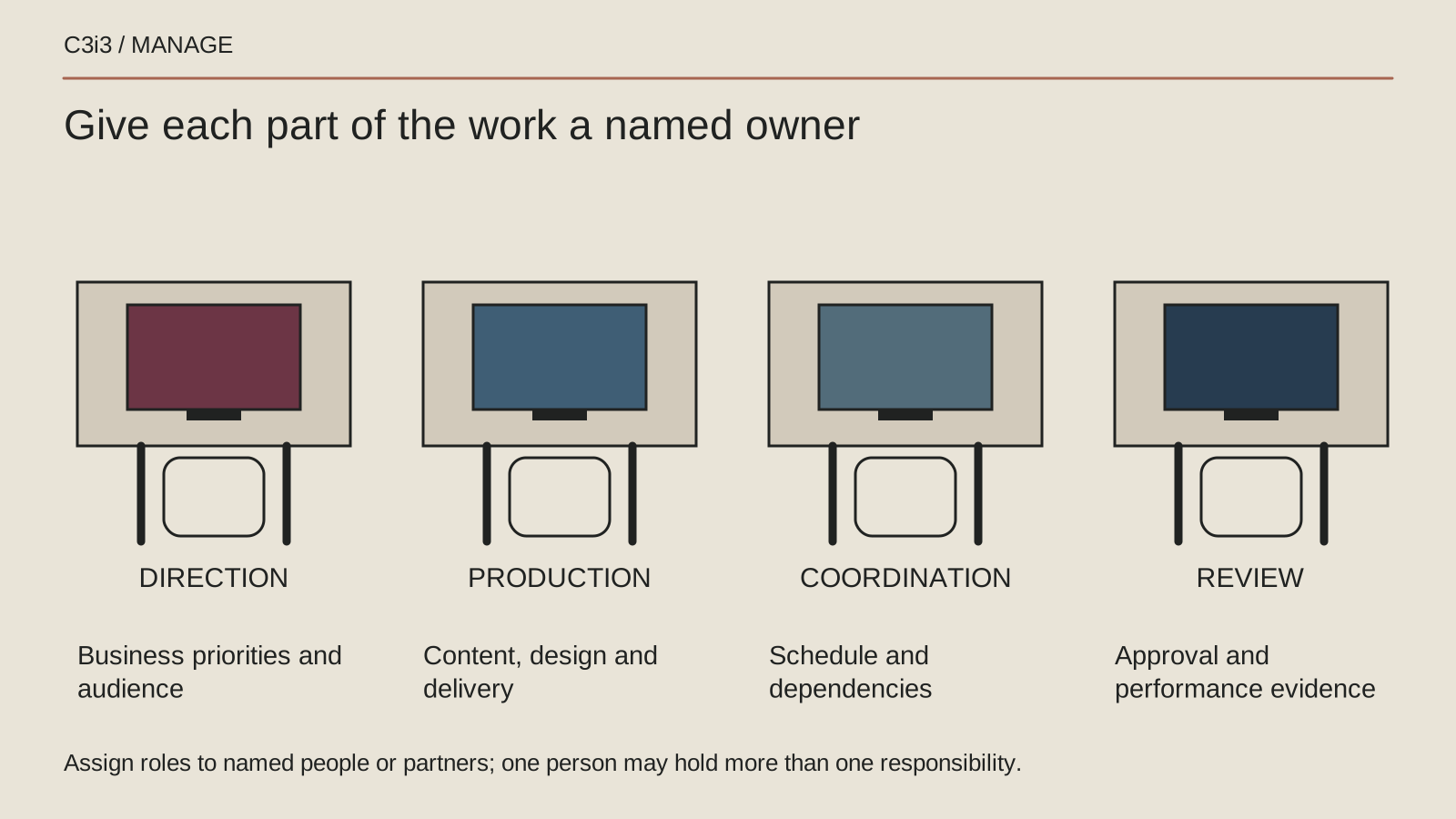
Give coordination to a named person
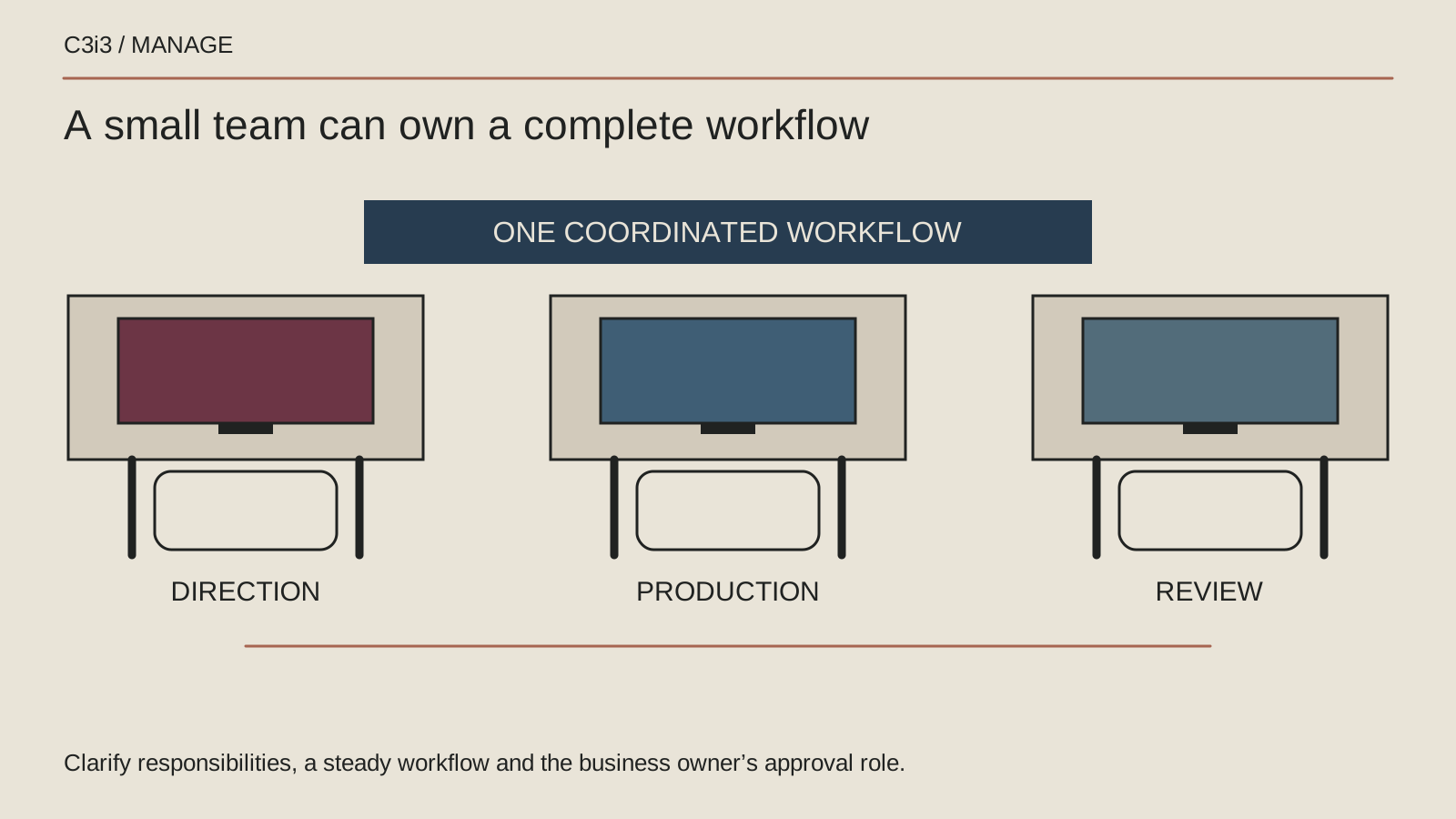
Ask who turns an approved objective into assignments, follows dependencies and tells you when a decision is needed. If every specialist reports separately to you, much of the management burden remains. One named coordinator should maintain the schedule and explain tradeoffs across the work.
For example, a service launch may require copy before design, design before publication and publication before an email announcement. The coordinator should identify that sequence early. You should receive a request to approve the service facts, rather than discovering three people waiting for different versions.
Confirm whether this coordination is included. Some agency engagements supply production only. They can still be useful when your business has someone ready to manage delivery.
Compare access to skills with actual delivery capacity
An agency may offer writing, design, technical support and reporting, but access does not mean unlimited production. Ask what can reasonably be completed within the agreement, how revisions are handled and what happens when an urgent request displaces planned work.
A full-time employee may provide deeper daily business knowledge and more continuous attention. A limited agency retainer cannot honestly be treated as equivalent to that availability. Conversely, one employee may need specialist support for tasks outside their experience. Compare the actual work and attention each arrangement provides.
Keep a visible queue with a small number of active priorities. When capacity is full, choose what moves or authorize additional scope through the agreed process.
Reserve business decisions for the business
You can delegate production while retaining responsibility for the offer. The team needs accurate service boundaries, availability, customer evidence and someone authorized to approve publication. It cannot infer a change in your delivery capacity from a social post or an unanswered email.
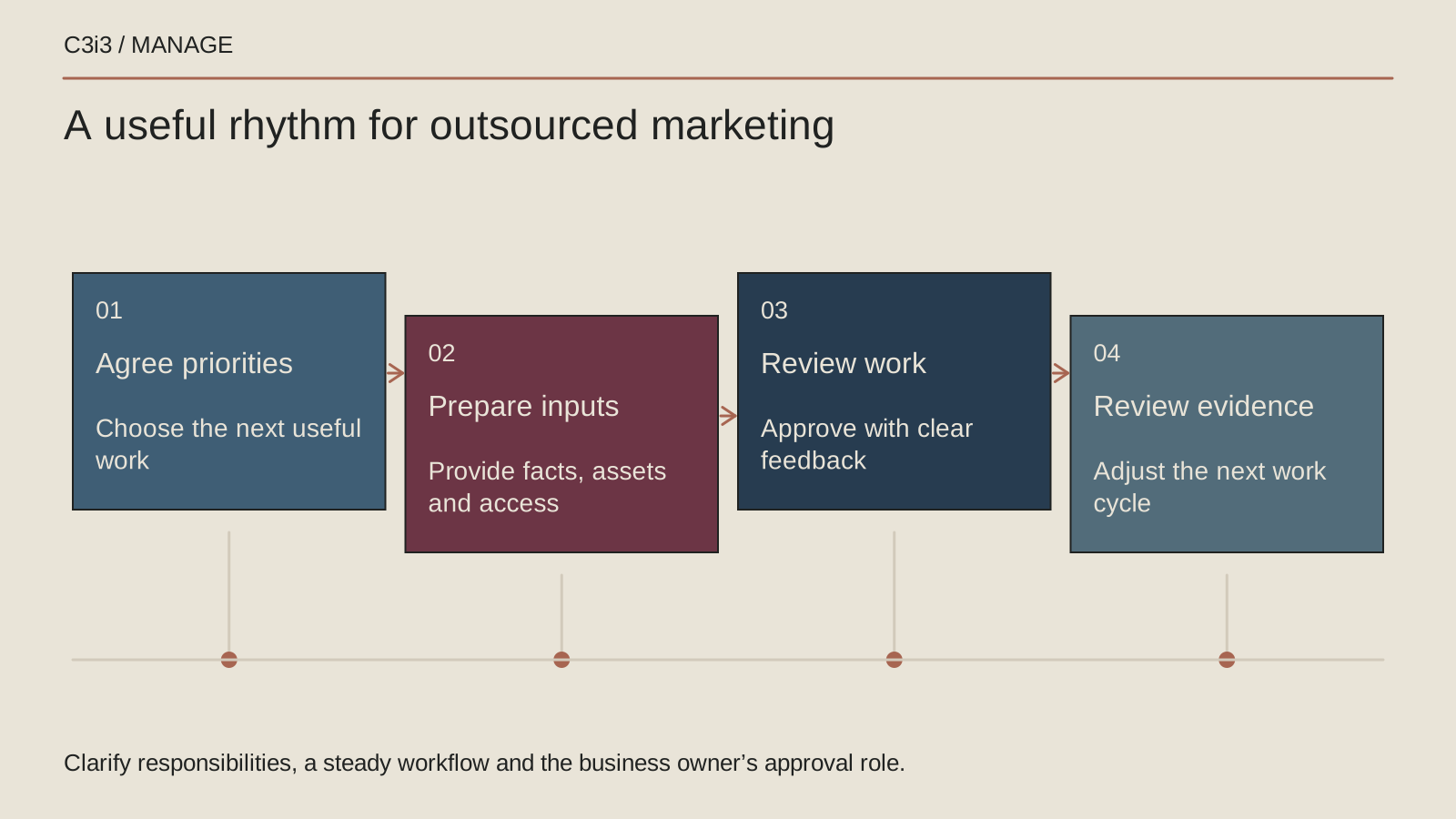
Create one regular review window and a separate route for genuinely urgent corrections. Ask for specific decisions with enough context to answer them. Approving a final service claim is different from rewriting every paragraph because nobody supplied the facts at the start.
An agency also needs supervision. Review the quality of its recommendations, completed work and use of access. Delegation works best when those checks are planned and proportionate.
Build coverage beyond one person’s memory
One employee leaving can interrupt marketing when passwords, supplier contacts and publishing knowledge sit only with that person. An outsourced arrangement can have the same weakness if only one account manager understands your business. Ask how either model provides coverage.
Maintain business-controlled accounts, a shared asset location and brief notes explaining recurring tasks. Give named people appropriate access instead of circulating a single password. NIST's small business security resources provide a practical reference for protecting the material involved.
Test continuity with an ordinary task. Another approved person should be able to find the current file, understand its status and identify the next decision without reconstructing months of messages.
Start with a manageable operating agreement
Choose a first period with defined priorities, named responsibilities and a review date. For an established service business, that might mean current service pages, a dependable publishing routine and a clearer record of website inquiries. Avoid launching every channel merely because the team has the skills.
Judge the arrangement by completed useful work, quality, remaining owner coordination and evidence of progress toward the business objective. Record delays caused by missing information as well as supplier delays. Otherwise the review becomes a contest over who remembers which email.
A hybrid may be strongest: an internal person maintains business knowledge while an external team provides specialist delivery and coverage. Choose the arrangement your actual workload supports.
Keep this checklist beside you
Questions before the next step
Can an outsourced team replace every marketing responsibility?
No. It can manage agreed work and coordination, but your business still supplies facts, decisions and approvals. Someone must also review the relationship. The right division reduces repeated chasing without removing business accountability.
Should I hire internally when the workload grows?
Consider it when continuous attention and close business knowledge become central to delivery. Compare the role with your real workload. An internal manager supported by outside specialists can be more practical than expecting either model to cover everything.

How C3i3 Can Help
C3i3 can help organize recurring marketing work and identify where dedicated support would remove gaps in delivery. Bring your current task list, outside suppliers and the decisions that keep returning to you.
We can discuss a defined scope, a coordination process and the business input it requires. The aim is a manageable working relationship with clear capacity and responsibilities, so you can assess whether the support fits before expanding it.