








































In this article
Rank and rent SEO describes a way to operate a local lead-generation website separately from the business that ultimately performs the work. A website owner develops the site, maintains its content and inquiry paths and arranges for a real provider to receive suitable requests. The practical question is whether that arrangement can help customers and a capable business while keeping ownership, identity and responsibilities clear.
This guide is for business owners assessing the model and the agency work behind it. It explains what an owned website can control, what remains dependent on search platforms and why a useful customer journey matters more than a collection of domains. C3i3's Local SEO service can support assessment and a defined pilot; this article does not claim an existing inventory of rental websites.
What does rank and rent SEO actually mean?
Rank and rent is an operating arrangement in which one party maintains a website intended to attract relevant service inquiries and another business receives requests under an agreed arrangement. Search engine optimization (SEO) helps make the site's useful information accessible and understandable. The word “rank” describes an aim rather than a result the operator can guarantee.
Consider a hypothetical site explaining a specific residential cleaning service in a verified coverage area. The site operator maintains the pages and request route. A separately identified cleaning business evaluates incoming requests and decides which appointments it can accept. The operator does not become a cleaning company simply by publishing cleaning content.
How is this different from SEO for the contractor's own website?
The difference is the asset arrangement. With ordinary client-owned SEO, the work improves the contractor's existing website and business information. With a separate lead site, the operator may retain control of that website while the contractor uses its inquiry channel. A contractor should understand which arrangement is being proposed before agreeing to the work.
Our contractor local SEO guide covers the client-owned route. Neither route removes the need for service accuracy, credible information and reliable response. If the contractor's existing site already has an appropriate service page and a strong contact journey, improving it may be the more coherent starting point.
Do not evaluate the separate-site model as an unattended asset. Content changes, inquiries fail to connect and provider capacity changes. Someone must continually verify that the public promise still matches the operation.
How does an owned website connect a customer with a real provider?
A useful lead website connects a visitor's service need with an understandable next step and an appropriate provider. The connection requires clear content, accurate coverage, an honest explanation of the site's role and a working inquiry route. Receiving a request does not establish that a provider has accepted it.
In a fictional HVAC example, a visitor arrives because an air conditioner is not cooling. The page explains that the inquiry concerns a service assessment, identifies who will receive the request and asks for location, problem description and a way to respond. It does not announce an appointment before anyone checks availability.
Which audience should each page serve?
A contractor searching “HVAC leads” is researching customer acquisition. A homeowner searching for air-conditioning repair is trying to obtain a trade service. They need different explanations and destinations. This C3i3 guide addresses the business decision. A real lead website must address the homeowner's service decision without pretending C3i3 performs HVAC work.
The dedicated HVAC lead website guide explores that business-owner path. For roofing businesses, evaluating a separate roofing lead website requires evidence about job fit and routing as well as the site itself.
Review the customer path as a sequence: understand the need, check coverage, understand provider identity, make an inquiry and receive a suitable response. A weak step cannot be repaired merely by attracting more visits. If people believe they contacted one company but hear from an unrelated company without explanation, the journey needs correction before expansion.
What does the website owner control and what stays with the contractor?
The website owner can control specified site assets and operating accounts. The contractor retains its business identity, trade capabilities, service decisions and responsibility for work it accepts. Those are separate layers, even when the parties collaborate closely on the website.
Record domain registration, domain name system (DNS) access, hosting, source files, content permissions, contact routing and reporting separately. One administrator login rarely proves control of all those components. A contractor receiving inquiries may have reporting access without the ability to change the site's domain or publish a new page.
Domain registration itself operates under a registrar agreement. ICANN's registrant guidance describes registration responsibilities and access to relevant terms. It does not turn a domain into physical property or guarantee continued search visibility. Our digital real estate ownership guide provides a layer-by-layer inventory.
What should stay distinct in everyday operations?
The site operator may correct a page, while the provider confirms whether a requested service is available. The operator may test a telephone route, while the provider decides whether to schedule an assessment. The operator should not invent credentials, reviews or project evidence to fill gaps in the provider's information.
Make these responsibilities visible in the working brief. If the provider changes, old photographs, claims and contact details need review before routing changes. Retaining the website does not grant continuing permission to represent a departed contractor. A separately controlled asset only remains useful when its public information is maintained as carefully as its technical accounts.
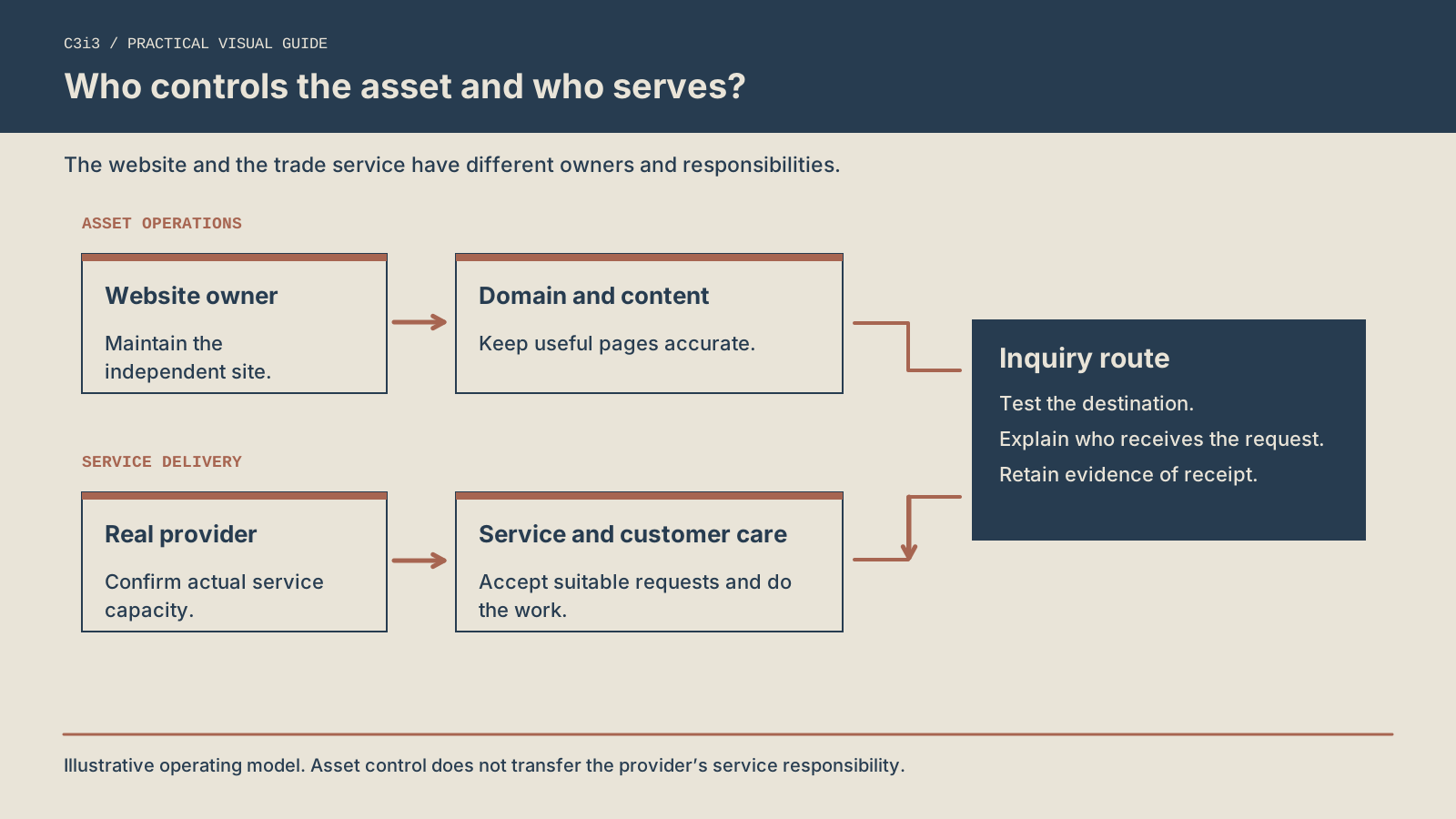
The website owner controls the site and routing. The real provider accepts suitable inquiries and performs the service.
How do you choose a service and location worth investigating?
Choose a service and location by combining evidence of customer demand with real provider capacity and a content purpose you can support. A measured keyword estimate is one input. It cannot establish how many suitable inquiries a particular website will receive or whether a provider can handle them.
Begin with the actual work the provider wants to assess. “Residential HVAC installation inquiries within verified coverage” is a more useful brief than “all home services across the region.” Ask which jobs the business performs, which locations are practical and when someone can respond. Then research the language customers use and inspect the relevant search results.
What makes apparently similar niches different?
A planned roof replacement requires different information from an urgent plumbing request. A recurring house-cleaning inquiry differs from a facility manager arranging a commercial walkthrough. The site must explain the appropriate next step for the service and ask enough to identify fit without expecting the customer to diagnose the problem.
Use the service and location selection worksheet to compare candidates. Look for a genuine provider, useful information and manageable response responsibilities before considering additional coverage.
A hypothetical operator might initially consider several cities but discover that its proposed provider only accepts a narrow service area. That finding should reduce the pilot scope. Creating pages for the larger region would attract requests the operation cannot serve and make the public explanation harder to trust. A smaller verified area gives the team a clearer test of demand, content and handling.
What makes a lead website useful enough to publish?
A useful lead website helps a person understand the service, evaluate whether the request fits and contact an appropriate provider with informed expectations. It needs a substantive purpose beyond occupying another search result. The visitor should learn something useful before surrendering contact information.
Build a small, connected information structure. The home page identifies the site's role. Service pages explain distinct customer needs. Coverage information describes where requests can be considered. Provider information establishes who may perform the work. The inquiry page explains what happens after submission.
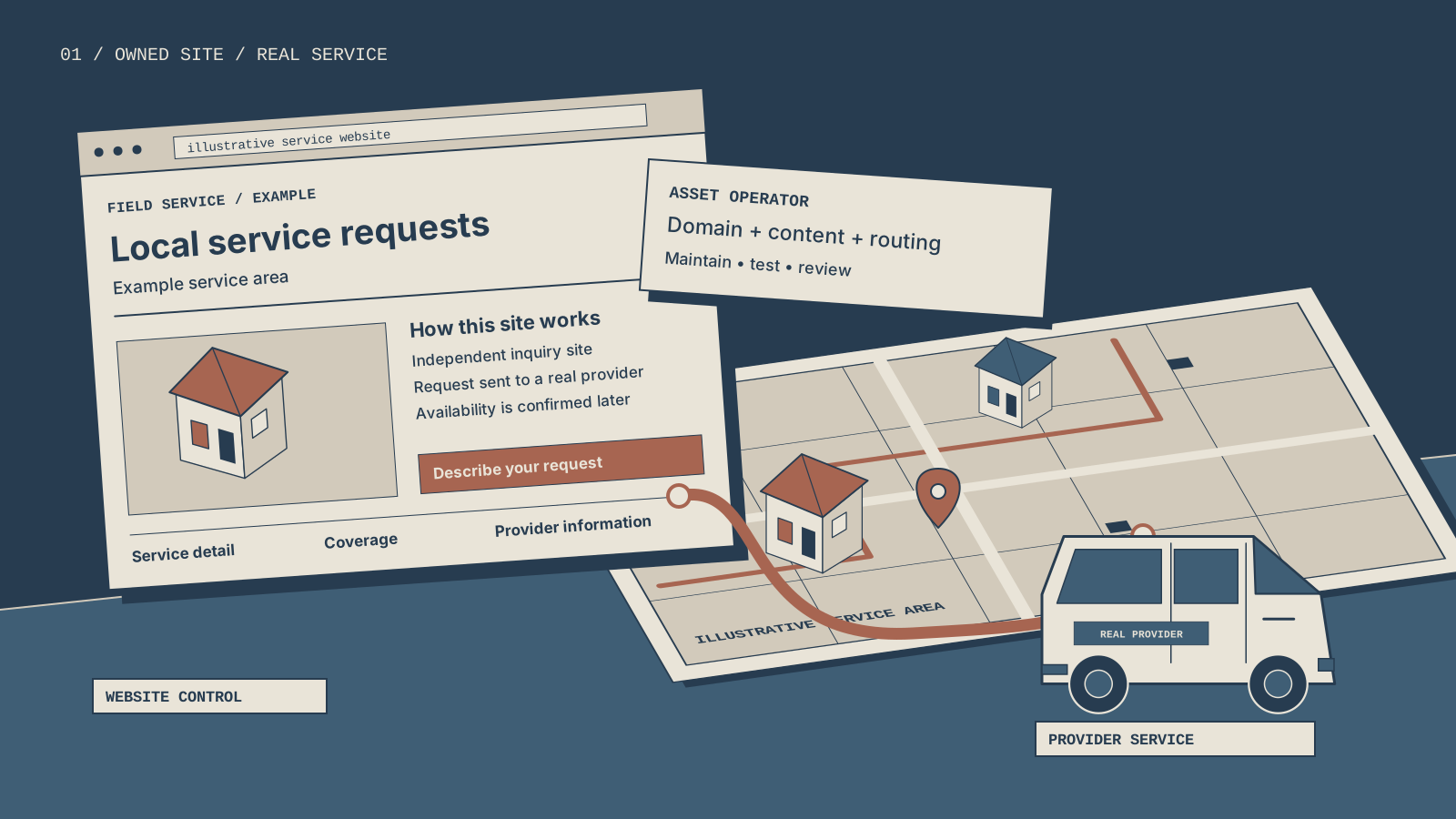
The annotated fictional lead website shows these relationships without presenting a mockup as a successful client. It also demonstrates why one honest coverage explanation can be more useful than many nearly identical location pages.
What evidence belongs on the site?
Use service facts confirmed by the provider and project material the business has permission to publish. Identify illustrative explanations as illustrative. Do not make stock imagery look like the provider's completed work or describe a planned relationship as an established operation.
Before launch, read the page as a skeptical customer. Can you tell whether the site is a provider or an inquiry service? Can you understand which requests are appropriate? Can you identify the intended recipient and the next action? If answers require opening a privacy policy or deciphering a disclaimer, improve the main content.
Google's people-first content guidance supports original, substantial information for an intended audience. Publishing more pages does not substitute for resolving those basic customer questions.
How can an independent lead website pursue search visibility responsibly?
Use ordinary SEO practices to make accurate, useful pages discoverable and understandable. Give distinct customer decisions clear pages, connect them with descriptive links and maintain the underlying technical site. Search engines decide whether and where pages appear.
Separate publication from visibility. A page can load correctly without being indexed, and an indexed page can receive little relevant attention. The operator should inspect search evidence rather than treating the word “rank” as proof that optimization succeeded. An exact-match domain does not guarantee placement.
Which shortcuts should the project reject?
Reject city-swapped site networks, large sets of near-identical pages, purchased ranking links and private blog network tactics. Google's spam policies address doorway abuse, scaled content abuse and link spam. A network that funnels similar searches through thin intermediary sites can conflict with those policies.
The practical alternative is not simply a longer article. Give each page a distinct reason to exist. A repair page can explain assessment and scheduling. An installation page can address planning and provider review. A location page needs useful, verified differences beyond substituting a place name.
Clear answers can also support answer engine optimization (AEO) and AI search optimization (AIO) work, but those labels do not create control over an assistant's recommendations. No question format, schema object or publishing schedule guarantees citation. For an implementation sequence, see building and operating a local lead-generation website.
Can a rank and rent site have its own Google Business Profile?
A lead-generation agent or company is not eligible for a Google Business Profile. A separately rented lead website must not be given a fictional contractor listing. The actual contractor may have an eligible profile for its real operation, subject to Google's requirements.
This is explicit in Google's business eligibility and ownership guidelines. The distinction changes how a pilot should be planned. Organic website discovery and a contractor's Maps presence are separate channels with different identity requirements.
Does contractor permission make the lead site eligible?
No. Permission can authorize an agency to manage a contractor's legitimate profile. It does not turn an independent lead-generation brand into the contractor or make the lead company eligible. A borrowed address, rented mailbox or invented office cannot resolve that underlying identity problem.
The contractor's business name, authoritative website, telephone destination and actual operation must remain accurate. The operator should not create a profile intended to be passed between unrelated providers as website routing changes. Our rank and rent Google Maps eligibility guide explains the checks in detail.
For planning purposes, write two separate lines: “independent website discovery” and “real contractor profile management.” If a proposal cannot explain which business a profile represents or relies on a fabricated location, stop that portion of the plan. A website can have a valid editorial and inquiry purpose without an invented Maps listing. The absence of eligibility should shape the model from the beginning.
What operating work continues after the website launches?
The operator must maintain the site, verify its claims, monitor inquiry delivery and coordinate changes with the provider. Launch is the start of an operating process. A functioning page does not establish that its telephone route or form destination still works.
Assign responsibility for content updates, technical maintenance, contact-path testing and provider availability checks. Keep a record of important changes so an unexpected inquiry pattern can be investigated. If the provider stops accepting a service, remove or revise the relevant promise before more people contact it.
How should an ordinary change be handled?
Suppose a hypothetical cleaning provider stops accepting move-out requests but continues recurring service. The operator reviews navigation, service descriptions, inquiry options and any confirmation message that mentions move-out work. The provider checks what its office will say to callers. Updating one sentence while leaving the rest of the journey unchanged creates confusion.
Technical checks should include backups, software maintenance where applicable and mobile usability. Keep permissions limited to the work each person needs. Recovery arrangements should survive a change in staff or suppliers.
A provider transition requires a broader review. Confirm the replacement's actual services and coverage before altering destinations. Remove old evidence that cannot be reused. Test without sending unsuspecting customers into an unfinished handoff. Maintaining clear business identity is part of normal site operations, not a one-time disclaimer exercise.
For contractor-specific assessment, the contractor lead-generation buyer guide connects these operating requirements with the business's capacity to accept work.
How do you evaluate inquiries without confusing activity with results?
Evaluate each stage separately: site discovery, inquiry creation, successful delivery, service fit, provider acceptance and any later appointment. These stages answer different questions. A phone-button click is not a connected conversation, and an inquiry is not proof of a completed job.
Define a suitable inquiry before reviewing totals. The definition might require a supported service, a workable location, usable contact details and a request the provider can evaluate. Record unsuitable requests by reason so the team can distinguish a content mismatch from a response problem.
What does a small worked review show?
Imagine an illustrative review containing twelve submitted requests. Nine reached the intended destination, six matched service and coverage and four were accepted for follow-up. These fictional counts are not a benchmark. They show that twelve submissions, nine deliveries and four accepted requests describe different observations.
The immediate priority would be investigating the three delivery failures before increasing traffic. The remaining unsuitable requests need their own review. If most request an unsupported service, page wording and navigation may need correction. If suitable requests arrive when nobody can respond, the operating arrangement needs attention.
Use aggregate reporting where possible and keep customer details in appropriately controlled systems. Record the review period, definition and missing outcomes. Provider feedback can add context, but an unverified statement should not become a published case-study result.
Cleaning businesses need the same separation, with service-specific acceptance rules. The cleaning lead website guide distinguishes recurring homes, facility inquiries and other materially different requests.
What should a first rank and rent pilot brief contain?
A first pilot brief should identify one customer problem, the real provider, the controlled asset, the supported territory and the evidence needed for a next decision. It should make uncertainties visible before publication. A focused pilot is a way to learn about the operation, not a commitment to expand.
| Worksheet field | Illustrative entry | Evidence to obtain |
|---|---|---|
| Service | Planned residential HVAC installation inquiries | Provider confirms supported work |
| Coverage | Only locations the provider verifies | Written operational coverage list |
| Identity | Independent inquiry site naming its role | Approved public explanation |
| Asset control | Operator maintains domain, pages and routing | Separate account inventory |
| Response | Named recipient reviews requests | Controlled receipt test |
| Review | Delivery, fit and acceptance assessed separately | Dated review with known gaps |
This worksheet is hypothetical. Replace every entry with verified facts for the actual project. Add an owner and a next action beside each missing item. If no provider has confirmed the service or nobody can describe the inquiry destination, the project remains in planning.
What should determine the next step?
Use the weakest unresolved dependency. Missing service facts call for provider input. Unclear asset control calls for an inventory. Failed receipt tests call for routing repair. Weak demand evidence calls for more research. These are different tasks and should not all be answered with another page.
After the pilot runs, review the evidence against the original purpose. Continue only if the public promise, provider operation and observed customer path remain coherent. A narrow, well-documented learning cycle gives the next decision a sounder basis than an assumption that more domains must create more suitable inquiries.
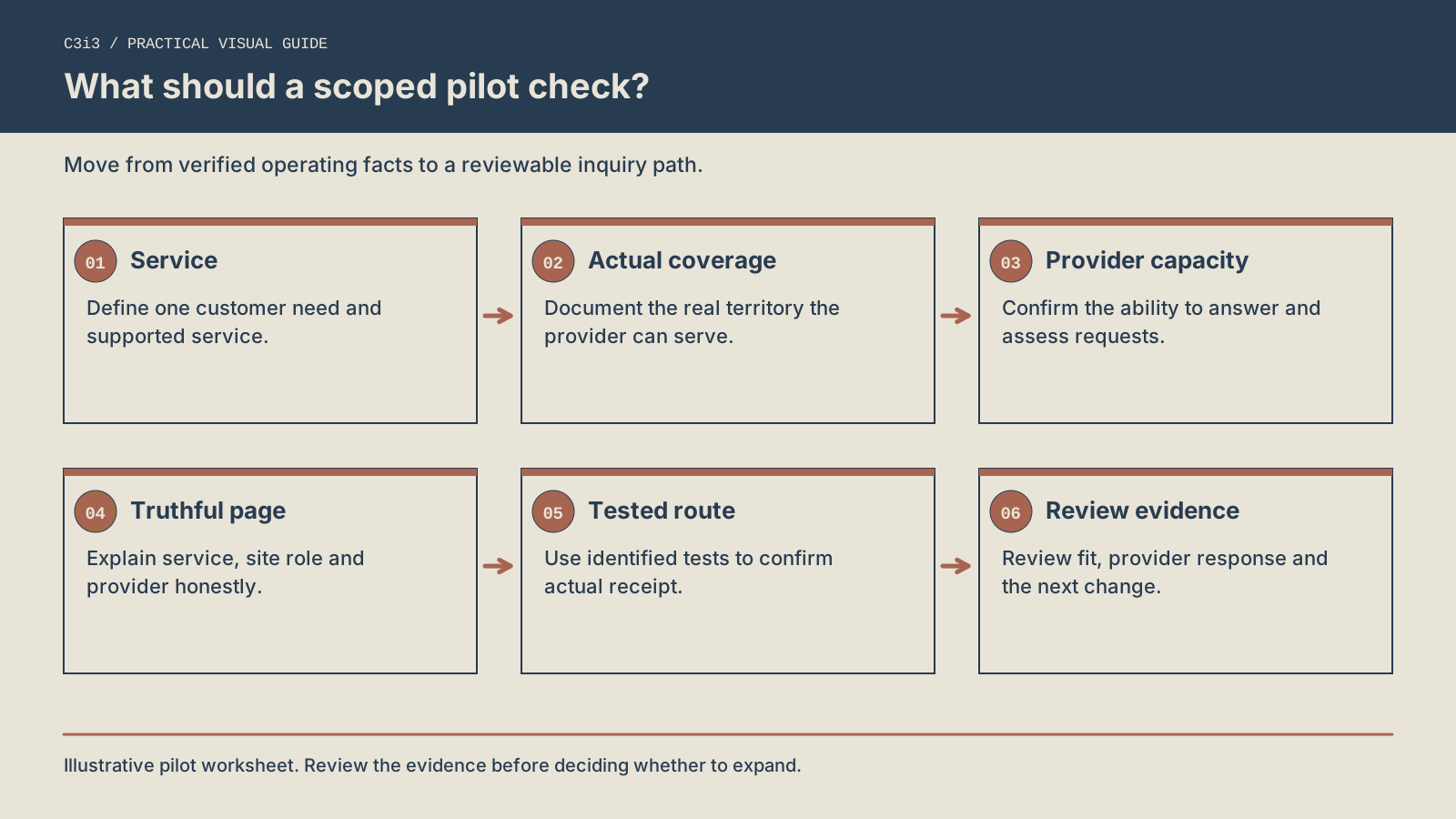
Choose a service and real coverage, confirm capacity, publish a truthful page, test routing and review the evidence.
What else should you ask before starting rank and rent?
Ask how the inquiry source, provider readiness, domain choice, information handling and existing website affect the proposed arrangement. The answers should clarify the next decision rather than imply guaranteed results.
Is rank and rent the same as buying a list of prospects?
No. A separately operated website receives requests from people using its public pages and contact route. A purchased prospect list is a different acquisition activity. Ask where requests originated, what the visitor understood and how the intended recipient was explained. A spreadsheet of contact details alone cannot demonstrate that customer journey.
Can you begin without a provider ready to accept inquiries?
You can research and prepare a private plan, but a live inquiry promise needs a truthful destination and a workable response process. Do not publish claims that a contractor is available before confirming the arrangement. Educational content can be developed first, with public contact behavior matched to what actually exists.
Does an exact-match domain establish a ranking advantage?
It does not establish or guarantee a ranking result. A descriptive name may help a visitor understand the subject, but the site still needs useful information and a functioning experience. Avoid a naming strategy that depends on creating many nearly identical local sites or presenting a keyword phrase as a real contractor's business name.
Does renting the website mean owning the contractor's customers?
No. Website access, inquiry handling and the contractor's customer relationship need separate operational treatment. Do not assume that control of a form permits unrestricted reuse of personal records. Establish the actual purpose, authorized access and appropriate handling of information with the responsible business before collecting it.
When is the contractor's existing website a better starting point?
Its existing site may be the better starting point when it already represents the service accurately and needs clearer content, stronger discovery or a repaired contact journey. Compare the customer and operating benefits of a separate asset with improving that established destination. The website arrangement should follow a defined business need.
Can C3i3 promise that a pilot will produce leads?
No. A pilot can establish a scoped research, build, SEO and review process. Demand, competition, visibility, customer decisions and provider response affect outcomes. Ask for concrete deliverables and observable checks rather than a promised position, assistant citation or lead total. Publication and measured business results remain separate milestones.

How C3i3 Can Help
C3i3 can assess whether a separately controlled lead website fits a defined service and provider operation. We can connect strategy, content, design and implementation with Local SEO and a scoped lead-generation campaign.
Bring the service you want to support, real coverage, provider responsibilities and any existing website. Contact C3i3 to discuss the evidence and work needed for a focused pilot. The starting conversation is an assessment of your situation, not a claim that a ready-made rental site or established lead stream is available.