








































In this article
When an HVAC contractor searches for HVAC leads, the immediate need is usually more customer inquiries or a better way to acquire them. The contractor may be comparing lead providers, evaluating an agency or exploring a dedicated search website. That is a business buying decision. A homeowner searching for a heating repair or an installation assessment has a different task.
A dedicated search engine optimization (SEO) website can connect those audiences through an HVAC offer and an identified receiving business. This guide helps the contractor decide what such a project should include and what to bring to an agency. It belongs within our contractor lead-generation framework and does not imply that C3i3 has a stock of HVAC leads ready to sell.
Why do contractors search for HVAC leads?
Contractors search for HVAC leads because they want potential customer demand for the work their business can accept. Some need repair inquiries, some want installation assessments and others need an acquisition partner. Agency scoping begins by identifying that need.
The phrase itself does not mean the searcher needs an air conditioner repaired. It often signals commercial research about marketing and lead supply. A contractor-facing article should therefore explain the acquisition approach, scope and evidence. A customer-facing website should instead help a homeowner understand the actual service and contact the real provider.
What is the difference between a dedicated site and a ready-made lead supply?
A dedicated site is an acquisition asset that needs research, content, technical maintenance and a working receiving process. It may be proposed as a new project or evaluated as an existing site. An offer of existing contacts is a different proposition. Confirm which one is being discussed before comparing its evidence.
In an illustrative Bay Area brief, a homeowner searches “San Jose AC repair” while an HVAC company searches “HVAC leads” to find an acquisition partner. The customer page must answer the repair need. If that operator also confirms San Francisco coverage, explain the actual service and response conditions there. A city-swapped copy or broader territory claim does not create repair capacity.
The contractor needs an acquisition explanation and a route to agency scoping. The homeowner needs the supported service, actual provider identity and an honest contact process.
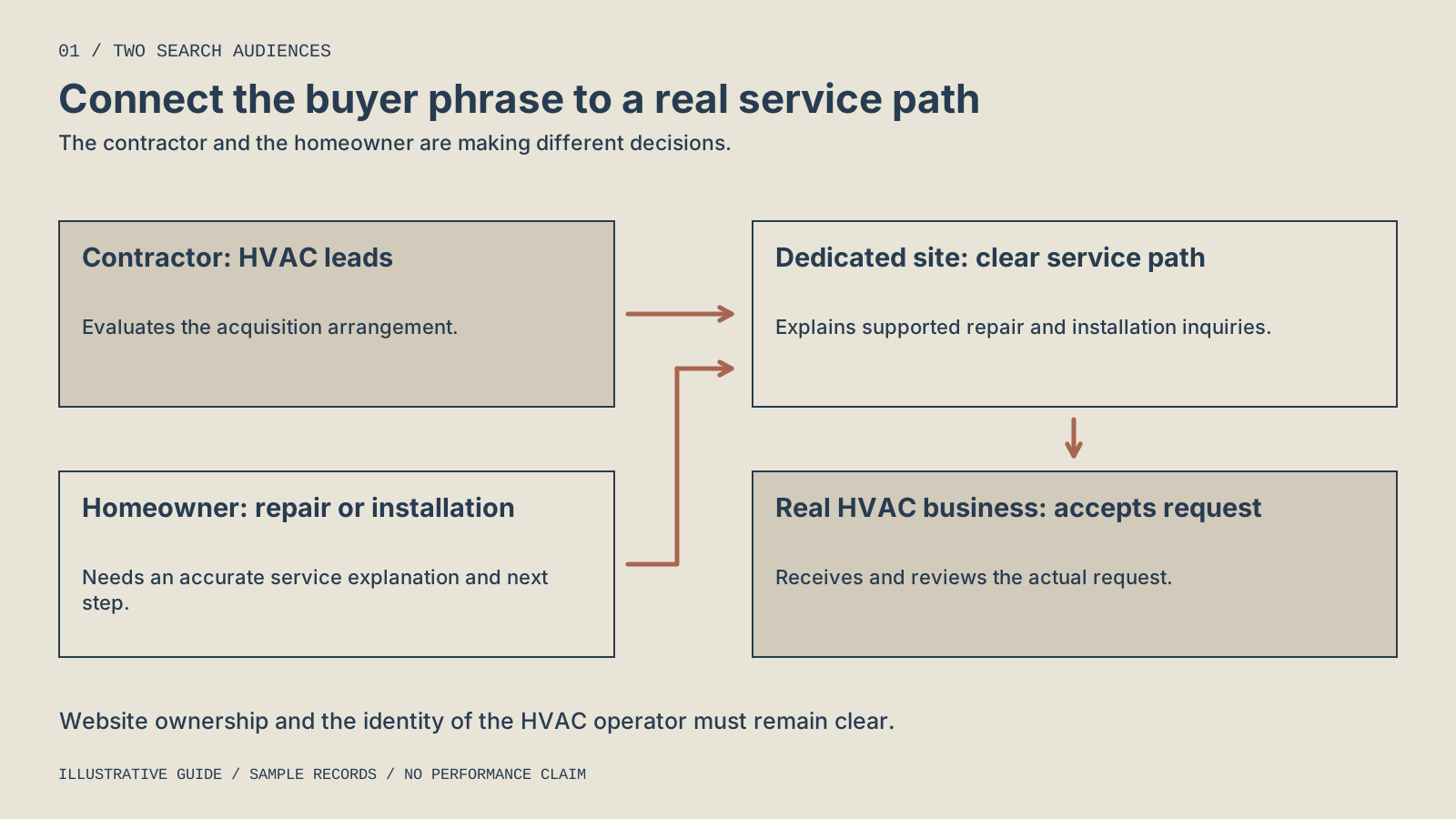
HVAC leads is a contractor-buyer phrase. A dedicated customer-facing site must answer homeowner service questions and identify the HVAC operator receiving the inquiry.
How should a dedicated HVAC site support repair and installation inquiries?
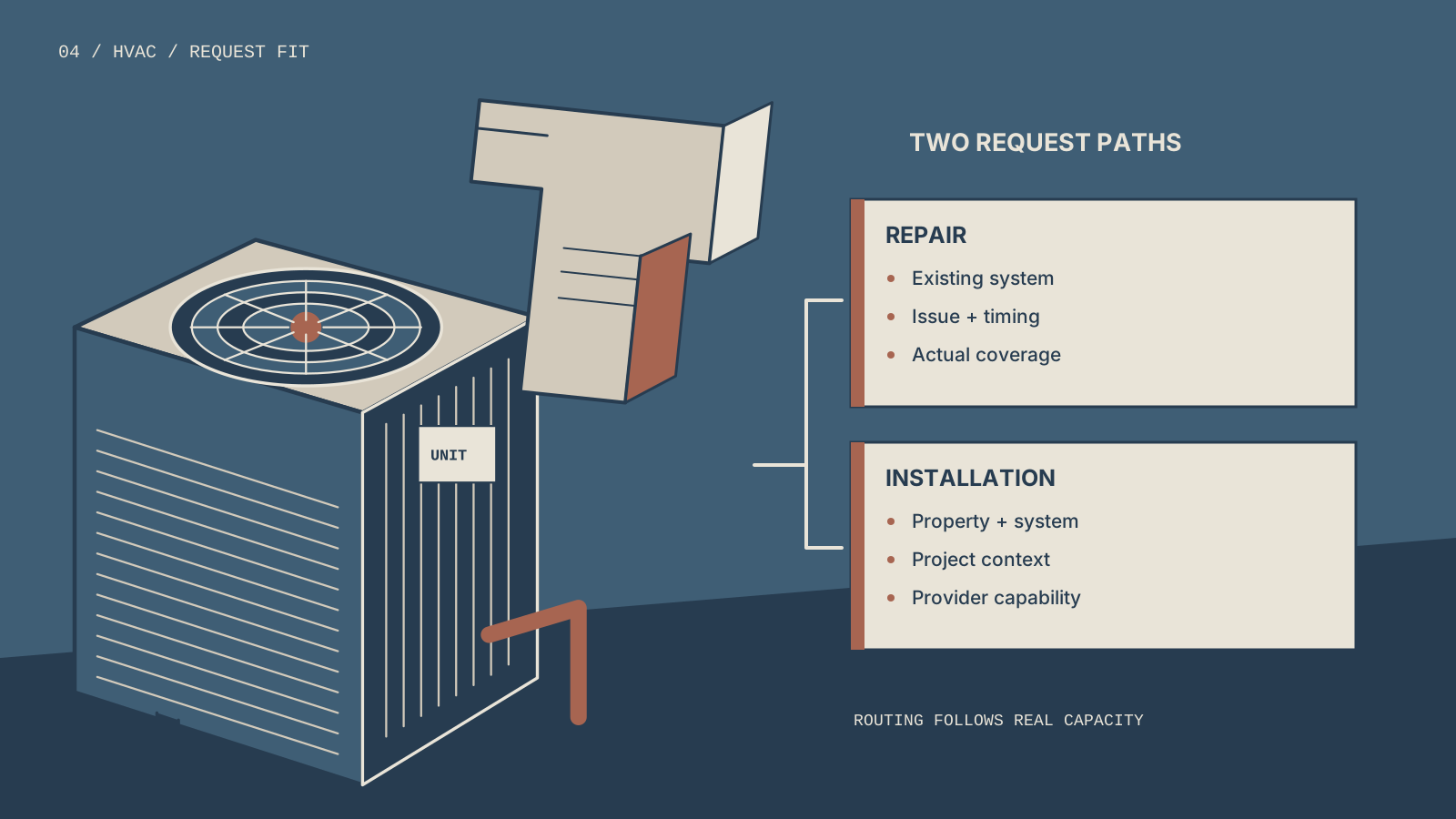
Give each supported customer decision a clear path. A repair visitor needs to understand whether the business handles the reported kind of problem and when a response can occur. An installation visitor needs to understand assessment, supported property types and the process for discussing a possible project.
This is an acquisition-content decision, not an online diagnosis. Let the visitor describe what prompted contact without requiring a system specification or asking them to select the work a technician must perform. Public service descriptions should be approved by the receiving HVAC business and kept within its actual capabilities.
Where do heat pumps fit when the customer mentions heating or cooling?
A heat pump can provide both heating and cooling, as the Department of Energy explains. A customer may describe a comfort problem rather than know the equipment category. Offer an understandable way to describe the need and let the contractor clarify the system and appropriate service.
The Department of Energy’s air-source heat pump guidance supports that basic distinction. It does not establish that a particular home needs a heat pump or that every HVAC business services one. The site must name only the services the actual operator has approved.
A useful illustrative page path begins with the customer’s task: request a repair conversation or request an installation assessment. It then explains coverage and the receiving business before offering contact. These paths can link where a visitor’s question changes, but the website should not automatically convert every repair description into an installation request.
For a deeper decision about whether heat-pump installation demand exists in a target market, our HVAC market-research guide addresses that distinct question. This guide concerns how a dedicated acquisition website should serve an approved offer.
How should HVAC seasonality and capacity shape the lead-site scope?
Plan around the contractor’s observed demand patterns and current capacity for each service. Repair availability and installation assessment availability may differ. A site that ignores those differences can attract appropriate customer needs at a time the receiving business cannot offer the next step it advertises.
Use the contractor’s own booking history and current staffing input to identify review points. Do not assume a nationwide seasonal calendar describes every market. Local climate, the services offered and the company’s operating pattern can change the practical acquisition question. A campaign brief should state what the business can accept now.
What would an illustrative HVAC capacity board contain?
It could list cooling repair, heating repair and planned installation assessments, with an approved territory, available next step and date last confirmed for each. The board is an operating aid. It is not a demand forecast or a public promise that appointments remain available.
| Service path | Contractor decision to confirm | Website consequence |
|---|---|---|
| Cooling repair | Is the office accepting requests in this area? | State the actual contact and review process |
| Heating repair | Which systems and property types are supported? | Keep the service explanation within approved capability |
| Installation assessment | Can the business offer assessment conversations? | Describe a request without implying a confirmed installation |
Assign someone at the HVAC business to communicate changes. If repair availability tightens, adjust that path deliberately rather than obscure the change inside a generic contact form. If installation assessments remain supported, they can retain their own accurate explanation. The agency needs those decisions to keep the website’s acquisition promise aligned with operations.
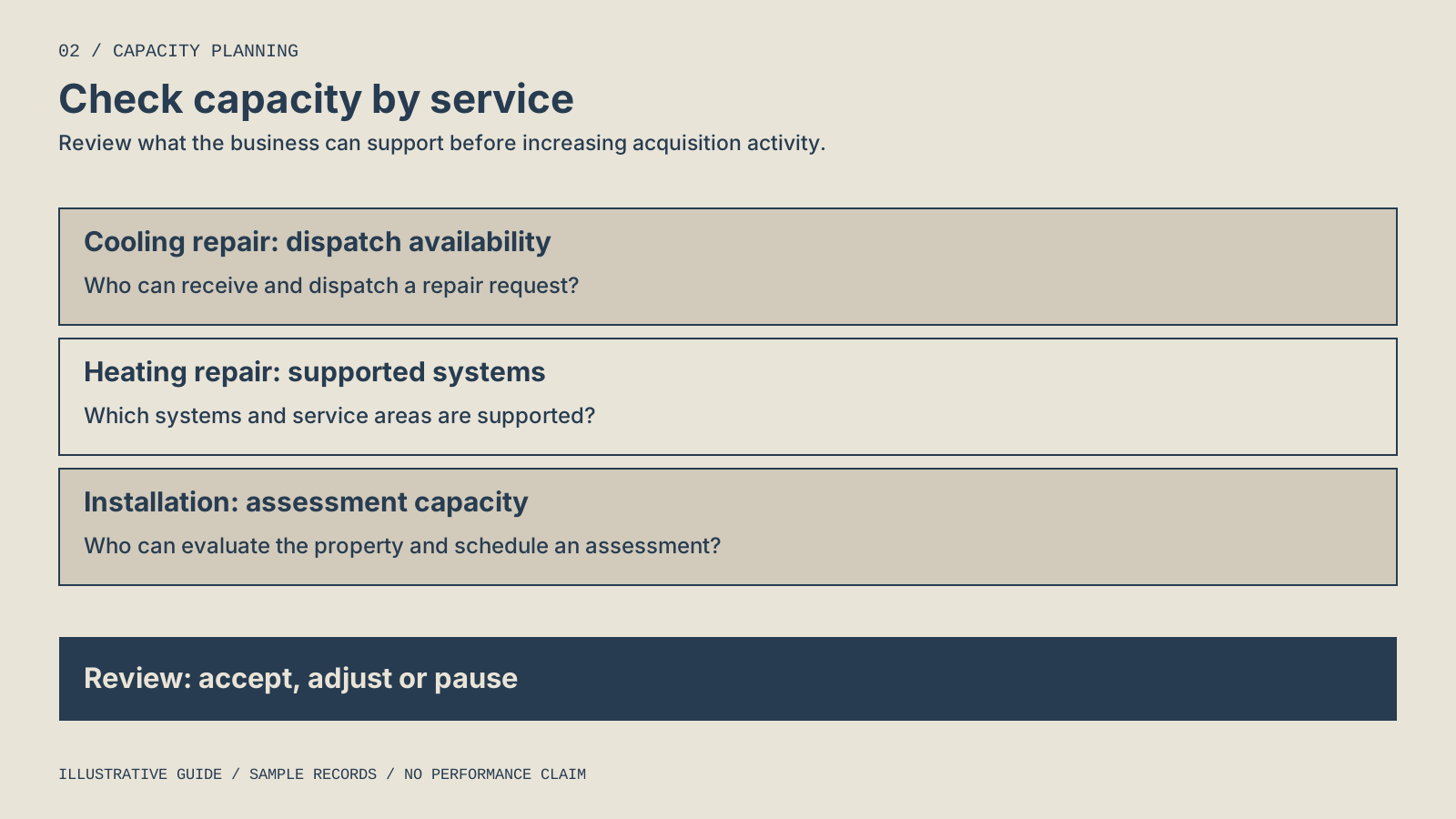
The contractor approves availability for each supported service, the site reflects it and inquiry reviews lead to an appropriate adjustment or pause.
What must be verified before the HVAC site receives customer inquiries?
Verify the visible business relationship, approved services, contact destinations and customer confirmations. A separately controlled website must still make sense to the person requesting help. The receiving HVAC business should recognize both the offer and the way the site describes its role.
Review the domain and the public pages together. Confirm who maintains the asset and who can approve service changes. Check that project images, descriptions and testimonials accurately relate to the business represented. Do not use generic technician imagery or borrowed project evidence to imply an operating history the site or contractor does not have.
Can the lead site have its own HVAC Business Profile?
A lead-generation website is not eligible for a Business Profile merely because its inquiries go to an HVAC contractor. Google explicitly identifies lead-generation agents and companies as ineligible. The real eligible HVAC operator can be represented accurately through its own profile; agency management requires the owner’s express consent.
Check Google’s eligibility guidance and its third-party management policies before including profile work in a proposal. Keep asset ownership and the operator’s genuine identity clear. An invented location is not a necessary or acceptable step in launching a search website.
Complete controlled delivery tests with authorized recipients before going live. Verify the normal request and the closed-hours experience. The plumbing prelaunch test provides an adjacent example of exception testing, while the website build guide covers the larger implementation process. HVAC-specific service and capacity approvals must come from the actual HVAC business.
How do you evaluate whether HVAC inquiries are useful?
Evaluate whether requests concern supported services in the approved area and progress to a next step the contractor accepts. Keep repair and installation observations separate. A high total can hide a poor match between the website’s offer and the business’s available capacity.
Use short, nonpersonal records with a request reference, service path, area fit, office acknowledgment and next-step status. An installation request awaiting assessment is different from an accepted repair conversation. A suitable request declined because the office is unavailable is different from a request for unsupported commercial equipment.
What should an illustrative HVAC review record show?
It should preserve the customer task and the contractor decision without pretending that a website diagnosed the system. For example, H-A can be an accepted repair discussion; H-B an installation assessment request awaiting office confirmation; H-C an unsupported property type. These examples demonstrate classification and do not imply expected results.
Use source reporting for discovery and office records for operational outcomes. Search Console performance reporting helps inspect pages and queries. It does not determine which inquiries became suitable HVAC work. The customer may also make contact through a route whose precise search source cannot be established.
Check the meaning of call measures too. Google’s phone conversion documentation distinguishes methods that observe different actions, including mobile number clicks. An interaction with a call link is not proof of an answered HVAC request. Review the configured method and acknowledge its limits rather than relabel every event as a qualified lead.
A practical review produces a next action: clarify supported systems, repair an unacknowledged contact path, revise current availability or continue observing the same scope. It does not extrapolate guaranteed installation work from early traffic.
What should an HVAC contractor ask an agency to scope?
Ask the agency to scope a defined acquisition problem with concrete outputs. Bring the real HVAC business, approved work, geography and current inquiry process. The agency can then assess whether a dedicated asset is appropriate and what research, content and testing it would need.
A useful request might say: “We want to evaluate a separate website for residential repair conversations and planned installation assessments in our actual coverage area. These are the services we support, these are our current response limits and this is how our office confirms appointments.” It gives the agency a decision to resolve rather than an undefined demand for more contacts.
Which deliverables should the proposal make reviewable?
Look for a service-and-location brief, distinct customer paths, identity explanation, page plan, contact-route tests and a reporting definition tied to useful requests. Ask who approves capacity updates and what happens when a service must pause. If an existing site is proposed, request evidence for that specific asset.
For a new build, distinguish the planned method from outcomes that can only be observed later. Ask how the agency will avoid repetitive city pages and keep information current. Google’s search spam policies make useful, differentiated content especially relevant to any plan involving many local pages.
A roofing contractor’s exclusive-source due diligence provides another way to think about source and distribution questions. Your HVAC scope should still reflect your own service mix and operating capacity. The immediate goal is an informed decision about an agency project, not a claim that searches for HVAC leads will automatically become homeowner appointments.
What else should contractors know about HVAC lead websites?
Verify availability, service definitions and the evidence needed before relying on the channel.
Can an HVAC website promise same-day repair appointments?
The public statement must match what the receiving business actually provides. A request for review is different from a confirmed appointment. Have the HVAC operator approve current availability wording and update it when conditions change. A website cannot create dispatch capacity by displaying a faster promise.
Should repair and installation inquiries be counted together?
They may be summarized, but preserve separate categories and next-step definitions. An answered repair conversation and an installation assessment have different operational contexts. A combined total without the underlying detail can hide which path needs adjustment and which work the contractor is able to accept.
Does the site need to mention every HVAC system?
Only include systems and services the real receiving business supports and can describe accurately. A longer equipment list does not prove expertise or improve inquiry fit. Provide an option for the visitor to describe uncertainty so qualified staff can clarify the need.
Is a dedicated site guaranteed to rank for local HVAC searches?
No. A dedicated asset still needs useful content, technical maintenance and evidence of relevance. Google controls its results. Evaluate the proposed method and later observations without turning publication, indexing or an early position into a promise of durable visibility or customer volume.
Can C3i3 discuss a project if no lead site exists yet?
Yes. The scoping question can be whether a new dedicated asset is appropriate for your service and territory. Bring the actual business facts and the acquisition problem. A new-project conversation should distinguish research and proposed work from a claim that an available site or inquiry history already exists.

How C3i3 Can Help
C3i3 can help an HVAC contractor connect buyer goals with search research, useful service content and a clear customer inquiry journey. Our Local SEO services can inform the dedicated site’s search and content scope. Our Lead Generation Campaigns services can help define a practical acquisition test and the observations that matter.
Bring your supported HVAC services, real coverage, current capacity and existing website if available. Contact C3i3 to discuss whether a dedicated-site project should be scoped. C3i3 provides agency work; the named HVAC business confirms appointments, accepts customers and performs repairs or installations.