








































In this article
A local lead-generation website needs more than pages that mention a service and a city. Its operator must decide who the website represents, which requests it should attract, how those requests reach a real provider and what evidence makes the asset ready to use. Those decisions matter before anyone discusses leasing the site.
This implementation guide is for business owners and marketing teams considering a separately controlled search engine optimization (SEO) asset. It follows the build from a verified service offer to a maintainable inquiry route. If you are still comparing the model itself, start with how rank and rent websites work. Here the task is narrower: turning an approved concept into a useful, truthful website whose operation can be inspected.
What must be verified before building a local lead-generation website?
Verify the service, service area, receiving provider and permitted public description before choosing page layouts. A site cannot offer a dependable request path if nobody can confirm what work the destination business actually accepts.
Prepare a short operating brief with the provider. Identify the specific work included, the property or customer types it can handle, the territory it serves and the route available when someone responds. Record who can approve changes to each fact. Separate a statement the provider has confirmed from an assumption the website operator still needs to check.
What does a useful offer brief contain?
A useful offer brief describes a request someone can make. In a hypothetical home-service project, “planned equipment replacement assessment for owner-occupied homes within the confirmed territory” gives the writer a better boundary than “all home services.” The former can guide content, a form and a routing test. The latter leaves almost every implementation decision unresolved.
Include conditions that change the next action. A provider might accept assessment requests but need a preliminary conversation before scheduling. A service might be offered in part of the region while another is not. The website should communicate the relevant boundary rather than relying on the receiving team to correct every mismatch.
Do not manufacture an offer by copying another contractor’s service list. Confirm the actual destination first. A website can remain in planning while a provider relationship is unresolved; public inquiry buttons should not imply a working handoff before one exists. Keep a dated approval note so a later service change can be traced to the affected pages.
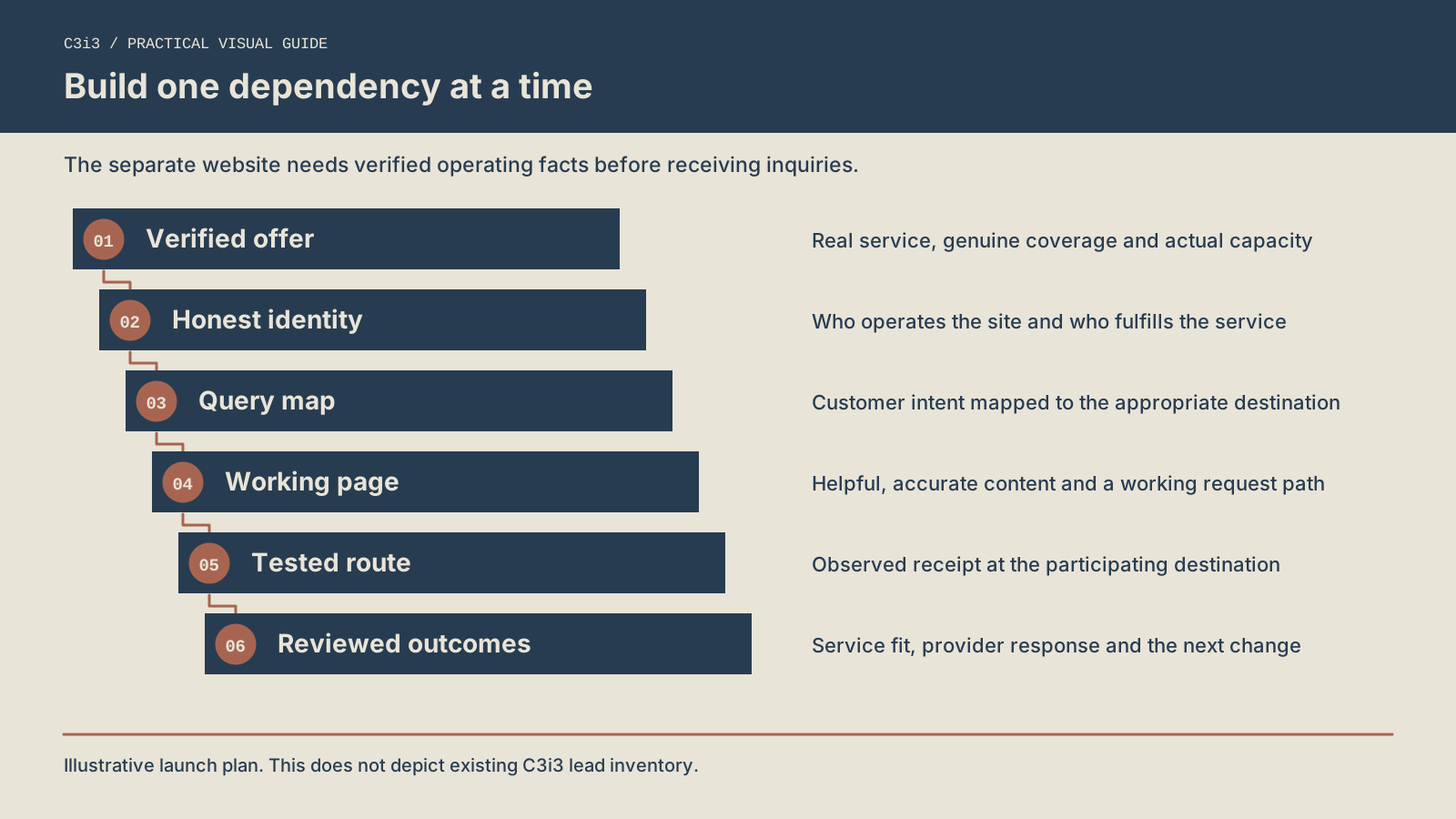
Build the dependency before opening the next stage. This is an illustrative launch plan, not a C3i3 inventory.
Which parts of the SEO asset need separate operational control?
The website operator needs reliable access to the domain, hosting, source files, content, search data and inquiry configuration. The provider needs appropriate access to the requests it is responsible for handling. Control should follow the task rather than depend on one person’s personal login.
Make an access inventory with the system, responsible owner, recovery method and operational dependency. Domain access affects whether the site can stay online. Hosting access affects deployment and recovery. Phone-platform access affects where calls go. Search Console access affects the ability to inspect discovery and search performance. These are different systems with different failure modes.
How should a build remain maintainable when the provider changes?
Separate reusable website structure from provider-specific facts. Keep the provider name, service limits, routing destination and approved public contact details in a maintained record. When a relationship changes, review every place those facts appear, including confirmation messages and notification settings. Replacing a logo alone is insufficient.
Keep a deployment history and an inventory of the pages currently public. Store a copy of the routing configuration with restricted access. A technical operator should be able to identify which release introduced a form change and which destination was active at the time without reconstructing the answer from memory.
The asset is also more than its search position. A page can remain visible after its provider stops accepting a service. That is an operating problem requiring a content and routing decision. Our website ownership guide explains the broader control layers; the build brief should convert those layers into named maintenance responsibilities.
How should an independent lead website explain its identity?
Explain who operates the site, what role it plays and who receives the inquiry before the visitor submits information. The site should make the difference between an independent inquiry service and a contractor performing the work understandable.
Use a visible identity explanation near the relevant action and a fuller explanation where visitors can review it. If a named provider receives requests, describe that arrangement accurately. If the receiving arrangement is not yet established, do not present the site as though a local service team is ready. Avoid first-person claims about crews, equipment or completed projects that belong to somebody else.
Can the lead site have its own Google Business Profile?
Google’s Business Profile eligibility guidelines list lead-generation agents and companies as ineligible. A real provider’s eligible profile belongs to its own business identity. An independent site does not become eligible merely because it forwards inquiries to that business.
Keep the organic website plan distinct from any authorized work on a provider’s profile. Do not create a fictional office, borrow a private address or invent a storefront to make the asset appear local. The rank and rent Maps eligibility guide covers that separate decision.
Authenticity also applies to evidence. Publish actual authorized examples with their correct owner and context, or label an editorial example as hypothetical. A stock scene, diagram or generated illustration can explain a process but cannot prove a local project occurred. If the site currently lacks experience evidence, answer useful service questions honestly instead of filling the gap with invented reviews.
How do services, locations and search intent become a page architecture?
Assign one clear reader decision to each indexable page, then group related searches around that decision. Separate people buying marketing services from people requesting the trade service that the lead asset will describe.
A contractor searching “roofing leads” or “HVAC leads” may be evaluating acquisition sources. A homeowner searching for a roof repair or an equipment replacement needs a real service path. Those searches belong to different audiences and different pages. C3i3’s commercial guides can explain the contractor’s evaluation; the independent service site should help its own intended customer make an appropriate request.
For an illustrative Bay Area map, “San Jose AC repair” and “Oakland roof repair” describe homeowner service intent, while “HVAC leads” and “roofing leads” can describe contractor acquisition intent. The asset should support only the service and territory its receiving arrangement actually covers. If a provider also serves San Francisco under the same process, explain that genuine coverage on the useful service page unless verified local differences justify another destination.
When does another location deserve a separate page?
Create a location page when it contains a distinct, useful service decision supported by confirmed information. The decision might involve different coverage, scheduling arrangements or relevant documented experience. A city name swapped into identical paragraphs does not supply that difference.
Begin with a small page inventory: the core service page, useful coverage explanation, essential identity information and a few substantial supporting questions. Write a purpose sentence for each proposed URL. If two pages would answer the same person’s same question with the same evidence, improve the stronger destination instead of publishing both.
Google’s search spam policies address doorway abuse and scaled content abuse. They also address manipulative linking practices. A network of similar sites or paid links is not a substitute for a useful service explanation. The detailed service, location and buyer-question map provides the worksheet for choosing actual destinations.
What should the first useful service page explain?
The first service page should explain the request it supports, the verified coverage, relevant boundaries and what happens after contact. It should also make the operator and provider roles clear enough that the visitor does not have to infer them.
Build the page in a reader’s decision order. Begin with the service and intended customer. Explain the situations the service addresses, what an initial assessment involves and which details help the receiving provider respond. Place the contact action beside an accurate next-step explanation. Supporting detail should resolve uncertainty rather than repeat a broad claim that the business is dependable.
Which information belongs near the request button?
Put the essential service limit, general coverage and receiving arrangement close to the action. A visitor who arrives directly from search may never read the homepage. The landing page must therefore carry enough identity and handoff context on its own.
In a hypothetical planned-service page, the form could ask for the service category, general location, a short description and a preferred contact method. Explain optional fields and avoid requiring detailed documents before their usefulness is established. A successful confirmation should say that the request was received for review, unless a later stage has actually been confirmed.
The lead-generation landing page guide develops that sequence in detail. This differs from repairing an existing company website’s broad messaging problem, covered in why a website attracts weak inquiries. An independent asset has the additional responsibility of explaining the relationship between the site and the eventual service provider.
Which technical SEO checks belong in the first release?
Check that intended public pages can be reached, understood and maintained before expanding the content library. Technical readiness includes working navigation, accurate metadata, readable mobile content and a deliberate decision about which pages belong in search.
Use descriptive page titles, one primary page heading and a sensible hierarchy of subheadings. Link related service and supporting pages with actual HTML links. Google’s link best practices explain the importance of crawlable anchors and meaningful link text. A page should be reachable through the site’s useful navigation as well as its sitemap.
What should the launch review inspect beyond a checklist?
Inspect the rendered page on a narrow phone. Confirm that the identity explanation remains readable, buttons do not cover text and forms can be completed without losing context. Open linked pages and image assets. Review the actual canonical destination and any indexing controls in the deployed environment, not only the source template.
Keep drafts, tests and internal records outside the public index. A staging form or test phone route should not be mistaken for a live customer destination. Record how the public release differs from the test environment so deployment does not accidentally expose unfinished content.
Search readiness does not guarantee discovery or indexing. A successful deployment proves the site was released. Search Console observations can later help examine whether pages were found and indexed. Maintain that distinction when reporting progress. Content that resolves a real customer task remains the priority; Google’s people-first content guidance supports evaluating usefulness rather than writing to a supposed required word count.
How should forms and calls reach the intended provider?
Define a destination, an accountable receiver and a failure path for each contact option. Test the route with participating people before treating the website as ready to receive live inquiries.
A form needs more than a visible success message. Confirm validation behavior, secure delivery to the intended recipient and a usable record of receipt. Keep test submissions identifiable so they can be excluded from lead review. If delivery fails, the visitor should receive an accurate state rather than an unconditional success message.
What does non-recording call testing verify?
A non-recording test can verify the displayed number, tap-to-call destination, routing rule, receiving line and expected behavior when nobody answers. Document the distinction between an inbound attempt and the destination leg of the call. A platform status may show that a call was answered without establishing that a suitable customer reached a person.
The call attribution and routing guide explains how to test those stages without recording conversations. Use participating test numbers and scheduled checks. Do not send unexplained calls to unrelated businesses or assume a routing fallback is staffed because its number exists.
When a provider cannot currently accept a request type, change the public route or explain the available next step. Repeatedly collecting information into an unmonitored destination undermines the usefulness of the site. Give someone authority to pause an affected action while the route is repaired, and identify which pages use it so the pause is complete.
What evidence makes the website ready for a controlled launch?
A controlled launch needs observed evidence for content accuracy, working contact paths and monitoring ownership. Treat each as a release gate rather than assuming that a completed design means the operating system works.
The following worksheet describes a hypothetical asset. It is a planning example, not a report of C3i3 performance or available inventory. Replace the sample observations with actual test evidence before making a launch decision.
| Gate | Evidence to retain | Action if unresolved |
|---|---|---|
| Offer verified | Provider confirms included service and coverage | Keep affected offer out of public copy |
| Identity understood | Unfamiliar reviewer can explain site and provider roles | Rewrite the explanation beside the action |
| Request received | Labeled form test reaches the intended receiver | Repair delivery before enabling the route |
| Phone route checked | Participating test confirms staffed and unavailable states | Correct destination or availability wording |
| Review assigned | Named operator can inspect failures and update pages | Assign responsibility before launch |
How narrow should the first release be?
Choose a scope whose facts and routes can actually be checked. One clearly defined service in a confirmed territory is easier to inspect than an extensive set of unverified offers. Narrowness is useful when it reduces uncertainty, not when it hides an incomplete experience behind an impressive page count.
Record the date, release identifier, reviewer and unresolved limitations. Confirm that fixes survive deployment. A passed test in a development environment does not establish that the live destination is correct. After release, inspect the public page and the first monitoring cycle before adding another service or territory.
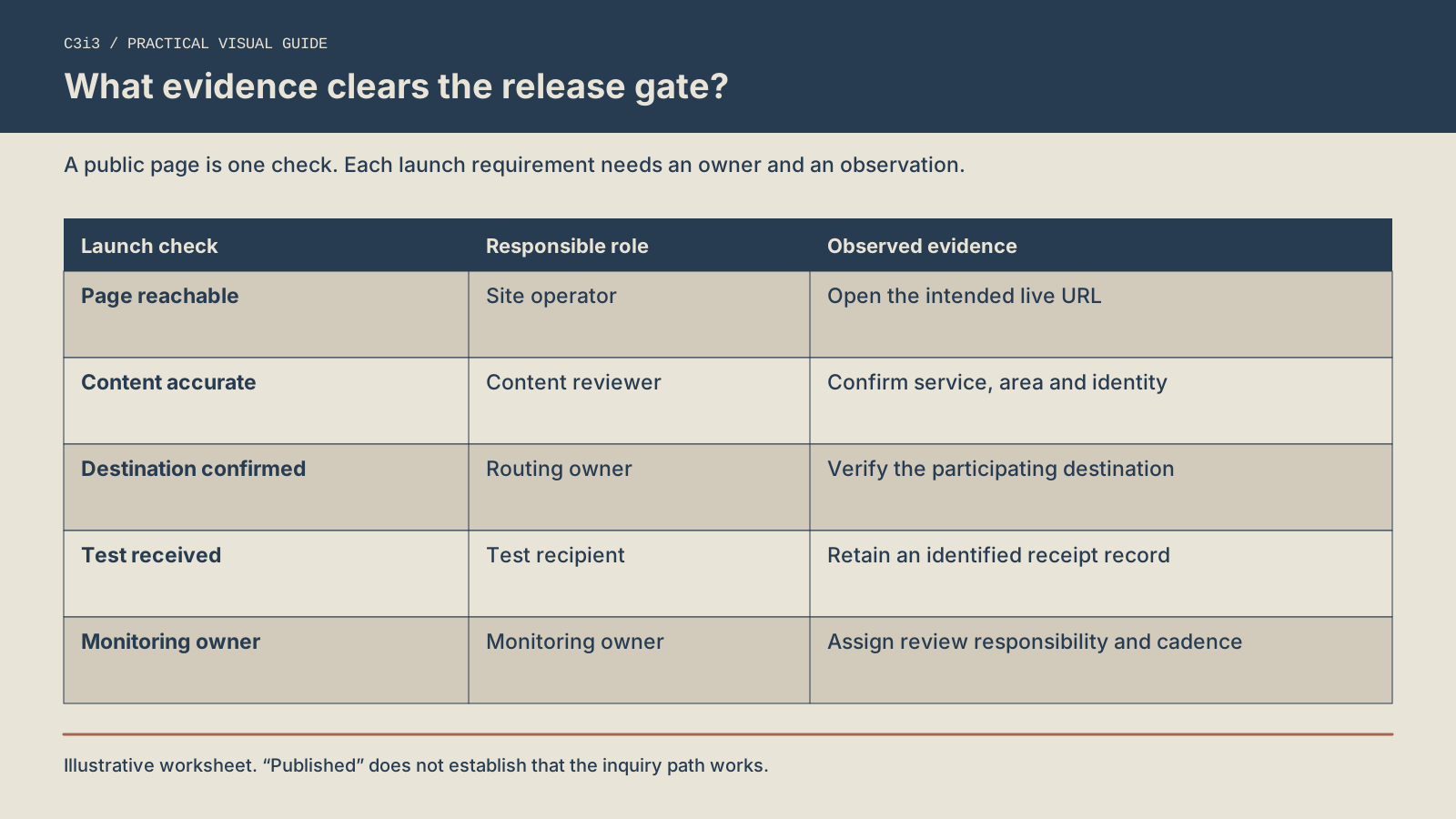
A public page is only one launch check. Each item needs an owner and observed evidence.
How do you measure an SEO lead asset without confusing activity with results?
Measure search exposure, website actions, received inquiries, qualified requests and provider acceptance as distinct stages. Each stage answers a different question and needs an appropriate source of evidence.
Search Console can inform a review of search queries and pages. Website analytics can show configured events. The inquiry system can establish receipt. The receiving provider can supply service-fit and next-step outcomes. These systems will not always reconcile perfectly, so record their scope, date range and known gaps before comparing totals.
Which events deserve business importance?
A verified successful request may be an important website event. A phone-link click is an attempt to act. A contact-panel opening is earlier still. Google Analytics distinguishes collected events from events marked as key events; choosing a reporting label does not independently validate the action or the customer’s suitability.
Keep contact details and free-text request content out of analytics event parameters and page URLs. Google’s guidance on avoiding personally identifiable information explains the platform’s restrictions. Use restricted operational records for the information needed to respond, with a deliberate access and retention approach.
Review the denominator behind each rate. Ten suitable requests out of twelve unique requests describes fit differently from ten requests out of a hundred button clicks. The lead qualification guide shows how to retain meaningful stages, duplicate relationships and unresolved outcomes instead of reporting a single inflated lead total.
When should you maintain, revise or expand the asset?
Expand when the existing offer is accurate, inquiry delivery is dependable and reviewed requests support a specific next decision. Revise when evidence shows confusion or poor fit. Maintain continuously when provider facts or technical dependencies change.
Set a recurring review around the site’s actual operating needs. Check service availability, coverage, routing destinations, form delivery and content ownership. Inspect search performance over a useful period while noting seasonality, provider capacity and other acquisition activity. A short burst of visits is not a sufficient reason to duplicate the site across new locations.
What should happen when the provider relationship changes?
Review the customer-facing offer before continuing to collect requests. Update identity information, destination settings, confirmation wording and references to previous experience where relevant. If a dependable route is unavailable, pause the affected action and give visitors an accurate explanation of the current state.
Industry differences can then guide a justified next scope. A contractor evaluating a separate asset should inspect service fit and receipt evidence, as explained in the contractor lead-generation buyer guide. A cleaning business may need to distinguish recurring and one-time requests, covered in the cleaning lead-generation guide. Those are operational differences, not reasons to publish identical templates.
Document the next change as a testable proposition: which audience it serves, what page or route changes and which observation will justify keeping it. That discipline keeps the asset connected to real requests as it grows. The useful outcome is a clearer, inspectable acquisition system, not merely a larger collection of indexed URLs.
What else should you know before launching a lead-generation website?
Keep the offer, operating access and inquiry evidence reviewable before launch. Naming, page count and reporting labels cannot substitute for those dependencies.
Does an exact-match domain make the website ready for SEO?
No. A domain name does not establish useful content, an authentic identity or a working request route. Choose a name that can be represented honestly and maintained over time. Inspect the service explanation and customer task before treating naming as the central build decision. Avoid names that imply a provider relationship, office or operating capability that has not been established.
Should the website publish every service a future provider might offer?
Publish services that a current receiving arrangement can support. Speculative service pages make it harder to keep the public offer accurate and create mismatched requests. Keep possible additions in a planning inventory with their verification dependencies. Add them when the provider facts, useful page purpose and inquiry route have been checked together.
Can one phone number prove the source of every inquiry?
A dedicated number can associate an inbound call with a route, but callers may save, share or redial it. A browser event and a later phone call also may not be joinable with confidence. Describe the source evidence available and preserve unknown cases. Attribution becomes more useful when its limits are explicit instead of hidden inside a total.
Is a completed form a qualified lead?
A completed form establishes a stage only when successful receipt has been verified. Qualification requires the additional information relevant to the offer, such as service fit and territory. Provider acceptance is another observation. Keep these states separate so a delivery problem, unsuitable request and capacity issue do not all receive the same label.
Can useful articles guarantee AI-answer citations?
No. Useful explanations and clear relationships between pages can help readers and make content understandable, but they do not control an external system’s selection. Treat any observed citation as a dated observation with its prompt and platform. Build the website for its real audience and review search visibility separately from inquiry outcomes.
What should an owner bring to an initial build assessment?
Bring the intended service, confirmed territory, provider arrangement, existing domain or website and the current inquiry route. Include examples of the requests the provider can accept and any known limitations. That gives the assessment a concrete operating problem and helps identify whether the next work is architecture, page design, routing or measurement.

How C3i3 Can Help
C3i3 can assess whether a separate lead website has a clear audience, a useful search architecture and an operationally credible inquiry path. Our Local SEO work can connect verified services and coverage to a focused content plan. Our Lead Generation Campaigns work can help define the landing experience, request stages and measurement brief.
Bring a proposed service and territory, the receiving provider’s requirements and any existing asset to discuss a scoped assessment with C3i3. The useful starting point is determining what can be built and tested responsibly. Availability of a ready-made site, existing lead inventory or a predictable search outcome should never be assumed.