








































In this article
Cleaning leads are useful when the person making the inquiry needs work the receiving business can actually consider. A facility manager seeking an evening walkthrough, a household exploring recurring visits and a property manager describing exterior work should not encounter the same vague promise or disappear into an indistinguishable contact queue.
For a cleaning business owner or independent website operator, a rank and rent website is a way to organize a separately controlled local lead asset around those decisions. The work includes accurate service information, search engine optimization (SEO), inquiry routing and ongoing provider coordination. This guide explains how to evaluate that model, choose a focused starting point and judge the inquiries it produces. C3i3 can help plan and build a scoped pilot.
What is a rank and rent website for cleaning leads?
A cleaning rank and rent website is an independently controlled lead-generation property whose inquiries may be directed to a participating cleaning business. The site operator manages the website asset while the provider evaluates and performs the cleaning work. Visitors need to understand that relationship before they submit a request.
The domain, content, hosting and inquiry destinations form the working asset. A business might participate in a defined service and territory while continuing to operate its own company website. The independent site needs its own useful information, clear identity and dependable maintenance. It should not masquerade as a provider's established business or imply a physical operation that does not exist.
Control should be practical as well as descriptive. Identify who can update the service copy, maintain the domain, access inquiry records and change a receiving destination. Keep recovery and continuity responsibilities clear within the operating team. If an inquiry channel depends on one person who cannot be reached, the apparent asset may be difficult to maintain when ordinary changes are needed.
How is this different from improving the cleaning company's own website?
Improving the company's website develops that company's primary digital presence. A separate lead asset creates another property with its own control, editorial decisions and operating responsibilities. Those differences affect who approves service copy, changes a phone destination and checks whether requests were received.
Compare the two approaches before creating additional work. If the existing business website cannot explain the offer or handle inquiries, repairing it may be the more useful starting point. A separate site makes more sense when it has a specific role that the operator and provider can describe. Our broader guide to owning a rank and rent lead website explains the model beyond cleaning.
What should a cleaning business confirm before supporting a separate lead site?
The cleaning business should confirm its current service scope, genuine coverage, workable scheduling patterns and ability to respond. These facts determine what the website can responsibly present. A desired service category is insufficient if the receiving business cannot evaluate those requests.
Begin with the person who understands the operation. Ask which requests are routinely considered, which need individual assessment and which fall outside the current offer. Separate a continuing service capability from a temporarily open appointment. A business may support recurring household work yet have no immediate opening for a requested day. The website should explain the inquiry process without turning a preference into a confirmed visit.
Ask the receiving team to describe a recent type of request it could consider and one it could not. Use those descriptions as internal planning inputs, without publishing customer details. This often reveals a boundary that broad category names conceal. The written brief should reflect the business as it operates now, rather than a service it might offer later.
Who should approve the public service descriptions?
A designated provider representative should confirm the trade-specific descriptions before they become public. The website operator can organize and edit the information, but the provider determines whether it accurately represents the work being considered.
Keep a dated operating brief with a named contact for updates. Include territories, request categories, receiving destinations and the response process. Review that brief when staffing, coverage or service priorities change. If a provider stops considering a category, remove unsupported claims and update the inquiry route together. Leaving an attractive page online while its destination no longer fits is a failure of operation, even when the form continues to work.
How should the website separate different cleaning customer journeys?
The website should separate journeys where the buyer's decision, required context or next step differs. Commercial facilities, residential visits, carpet services and exterior work ask different questions. Useful navigation should reveal those differences before collecting a request.
A facility manager may need a conversation about premises, recurring service windows and a walkthrough. A household may need help distinguishing an ongoing visit pattern from a one-time project. A carpet inquiry needs room and access context. An exterior inquiry needs the property setting and requested surface without assuming a particular treatment is suitable.
These are editorial distinctions, not a requirement to launch every category. Use the pathways supported by the participating provider. If one company handles only residential visits, a broad cleaning directory would misrepresent the actual starting point.
| Path | Buyer decision | Useful next step |
|---|---|---|
| Commercial | Can this provider consider our facility and service window? | Scope conversation and possible walkthrough |
| Residential | Does my need fit recurring, deep or move-out service? | Clarification of visit intent |
| Carpet | Can the provider assess these rooms or areas? | Review of scope and access |
| Exterior | Does this property and surface match supported work? | Provider assessment of the request |
The supporting guides develop commercial facility inquiries, residential service intent, carpet intake and property and surface matching. Each resolves a different operating decision.
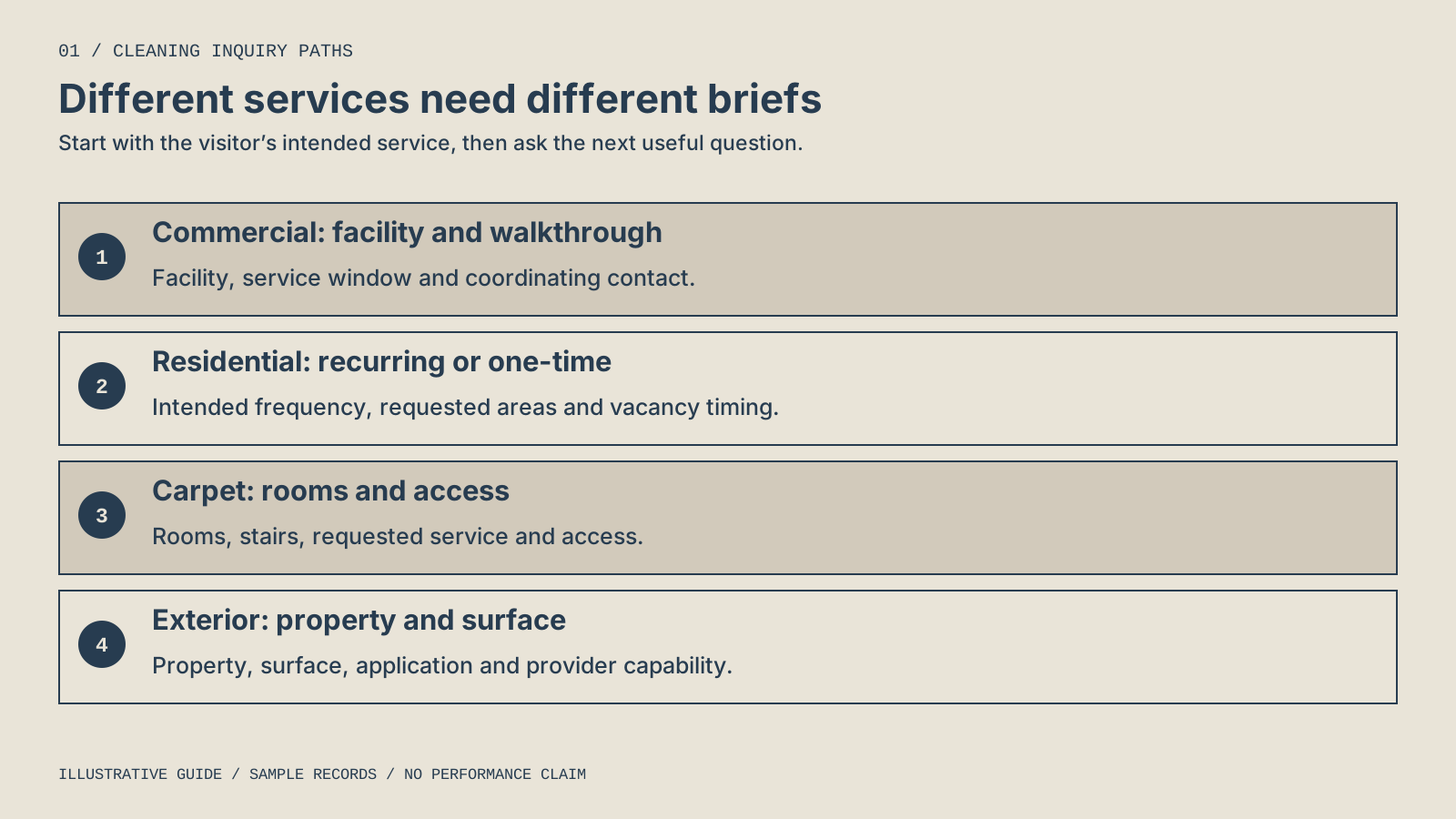
<ul><li>Commercial: identify facility, service window and walkthrough.</li><li>Residential: separate recurring, deep and move-out intent.</li><li>Carpet: capture requested rooms and access context.</li><li>Exterior: identify property, surface and application.</li></ul>
What information makes a cleaning lead website useful before someone contacts it?
A useful cleaning lead website explains the supported service, relevant boundaries, genuine coverage and what happens after an inquiry. It helps visitors decide whether a conversation is appropriate without requiring them to submit personal details just to understand the basic offer.
Write descriptions around the questions the office repeatedly answers. Explain whether a request concerns ongoing visits or a one-time project, what information the provider needs and when a further discussion may be necessary. Use specific descriptions approved by the provider rather than broad assurances that every building, surface or condition is covered.
Review the page as a visitor who arrives directly from search. That person may never see the home page. The destination should provide enough context to identify the service, understand the site’s role and locate the appropriate next step. Essential boundaries should appear where the decision happens, rather than relying on another page the visitor may not read.
What evidence belongs on the page?
Evidence should be genuine, attributable and relevant to the described work. An approved provider explanation, accurately labeled project photograph or documented operating process can help a visitor understand the offer. An invented testimonial or a generic photograph presented as completed work cannot supply that evidence.
Distinguish illustrative material from provider evidence. A sample intake worksheet can teach the website operator how to organize requests, but it should not resemble a measured campaign result. Google's people-first content guidance emphasizes original usefulness and trust. For a cleaning site, the practical editorial test is whether someone can make a better service decision after reading the page. Adding repeated keyword paragraphs does not answer a missing customer question.
How do you connect local search intent with genuine provider coverage?
Connect search intent with pages that reflect actual service decisions and supported coverage. A location page deserves a separate role when its information materially helps a visitor. A changed place name alone does not create that role.
Start with an inventory of the real offer. Map the services being considered, the geographic boundaries and the buyer questions that require explanation. Decide which page owns each question before writing. A residential service page might explain visit types across a supported area, while a commercial page needs a different premises and walkthrough journey. Neither requires a thin duplicate for every nearby city.
Google's search spam policies address doorway abuse, including substantially similar location pages that funnel visitors onward. A focused, browsable site gives each page an actual job and links related information where readers need it.
Keep a query-to-page record as a planning tool. For each proposed destination, write the customer question, supported answer and reason it belongs separately. When two pages would answer the same question with the same information, choose a clear primary destination. This makes future editing easier and helps the team avoid creating competing explanations of one offer.
Should one site cover every cleaning category from the beginning?
One site should cover only the categories it can explain and support credibly. Begin with a coherent scope, then add a category when the provider relationship, content and inquiry destination are ready.
Expansion should create a meaningful new path. Adding commercial facilities to a household site changes the buyer, questions and next step. That requires more than another navigation label. The local lead website implementation guide explains how to turn a confirmed offer into architecture and an operating plan.
What should a cleaning inquiry form collect and explain?
A cleaning inquiry form should collect the minimum context needed to begin a relevant conversation and explain who will review the request. It should distinguish a submitted inquiry from an accepted scope or confirmed appointment.
Common starting fields include service interest, general location, timing preference and a suitable contact method. Add category-specific questions when their answers change the receiving business's next action. A facility walkthrough contact is useful for commercial work. A vacancy deadline matters to a move-out discussion. Neither belongs on every carpet request simply because the form builder makes another field easy to add.
How should the handoff work when the site is independent?
The handoff should make the website's role and receiving provider clear. The visitor should understand whether they are contacting a cleaning company directly or asking an independent site to connect their inquiry with a participating business.
Review the confirmation message as carefully as the form. Explain that the request has been received, identify the expected follow-up route and avoid promising service before provider review. Keep sensitive entry details out of the general inquiry. The provider can establish an appropriate way to discuss access later.
Test realistic requests before live use. Confirm that the selected category, location and visitor context reach the intended recipient intact. Verify both the delivery and the recipient's ability to recognize the next step. A successful browser message alone does not show that the office can act on the inquiry.
Can the independent cleaning lead site have a Google Business Profile?
A lead-generation agent or company is not eligible for a Google Business Profile. An independent cleaning lead website should not be treated as a separate cleaning operation merely because it forwards requests to a real provider.
Google's eligibility and ownership guidelines explicitly exclude lead-generation agents or companies. The genuine eligible business owns its profile. Authorized assistance with that business's presence is a separate responsibility from operating the independent website.
How can the site explain its local relevance accurately?
The site can explain the real service territory and the participating provider's role without inventing a storefront, crew or additional business identity. Local relevance comes from useful information about supported requests and coverage.
Keep identity consistent across the page, inquiry confirmation and provider follow-up. If a visitor sees one name in the header and hears another when contacted, the relationship should already have been explained. A buried sentence that contradicts prominent claims will not resolve that confusion.
This distinction also helps the participating company preserve its own presence. A separate asset should add a clearly defined acquisition path, not obscure who performs the work. The wider contractor guide to evaluating a dedicated lead website examines the same separation between a marketing property and the real service business.
How do you measure whether the website generates relevant cleaning inquiries?
Measure discovery, received inquiries, provider fit and subsequent actions separately. An increase in search impressions does not show that a cleaning business received a usable request. A submitted form does not establish that the provider accepted the work.
Search Console's performance report describes search clicks and impressions. Use those observations to understand which pages are being discovered. Compare them with verified inquiry receipts and the provider's review notes rather than treating them as interchangeable totals.
Define fit before reviewing the pilot. A relevant inquiry might require a supported cleaning category, a location within the confirmed territory, sufficient context for follow-up and a reachable person seeking an actual next step. Record uncertainty instead of assuming that an incomplete message is either valuable or worthless.
Review the denominator beside every summary. A count of supported inquiries means something different when compared with all received requests, only reviewed requests or only requests with complete location information. State the period and the group being evaluated. Small or incomplete samples can guide a question for further review without establishing a dependable pattern.
What should the provider report back?
The provider should return a simple disposition and the reason behind it. Useful descriptions include awaiting clarification, supported request, outside coverage and scope not offered. A walkthrough proposed or a visit discussed is a separate observation.
Google Analytics documents distinct lead-generation events, including request generation and qualification. Any implementation still needs verified triggers and real operating definitions. Keep private customer details out of general analytics reporting. The goal is to identify a correctable break in the journey, such as a page attracting the wrong service intent or a receiving office missing otherwise relevant requests.
What should a focused cleaning lead website pilot test first?
A focused pilot should test one coherent service path, genuine coverage and an accountable inquiry handoff before expansion. The first decision is whether the website explains a supported offer and the provider can act on the resulting context.
Choose the category with the clearest operational brief. Prepare its page, form questions, confirmation language and receiving process together. Then use clearly labeled test scenarios covering a relevant request, an unclear scope and a location outside current coverage. These scenarios are quality checks, not campaign results.
| Observation | Question to resolve | Possible correction owner |
|---|---|---|
| Search visibility | Which page and query are being observed? | SEO lead |
| Received inquiry | Did the intended recipient receive usable context? | Website operator |
| Provider fit | Does the request match the supported offer? | Provider representative |
| Next action | Was clarification or a service discussion appropriate? | Receiving office |
| Correction | What will change and who will verify it? | Named project owner |
Set the review questions before the pilot begins: what information must reach the office, what makes a request relevant and what evidence would justify another service path? This helps the team evaluate the asset against a shared operating purpose. It also prevents a later discussion from switching between traffic, inquiries and appointments as though they were equivalent measures.
Keep a brief change record so later observations remain interpretable. If the service page and routing both change, the team needs to know when that occurred. Expand only when the next category has its own verified offer and a useful customer path. A larger navigation menu is not evidence of a better operating asset.
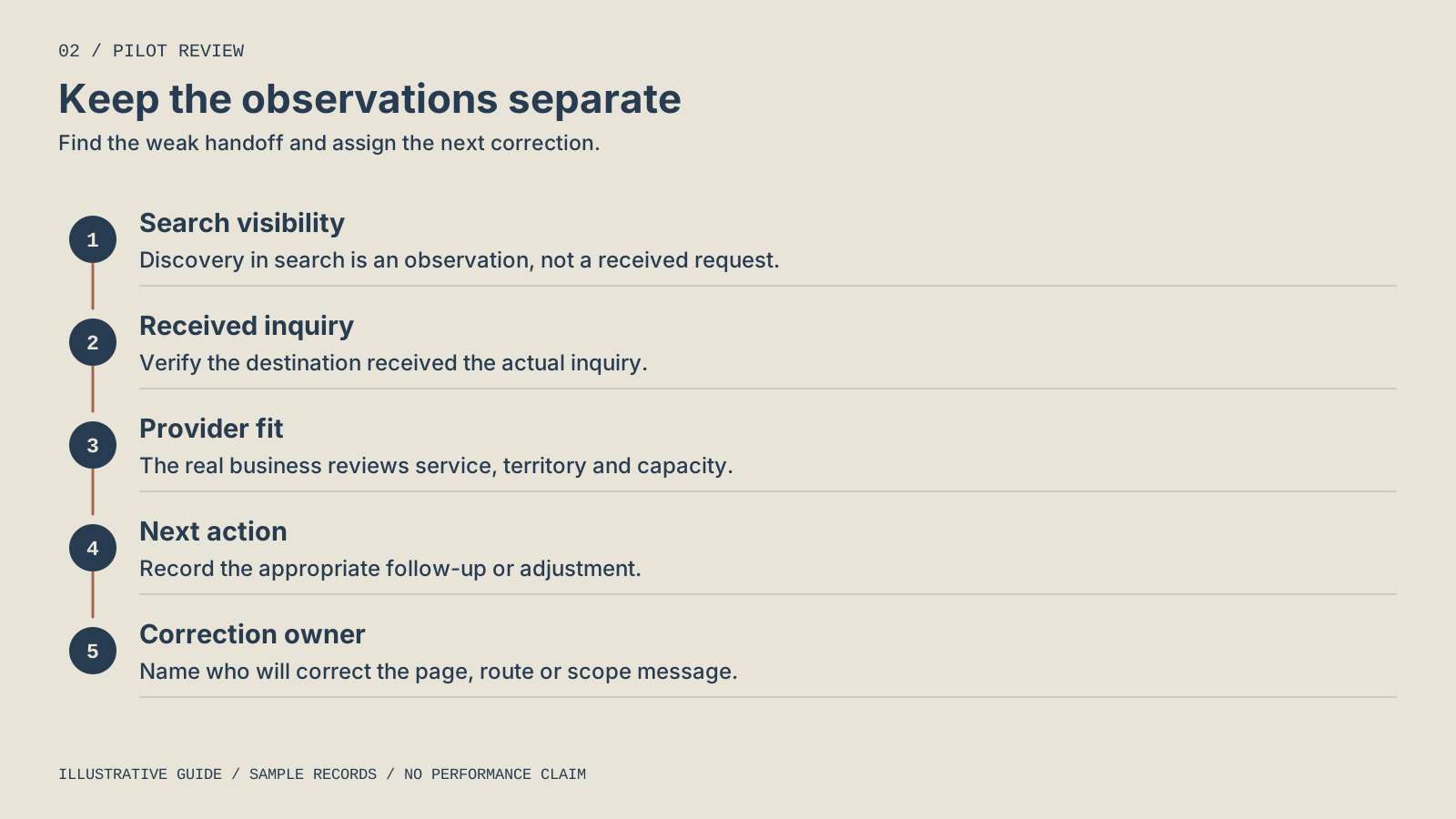
<ol><li>Observe search visibility.</li><li>Verify inquiry receipt.</li><li>Review provider fit.</li><li>Record next action.</li><li>Assign the correction owner.</li></ol>
Which warning signs suggest the cleaning lead site needs revision?
Repeated misunderstandings, unsupported service claims and unexplained handoffs suggest that the website needs revision. Read the inquiry context alongside the page that prompted it before concluding that the visitors are simply poor leads.
If households repeatedly ask whether carpet service is included, check whether the residential copy blurs the boundary. If facility managers reach a household appointment form, fix the commercial path. If exterior requests describe work outside the provider's capabilities, review the surface and application descriptions. Each pattern points to a different editorial or operational repair.
Assign each recurring issue to the person able to correct it. The writer can clarify a service boundary, the website operator can repair a missing notification field and the provider can update its capability brief. A general instruction to improve lead quality leaves these different causes unresolved. Ownership of the correction matters as much as recognizing the pattern.
When should a category stop accepting new requests?
A category should stop inviting requests when its receiving provider or supported service is no longer available to review them. Update the relevant page and contact path promptly, then confirm that visitors receive an accurate next step.
Do not use continued traffic as a reason to preserve an unsupported promise. Equally, do not rewrite every page because of one ambiguous inquiry. Review recurring patterns with the provider, distinguish confirmed facts from assumptions and make the smallest change that answers the actual problem. A disciplined review protects the usefulness of the asset while preserving the clarity of its original service focus.
What else should cleaning business owners ask?
Does a dedicated website replace referrals or the company website?
A dedicated website adds a separate inquiry path. Its role should be explained alongside the company's existing website and other acquisition sources. Review where each source helps customers make a decision and whether the office can identify the origin of a request. Creating another site is useful only when its purpose and operating responsibilities are clear.
Can one cleaning company receive several service categories?
One company can review several categories when it genuinely supports them and the website explains each accurately. The same receiving team may still need different information for a facility walkthrough, recurring household visit or carpet assessment. Keep those distinctions visible in both the customer path and the provider's review record.
Should a new site promise immediate appointments?
A new site should state only the response and availability information the provider can support. A visitor's preferred time is a request until the business confirms arrangements. When availability changes frequently, explain the confirmation process clearly and keep the person responsible for public information connected with the receiving office.
Is this the same as optimizing a Yelp cleaning profile?
Yelp profile work concerns a business's presence on that platform. An independent lead site has its own content, structure and inquiry operation. Our house-cleaning Yelp inquiry guide covers profile-specific decisions. Use it for that task while keeping the independent website's role and provider relationship clear.
Can C3i3 supply a cleaning website that is already producing inquiries?
A conversation with C3i3 should begin with the proposed service, coverage and provider capacity. This guide does not present an inventory of available rental websites or establish existing performance. C3i3 can assess the opportunity, plan the asset and scope a pilot with explicit content, implementation and measurement responsibilities.

How C3i3 Can Help
C3i3 can help a cleaning business or independent site operator define a focused lead-website pilot around real service capability. That work can include offer clarification, customer-path planning, website design, service content, inquiry testing and an SEO measurement plan. The provider remains responsible for evaluating and performing cleaning work.
Explore our Local SEO services and lead-generation campaign planning. For an initial discussion, bring the cleaning categories being considered, actual coverage, current website and the person who reviews new requests. Contact C3i3 to discuss a useful starting scope and the evidence needed to evaluate it.