








































In this article
A carpet cleaning inquiry that says three rooms can still leave the receiving business with important questions. Does the visitor mean three enclosed rooms, several connected areas or carpet on multiple floors? Is the request for a home or a commercial space? A simple room count helps only when the website preserves its context.
This guide is for cleaning business owners and independent lead-site operators planning better marketing intake. It explains what a separately controlled website can ask before an estimate conversation and where provider assessment begins. It does not prescribe cleaning methods or predict results. The broader cleaning lead website guide explains the owned or leased asset model, including how useful information connects visitors with a real service provider.
What should a carpet cleaning lead website capture before an estimate conversation?
A carpet cleaning lead website should capture the visitor's requested areas, property setting, approximate room context and information that affects follow-up. The provider determines which details require clarification before discussing the actual scope.
Start with the request itself. A visitor may describe carpet in several bedrooms, a connected living area, stairs or part of an occupied commercial space. Those descriptions are more useful when the form lets the person use ordinary language and identify what they do not know. An unexplained number field can hide those distinctions.
| Input | Context to preserve | Assessment boundary |
|---|---|---|
| Requested areas | Where the visitor wants service considered | Provider verifies actual scope |
| Rooms and stairs | Approximate description, including connected areas | Counts do not establish an identical job |
| Access | Floor, arrival or coordination considerations | Detailed arrangements follow later |
| Timing | Preferred window or relevant deadline | Availability requires confirmation |
Should the form ask for an exact area measurement?
Ask for an exact measurement only if the provider needs it at this stage and visitors can reasonably supply it. Otherwise, accept an approximate description and indicate that the provider will clarify what matters.
The objective is to improve the first conversation. A mandatory field that encourages guessing can make the record appear more precise while reducing its reliability. Keep the difference between visitor-supplied information and provider-confirmed scope visible in the receiving team's notes.
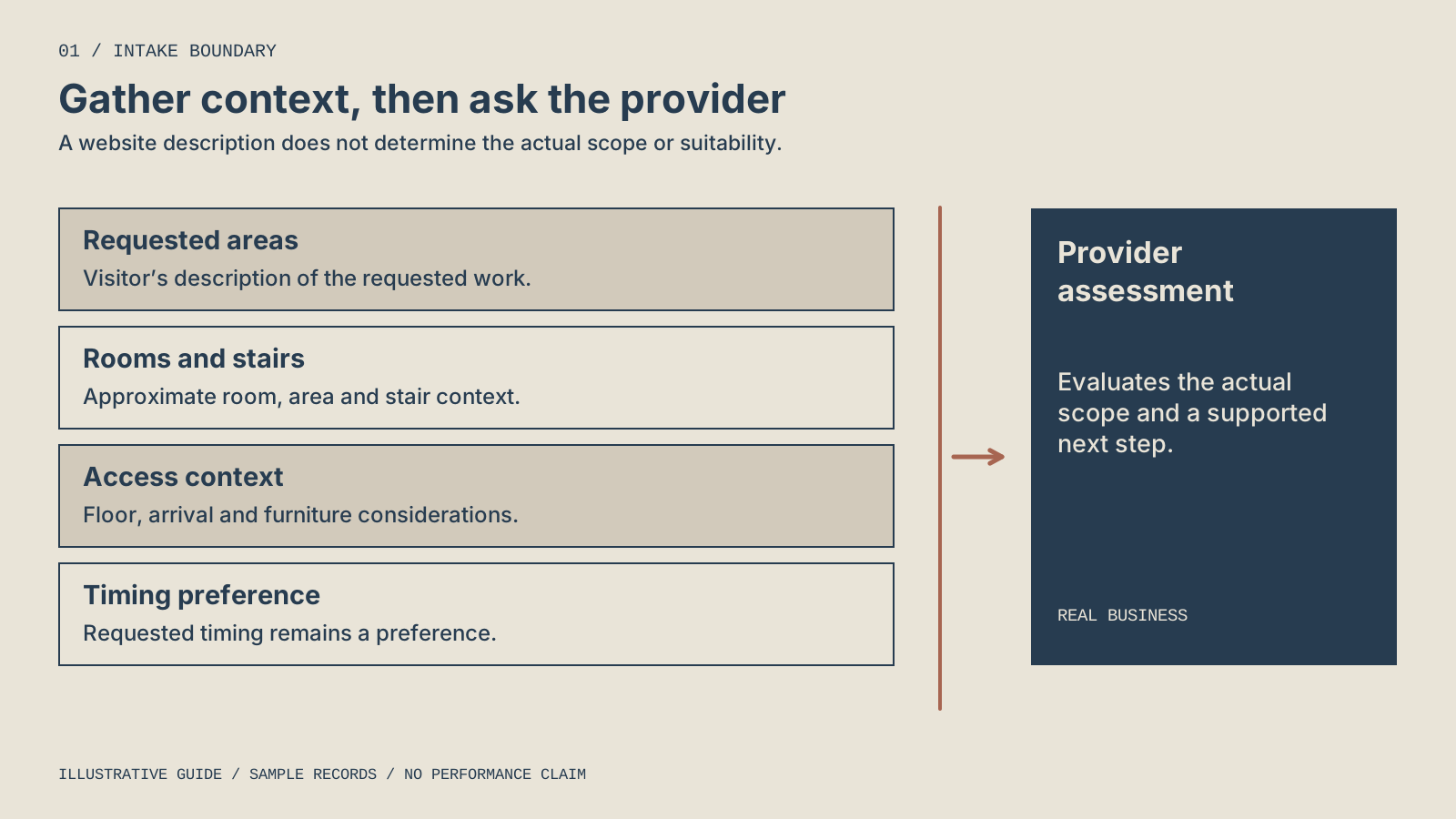
<ul><li>Requested areas: visitor description.</li><li>Rooms and stairs: approximate context.</li><li>Access: floor and arrival considerations.</li><li>Timing: preference only.</li><li>Provider: evaluates actual scope.</li></ul>
How should the website ask about rooms, stairs and connected areas?
The website should ask visitors to identify the spaces they mean, with room counts serving as context rather than a complete definition of work. Clarify connected areas and stairs without making the visitor interpret technical service categories.
Use a short description field beside any count. For example, an illustrative inquiry might say two bedrooms, a hallway and stairs between floors. Another might say one large connected area. Neither should be silently converted into the same request simply because both visitors entered a number.
What if a visitor is unsure how to classify a space?
The visitor should be able to describe the space in their own words and leave the classification to the provider. The form can say that approximate information is enough to begin a scope conversation when that matches the business's actual process.
Keep service interests distinct. If the provider also considers rugs or upholstery, those requests need an explicit supported route. Do not assume that a carpet page includes every textile or furnishing service. If the provider does not consider them, make the relevant boundary easy to find before submission.
The same principle applies across property settings. A household describing bedrooms differs from a facilities contact describing a carpeted meeting area. A business visitor may need the wider facility and walkthrough inquiry path, while the carpet-specific questions preserve the area context. Useful linking helps the visitor explain the request without duplicating it.
Which access and timing questions belong in the initial carpet inquiry?
Initial access and timing questions should identify coordination needs that affect the provider's next conversation. They should not collect sensitive entry information or imply that the website has approved an arrival arrangement.
Depending on the provider's process, useful context may include whether the requested areas are on more than one floor, whether arrival requires coordination with a building contact or whether the space will be occupied. The business should confirm which questions genuinely help it review requests. Avoid publishing an exhaustive checklist that visitors cannot reasonably complete.
How should timing be phrased when availability is not confirmed?
Ask for a preferred window or relevant deadline and state that the provider will discuss availability. A date selection should describe the visitor's request, not display an appointment the business has not accepted.
A move-out deadline can be relevant, but it should not be mistaken for confirmation that carpet work is included in a broader household visit. Link the residential context to the recurring, deep and move-out intent guide where the relationship needs explanation.
Keep detailed entry arrangements for an appropriate later exchange. The general form can note that coordination is needed and identify a contact method. That is enough to begin a conversation without asking for entry codes, private schedules or other details unrelated to initial fit. The provider decides what must be resolved before any visit is arranged.
How can the page explain provider assessment without promising a result?
The page can explain that visitor descriptions begin the review while the provider evaluates actual scope, condition and suitability. It should describe the next conversation rather than predict an outcome from a room count, image or short comment.
Ask the provider to approve the service explanation. A useful description identifies the kinds of requests being considered, information needed for review and situations where further clarification is necessary. Keep specific treatment decisions with the real business. The independent website operator is organizing a marketing journey, not assessing the material.
Should visitors be invited to upload photographs?
Photographs can be optional context if the provider has a suitable process for receiving and reviewing them. They should not be presented as a substitute for assessment or a basis for a guaranteed result.
Explain what the image is for and avoid requesting unrelated personal information. The receiving team should be able to connect any approved image with the correct inquiry. If that process is not ready, a text description and follow-up conversation may be a clearer starting point.
Google's people-first content guidance emphasizes useful information for the intended audience. For a carpet lead site, useful content clarifies the request and the assessment boundary. Unsupported claims about restoring every surface or resolving every condition undermine that purpose, even when they sound persuasive in a headline.
How should the receiving team turn an inquiry into a scoping conversation?
The receiving team should separate what the visitor supplied from what remains uncertain, then ask the next question that materially affects provider review. This keeps the first response focused and prevents assumptions from becoming an apparent agreed scope.
Use a compact review record. Preserve the visitor's original description, mark uncertainties and record the provider's chosen next step. The website should deliver those inputs together so the office does not have to reconstruct the request from disconnected notifications.
| Known | Uncertain | Next useful question | Provider decision |
|---|---|---|---|
| Visitor describes two rooms and stairs | Which floors contain the requested areas? | Can you describe the arrangement? | Review further context |
| Business contact describes a meeting area | Who coordinates site discussion? | Who should the provider contact? | Choose the commercial follow-up route |
| Visitor requests a particular week | Whether the preference can be accommodated | Is there a relevant deadline? | Discuss availability separately |
What should the confirmation message say?
The confirmation should acknowledge receipt and explain the expected follow-up process. It should identify the website's role and the receiving business without describing a submitted inquiry as an accepted job.
Test that message together with the provider notification. Both should preserve the same request context. If the visitor believes they have an appointment while the office sees an unreviewed inquiry, the journey needs revision before live use.
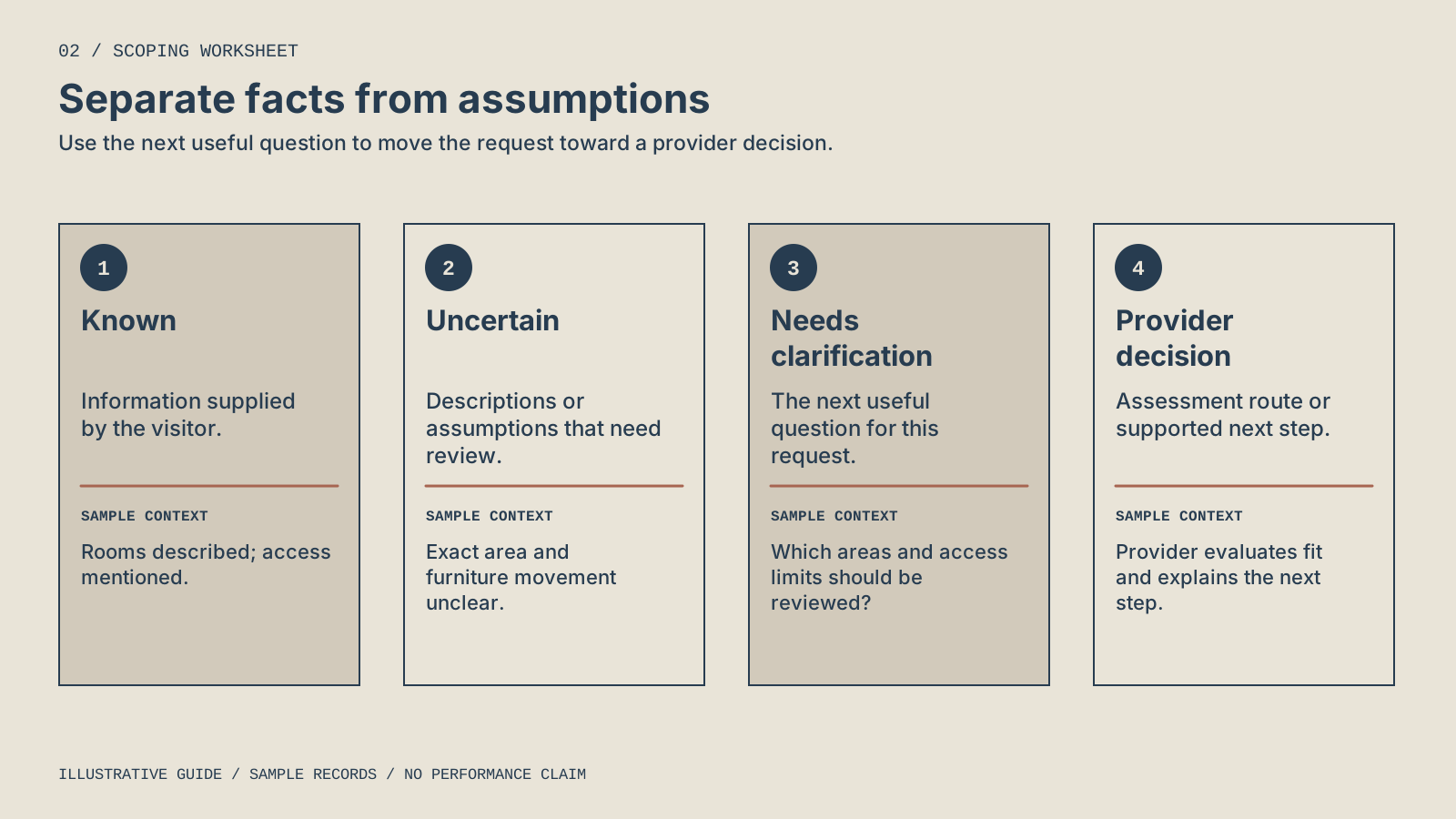
<dl><dt>Known</dt><dd>Information supplied by the visitor.</dd><dt>Uncertain</dt><dd>Descriptions or assumptions requiring review.</dd><dt>Needs clarification</dt><dd>The next useful question.</dd><dt>Provider decision</dt><dd>Assessment route or supported next step.</dd></dl>
How do you judge whether carpet cleaning leads are relevant?
Judge relevance by supported service interest, genuine coverage, useful context and the provider's ability to identify an appropriate next step. A partially described request may need clarification rather than immediate rejection.
Review patterns in the uncertainties. Repeated confusion about stairs suggests a missing explanation or question. Requests for unsupported additional services suggest that the page's boundaries are unclear. Relevant inquiries that never reach the receiving contact suggest a handoff problem rather than an audience problem.
Which actions should be measured separately?
Separate viewing the page, submitting an inquiry, receiving it and determining provider fit. Google Analytics documents recommended lead-generation events, but the actual implementation must match verified actions and defined stages.
A useful review links the source page with the inquiry record and provider disposition. It does not require placing customer descriptions into broad analytics reporting. Keep the detail where the receiving team can use it appropriately, then summarize the pattern for the website operator.
Give the provider a way to mark a request as awaiting information. That preserves an honest intermediate stage when the original description is insufficient. Review what information was missing before adding another mandatory field; a clearer explanation may answer the problem with less effort for future visitors.
Make one concrete correction at a time when possible. If the form changes, note what changed and when. Later inquiries can then show whether the new wording preserves better context, rather than leaving the team to guess which version visitors used.
What else should carpet lead-site operators clarify?
Is a room count enough to define the work?
A room count is initial context. The provider still needs to understand what spaces the visitor means and which details affect scope review. Give visitors a way to describe connected areas and stairs, then preserve their wording rather than converting it into an unsupported standardized job description.
Should the form require a diagnosis of the carpet condition?
The form should invite a plain-language description of the request. Visitors should not need to diagnose a material or condition to contact the provider. The real business evaluates the information and determines what further assessment or clarification is needed.
Can one intake form cover both homes and offices?
One form can begin by distinguishing residential and commercial settings, then show relevant questions. The commercial path may need a facility contact and service-window discussion. If a shared form becomes confusing, use focused paths that preserve the same inquiry context for the receiving team.
Does an estimate request confirm service availability?
An estimate request expresses interest in a conversation. It does not establish availability or provider acceptance. Keep the requested timing visible and explain how the receiving business confirms next steps. Test the confirmation language with the people who actually respond.
Who owns the Business Profile when the website is independent?
The real eligible business owns its profile. Google explicitly excludes lead-generation agents or companies in its eligibility guidelines. Operating a separate carpet lead website does not turn the marketing asset into an additional eligible cleaning business.

How C3i3 Can Help
C3i3 can help plan a carpet cleaning lead-site pilot that gathers useful request context and preserves the provider's assessment role. Work can include page structure, provider-approved service descriptions, intake design and handoff testing. The goal is a clearer first conversation with a real cleaning business.
Explore Local SEO services and contact C3i3 with your supported services, territory and the questions your receiving team repeatedly needs to ask. We can use those inputs to scope the website and its review process.