








































In this article
Pressure washing leads can describe very different requests: an exterior area at a home, a shared space managed for a property or a surface at a business premises. The search phrase alone does not tell a receiving company whether the work fits its capabilities. A website that treats every exterior request as interchangeable creates confusion before the provider has reviewed the property.
This guide helps cleaning business owners and independent lead-site operators organize those inquiries around property setting, requested surface and application goal. It concerns marketing information and provider matching, with actual suitability assessed by the real business. The broader cleaning lead website guide explains how that journey fits a separately owned or leased asset. C3i3 can plan and build the marketing system; it does not perform exterior cleaning.
How should a lead website match property and surface types to a provider?
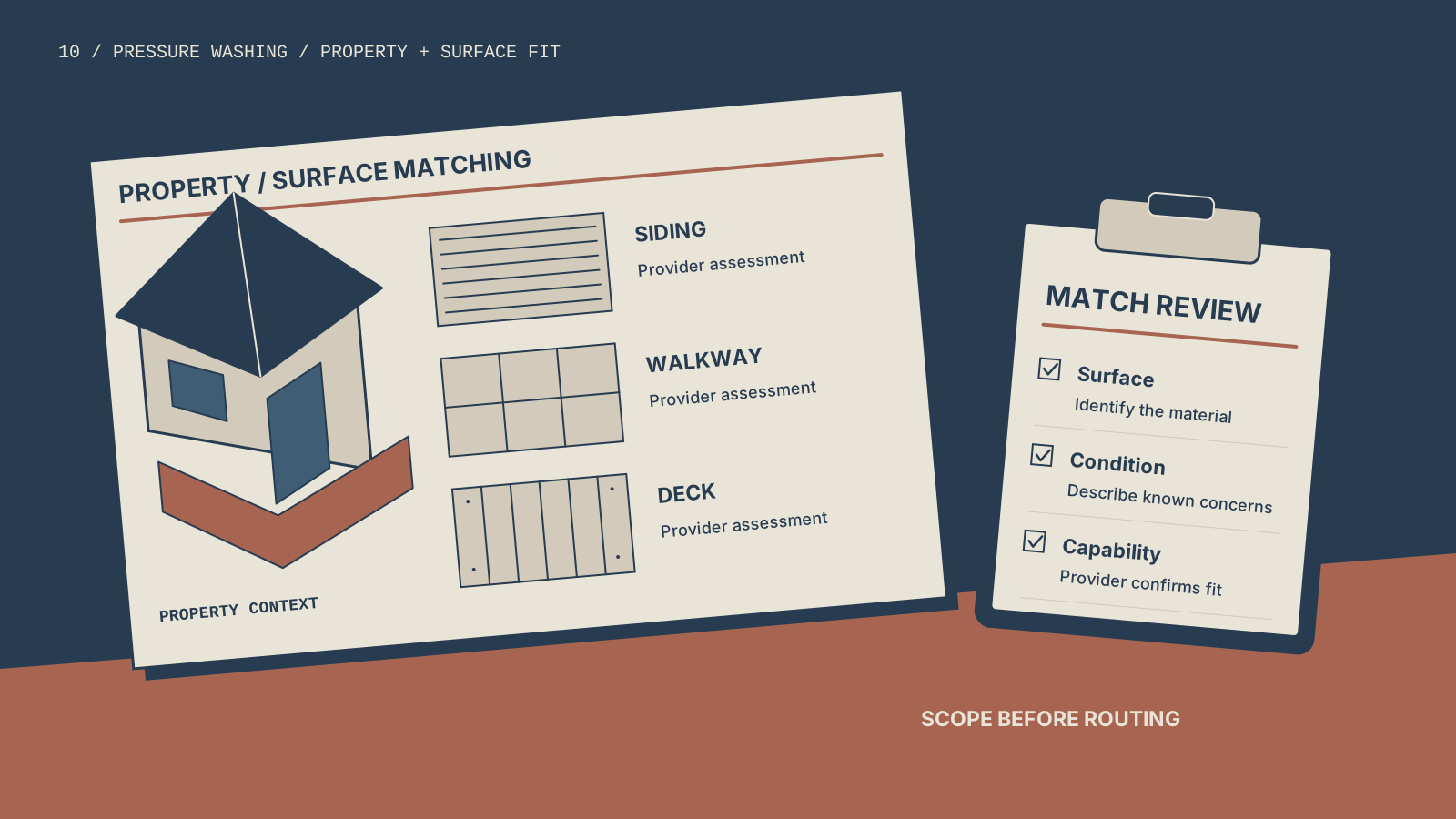
A lead website should compare the visitor's request with a provider-approved capability map. The map should distinguish the property setting, requested surface and application being considered, then identify where provider assessment is needed.
Start with the real business, not a list of popular service phrases. Ask which property settings and request categories the company currently considers. Ask what information helps it recognize work outside that scope. The website operator can translate those answers into navigation and intake questions, but should not infer capability from a broad service name.
| Matching input | Question for the website | Provider responsibility |
|---|---|---|
| Property setting | Home, managed property or business premises? | Confirm supported context |
| Requested surface | Which exterior area does the visitor describe? | Assess actual material and condition |
| Application goal | What is the visitor asking to have considered? | Determine appropriate scope |
| Access context | Will arrival or site discussion need coordination? | Establish arrangements later |
| Capability | Does the public offer match current operations? | Review and update the capability brief |
Why is a surface name alone insufficient?
A surface name identifies part of the request, but it does not establish condition, suitability or the provider's ability to consider the work. Preserve the description as visitor-supplied context and let the business determine what needs assessment.
This boundary should remain visible in the page copy and confirmation. A label that helps route an inquiry should not quietly become a promise that the requested application will be accepted.
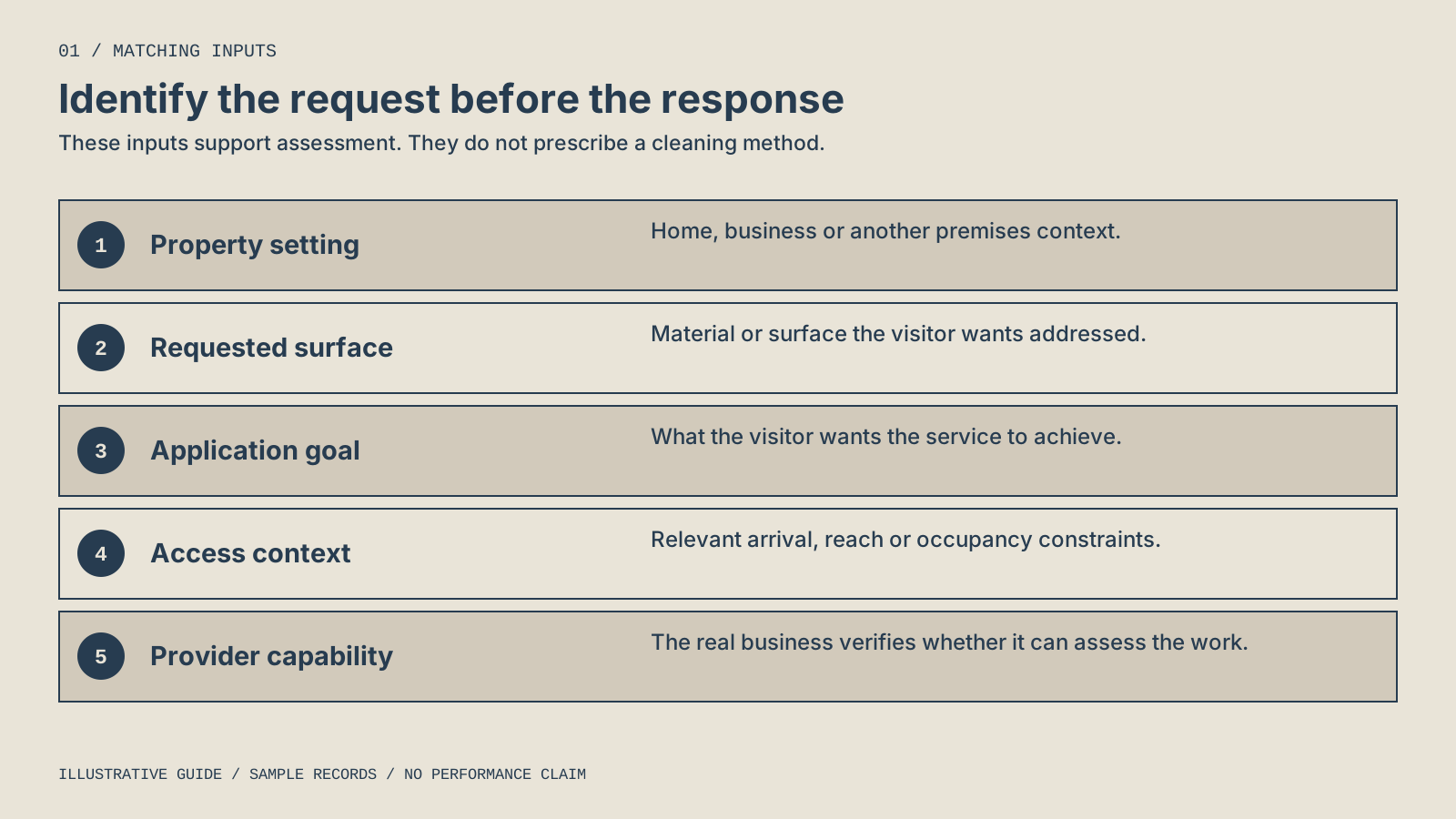
<ul><li>Identify the property setting.</li><li>Record the requested surface.</li><li>Describe the application goal.</li><li>Note access context.</li><li>Ask the provider to assess capability.</li></ul>
Which exterior service pages deserve separate destinations?
A separate destination deserves a place when it answers a distinct buyer question and reflects supported provider capability. Organize pages around meaningful property or application differences rather than every possible surface phrase.
A household visitor may need a straightforward explanation of the areas the business will consider and how to begin assessment. A property representative may need to identify a shared area and coordinate a site discussion. A business contact may need to explain a service window around occupied premises. Those differences can justify focused content when the provider actually supports them.
Should the site create a page for every surface and city combination?
The site should create a page only when it has useful, distinct information to supply. Repeating the same promise with another city or surface name does not improve the visitor's decision.
Google's search spam policies address doorway pages and scaled unoriginal content. Use a browsable service hierarchy with genuine coverage information. A single well-developed page can be the right destination when the supported offer is narrow.
Keep related services connected without merging their scope. The commercial facilities guide explains a manager's walkthrough journey. The residential cleaning intent guide handles household visit patterns. An exterior request needs its own matching questions even when the same business considers several categories.
What should the exterior inquiry form ask without prescribing treatment?
The form should ask visitors to describe the property, requested exterior area, application goal and relevant coordination needs. It should avoid asking them to choose a technical method or confirm a surface's suitability.
Begin with plain language. Ask which area they want the provider to review and what prompted the inquiry. A short description can preserve context that a dropdown misses. Include a not-sure option for classifications the visitor may not know, rather than forcing a guess that later appears authoritative.
How should the form handle surface descriptions?
Surface descriptions should be recorded as the visitor understands them. Make room for uncertainty and explain that the provider may need more information before determining whether the request fits.
Do not attach treatment instructions to the chosen option. The website is collecting marketing context. The real provider evaluates the property, actual surface and scope. Similarly, optional photographs can support a conversation when a suitable receiving process exists, but should not be presented as proof that a particular approach is appropriate.
Ask for a general location to check genuine coverage and a preferred time to frame follow-up. If arrival requires a property contact, ask who should coordinate that discussion. Keep sensitive access details for a later appropriate exchange. Every field should have a clear purpose in the receiving team's first review.
How should the site route supported, uncertain and mismatched requests?
The site should send supported and uncertain requests to a provider that can review them, while accurately identifying requests outside the current offer or coverage. Routing should follow verified capability, not the broadest possible interpretation of the search term.
Keep uncertainty distinct from mismatch. A visitor who cannot identify an exterior surface may still have a relevant request. A visitor asking about an application the business does not consider needs a different response. The receiving process should preserve that difference.
| Outcome | Meaning | Next action |
|---|---|---|
| Supported request | Initial description matches the current offer | Provider reviews the next step |
| Assessment needed | Material context remains uncertain | Ask a relevant clarification question |
| Outside current scope | Requested application is not supported | Do not imply provider acceptance |
| Coverage mismatch | Location falls outside the confirmed territory | Review the coverage explanation |
What happens when provider capability changes?
Update the public service explanation, relevant page links and inquiry destination together. A page should not continue inviting a category of work simply because it attracts visits after the receiving business stops considering it.
Use a dated capability brief with a responsible provider contact. Before expanding into another application, confirm what the company will consider, what needs assessment and how requests will be handled. This creates an operational basis for new content rather than allowing a writer's keyword list to define the trade offer.
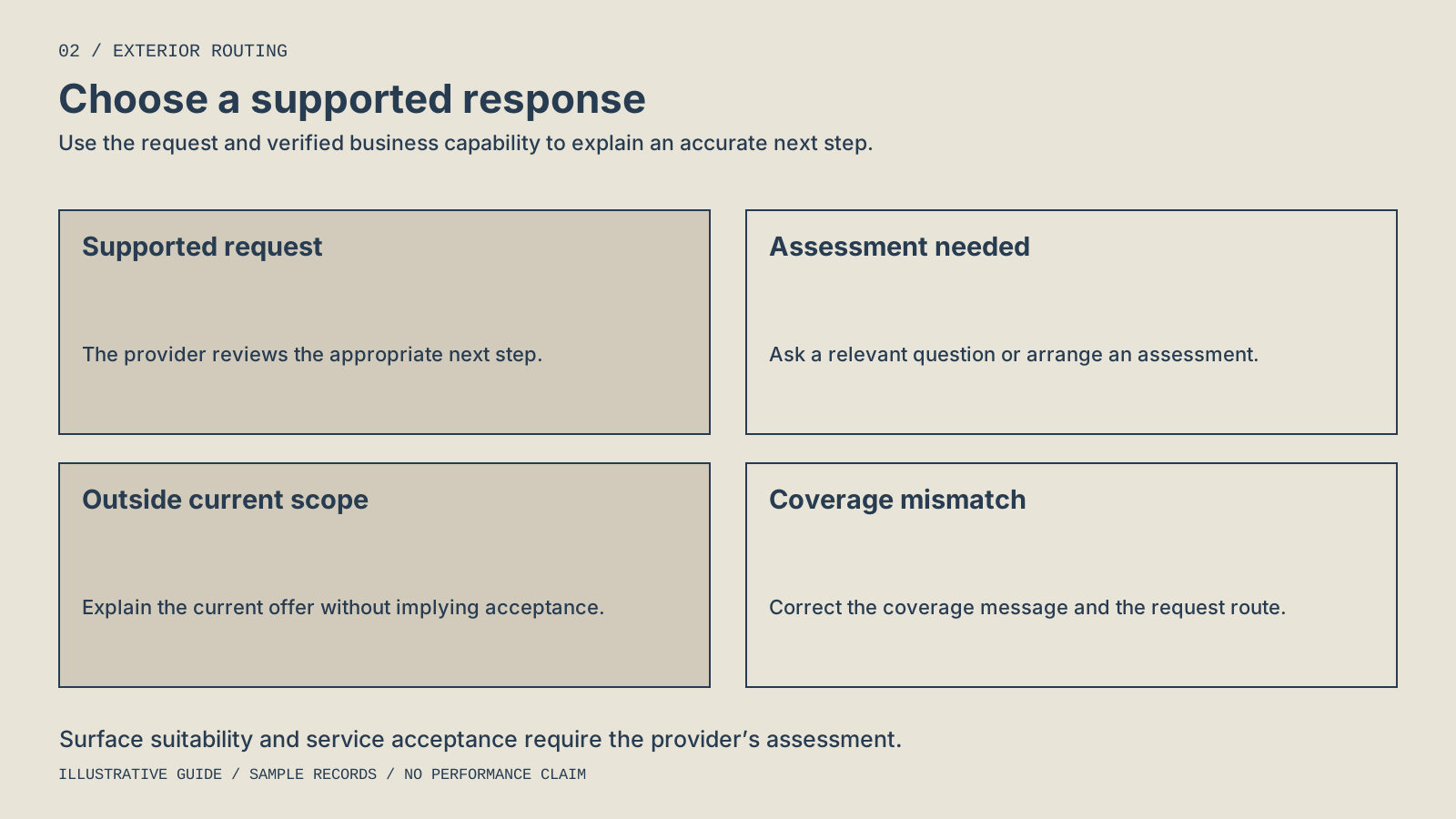
<ul><li>Supported request: provider reviews next step.</li><li>Assessment needed: ask a relevant question.</li><li>Outside current scope: do not imply acceptance.</li><li>Coverage mismatch: correct the coverage message.</li></ul>
How do you test property and surface matching before attracting live inquiries?
Test matching with clearly labeled scenarios that exercise supported work, uncertain descriptions and requests outside the current scope. Ask the provider to review both the visitor-facing path and the context delivered to the receiving team.
One illustrative scenario can describe a household with an exterior area the visitor cannot confidently classify. Another can describe a property contact coordinating a shared space. A third can request an application outside the provider's confirmed offer. These scenarios test the information architecture without making claims about a real campaign.
What should the receiving provider be able to explain?
The provider should be able to explain what the visitor requested, which information remains uncertain and the appropriate next conversation. If the notification omits property setting or merges several applications into a vague cleaning label, repair the handoff.
Review the confirmation message as part of the test. It should acknowledge the request and identify how it will be reviewed. A selected date should remain a preference. A surface selection should remain visitor context. Neither should become a confirmed appointment or suitability decision.
Include one scenario in which the visitor requests several exterior areas together. Check whether the provider can distinguish the supported portion from the part needing clarification. The website should preserve the combined request without making every selected area appear accepted. This is a useful test of both notification layout and confirmation wording.
Test the path on a phone as well as a wider screen. Long option lists can be difficult to interpret, while a concise description field may preserve more useful context. Choose the interface that helps the visitor explain the actual need and lets the provider recognize it reliably.
Which lead-fit patterns should guide changes to the exterior website?
Lead-fit patterns should show whether inquiries match supported property settings, applications and coverage. They should also show whether uncertainty can be resolved through useful follow-up. Review the reasons behind mismatches rather than relying on a single raw inquiry total.
If visitors repeatedly request an unsupported application, examine the page heading and surrounding claims. If they consistently cannot choose a surface option, revise the language or allow a more natural description. If well-matched inquiries are not reaching the receiving team, repair delivery before expanding the content.
How do search observations relate to accepted requests?
Search observations describe discovery, while provider notes describe request fit and subsequent action. Keep them connected by page and period without treating them as the same result. Search Console's performance report records search clicks and impressions, not provider acceptance.
Distinguish an unsupported application from a temporarily unavailable window. The first can indicate a scope-message problem; the second may require clearer scheduling expectations. Combining both under a generic rejection label conceals which part of the website should change.
Record a request received, clarification returned and next step confirmed separately. A useful pilot review identifies which part of the journey needs work. The correction may be a service boundary, a form question, a coverage description or the receiving process. Keep a dated change note so later inquiries can be interpreted against the version visitors actually saw.
What else should exterior lead-site operators clarify?
Can the site say every listed surface is suitable for service?
A listed surface describes the type of request being considered. It should not establish suitability for every property or condition. The provider assesses the actual request and determines what it can consider. Make that boundary clear wherever a menu or form option might otherwise imply acceptance.
Should visitors select a cleaning method?
The initial inquiry should let visitors explain the desired application and relevant property context. It should not require them to select a technical method. The provider determines the assessment process and actual scope, while the website preserves the information needed to begin that conversation.
How should photographs be used?
Use photographs as optional context only when the receiving business has an appropriate review process. Explain their purpose and keep them connected with the correct inquiry. A photograph does not establish suitability, final scope or a promised result. It should not be described as doing so.
Can an independent exterior lead website have a Business Profile?
Google's eligibility guidance excludes lead-generation agents or companies. The real eligible service business owns its profile. Operating a separate website does not create an additional eligible exterior-cleaning operation.
When is another service category ready to launch?
Another category is ready when the provider has confirmed its scope, the page explains a distinct visitor decision and the inquiry handoff has been tested. Search interest can inform research, but it cannot substitute for real capability or a receiving team prepared to review requests.

How C3i3 Can Help
C3i3 can plan an exterior lead-site pilot around verified provider capability rather than a broad list of surface keywords. Work can include service mapping, focused page design, inquiry questions, provider handoff tests and an SEO review plan. Your service business remains responsible for assessing property conditions and actual work.
Explore Local SEO and lead-generation campaign planning. Contact C3i3 with your supported property settings, application categories, territory and current inquiry process to discuss a concrete starting scope.