








































In this article
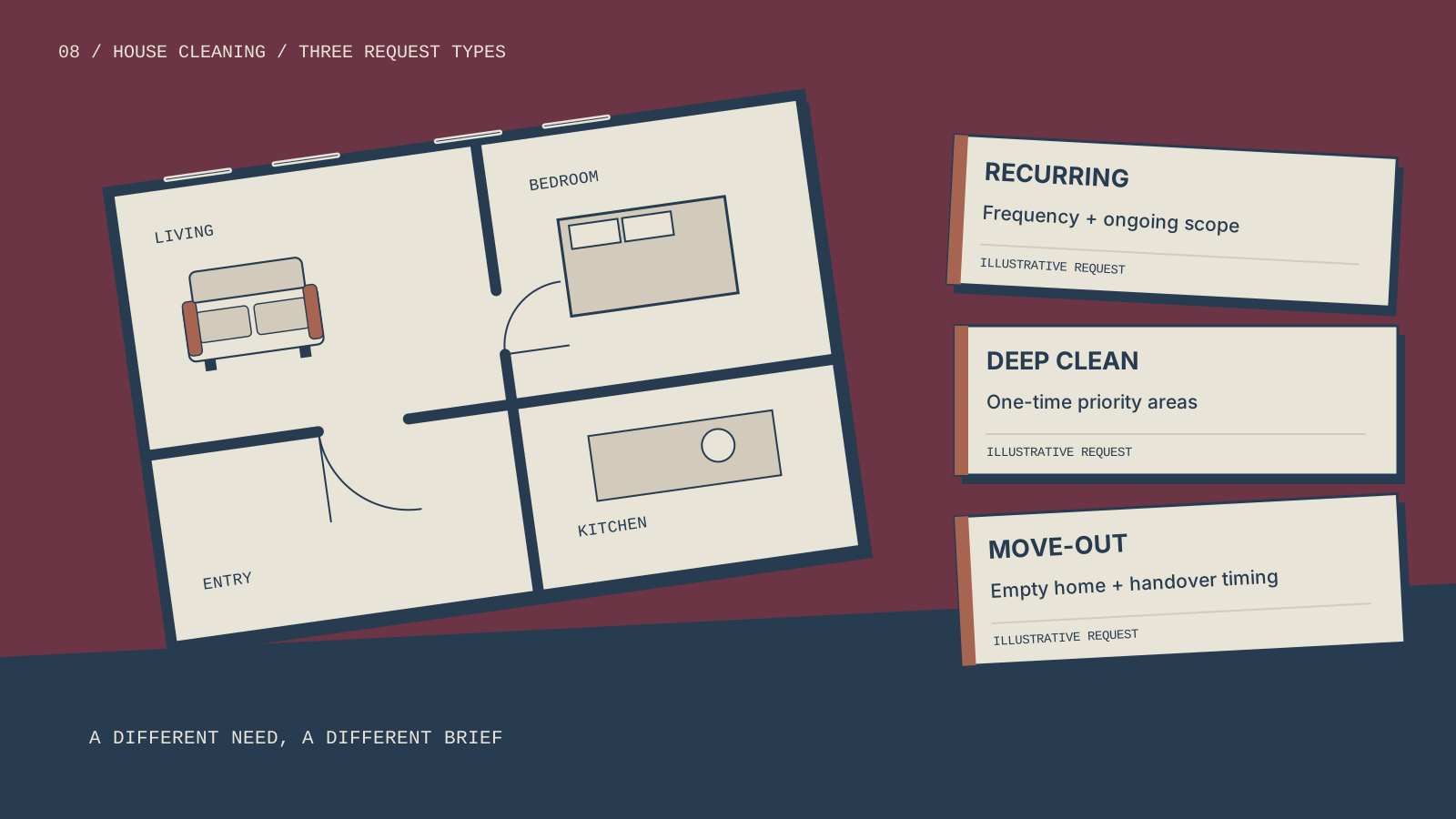
A household can use the same phrase, house cleaning, to describe several different needs. One person wants an ongoing visit pattern. Another is asking about a one-time deep clean. Someone moving out is working toward a vacancy deadline. When a lead website treats those requests as identical, the cleaning business spends its first conversation correcting expectations.
This guide helps cleaning business owners and independent lead-site operators design clearer residential inquiry paths. It focuses on how the website classifies intent, explains provider-approved boundaries and gathers useful context before a service discussion. It does not define the cleaning work itself. The broader cleaning leads and rank and rent guide explains the separately owned or leased website model and the responsibilities behind it.
How should a house cleaning lead site distinguish recurring, deep and move-out intent?
A house cleaning lead site should distinguish ongoing visit patterns from one-time projects and vacancy-related requests. These categories describe why the visitor is inquiring. They do not automatically establish the tasks included in the provider's service.
Recurring intent concerns a continuing arrangement the household would like to explore. Deep-cleaning intent usually needs a discussion of requested areas and the visitor's expectations for a particular visit. Move-out intent adds a change in occupancy and a deadline that may affect coordination. The provider needs to confirm how its own service descriptions apply.
| Visitor path | Main distinction | Useful context |
|---|---|---|
| Recurring | Ongoing visit pattern | Intended frequency and start preference |
| Deep | One-time scope discussion | Requested areas and reason for the visit |
| Move-out | Vacancy and deadline | Occupancy timing and requested completion window |
| Not sure | Provider clarification needed | Description in the visitor's own words |
Why should the form include a not-sure option?
A not-sure option preserves an honest inquiry when the visitor cannot map their need to the provider's labels. It is more useful than forcing a selection the receiving team will later need to correct.
Keep the wording neutral. The visitor is describing a need, not passing a qualification test. If many relevant households choose not sure, review whether the service names are sufficiently explained before the form. Their uncertainty can reveal a content problem rather than an unsuitable audience.
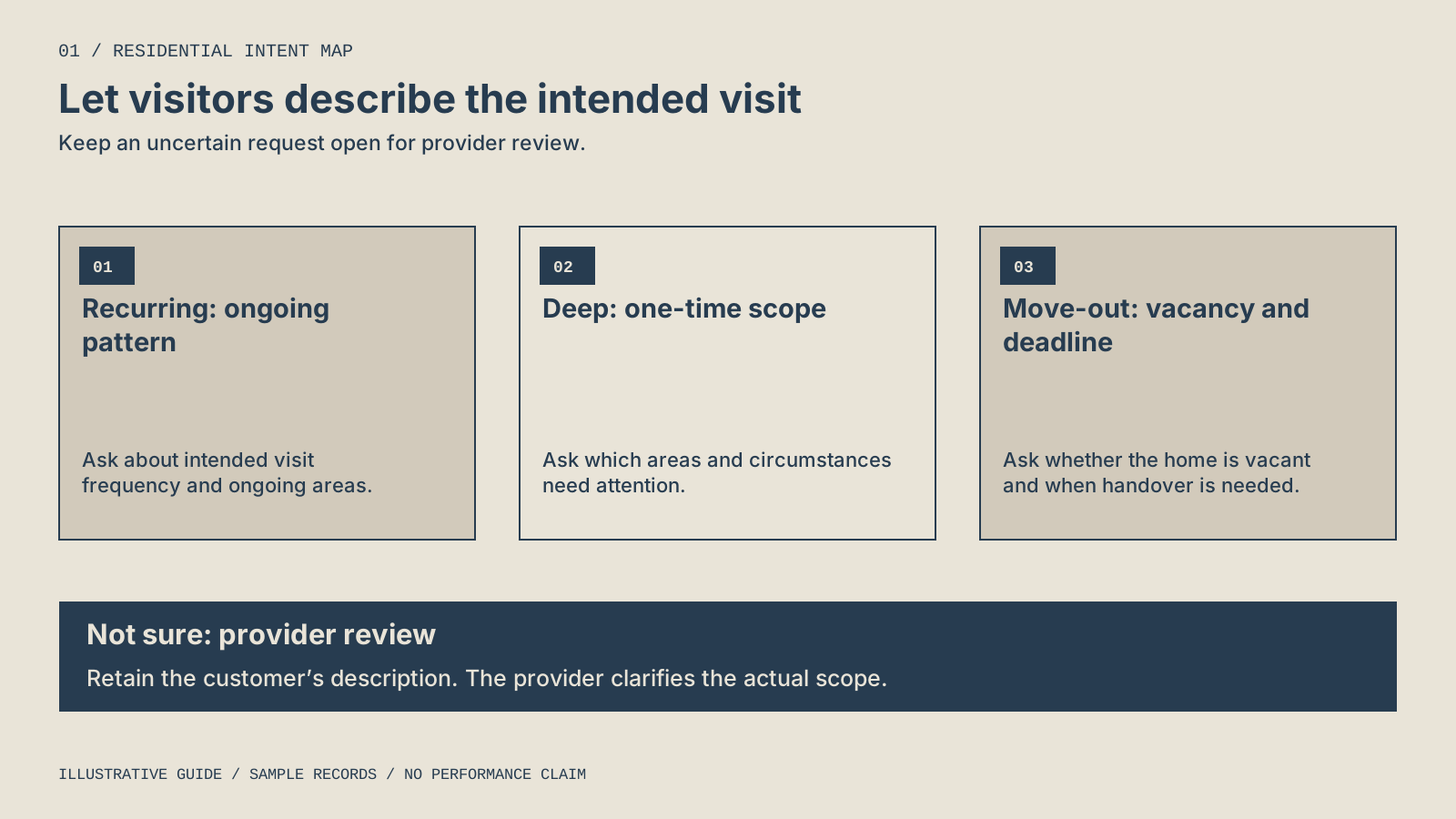
<ul><li>Recurring: ask about intended frequency.</li><li>Deep: ask about requested areas and context.</li><li>Move-out: ask about vacancy and timing.</li><li>Not sure: retain the request for provider review.</li></ul>
What should each residential service description explain?
Each description should explain the type of request being considered, the questions needed to review it and any provider-approved boundaries that affect the inquiry. The website should help visitors choose a sensible conversation without presenting the label as a universal scope.
A recurring page can explain how the business reviews a proposed visit pattern and establishes the next step. A one-time page can ask visitors to identify the areas or circumstances prompting the request. A move-out page can explain why vacancy timing and access coordination matter to the discussion. These differences give the pages a purpose beyond repeating the same benefits under new headings.
How can the site handle requests that overlap categories?
The site should allow one primary intent plus a short explanation of related needs. A household exploring recurring service may also ask about an initial one-time visit. The provider should review that combination without the website declaring one arrangement mandatory.
Use provider-approved examples to clarify ambiguous boundaries. If carpet service follows a separate review process, explain that and link to the carpet inquiry guide rather than implying inclusion in every house visit. If exterior work is offered separately, the property and surface matching path asks different questions.
Review the entire page for consistency. A careful scope paragraph can be undermined by a prominent button that implies immediate confirmation or a heading claiming every household need is covered. The visible offer and the actual receiving process should tell the same story.
Which questions make a residential cleaning inquiry more useful?
Useful residential questions establish service intent, general property context, coverage, timing preference and a way to follow up. Add detail only when it helps the provider decide what to ask or do next.
For recurring requests, ask about the intended visit pattern without implying that the requested frequency is already available. For deep-cleaning inquiries, invite a short description of the requested areas and the reason for a one-time visit. For move-out work, distinguish the preferred completion window from the expected vacancy date when that information affects coordination.
How much property detail belongs in the first form?
The first form needs enough context for an informed response, not a complete assessment of the home. Approximate room or area information may help, provided the provider confirms why it is needed and how uncertainty is handled.
Do not require households to invent precise answers. A visitor who is uncertain about a measurement should be able to say so. Likewise, a free-text description should not be interpreted as a provider-approved assessment. Keep the inquiry at the level of request context.
Explain why questions appear. A short note that timing preferences help the provider organize follow-up is clearer than an unexplained mandatory date field. Keep sensitive access information for a later appropriate conversation. The initial form can ask whether coordination will be needed without collecting entry codes or private household routines.
The result should be readable by the receiving office. Group the chosen intent with its related answers in the notification so a move-out deadline is not lost beneath unrelated recurring-service fields.
Should recurring, deep and move-out requests have separate website pages?
Separate pages make sense when each provides distinct, useful information and a supported inquiry path. A single clear page with well-developed sections can be better when the offer is narrow or the distinctions do not justify independent destinations.
Start with a content map. Identify the visitor's question, the explanation needed and the provider's next action. If each intent produces a materially different conversation, a focused page may help visitors orient themselves. If three drafts repeat the same introduction, service description and form, the architecture needs another look.
When does another page add real value?
Another page adds value when it answers a decision the existing page cannot handle clearly. A move-out page might explain the relationship between vacancy context, a requested completion window and provider confirmation. That information differs from planning an ongoing household visit pattern.
Use internal links to show those relationships. A recurring page can acknowledge that a visitor may be seeking a one-time starting visit and point to the relevant explanation. Avoid making households restart their inquiry simply because their need spans two labels.
Google's spam policies address substantially similar doorway pages. Do not create near-identical residential pages for numerous city and service combinations. Base the architecture on meaningful questions and genuine coverage, then maintain the information as the provider's offer changes.
How do you test whether visitors understand the service choices?
Test the choices by comparing the visitor's selected intent with the explanation they provide and the receiving provider's interpretation. A technically working form can still produce a misleading classification.
Before launch, use clearly labeled scenarios with different needs. One illustrative household wants an ongoing pattern but has no preferred start date. Another wants a one-time visit and is unsure whether deep cleaning is the correct label. A third is moving out and can describe the vacancy window. Check whether each person can express the need without making unsupported assumptions.
- Record the visitor's service choice.
- Read the property and request context together.
- Check whether timing is described as a preference.
- Ask the provider what clarification would be needed.
- Record the appropriate next step without implying a booking.
What should you do when the provider reclassifies the request?
Record why the provider reclassified it, then decide whether the page needs a clearer explanation. Reclassification can be a useful service conversation, but repeated confusion about the same boundary suggests a website problem.
For example, if recurring visitors repeatedly expect a separate carpet service to be included, examine the residential scope language and adjacent links. If move-out visitors select an unavailable completion date because the interface appears to offer appointments, revise the timing label and confirmation. Repair the expectation that caused the mismatch.
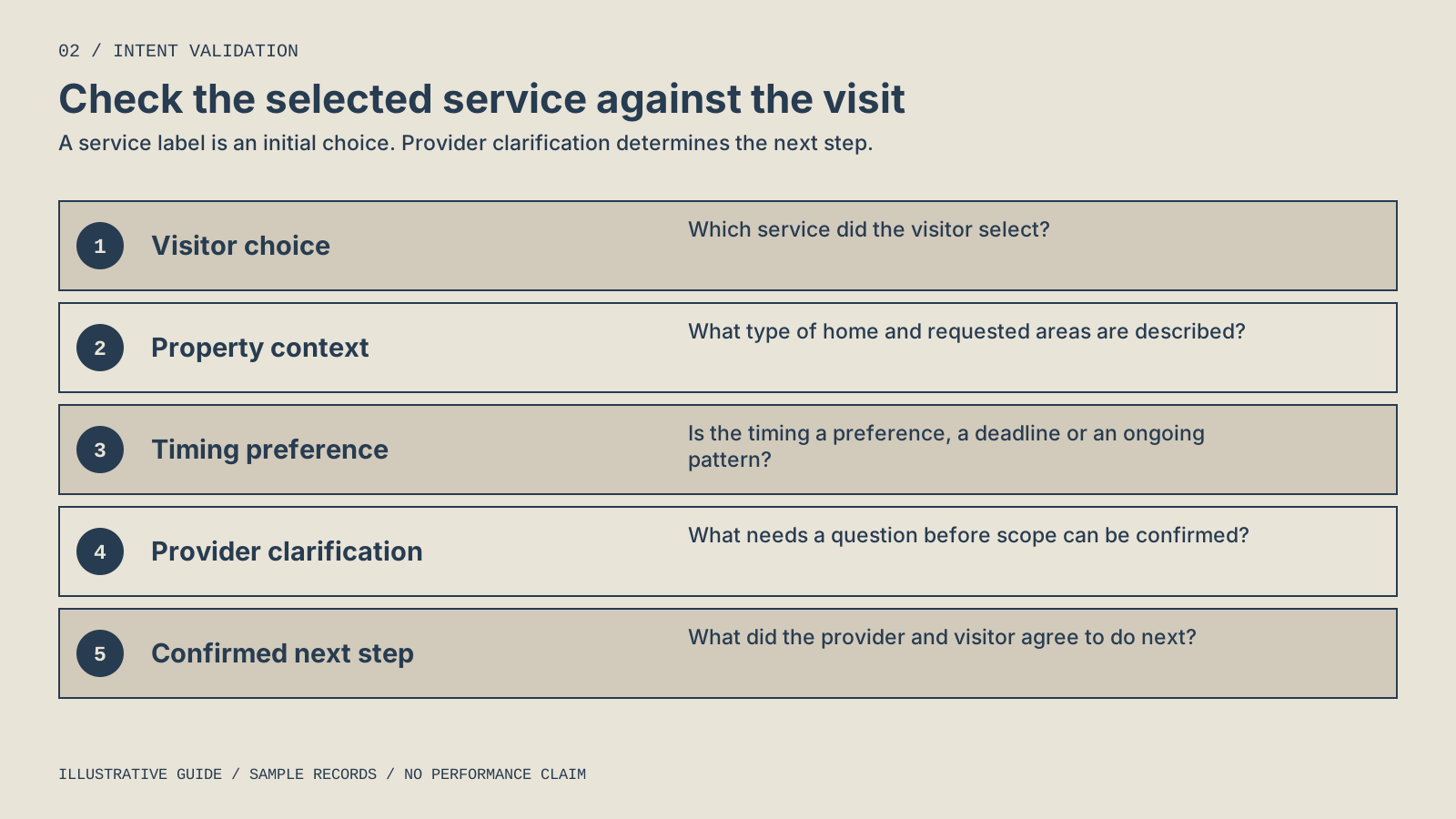
<ol><li>Record visitor choice.</li><li>Review property context.</li><li>Check timing preference.</li><li>Obtain provider clarification.</li><li>Record confirmed next step.</li></ol>
How should the website operator review the resulting house cleaning leads?
Review house cleaning leads by intended service, coverage fit, clarity of context and provider disposition. Keep household preferences, provider clarification and confirmed arrangements as distinct observations.
A recurring request awaiting a schedule discussion differs from a one-time request outside the current offer. A move-out inquiry with an unclear deadline needs clarification. These situations should not disappear into a single accepted-or-rejected total, because each suggests a different next action.
Which measurements belong beside the provider notes?
Useful measurements include the originating page, verified inquiry receipt and the service intent recorded at submission. The provider notes explain what happened after that initial action. Compare the two when looking for patterns.
Google Analytics lists lead-generation events for stages such as generating and qualifying a lead. Implementation needs to reflect the actual confirmed action. Opening a form or choosing recurring service does not establish a received inquiry.
Review enough context to choose a concrete repair. The issue might be an unclear label, missing explanation, unsupported scope or a receiving process that does not preserve the answers. Make that correction and record when it changed. The purpose of the review is a clearer service conversation, not an inflated activity count.
What else should residential lead-site operators clarify?
Does recurring interest mean the household is ready to begin?
Recurring interest identifies the type of arrangement the household wants to explore. The business still needs to review the request, clarify scope and discuss timing. Preserve that distinction in the confirmation message and provider notes so an expression of interest is not reported as a confirmed continuing service.
Should deep cleaning always be a required first visit?
The website should describe the actual provider's process rather than impose a universal requirement. If the business needs an initial assessment or a separate discussion before considering recurring visits, explain that accurately. The provider determines what applies to a particular request.
Can a move-out page promise a particular inspection outcome?
A move-out page should explain the supported inquiry and scope-review process. It should not promise an outcome controlled by another party or by conditions the provider has not assessed. Keep the visitor's requested deadline and the provider's confirmed arrangements separate.
What if the visitor selects the wrong category?
The receiving team should clarify the request and preserve the original context. Use repeated misclassification as evidence to review labels and explanations. A visitor should not need to start again solely because the website's category names did not match the words they used for their need.
Does this replace work on the cleaning company's Yelp profile?
An independent website and a Yelp business profile serve different operating contexts. Our Yelp house-cleaning inquiry guide covers that platform. This guide concerns the residential pathways and handoff within a separately controlled lead asset, with the real cleaning business evaluating the work.

How C3i3 Can Help
C3i3 can help translate your residential service offer into clear recurring, deep and move-out inquiry paths. A scoped pilot can include content mapping, provider-approved explanations, form planning and tests that show whether the receiving team understands each request. C3i3 plans the marketing asset; your cleaning business determines the actual service scope.
Explore our Local SEO services or contact C3i3 with your current service descriptions, supported territory and examples of recurring inquiry confusion. Those inputs make the first planning discussion specific.