








































In this article
A commercial cleaning inquiry can begin with a facility manager who knows the building but has not yet defined the full service scope. That person may need to coordinate a walkthrough, compare workable service windows and involve another decision-maker. A generic request form that asks only for a name and telephone number leaves the receiving business without the context needed for a useful first conversation.
This guide is for cleaning business owners and independent lead-site operators designing that business-to-business journey. It explains how a separately controlled website can help managers describe premises, requested areas and timing while preserving the provider's role in assessing actual work. The broader cleaning lead website guide explains how this path fits an owned or leased marketing asset.
Why do facility managers need a different cleaning inquiry journey?
Facility managers need a journey that supports coordination and assessment before service is confirmed. The website should help them explain a premises-level need and identify the next useful conversation, rather than push every visitor toward a household appointment.
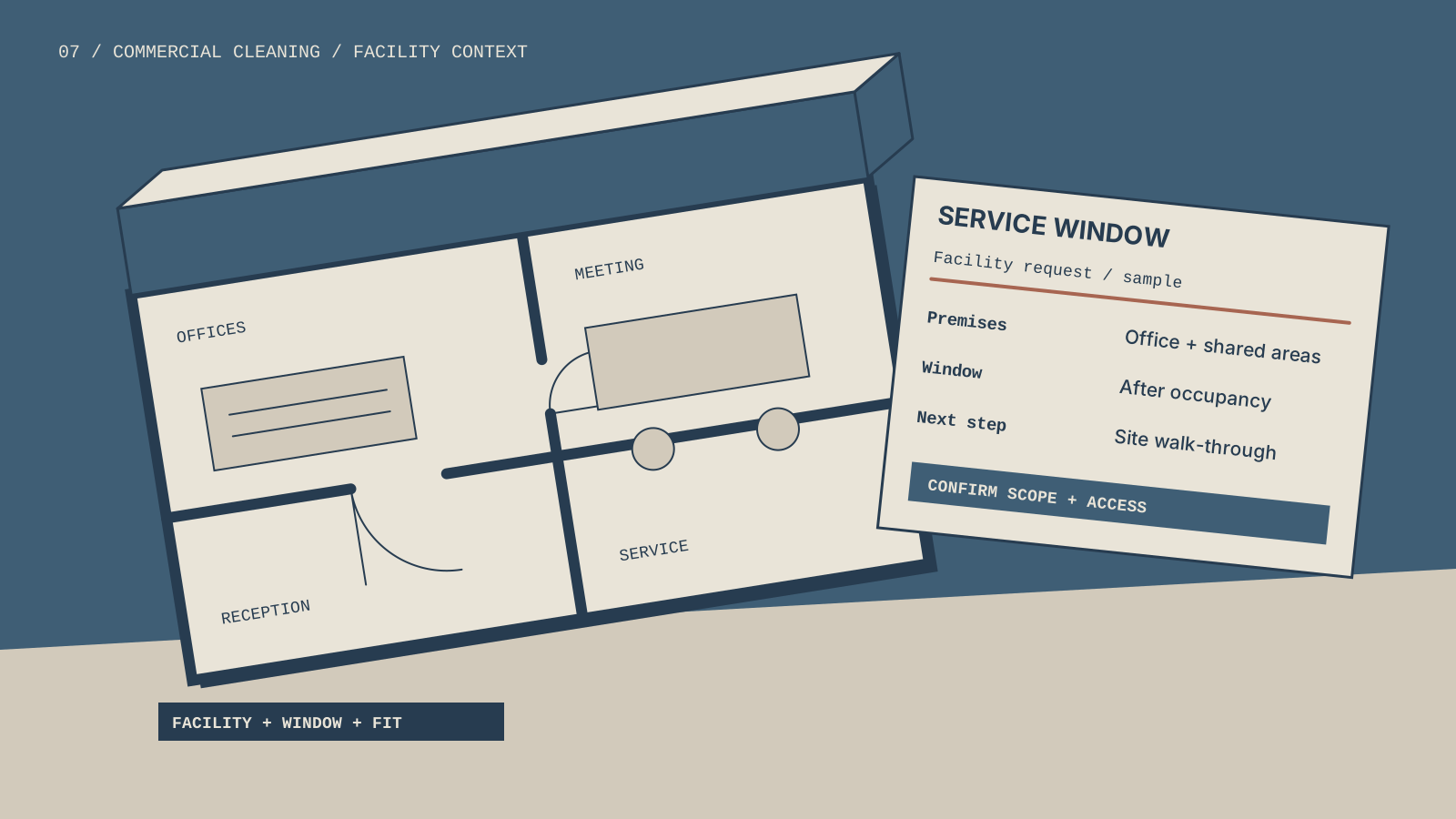
Consider an illustrative manager responsible for an office with shared meeting rooms and several occupied suites. The manager can describe building use and possible service windows, but may need another person to confirm which spaces are included. A site that assumes a single ready-to-book customer misses that decision structure.
Who is the commercial visitor actually representing?
The commercial visitor may be the operational contact, a property representative or someone gathering information for another decision-maker. Ask for their role when that helps the provider organize follow-up. Do not assume that a job title establishes authority to confirm work.
Write the page for this staged process. Explain the kinds of facilities the provider considers, the information needed for an initial review and how a walkthrough may be discussed. Keep specialized premises out of the offer unless the provider has confirmed that scope. A broad heading such as commercial cleaning should not silently expand the business's capabilities.
The distinction is practical: the first useful outcome might be a well-framed scope conversation. A website can support that outcome even when a site visit or additional internal discussion must happen before anything else is decided.
What should a commercial cleaning lead website ask about the facility?
A commercial cleaning lead website should ask for the premises type, general location, requested areas, current need and workable service window. These details let the provider decide what to clarify and whether a walkthrough is an appropriate next step.
Use language a manager can answer without preparing a technical specification. An approximate description of the occupied spaces may be more useful at this stage than a mandatory exact measurement. Allow an uncertain answer where the visitor genuinely does not know. The provider can verify material details during assessment.
| Topic | Useful question | Why it matters |
|---|---|---|
| Premises | What kind of facility needs review? | Checks the supported setting |
| Areas | Which spaces are being considered? | Begins the scope discussion |
| Window | When could service take place? | Reveals coordination needs |
| Current need | Is this ongoing service or a defined project? | Frames the conversation |
| Contact | Who can coordinate a walkthrough discussion? | Identifies the next participant |
Which details should wait for a provider conversation?
Detailed access arrangements, sensitive building information and final scope decisions should wait for an appropriate provider conversation. The general inquiry should identify that coordination is needed without inviting visitors to submit keys, entry codes or internal security instructions.
Keep optional context focused. A short description of the current need can reveal that the manager is planning a service change, preparing an occupied space for a particular date or exploring an ongoing schedule. Those are useful distinctions. A long questionnaire collecting every imaginable building detail can make the initial request harder without improving the first response.
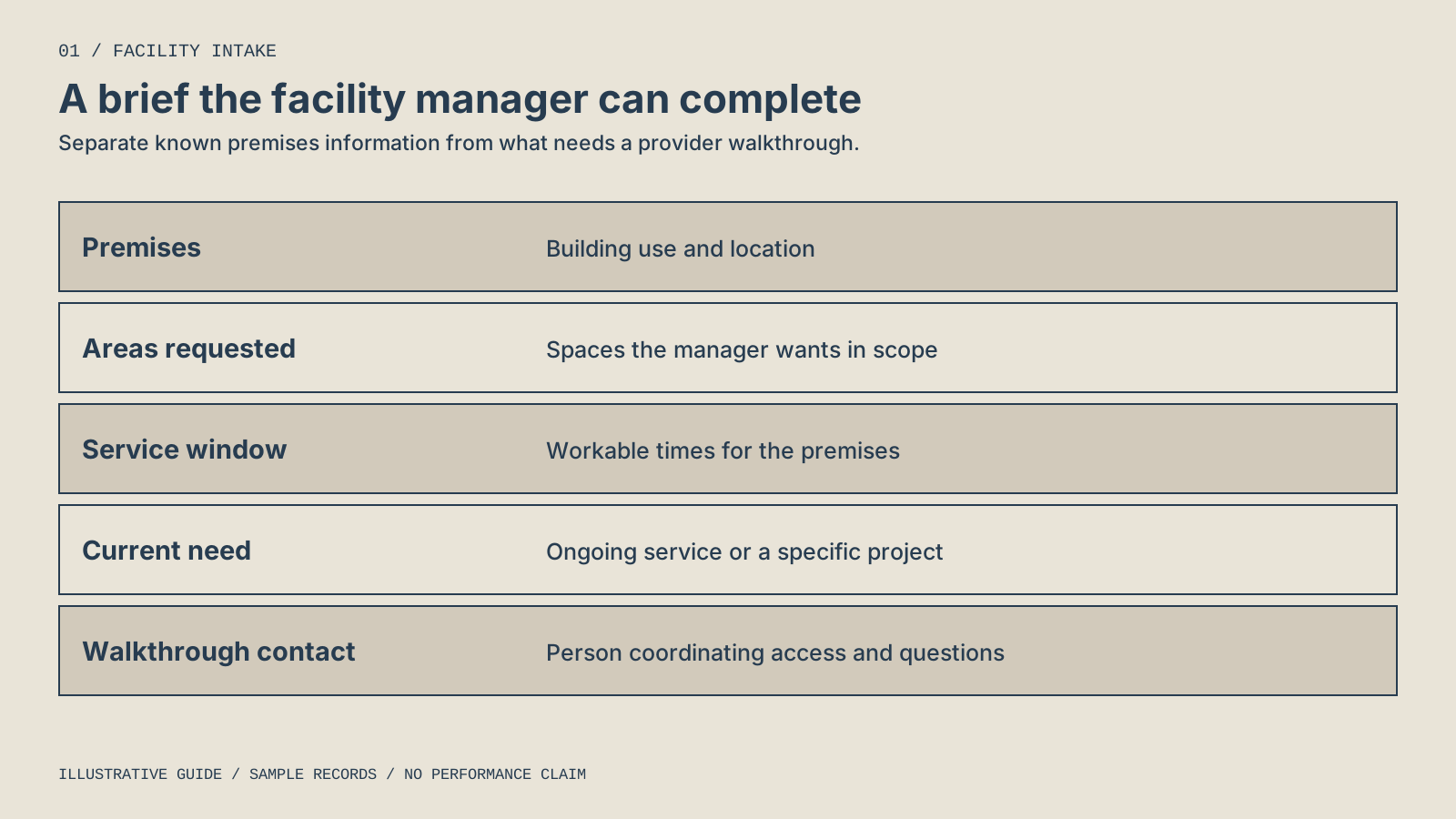
<ul><li>Premises: building use and location.</li><li>Areas requested: spaces in scope.</li><li>Service window: workable times.</li><li>Current need: ongoing or project.</li><li>Walkthrough contact: coordinating person.</li></ul>
What should the commercial service page explain before the form?
The service page should explain supported facility settings, the scope-review process and the relationship between the independent site and the receiving provider. A manager should understand what kind of inquiry is welcome before reaching the form.
Organize the page around the actual offer. State whether the provider considers ongoing service, defined projects or both. Describe the requested information and why a further conversation may be needed. If a walkthrough is usually part of the provider's process, explain its purpose without promising that every inquiry will receive one.
How do you make the offer specific without publishing unsupported claims?
Use verified operational descriptions and explain their boundaries. For example, a provider-approved list of supported premises is more useful than claiming to handle every commercial environment. Avoid turning a general cleaning page into a promise about specialized facilities the business has not assessed.
The content should also explain who follows up. A separately owned or leased lead website is a marketing asset, while the participating cleaning business determines whether it can consider the work. That relationship belongs near the inquiry path, with consistent wording in the confirmation message.
Google's guidance on helpful content asks whether a page serves its intended audience. For this audience, a practical test is whether a manager can brief a colleague using the page: which premises are considered, what information is needed and what happens next. General promotional language does little to answer those questions.
How should a received request become a walkthrough decision?
A received request should first reach the responsible provider contact with its facility context intact. The provider then reviews fit, asks material questions and decides whether to propose a walkthrough. The manager still needs to confirm the arrangements.
Design the website confirmation around that sequence. It can acknowledge receipt and explain the expected follow-up process. It should not describe a walkthrough as booked simply because the visitor selected a preferred day. A useful handoff includes the page source, requested premises, areas, service window and the visitor's role.
- Confirm that the request reached the intended receiving team.
- Have the provider review supported setting and geographic fit.
- Return questions that materially affect the next conversation.
- Propose a walkthrough when the provider considers it appropriate.
- Record the manager's confirmation separately from the proposal.
What if several people need to attend or approve the walkthrough?
The receiving team should clarify who needs to participate and who coordinates the next step. The form can identify an initial contact, but it should not attempt to model every internal approval relationship.
Use a short handoff note rather than expecting the office to infer the situation from scattered messages. For example, an illustrative request may identify a facilities coordinator as the first contact while noting that a site manager will discuss access later. That context changes the follow-up conversation without requiring sensitive details in the public form.
Requests about individual homes should reach the residential service-intent path. A facility's carpet-only request may need the narrower carpet intake questions rather than an assumption that all requested work belongs in a general facilities scope.
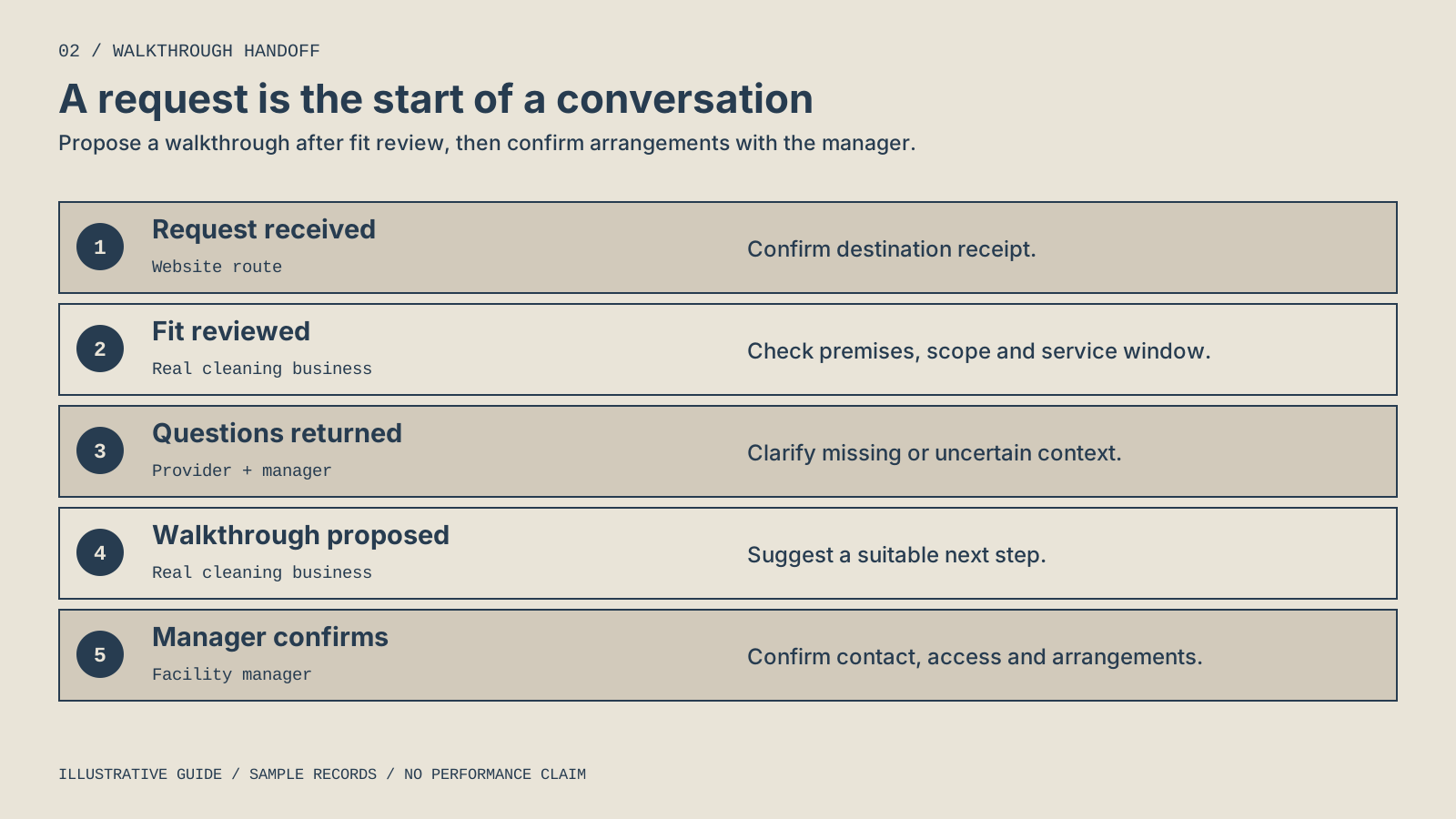
<ol><li>Confirm request receipt.</li><li>Provider reviews fit.</li><li>Return scope questions.</li><li>Propose walkthrough.</li><li>Manager confirms arrangements.</li></ol>
How do you test the facility inquiry journey before launch?
Test the journey with realistic facility scenarios and verify that the provider receives enough context to choose a sensible next step. The test should cover content clarity, form delivery and receiving-team interpretation.
Use clearly labeled scenarios rather than real customer submissions. One can describe an occupied office seeking ongoing service. Another can describe a manager who knows the requested areas but cannot confirm a service window. A third can concern an unsupported premises type. The purpose is to discover whether the website guides and routes these situations accurately.
What counts as a passing handoff test?
A passing handoff test shows that the intended recipient received the request, recognized the facility context and could describe the appropriate follow-up. A browser success message or email delivery check alone establishes less than that.
Ask the receiving contact to summarize the request in their own words. If they mistake a request for ongoing facilities service as a one-time household visit, inspect both the wording and field labels. If the premises type disappears from the notification, repair the handoff before attracting live inquiries.
Test the mobile page as part of the same review. Confirm that the explanation precedes the form, labels remain understandable and the visitor can express uncertainty. The quality question is whether the system supports an actual manager's next decision, not whether every field can technically accept text.
Which observations show whether commercial cleaning inquiries fit?
Useful observations include supported premises, coverage fit, sufficient scope context and an appropriate next action. Track these separately from raw form totals so the team can distinguish inquiry generation from a productive facilities conversation.
An inquiry can be relevant even if the manager is not ready to arrange a walkthrough immediately. Record the stage accurately. A request awaiting internal clarification differs from one outside the provider's service scope. Combining them under an unqualified label hides the work needed to improve the page or follow-up process.
Review the source page alongside provider notes. If multiple requests concern unsupported premises, revise the service explanation. If relevant managers submit incomplete windows, check whether the question asks for a preference they cannot yet know. Give uncertainty a usable route rather than forcing a misleading answer.
How can analytics support this review?
Analytics can record verified request actions and later lead stages when they are deliberately implemented. Google lists separate events for generated and qualified leads. Those labels still require definitions and confirmed triggers.
Keep an inquiry received, a walkthrough proposed and a walkthrough confirmed as separate records. This makes the review actionable. It also prevents a site operator from reporting a page interaction as an appointment the provider has never accepted.
What else should commercial cleaning website operators clarify?
Should a facility inquiry require exact square footage?
Require exact measurements only when the provider genuinely needs them to begin review and visitors can reasonably supply them. An approximate description with a clear uncertainty option may be a better initial question. The provider determines what must be verified before defining the actual scope.
Can the site describe evening or weekend service?
The site can describe service windows the provider has confirmed it will consider. Separate that capability from an available appointment. A visitor's preferred window starts a scheduling discussion; it does not show that staff or building arrangements are already confirmed.
Does a walkthrough request count as a confirmed appointment?
A walkthrough request shows interest in that next step. Confirmation requires the receiving provider and facility contact to establish arrangements. Record the request, proposal and confirmation separately so both the website operator and cleaning business understand what actually happened.
Can the independent lead site create its own Business Profile?
Google's eligibility guidelines exclude lead-generation agents or companies. A real eligible cleaning business owns its profile. A separately controlled lead website should not invent another cleaning business identity to pursue a Maps presence.
What should happen when the provider cannot consider the facility?
The receiving process should acknowledge the scope mismatch accurately and avoid implying acceptance. Use the reason to review the page, coverage explanation or intake question. If the category is no longer supported at all, update the public offer and inquiry route together.

How C3i3 Can Help
C3i3 can plan a commercial cleaning lead-site pilot around the facility manager's actual decision process. We can organize supported premises and service windows, develop the scope-review content and test the inquiry handoff with your receiving team. The cleaning provider evaluates the facility and performs the work.
Explore Local SEO and lead-generation campaign planning. Contact C3i3 with your supported facility types, genuine territory and current walkthrough process so the first discussion can focus on a concrete, reviewable pilot.