








































In this article
Contractor lead generation should connect a real customer request with a business that can accept the work. If you are considering a dedicated rank and rent website, the buying decision is more specific: can a separately controlled website become a useful acquisition channel for your services, territory and available crews? A polished homepage alone cannot answer that question.
This guide is for the contractor evaluating that channel and the agency scoping it. It explains what to verify before a pilot, how to distinguish website control from business identity and which observations justify continuing. The examples are planning aids, not C3i3 client results or a claim that a ready-made lead website is available. For the underlying model, start with our rank and rent website guide.
What is a contractor buying when they search for lead generation?
A contractor is usually looking for access to potential customers, help attracting inquiries or an agency that can build an acquisition channel. The contractor is the buyer of marketing work. The homeowner or property manager is the person whose service need that work must eventually satisfy.
That distinction changes the entire brief. “HVAC leads” is a plausible search by an HVAC business seeking work. “Air conditioner repair near me” is a plausible search by someone needing service. A C3i3 buyer guide should answer the first person’s questions about strategy, evidence and scope. A customer-facing lead website must answer the second person’s questions about the service and actual provider.
Does buying a website channel mean buying a list of customers?
No. A dedicated search website is an operating channel with uncertain future discovery and inquiry activity. It is different from receiving a batch of existing contact records. Ask whether the proposal concerns a new build, an existing site that can be inspected or work on the contractor’s current website. Each requires different evidence.
Start the conversation with a concrete business need: residential installation assessments within an approved territory, for example. Avoid “more leads” as the only requirement. That phrase leaves the agency unable to distinguish work the contractor wants from calls the office will decline. Record which job types the business accepts now, which it may accept later and who can approve changes.
This is also why national keyword estimates should guide topic research rather than promises. Searches for a marketing phrase do not count local homeowners ready to book that contractor. The two audiences and their conversion paths must be evaluated separately.
Who controls the website and who performs the contractor work?
The website operator controls the agreed digital asset. The real contractor decides whether to accept a customer request and performs any resulting trade work. A separately controlled lead site must explain that relationship clearly enough for a visitor to understand who receives the inquiry.
Website control can include the domain, hosting, content, phone service and reporting access. These are separate components. A proposal saying “your exclusive website” does not establish that the contractor owns the domain or can take the site when the arrangement ends. Ask for a plain inventory of controls and available access before treating the channel as part of the business.
What should the customer see before making contact?
The customer should see an accurate service description, genuine coverage and a clear explanation of the receiving business or matching process. If only one named contractor receives the request, the site should not create the impression of several independent local branches. If the receiving business changes, review the visible identity and contact expectations before routing changes.
For an illustrative pilot, the operator might maintain a dedicated residential HVAC website while one identified HVAC company approves the service descriptions and receives the requests. The operator handles site maintenance. The HVAC office handles scheduling. The contractor remains responsible for its work. The public presentation should reflect those actual roles rather than attributing technician experience to the website operator.
C3i3 is a strategy, creative, design and marketing agency. C3i3 can assess and scope marketing work; it does not become the roofer, plumber, HVAC company or removal operator described in a campaign. Keep that distinction in imagery, copy and every contact confirmation.
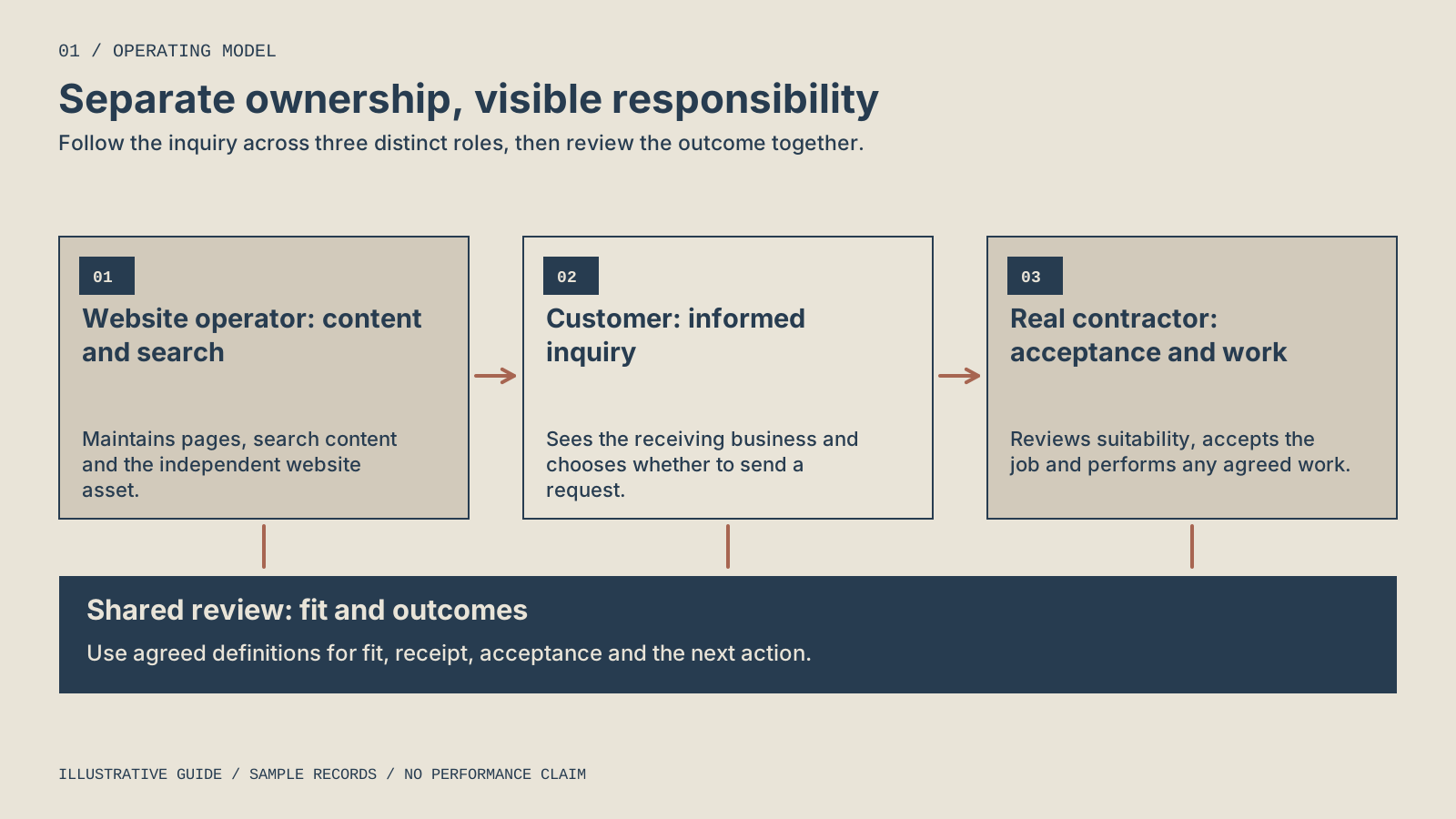
The website operator maintains the lead asset. The customer sees who receives the inquiry. The real contractor confirms suitability and carries out any accepted work. Both parties review agreed outcomes.
Which services and locations belong in the first contractor pilot?
Choose a service and territory that the actual business can support, then document the conditions that make an inquiry suitable. A compact, verifiable scope gives the agency something useful to build and gives the contractor a fair basis for reviewing the resulting requests.
Begin with the office’s acceptance decisions. Which residential or commercial work is supported? Which locations are workable for that service? Is a request for a planned assessment acceptable when same-day capacity is unavailable? Does the business accept property-manager inquiries? These operational facts should determine the pilot more than a list of cities an agency hopes to target.
Why can the same territory work for one job and fail for another?
A planned installation assessment may fit a wider booking area than a time-sensitive repair request. A removal job with difficult access may need a different crew arrangement from an ordinary curbside pickup. The site should present the confirmed boundaries for the specific offer rather than apply one broad service-area claim to every request.
Consider an illustrative Bay Area pilot. “San Jose AC repair” describes a homeowner service need, while “HVAC leads” describes the contractor’s acquisition question. An Oakland roof-repair request belongs with a roofer that accepts that work. A San Francisco request fits only if the real operator confirms coverage and an available next step. Those facts belong in the approval record. Adding city names cannot substitute for them, and these examples do not claim available C3i3 sites or provider results.
The trade clusters develop different parts of this decision. The exclusive roofing lead evaluation focuses on evidence and distribution. The plumbing launch test checks realistic exceptions before going live. HVAC lead-site planning addresses repair and installation capacity. junk removal job matching shows how item and access context affect fit.
What evidence should you request before relying on a dedicated lead site?
Request evidence appropriate to the asset’s actual stage. An existing website can be reviewed for its public content, source reports and inquiry records. A proposed website can demonstrate a research basis and a test plan, but it cannot demonstrate a history it does not have.
For an existing site, ask to see the relevant landing pages, service coverage and dated source reporting. Verify that a report refers to the offered domain and period. A screenshot with a large traffic total but no page, geography or date is insufficient to evaluate contractor fit. A website may attract useful readers while producing very few appropriate service requests.
Which search observations are useful without overstating them?
Search Console can show page and query performance, including impressions and clicks. Those observations help explain discovery. They do not establish that an inquiry reached the right office or became accepted work. Review the source and the operational record together, keeping their different measurement limits visible.
Google’s Search Console performance documentation describes search reporting by query, page and other dimensions. Ask for a focused view of the relevant pages rather than a whole-property total. Preserve the review period and selected filters so later comparisons concern the same scope.
For a new asset, request a service-and-location brief, an explanation of the intended customer decisions and a proposed page structure. Ask what will be checked at launch and what remains unproven until genuine activity occurs. This makes uncertainty explicit without treating a new site as inherently unsuitable. The important distinction is whether the proposal acknowledges the evidence it still needs.
Refuse to substitute stock screenshots, unrelated projects or a ranking claim for this review. An agency can demonstrate its proposed working method without presenting someone else’s results as evidence for your pilot.
How should inquiry distribution match the contractor’s actual availability?
Distribution should follow an agreed recipient, supported scope and current response capacity. A request arriving at a phone number is only one step. The office must understand why it arrived, what the customer was told and which next action is appropriate.
Specify the destination for each approved contact route. Identify the person responsible for acknowledging delivery problems and the contractor representative responsible for availability changes. If the office closes earlier than the website implies, fix the public expectation before seeking more traffic. A callback route must not be presented as an immediately confirmed appointment.
What does exclusive distribution actually establish?
Exclusive distribution can describe an agreement to send defined inquiries from a named source to one receiving business. It cannot ensure that customers have contacted no other contractor. Ask which services, territory, channels and repeat requests the arrangement covers, then verify the configured destinations against that definition.
Availability can change without the service itself changing. The HVAC office may still accept installation assessments while pausing new repair requests. A junk removal operator may accept ordinary household items while reviewing larger cleanouts individually. The operator needs a way to communicate those changes before the site creates unsuitable expectations.
Agree on a deliberate response to capacity constraints: update the stated availability, pause the affected acquisition path or use an approved request-for-callback message. Do not silently send the inquiry to a different trade business while leaving the original identity visible. A new recipient changes the customer’s understanding and the contractor’s evaluation of the channel.
These decisions do not require a complicated system. They require a maintained record of who receives what, who approves changes and what a visitor can reasonably expect. Review the record whenever coverage, staffing or the offer changes.
Can a separate contractor lead website use Google Search and Maps?
A useful website can pursue organic Google Search visibility, subject to Google’s requirements and discretionary rankings. Business Profile eligibility is a separate matter. Google lists lead-generation agents and companies as ineligible for Business Profiles; a lead website does not become an eligible contractor by leasing its inquiries.
The official eligibility guidelines should be checked before anyone includes a Maps profile in the plan. Only a genuine eligible operator should have a profile representing that business. Its identity and location information must be accurate. An agency’s management role requires the owner’s express consent and must follow Google’s third-party policies.
What should an organic website contribute beyond another contact button?
The site should help customers understand a real service, recognize the coverage and know what happens after contact. Useful information can include assessment expectations, supported property types and the questions the receiving office can answer. It should be maintained when the actual provider’s capabilities change.
A separate domain is not a shortcut around useful content. Google’s search spam policies cover doorway abuse and scaled content abuse. A network of nearly identical city pages or websites that add little for the visitor creates a different risk from a focused site with a genuine service explanation. Ask the agency why each proposed page deserves to exist.
Do not invent local branches, crews or addresses to make a site look established. The customer’s need for a credible provider and the contractor’s need for accurate inquiries point toward the same practice: clear identity, useful information and a working contact route. If the business wants its own website improved instead, our contractor local SEO guide addresses that broader route.
How should you measure a contractor lead website pilot?
Measure discovery, contact delivery, request fit and contractor acceptance as separate stages. A pilot is useful when the evidence explains which part of the channel works and which part needs revision. A single total labeled “leads” hides those distinctions.
Use a small operating record with a nonpersonal request reference, date, source when known, requested service, territory decision, delivery acknowledgment and next-step outcome. Keep customer details in the systems that need them for follow-up. The marketing review does not need a copy of every personal message or a recording of every conversation.
Why are phone clicks and form events insufficient on their own?
A phone click shows an interaction with a contact link. It does not prove that someone answered or accepted a job. A form event is useful only when the implementation matches the intended action. Verify the behavior rather than assuming a report label establishes successful delivery.
Google’s call-conversion documentation distinguishes tracking methods with different meanings, including mobile number clicks that measure clicks rather than the calls themselves. Google Analytics lists generate_lead for a submitted form or request for information. Neither label replaces the contractor’s record of fit and follow-up.
Consider an illustrative review: one request concerns an accepted service and becomes an assessment; another is outside the defined territory; a third is a repeat contact about the same project. Record those as different observations. Counting all three as new qualified opportunities would obscure what the website contributes. These are example records, not a benchmark or expected outcome.
Agree on review dates and the evidence needed to make a decision. If activity is sparse, report the limitation. There is no useful reason to declare success or failure from a handful of ambiguous interactions just because a meeting date has arrived.
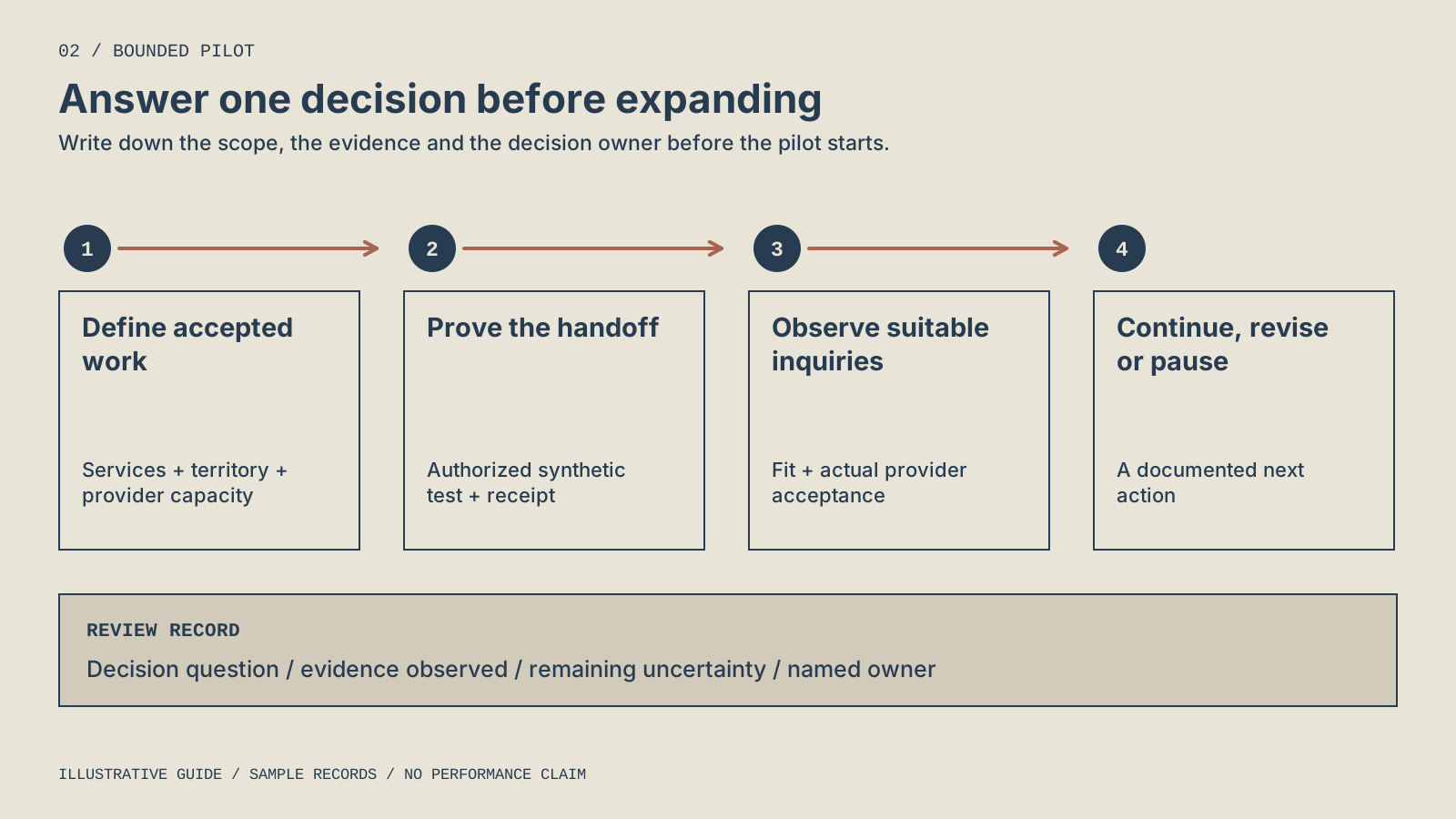
Define services and territory, test delivery with permission, observe qualified requests and provider acceptance then make a documented decision.
What should you change when contractor inquiries do not fit?
Change the part of the journey that the evidence identifies. Wrong-service inquiries suggest a different problem from missed delivery, unclear territory or a fully booked office. A reasoned diagnosis prevents the agency from responding to every weak result with more pages or more traffic.
Read a small sample from the landing-page promise through the contractor’s decision. If the page broadly advertises commercial work but the operator handles residential projects, fix the offer. If customers understand the service but receive no acknowledgment, investigate delivery and staffing. If an inquiry is appropriate yet cannot be accepted this week, review capacity and availability claims.
How can the contractor avoid blaming every unbooked inquiry on lead quality?
Use consistent reason codes and review a sample together. A customer who chooses another provider after a suitable assessment is different from a request for a service the business never offered. Separate source fit, contact success, appointment availability and the customer’s later decision before judging the channel.
A useful correction log names the observation, likely cause, proposed change, owner and retest. For example, “Out-of-area requests appear on the outer-territory page” supports a coverage clarification. “Office reports no notifications” supports a controlled delivery test. “Installation capacity unavailable” supports a service-specific pause. Each action should resolve a stated uncertainty.
The agency and contractor should agree on who approves public edits. Changes to the trade offer need the operator’s input; technical fixes can follow the approved implementation process. After a correction, verify the actual customer path again. A changed setting without a successful retest is still an open issue.
Keep a practical stop condition. If the receiving business cannot maintain an accurate offer or acknowledge requests reliably, pause the affected path. Continuing to attract customers into a known broken experience makes the evidence harder to interpret and the customer experience worse.
What should you bring when asking an agency to scope the work?
Bring the actual business facts, the decision you want the pilot to resolve and whatever evidence already exists. An agency can scope a more useful project when it understands supported work, territory, inquiry handling and the proposed ownership arrangement before planning content.
Prepare a concise brief naming the receiving business, priority service, customer type, approved geography and current availability. Include existing website URLs and a summary of recent inquiry problems, using anonymized examples where possible. Say whether you are evaluating a specific available asset or asking whether a new one should be developed.
Which outputs should a useful scope make concrete?
The scope should identify the service-and-location brief, proposed page responsibilities, visible business identity, contact paths, access arrangements, controlled launch checks and review method. It should also state the assumptions that require contractor confirmation and the evidence that cannot exist before the pilot runs.
Use our local lead-generation website build guide when you need the implementation detail behind those outputs. If your work combines property cleanouts with cleaning, the cleaning lead-generation guide can help separate the service promises rather than combine them into an unsupported offer.
The immediate next step is a scoping conversation about one defined acquisition question. It is not a promise that a site will rank or that existing inquiries are waiting. A contractor should leave that conversation knowing what can be examined now, what would need building and what evidence would support a later decision to continue.
Keep the brief short enough that the office and agency can use the same version. Update it when the accepted service, receiving business or available next step changes. A maintained one-page decision record is more useful than an ambitious plan that no longer matches the contractor’s operation.
What else should contractors ask about dedicated lead websites?
Clarify transition expectations, ownership, customer confirmation and the limits of the available evidence.
Can a new dedicated website replace an existing lead source immediately?
A new website has no established record of useful inquiries for your business. Keep the decision tied to observed activity and the contractor’s acceptance outcomes. A launch confirms that a channel is available to evaluate; it does not establish that it can replace another source. Review the actual evidence before relying on it operationally.
Does the contractor need to own the lead website?
Ownership depends on the arrangement being evaluated. A leased separate asset may remain under the operator’s control. That makes clarity about domain access, content, numbers, reporting and the end of the arrangement especially useful. The contractor should understand those controls and keep its real business identity distinct from the asset.
Should every service have a separate domain?
No. A separate domain needs a clear purpose and enough useful content to serve customers on its own. Additional domains can create more maintenance and fragmented evidence. Start with the customer decisions and approved business scope, then assess whether a distinct asset adds value rather than assuming more websites mean more opportunity.
Can a contractor approve inquiries before offering an appointment?
Yes. A request can be acknowledged and reviewed before a specific appointment is confirmed. The website should make that sequence clear so the customer understands what has happened. A submitted form must not display a confirmed booking message when the office still needs to check service fit and availability.
Can an agency manage the contractor’s Business Profile too?
A consentful agency relationship can include management of the real eligible contractor’s profile. That remains separate from the lead site. Google requires accurate representation and appropriate owner control. Do not accept a plan that creates a profile for an ineligible lead generator or uses a fictional business location.
What if a pilot produces too little activity to evaluate?
Report insufficient evidence and identify the unanswered question. Review discovery and technical delivery before drawing a conclusion about demand or fit. A low-activity period may support a narrower adjustment or a pause, but it cannot establish a reliable inquiry rate or predict future job outcomes.

How C3i3 Can Help
C3i3 can help a contractor evaluate whether a dedicated website is an appropriate acquisition project and define a practical pilot. Our Local SEO services connect search research, useful service content and local relevance. Our Lead Generation Campaigns services can help connect the offer with a clear inquiry journey and an agreed review method.
Bring the business that will perform the work, the services it wants, actual coverage and the inquiry problem you are trying to solve. Contact C3i3 to discuss what evidence is available and what a bounded scope would need to establish. C3i3 provides agency strategy and marketing work; contractor availability, acceptance and fulfillment remain with the real service business.