








































In this article
A leased website can look ready to generate plumbing leads while its contact path still sends requests to an unmonitored inbox or promises availability the plumbing office has not approved. Those failures are easier to find before real customers depend on the site. The prelaunch decision is whether the complete request experience behaves as agreed.
This guide gives the plumbing business and website operator a controlled acceptance test. It uses synthetic scenarios and authorized test recipients. It does not provide plumbing instructions or repeat the wider marketing plan in our plumbing lead-generation guide. For the buying decision behind a separate asset, read the contractor lead-website guide.
What must be agreed before testing a plumbing lead website?
Agree on the accepted service scope, actual coverage, office availability and expected behavior for each contact route. The test needs a known standard. Otherwise the website operator may declare success while the plumbing business is expecting a different result.
Name the real plumbing business that will receive the inquiries. Have an authorized representative confirm the public service description and the available next step. If the office reviews requests before offering an appointment, the website should describe a request for contact rather than display a confirmed booking. If calls are answered only during stated hours, the public message must reflect that.
Who should participate in a controlled test?
Include the website operator and a designated plumbing-office recipient who has agreed to the test window and method. Use approved test contact details. Label the records clearly so staff do not mistake them for customer work or enter them as genuine acquisition outcomes.
Create a brief acceptance sheet with the page URL, service category, covered location, expected destination, expected customer message and person responsible for acknowledging receipt. Keep one approved version for the test. A change to coverage or the destination during testing should be recorded so the result remains interpretable.
Do not use a real homeowner’s personal information as convenient test data. A synthetic request can still test the meaningful behavior. Keep access to testing systems within the agreed scope and avoid contacting unrelated businesses to see where a route happens to lead.
Which plumbing request scenarios should the prelaunch test include?
Include a covered daytime request and the exceptions most likely to confuse a customer or the office. For a plumbing website, territory, closed-hours expectations and duplicate retries deserve explicit tests. A single successful form submission checks only the ordinary path.
The following examples are fictional acceptance cases, not actual customer requests. Adjust them to the approved services and office arrangements. Test only contact routes and recipients that the responsible business has authorized.
| Case | Synthetic situation | Expected observation |
|---|---|---|
| P01 | Covered household asks about an approved service during office hours | Correct recipient receives a labeled test; customer message describes the next step |
| P02 | Request uses a location beyond confirmed coverage | Coverage response is accurate; no unsupported appointment promise |
| P03 | Request occurs outside stated response hours | Closed-hours wording matches the actual receiving process |
| P04 | Same test request is submitted again after a retry | Office can recognize the repeat; reporting distinguishes the test contacts |
Should the test include a customer who does not know the plumbing terminology?
Yes. Use an ordinary description such as a request to discuss a water-heater problem without selecting a technical diagnosis. The form should let the customer describe the need or choose an appropriate general category. The receiving plumbing staff decide what clarification is needed.
Check unsupported work as well. If the contractor has approved residential inquiries only, test how a commercial request is handled. The desired outcome may be a clear limitation or manual review, depending on the agreed process. It should not be an automatic promise that every request will be accepted.
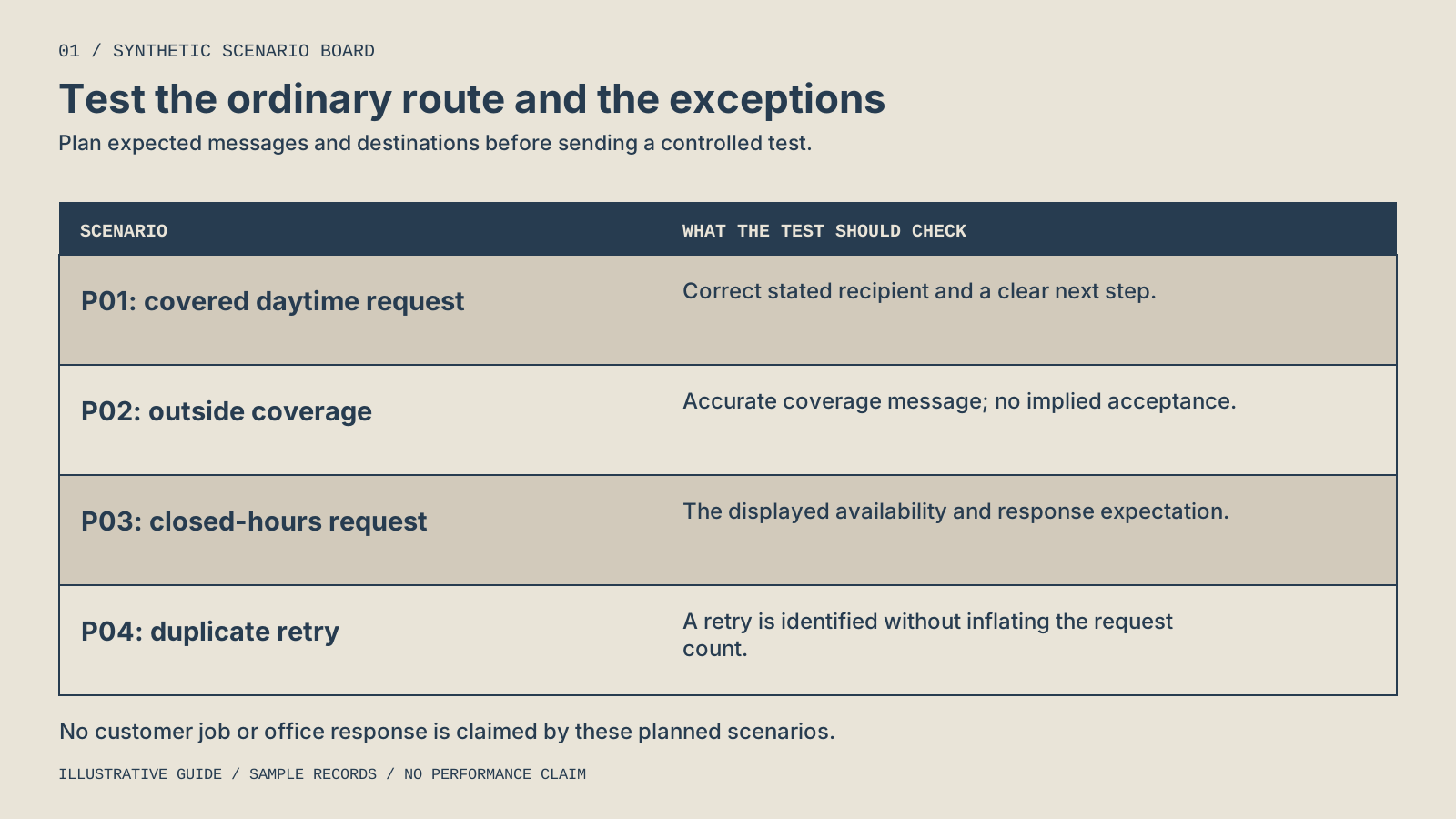
Synthetic tests check an accepted request, declined territory, accurate closed-hours message and an identified duplicate.
How do you test the customer-facing plumbing request experience?
Use the public page on a phone and follow each approved contact action through its visible result. Check what the person is told before contact, what happens during the action and what the confirmation says afterward. The copy and the behavior should agree.
Start without assuming the visitor knows the website’s arrangement. Can you identify the receiving plumbing business? Is the service area understandable? Does the contact button describe a call, a callback request or an appointment? If the page claims immediate assistance but the approved process is a later office review, the wording fails even if the form technically works.
What should a form failure show?
A failed submission should not display the same message as a successful request. Test missing required information and an approved simulated failure condition where available. Confirm that the page explains the problem clearly and lets the person recover without guessing whether the office received the request.
Inspect the mobile keyboard, readable labels and the ability to correct an entry. An inquiry form should ask for context the office needs, not force the visitor through a long technical questionnaire. Test whether a required field unnecessarily blocks a person who does not know equipment details.
For phone links, verify the intended number and the displayed identity before placing any authorized test call. Confirm what the receiving person hears or sees when that matters to recognizing the source. Do not assume a click count proves a conversation. The purpose is to establish an accurate customer journey and dependable receipt, not to manufacture report activity.
What evidence proves that the plumbing office received the request?
Evidence of receipt should come from the approved destination and a designated office acknowledgment. A browser success message proves only what the browser displayed. Connect the test reference to the actual receiving system or person before marking that route as passed.
Use a short test log with case ID, timestamp, page, expected behavior, observed behavior, receipt acknowledgment and any defect. A screenshot of the confirmation can document the customer message. A matching nonpersonal reference in the receiving system documents delivery. The office can then confirm whether the request is recognizable and usable for follow-up.
What does a complete P03 closed-hours record look like?
The record should state the approved closed-hours message, the actual message shown, the destination that received the synthetic request and the office’s acknowledgment when it resumes handling. If the page promises an immediate reply but the approved process does not provide one, the test remains failed even though the inbox received the message.
Keep defects concrete. “Form broken” is difficult to act on. “P02 accepts a location the page says is outside coverage and then displays an appointment confirmation” identifies the mismatch. Assign an owner to the public wording or behavior change and record a retest against the same case.
The lead-website build guide places this review within the larger launch process. For a comparison focused on a mature asset’s evidence rather than prelaunch behavior, the roofing due-diligence guide follows samples through source and acceptance. Neither replaces the plumbing office’s own approval of what this website promises.
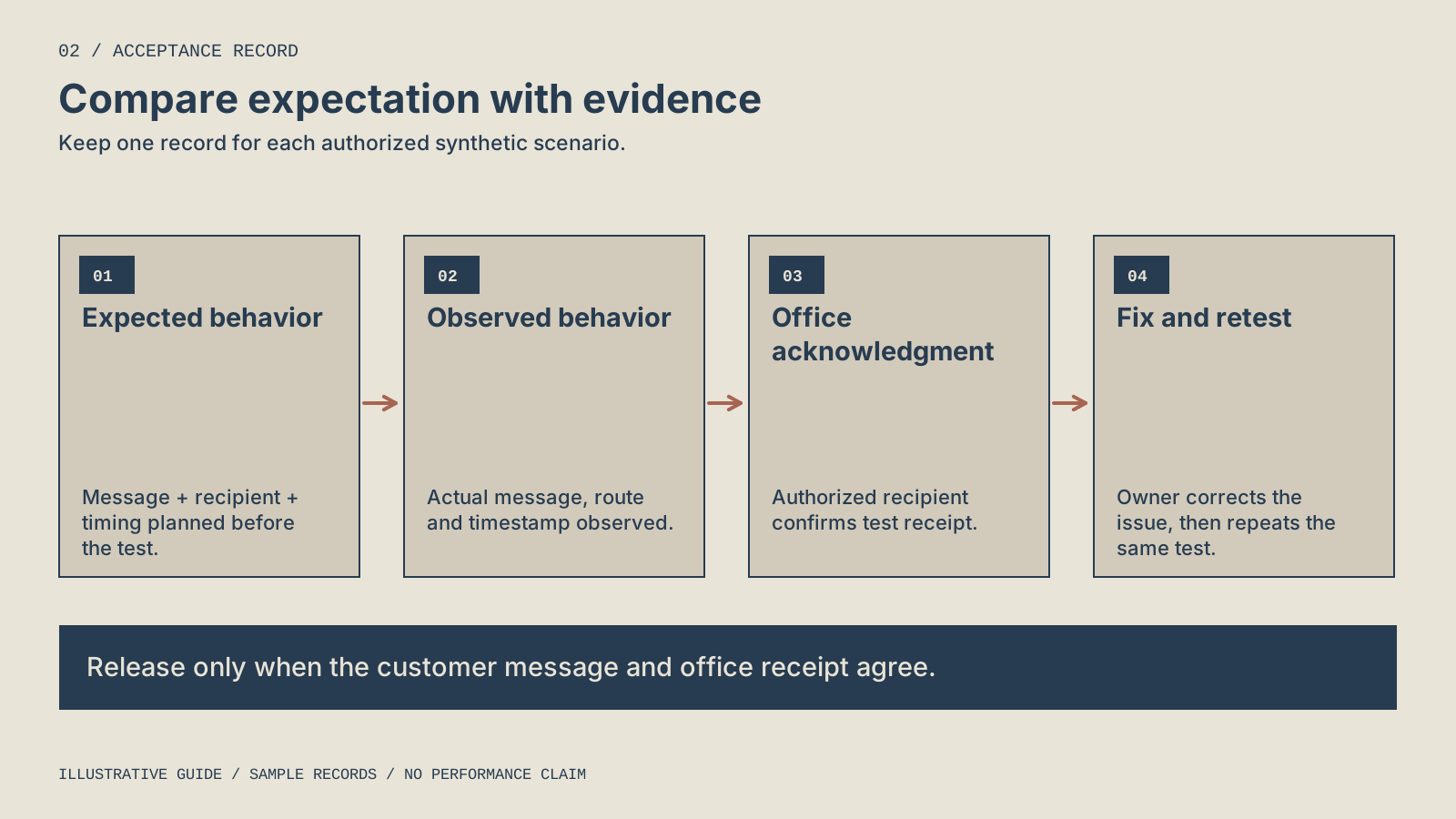
Record the expected message and destination, compare observed behavior, obtain acknowledgment from the authorized test recipient and retest any failed step.
How should analytics and test records be checked before launch?
Verify that the chosen measurement corresponds to the intended action and that synthetic tests can be identified in review. A form-open event, a phone-link click and a received plumbing request are different observations. They should not be presented as equivalent qualified leads.
Google Analytics describes generate_lead as a submitted form or request for information. That event still needs an implementation that matches the site’s actual successful action. Check whether it fires on an attempted submit, a validation failure or a genuinely accepted request. Correct misleading behavior before relying on the total.
Should the phone test compare a click with an answered call?
Yes, but keep the observations distinct. Google’s call-conversion documentation explains that some mobile number tracking measures a click rather than the call itself. A test should document what the selected method can observe and what the receiving office confirms separately.
Use the official phone call conversion guidance for the relevant setup. A basic acceptance review can use agreed timestamps and test references without recording conversations. Do not put customer project descriptions or personal contact details into every reporting system just to make the test easy to follow.
Maintain an exclusion or annotation process for synthetic activity in the operational review. Even if a test appears in a technical report, it should not become evidence that the website generated a genuine plumbing opportunity. Include the measurement limitation in the handoff: what is visible, what is confirmed elsewhere and what remains unknown.
When is the plumbing website ready for live acquisition?
The site is ready for a bounded launch when the approved service promise is accurate, each contact route passes its acceptance cases and the receiving business acknowledges its responsibilities. Readiness means the customer path has been tested. It does not establish future search visibility or inquiry volume.
Create a short launch record naming the approved page version, tested destinations, unresolved issues and person authorized to confirm the receiving business’s availability. A known failure that can mislead customers or lose requests should be corrected and retested before that path is enabled.
What should happen if availability changes immediately after testing?
Recheck the affected promise and route. If the office changes hours or stops accepting a service, a previously passed case may no longer represent the live experience. Update the message, tell the website operator and rerun the relevant scenario. The test record is tied to actual operating conditions.
Confirm the Google boundary as part of the handoff. A lead generator is not eligible for a Business Profile under Google’s eligibility rules. A real eligible plumbing operator may have its own accurate profile, with consentful agency management where appropriate. A leased site should not be given a fabricated Maps identity to complete launch.
After launch, review the first genuine requests against the same approved definitions. A supported request that the office declines because it is fully booked is different from a request for unsupported work. The HVAC capacity guide offers a related example of keeping current availability connected to a dedicated acquisition site.
What else should a plumbing business ask before launch?
Confirm office participation, current availability and how the test handles customer uncertainty or failed submissions.
Can the website operator run every test without the plumbing office?
The operator can inspect public copy and interface behavior. Office receipt and operational usability still need the agreed recipient’s acknowledgment. Schedule a controlled test window so a real employee is not surprised by synthetic requests and the evidence connects both sides of the handoff.
Does a passed test mean every future inquiry will arrive?
No. A test verifies the observed behavior under specified conditions. Systems, settings and staffing can change. Maintain a way to report delivery problems and retest after meaningful changes. Continue reviewing actual receipt rather than treating launch evidence as a permanent guarantee.
Should the site advertise round-the-clock plumbing response?
Only if the receiving business has confirmed the actual response it can provide. Distinguish leaving a request outside office hours from reaching an available person. The wording should describe the current process accurately, including any need for the office to confirm an appointment.
Must the customer know what repair is needed?
No. The website should support an ordinary description of the service need. Technical diagnosis and the scope of plumbing work belong with the real provider. A test should include a visitor who cannot identify equipment or choose a detailed technical category.
What if a failed test has already created a report event?
Keep it labeled as a test and correct the measurement interpretation. A report event does not turn an unsuccessful synthetic request into a lead. Retest after the fix and preserve the failure and correction so the launch decision has an accurate history.

How C3i3 Can Help
C3i3 can help scope the marketing and website checks for a dedicated plumbing acquisition project. Our Local SEO services support accurate service content and search planning. Our Lead Generation Campaigns services can help define the request journey and the observations a pilot should collect.
Bring the proposed site, approved services, current coverage and the person who can confirm office receipt. Contact C3i3 to discuss a practical scope for the page and handoff review. The plumbing business approves availability, accepts requests and performs the trade work.