








































In this article
If you run a roofing company and search for exclusive roofing leads, you are looking for potential customers or a more dependable acquisition route. A dedicated leased website is one possible route. Before relying on it, you need to know which site creates the requests, how those requests are distributed and whether the work matches your roofing operation.
This guide focuses on evaluating that separate asset. It does not assume a ready-made website is available or that a customer will speak with only one roofer. For the broader acquisition discussion, use our guide to roofing leads and owned acquisition. For the overall separate-site decision, see the contractor lead-generation buyer guide.
What should exclusive roofing leads mean in a website arrangement?
Exclusive should describe an observable distribution arrangement: a named website sends a defined class of roofing inquiries to one agreed recipient. Clarify the covered services, territory, channels and exceptions. A broad exclusivity label without those details does not tell the roofing office what it will receive.
Ask what happens when a homeowner submits a form and calls about the same roof. Ask whether a request outside the approved area is declined, held for clarification or handled differently. Confirm whether other sites operated by the same provider are part of the arrangement. Do not assume that one domain’s distribution rule extends to every source the provider operates.
Does exclusive mean the homeowner has not contacted other roofers?
No. Distribution controls describe what the site operator does with the request. The homeowner can independently contact other businesses, revisit the site or continue researching. Assess the arrangement based on verifiable distribution and useful customer fit rather than an impossible assumption about all of the homeowner’s activity.
Create a plain-language source record before reviewing performance: domain, covered inquiry type, approved receiving roofer, territory and current distribution behavior. Include how changes will be acknowledged. The record is an operational description for due diligence, not a substitute for reviewing the actual arrangement with the responsible parties.
If the proposal concerns a new website, label it as a proposed acquisition test. If it concerns an existing asset, identify that asset and inspect it. Evidence from an unrelated roofing campaign cannot establish the exclusivity or activity of the specific site being offered.
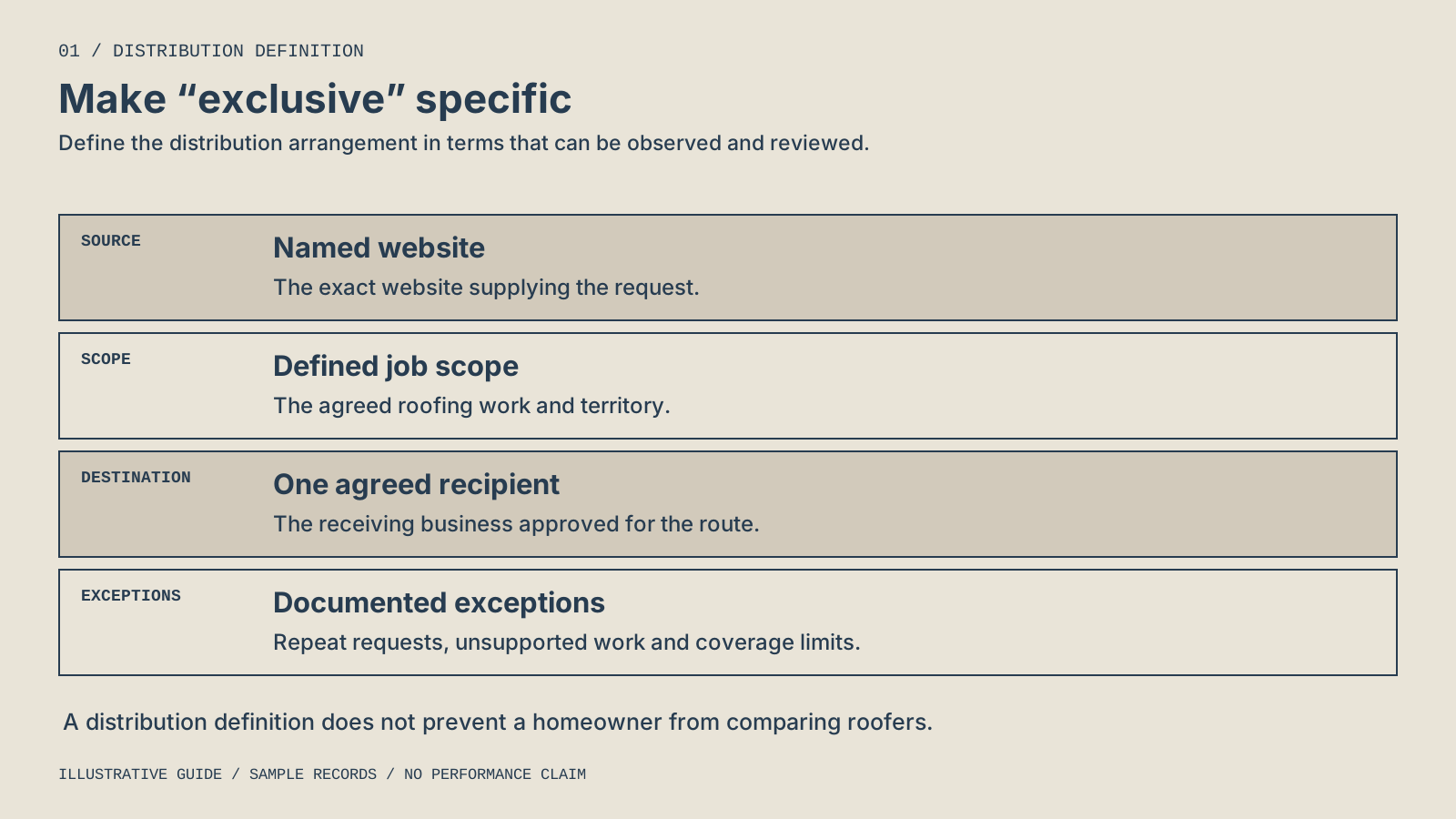
Specify the source website, covered services and territory, receiving roofer and any repeat-request or coverage exceptions.
How do you verify that the roofing requests come from the offered site?
Review dated reporting for the offered domain and follow a sample from its entry page to the receiving office’s record. Source evidence and destination evidence answer different questions. Together they help establish what the contractor can actually inspect.
Begin with public pages. Does the site explain roofing services the recipient performs? Is its coverage accurate? Does it identify the real roofing business or explain the inquiry relationship? A large traffic screenshot cannot resolve those questions. The page a homeowner actually reads matters more than the appearance of a vendor’s presentation.
Which report details should stay visible in a review?
Keep the domain, reporting period, relevant pages and selected geography visible. A reviewer should be able to distinguish whole-site visits from traffic to pages that invite roofing requests. Search Console reports can support discovery analysis, but the receiving office’s record is still needed to confirm a useful request arrived.
Google’s Search Console documentation describes performance measures such as impressions and clicks. Those measures do not count accepted roof assessments. Treat a report as evidence for its stated stage, then ask what connects it to the next stage in the contractor’s process.
A controlled contact test can verify a destination when the receiving office has agreed to participate. Mark it as a test and exclude it from genuine customer totals. For historical review, use anonymized request references where possible. The goal is to inspect continuity of evidence without copying personal customer details into a sales presentation.
Which roofing job details determine whether an inquiry fits?
A useful roofing request matches the contractor’s supported work, property type, territory and available next step. The customer does not need to diagnose the roof. The office needs enough context to decide whether an assessment conversation is appropriate.
Ask the roofer to approve a fit sheet before the website is evaluated. It might distinguish residential from commercial work, the roof systems the business handles and whether the office accepts owner, property-manager or general-contractor requests. Use supported categories, not a list of materials added for search reach.
What should remain unknown until the roofing business reviews the request?
Roof condition, the necessary work and the final scope can remain unconfirmed. A homeowner’s description of a leak does not establish the solution. The site can ask what prompted contact and explain the assessment process without declaring a diagnosis or steering the person toward a predetermined project.
Consider an illustrative inquiry about a flat-roofed commercial building. It may be a real local roofing opportunity, yet unsuitable for a company that has approved only residential pitched-roof assessments. Record the mismatch accurately. Calling it a poor contact obscures the more useful finding that the page or coverage description attracted unsupported work.
For an illustrative Bay Area check, an Oakland roof-repair request may fit the approved service but need a timeframe the office cannot offer. A San Francisco request may fall outside that roofer’s genuine coverage altogether. Keep availability and geography separate in the review. The correction might be a clearer next step or a narrower coverage statement. Creating matching Oakland and San Francisco pages would not resolve either operating limitation. These are fictional fit examples, not C3i3 inquiry results.
How should you inspect an illustrative roofing lead sample?
Inspect each sample against the same sequence: source page, request receipt, roof-job fit and contractor decision. Keep the reviewer’s observations separate from assumptions. A traceable sample is more useful than a headline count that combines unsuitable, duplicate and unacknowledged contacts.
Use a small sample register with an anonymous reference and a short outcome note. Do not fill blank fields with a favorable interpretation. If source is unknown, say unknown. If an assessment is awaiting confirmation, keep it pending rather than count it as accepted.
| Reference | Observed context | Review outcome |
|---|---|---|
| R-A | Covered residential request; office acknowledged receipt | Assessment discussion accepted |
| R-B | Commercial roof outside approved work | Scope mismatch; inspect public wording |
| R-C | Caller follows an earlier form about the same property | Repeat contact; link to existing request |
These examples illustrate classification. They do not establish expected proportions, inquiry volume or conversion. A contractor should define its own accepted-next-step status and apply it consistently. An accepted conversation is also different from a completed assessment or an agreed roofing project.
What if the sample cannot be connected to a source page?
Keep that attribution limitation in the record. The inquiry may still be genuine and useful, but it cannot support a precise claim about the website’s source contribution. Ask whether future reporting can preserve the necessary nonpersonal source reference and test that behavior before relying on it.
Review disagreements using the underlying context. If one person counts every answered call and another counts only accepted assessments, their totals will differ even when both read the same records. Align the definitions before judging performance.
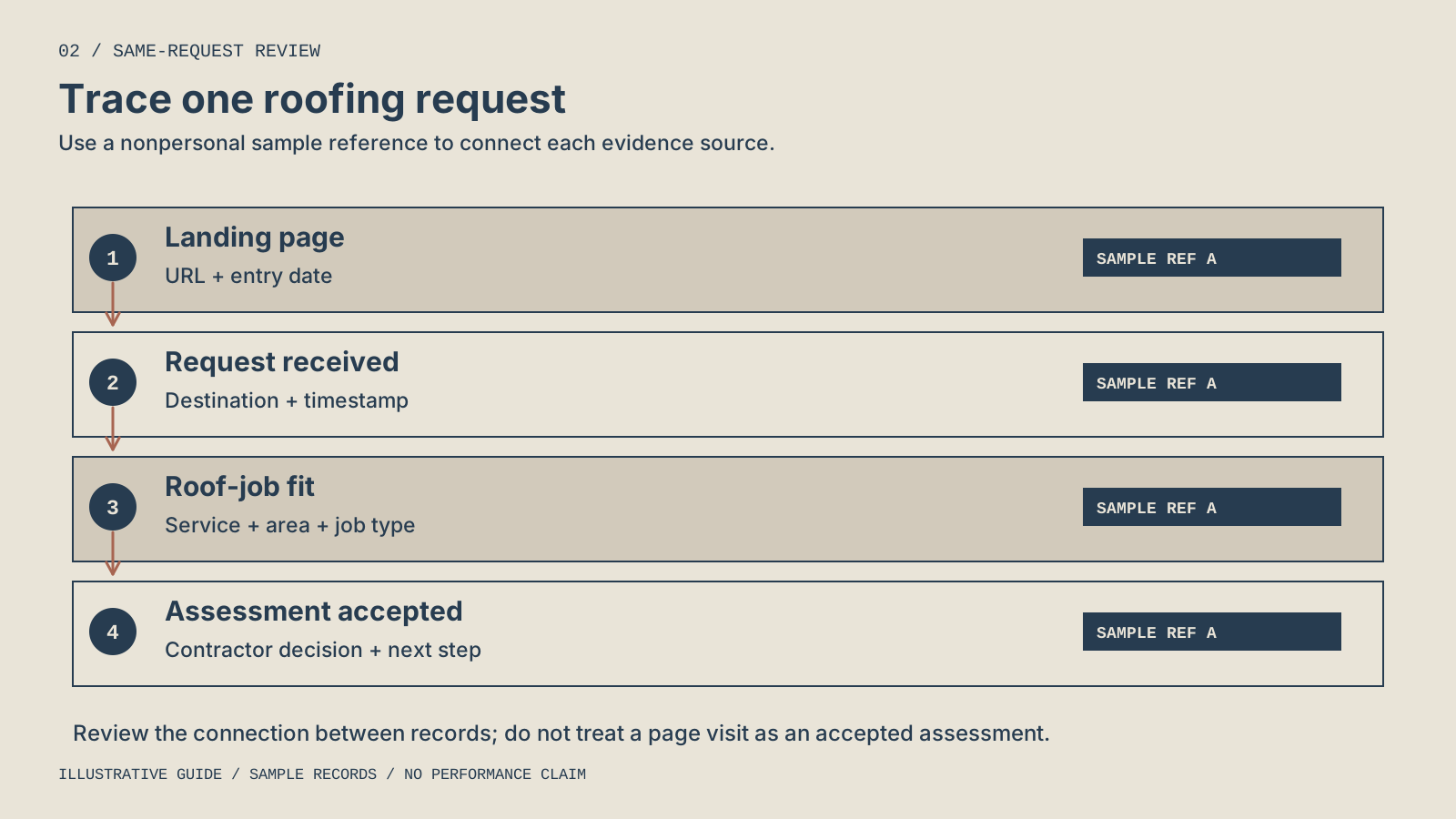
A sampled request should preserve a nonpersonal reference linking the entry page, destination receipt, roof-job classification and assessment decision.
What identity and Google checks should happen before a pilot?
Verify that the site accurately describes the real roofer receiving inquiries and that any proposed Google presence follows the eligibility rules. A separate lead-generation asset does not acquire a contractor’s identity merely because its requests are leased to that contractor.
Google lists lead-generation companies as ineligible for Business Profiles in its business eligibility guidance. The real eligible roofing operator may have its own accurately represented profile. Agency management requires the business owner’s express consent. Keep those profile responsibilities distinct from ownership of the lead website.
What should happen if the receiving roofer changes?
Review the customer-facing identity, coverage, contact destination and confirmation messages before the new route is enabled. Old testimonials or project photographs must not imply that a new receiving company performed another business’s work. Use only evidence whose meaning remains accurate for the actual arrangement.
Inspect the site’s locality claims too. A list of towns is not proof of offices or crews in those towns. Google’s search spam policies are relevant when a proposal relies on many nearly identical local pages. Ask what useful service information each page contributes and why a customer would need it.
If construction or maintenance is still required, the lead-website build guide explains the operating work behind a separate asset. A roofing pilot needs maintained facts and a dependable inquiry route, not just a domain name and a collection of city phrases.
What evidence supports continuing or changing the roofing pilot?
Continue only when the evidence supports the defined purpose: suitable inquiries reach the intended roofer and can be evaluated against its actual capacity. Revise or pause when the observations show a specific mismatch. Avoid turning one successful assessment into a forecast.
Separate a technical delivery issue from a demand question. A form that never reaches the office tells you the contact route needs correction. A page receiving little relevant discovery leaves demand and visibility uncertain. Appropriate inquiries that reach a fully booked office suggest an availability problem. These situations require different next actions.
Why should call metrics be checked against the roofing office’s record?
Call-reporting methods measure different things. A clicked telephone link does not establish an answered conversation or a suitable roofing project. Google’s official call-tracking guidance distinguishes clicks from other call-conversion methods. Confirm what the site actually measures before treating the report as evidence of fit.
Use Google’s call-conversion documentation to understand the relevant method, then compare the observed action with the office’s acknowledgment. This review does not require recording customer conversations. A concise status record can establish the practical next step without placing detailed homeowner information in analytics.
Set the next decision in writing: correct unsupported commercial wording, retest an unacknowledged route or keep observing the same approved residential scope. The plumbing prelaunch test offers a different trade example of testing exceptions, while the HVAC guide shows how capacity can change the acquisition plan.
What else should roofing businesses ask before relying on the site?
Check distribution, historical evidence, repeat contacts and the distinction between a suitable inquiry and accepted work.
Can exclusivity be verified from the public homepage?
The homepage can explain the receiving relationship, but distribution requires a review of the agreed arrangement and actual destinations. Test the approved contact routes and inspect how exceptions are handled. Public wording alone cannot prove what happens to an inquiry after submission.
Should a newly built site show historical roofing lead results?
A new site should identify its assumptions and test plan. It has no historical inquiry results of its own. A separate example may explain a method if accurately labeled, but it should not be presented as evidence that the new domain has already produced roofing opportunities.
Is every repeat call a new roofing lead?
No. A repeat contact can concern the same customer and project. Connect it to the earlier inquiry where the office can do so accurately. Distinguish new projects from follow-up interactions so the review does not inflate the number of opportunities.
Can a useful request still fail to become roofing work?
Yes. A suitable inquiry can lead to a conversation or assessment without becoming an accepted project. The customer’s decision, scheduling and later scope discussions are separate stages. Record them honestly rather than redefine all unbooked work as unsuitable leads.
What should I send an agency before discussing a pilot?
Send the site being evaluated if one exists, approved roofing services, actual territory and the office’s preferred next step. Include anonymized examples of fit problems. Those inputs let the agency distinguish source evidence, public content and handoff issues before proposing work.

How C3i3 Can Help
C3i3 can help a roofing business assess the search opportunity, public service explanation and inquiry path for a defined dedicated-site project. Our Local SEO services can inform the content and discovery scope. Our Lead Generation Campaigns services can connect that scope with clear handoff and evaluation requirements.
Bring the domain if one is under review, the roof work your business accepts and the evidence you want a pilot to establish. Contact C3i3 to discuss an appropriate agency scope. This is an invitation to evaluate marketing work, not a claim that C3i3 has an available roofing lead inventory or performs roofing services.