








































In this article
Junk removal leads are useful when the receiving operator can understand the job well enough to consider it. “I have some things to remove” may be a genuine request, but it leaves important questions unanswered: what items, approximately how much, where they are and what access the crew would face. A dedicated lead website should help the customer provide that context without turning the first contact into a complicated survey.
This guide is for a junk removal business evaluating the inquiry process on a separately controlled website. It focuses on job matching, not disposal instructions or trade work. The broader contractor and home-service lead guide explains the dedicated asset decision; this article shows what a removal request should communicate before an operator accepts it.
What makes a junk removal inquiry a match for the operator?
A matching inquiry concerns items and a pickup situation the actual operator is willing to review within its service area. Matching is an operational decision, not simply a form with every field completed. The website should collect useful context and leave acceptance with the real business.
Begin with the operator’s approved service description. Does the business consider single-item pickups, household cleanouts or commercial requests? Are there property types or access situations it reviews individually? A generic “we remove anything” promise can attract work the operator does not accept and mislead the customer about what has been agreed.
Why does the pickup situation matter as much as the item name?
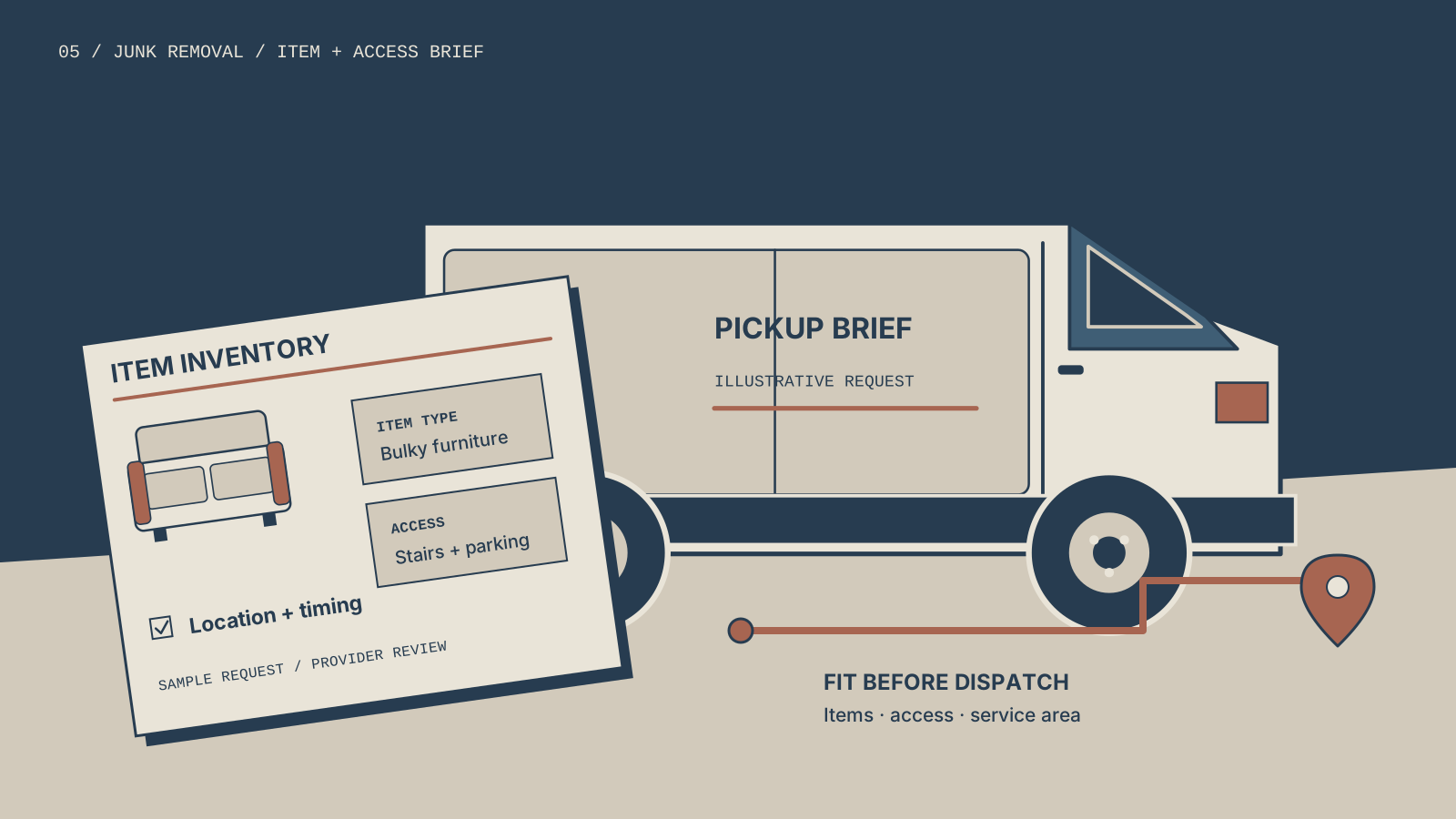
A sofa at an accessible collection point is different from a sofa inside an upper-floor property with restricted access. The website does not need to plan the physical work. It does need a way for the customer to disclose the context that the operator considers when deciding whether to review the job.
Define the next step accurately. It might be an operator callback, a review of the described items or a separate assessment. A customer should know whether they are asking a question or booking a confirmed pickup. Keep that wording consistent on the button, form introduction and confirmation.
For a separate lead asset, identify the receiving removal business or explain the matching relationship before contact. The website operator may maintain the marketing site, but the real removal operator decides what it can accept and performs any agreed work. That relationship should remain visible as the request moves forward.
Which questions belong in the first junk removal request?
The first request should establish item type, approximate scope, pickup area, access context and timing. Ask in ordinary language and allow “not sure” where a precise answer is unnecessary. These fields should support a useful first conversation rather than demand a customer’s technical assessment.
A concise form can use one description field for “What would you like removed?” and optional examples approved by the operator. Let the person estimate quantity in familiar terms, such as one large item or several room contents, without forcing them to calculate a load volume they cannot judge.
What access information is useful without overcomplicating the form?
Ask about known stairs, elevator use, entry restrictions or other practical limits the operator wants to review. Give the customer a simple way to explain uncertainty. The form should not instruct anyone to move heavy objects, measure unsafe spaces or prepare materials for collection.
| Prompt | Why the operator needs it |
|---|---|
| What items or contents are involved? | Recognize the proposed work and any uncertainty |
| About how much is there? | Understand rough scope without treating it as a final assessment |
| What is the pickup area? | Check genuine coverage |
| Are there stairs or known access limits? | Decide what clarification is needed |
| When would you like to discuss pickup? | Compare the request with current availability |
Collect only what is useful for that initial step. A general area may be enough for the first coverage check, with the operator obtaining precise location information when needed. Do not require unrelated personal details or sensitive documents to establish whether a removal conversation is appropriate.
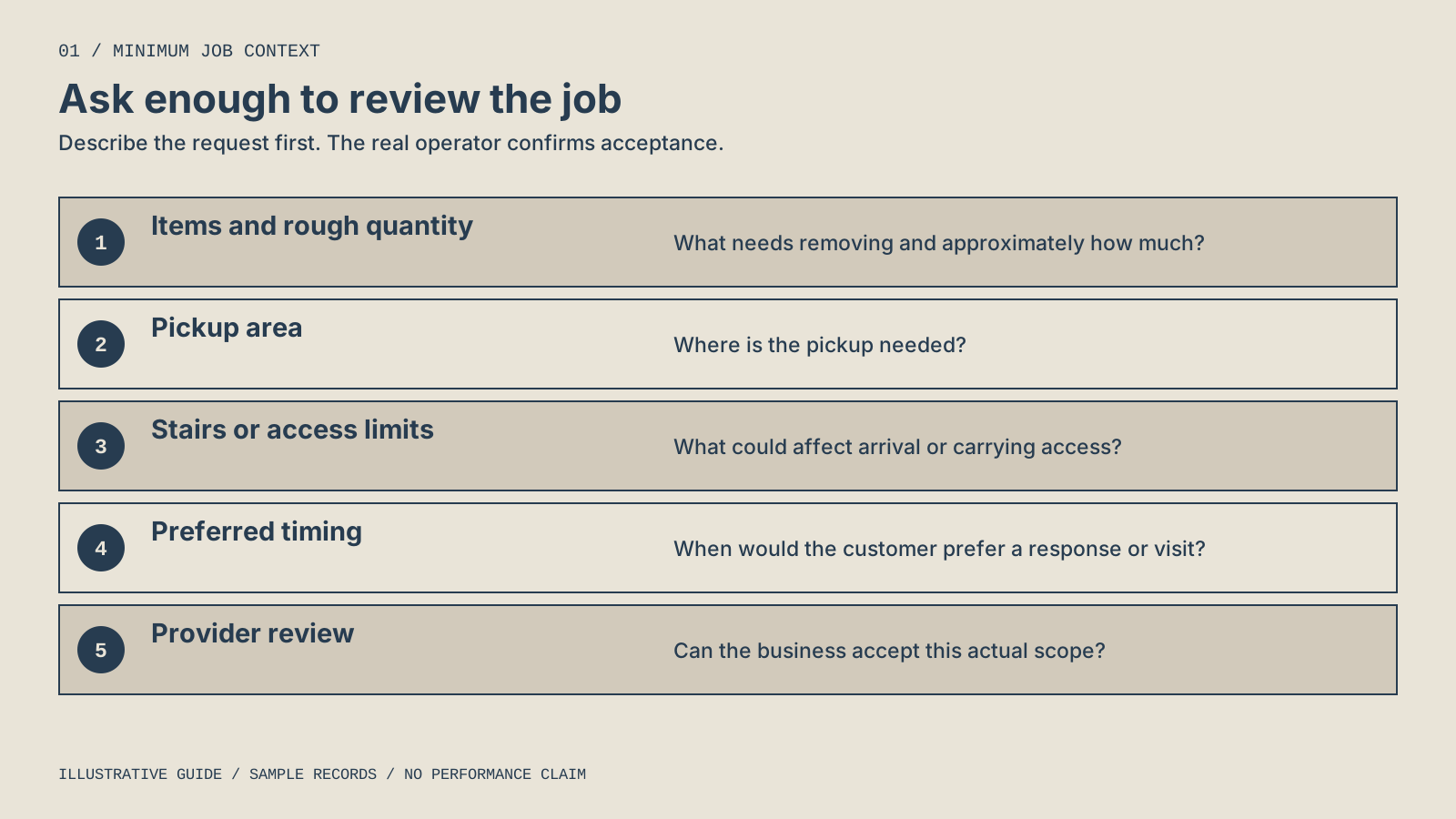
Ask what needs removing, approximately how much, where pickup is needed, relevant access limits and preferred timing. The real operator confirms acceptance.
How should the site handle items the customer cannot classify?
Let the customer describe the item and flag uncertainty for the operator. Avoid automatic acceptance based on a broad category. The website is a request interface; it is not a disposal authority or a substitute for the receiving business’s review of what it accepts.
A household cleanout may include ordinary furnishings alongside items the operator handles differently or declines. The customer may not know which is which. An “other or unsure” option preserves that uncertainty without asking the person to identify a chemical or determine the right disposal method.
Why should a general removal form avoid universal acceptance claims?
Some household products require special care. The Environmental Protection Agency identifies examples including certain paints, cleaners, oils and batteries. That does not establish what a particular removal operator can accept. Public copy should use the operator’s confirmed scope and direct uncertain cases to review.
The EPA’s household hazardous waste information explains the category and points readers to local agencies for area-specific options. This article does not provide handling or disposal instructions. The practical website decision is to avoid “everything accepted” language and keep questionable items from receiving an automatic pickup confirmation.
Do not require photographs as the only way to ask a question. If the operator supports optional images, explain their purpose and allow a text description. The website should not encourage a customer to open containers, disturb materials or enter a restricted area to produce a better submission.
Keep the confirmation neutral: the request has been received for review, subject to the operator checking the described scope. If the actual process differs, use the approved explanation. The customer should never infer acceptance merely because the form allowed a description to be entered.
How do you separate removal, cleaning and mixed job requests?
Separate the work the customer wants completed rather than treat every cleanout as one service. Removing objects and cleaning surfaces are different scopes. A website should promise both only when the receiving business has approved both or the distinct responsibilities are clearly explained.
Consider a fictional property turnover inquiry: furniture needs removal, loose contents remain and the customer also wants the kitchen cleaned. A removal operator may be willing to review the first parts while the cleaning work needs a separate provider. The website should preserve those distinctions rather than turn the phrase “full cleanout” into an undefined completion promise.
What should an illustrative job review note look like?
A useful note records the stated items, rough scope, location fit, access uncertainty and next action. It can also identify a separate cleaning request. The note should say which parts are accepted for discussion and which remain unresolved, without presenting the operator’s later assessment as already completed.
| Requested removal | Furniture and boxed household contents |
|---|---|
| Access context | Upper-floor pickup; entry arrangement needs clarification |
| Additional request | Surface cleaning after items leave |
| Operator next step | Review removal scope and access; explain separately whether cleaning is supported |
These are fictional details for a request review, not evidence that any provider accepts the work. The cleaning lead-generation guide examines the cleaning side of the customer decision. Link the services when the relationship is real and useful, but do not imply a shared crew or one confirmed appointment without the businesses’ approval.
The same discipline helps commercial inquiries. A customer may use “office clear-out” to mean furniture removal, document handling and cleaning together. Preserve the actual request, then let the responsible operator explain which scope it can consider.
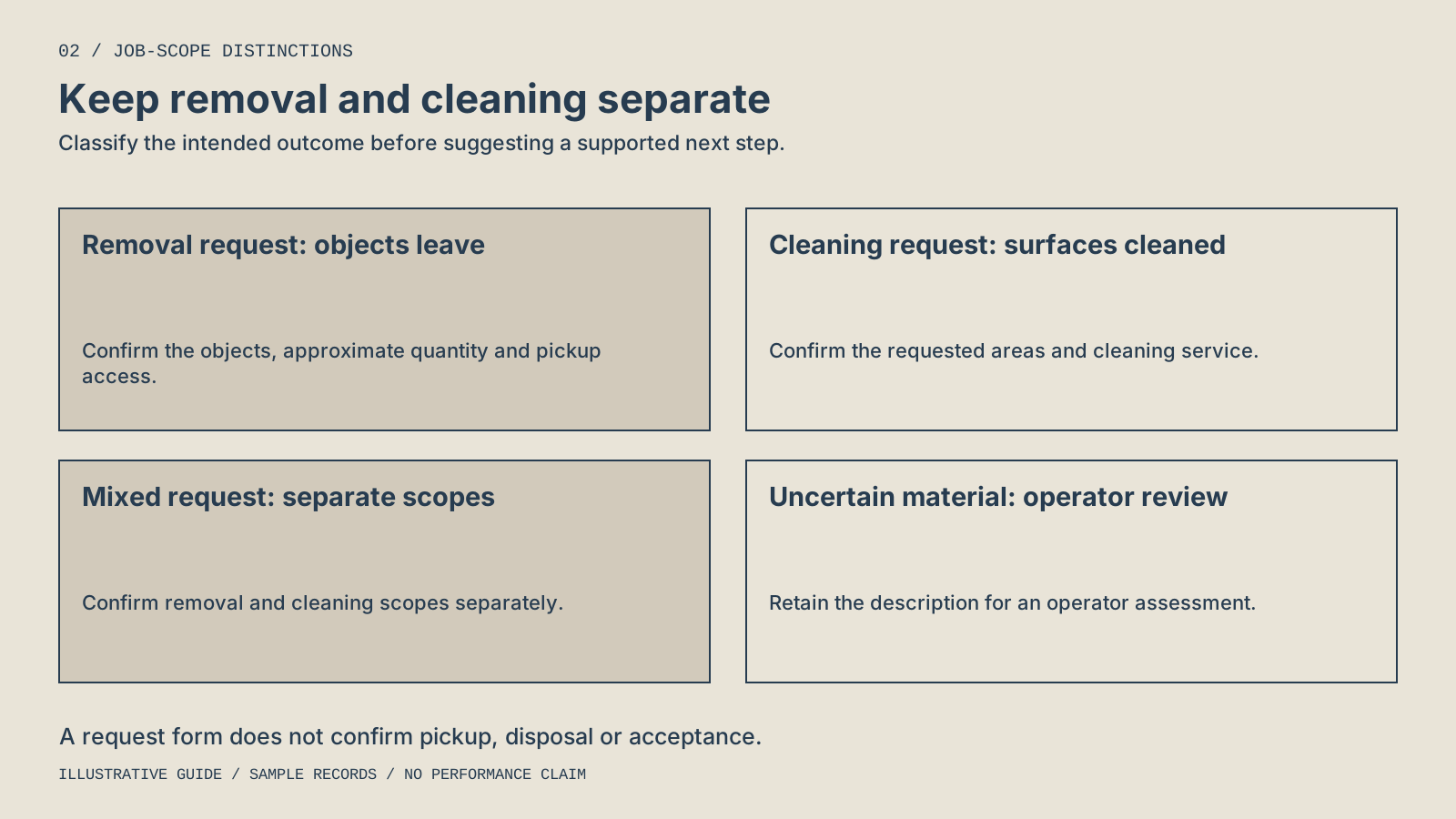
Distinguish removing objects from cleaning surfaces. For mixed projects identify separately confirmed scopes. Unknown materials require provider review rather than an automatic acceptance.
How should coverage, access and timing affect the next step?
Use those details to determine whether the operator can review the request and what needs clarification. They should not automatically create a confirmed schedule. A form can gather a preferred time while making clear that the real business checks availability.
Coverage should reflect actual pickup operations. If an area is outside the approved territory, the site should say so accurately or explain that review is needed, according to the operator’s process. Do not create pages implying local depots or crews merely to capture town searches.
What if a request is urgent but the operator has no confirmed availability?
Describe the current contact process honestly. A preferred pickup date is a customer request, not an inventory reservation. The operator can explain what is possible when it responds. The website should not imply that a calendar choice or successful form submission guarantees collection at that time.
Test ordinary and exception cases with authorized recipients: a covered pickup, an outside-area request, a known access limitation and a mixed job description. Compare what the customer sees with what the operator receives. The plumbing prelaunch guide shows a controlled test method, though the actual scenarios here should remain specific to removal work.
Check the Google identity boundary too. Under Google’s eligibility rules, a lead-generation company is ineligible for a Business Profile. Any profile should represent the real eligible operator accurately, with express owner consent for agency management. The separately controlled website must not create a fictional local removal business to make the acquisition plan appear complete.
How can you tell whether better questions improve job fit?
Review whether the operator receives enough relevant context to make the next decision and whether the requests match its actual service. More completed fields do not automatically mean better leads. Compare missing information, scope mismatches and accepted follow-up before adding more requirements.
Maintain a small outcome log with a nonpersonal request reference, rough job category, coverage decision, missing context and operator next action. Useful categories can include accepted for discussion, needs access clarification, unsupported scope and repeat contact about an existing job. Use the categories the receiving business can apply consistently.
Which observation would justify a change to the form?
If the operator repeatedly has to ask whether items are upstairs, a short optional access prompt may help. If customers abandon a mandatory technical quantity field, replace it with an ordinary description or an uncertainty option. Make the change because it resolves an observed information gap, not because a longer form appears more qualified.
A form event alone does not prove operator acceptance. Google Analytics lists generate_lead for a submitted form or information request. Verify the actual trigger and confirm receipt separately. Keep customer descriptions and contact details within systems that need them rather than copying them into general marketing reports.
The lead-site operating guide explains the larger measurement and maintenance context. For a different industry’s capacity review, the HVAC lead-site guide separates supported demand from available next steps. In removal, the key question remains whether the operator can understand and consider the proposed pickup without misleading the customer.
What else should junk removal businesses ask about lead forms?
Keep quantity estimates, optional images and mixed service requests subject to the operator’s actual review.
Should customers calculate an exact load size?
Only ask for information they can reasonably provide. An approximate description can begin the conversation while the operator confirms the scope later. Do not make an unfamiliar volume calculation the only route to contact or present a rough estimate as a completed assessment.
Can a photo replace the item description?
A photo may add context if the operator supports it, but a text description remains useful. Avoid making images mandatory for every request. Explain that the operator still reviews the items and access; an uploaded photo does not confirm acceptance or a pickup appointment.
Should the website promise recycling or donation for every item?
Only make claims the actual operator can substantiate for the service described. A general request form cannot establish what will happen to each item. Keep outcome claims accurate and let the operator explain the confirmed process for the accepted scope.
What if the customer wants removal and cleaning together?
Identify both requests and explain which business handles each approved scope. Do not assume they form one service or imply one crew performs everything. The customer should understand what remains to be confirmed before arranging follow-up.
Does a detailed form guarantee a qualified removal job?
No. It helps the operator review context. Availability, coverage, scope clarification and the customer’s later decision still matter. Evaluate delivered requests and accepted next steps, while keeping duplicate contacts and unsupported work separate from new suitable opportunities.

How C3i3 Can Help
C3i3 can help a removal business define the customer questions and marketing scope for a dedicated lead website. Our Local SEO services can support useful service content and accurate coverage. Our Lead Generation Campaigns services can connect that offer with a clear request process and a practical review of job fit.
Bring your accepted job types, actual territory, recurring clarification questions and current follow-up process. Contact C3i3 to discuss what the website should establish before a pilot. The real removal operator reviews materials, confirms pickup and performs any accepted service.