








































In this article
SEO lead generation begins with a mapping decision: which page should answer each person’s question? Without that decision, a website can accumulate overlapping service pages, thin city copies and informational articles that attract the wrong audience. More URLs then make the site harder to understand without making the inquiry path more useful.
This guide explains how to map services, locations and buyer questions for an independent lead website. It is for owners and marketing teams planning the asset, rather than homeowners looking for a trade provider. The broader lead-generation website implementation guide covers the complete build. Here you will create a practical query-to-page worksheet that distinguishes genuine search decisions before content production starts.
Whose search are you trying to satisfy before choosing keywords?
Identify the searcher and intended action first. A contractor investigating acquisition sources and a homeowner requesting work can use related vocabulary while needing entirely different pages.
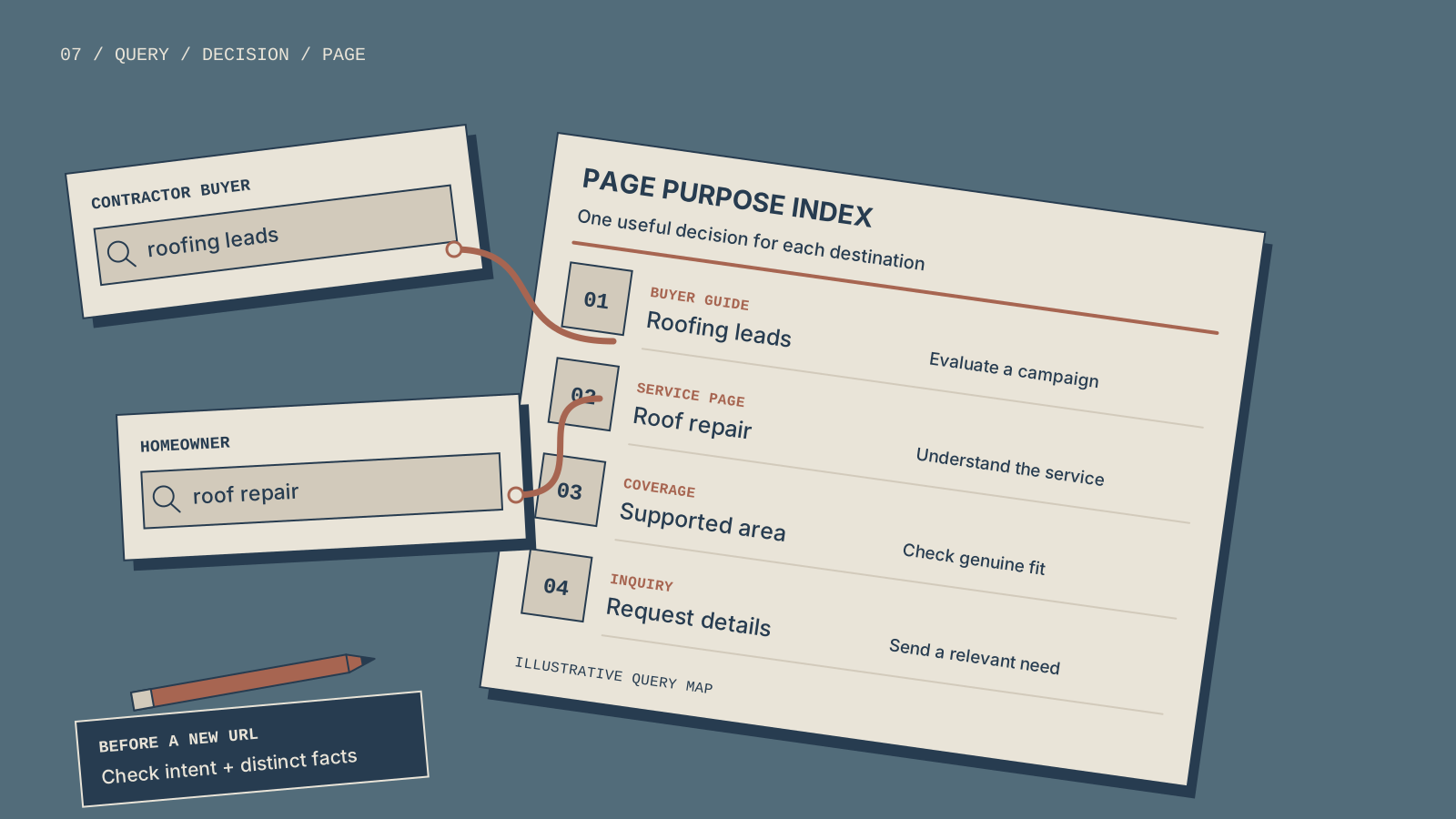
“Roofing leads” is a commercial search when the searcher is a roofing business evaluating where inquiries come from. “Roof repair near me” describes a potential service customer’s need. Similarly, a contractor comparing “HVAC leads” needs source quality and handoff information; a homeowner seeking HVAC repair needs service scope, coverage and a working provider route. Mixing these audiences creates a page that cannot answer either task well.
How do you document uncertain intent?
Write the likely audience, decision and next action beside the phrase. Inspect current search results as an intent sample, then compare that observation with your actual offer. Search results can change, and an ambiguous term may support several needs. Do not force it into a page merely because the estimated volume looks attractive.
The C3i3 contractor acquisition guide serves a buyer evaluating a separate lead asset. A service page on that asset serves the person requesting trade work. The distinction also affects examples and calls to action: a contractor should be invited to assess an acquisition arrangement, while a homeowner needs an honest explanation of who can receive the service request.
Record the intent boundary in the page brief so later writers do not turn a commercial buyer guide into a homeowner troubleshooting article. Search positioning starts with that editorial discipline.
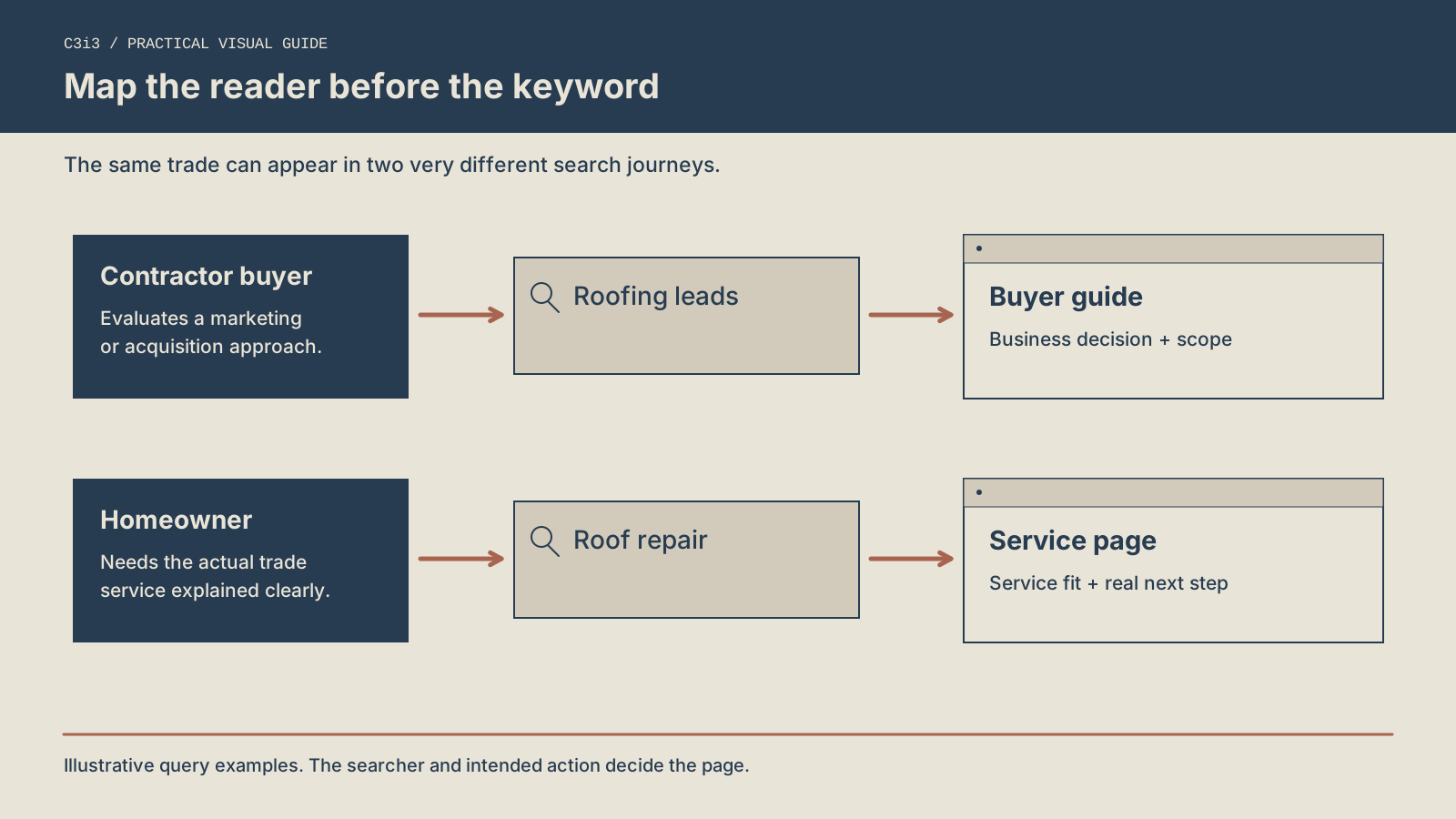
The searcher and intended action decide the page. These query examples are illustrative.
How do you turn related queries into one useful page brief?
Group queries when the same person needs the same decision supported by the same core information. Choose one primary destination for that group, then record supporting questions that belong inside the page.
A hypothetical planned replacement service might attract searches about eligibility, assessment preparation and the information needed before a visit. Some questions may fit directly on its service page. A substantial preparation task could justify a separate guide if it helps the reader complete something beyond recognizing the offer. A slight wording variation alone does not justify another URL.
What columns make the mapping worksheet actionable?
Use query group, audience, decision, intended page, evidence required and next action. Add an existing-page field before creating anything new. That turns research into a content decision rather than a spreadsheet of phrases waiting to become pages.
| Illustrative query group | Reader decision | Primary destination |
|---|---|---|
| Roofing leads, dedicated roofing lead source | Evaluate an acquisition arrangement | Contractor buyer guide |
| Planned replacement service in confirmed area | Determine service fit and request review | Verified service page |
| What information is needed before an assessment? | Prepare a useful request | Service-page section or substantial preparation guide |
These examples are hypothetical mappings, not measured demand or C3i3 results. The worksheet should explain why a page exists even if you hide the keyword column. If its purpose disappears without the phrase, the brief may be organized around wording rather than a customer task.
When does a service-location combination need its own page?
A separate location page is useful when it answers a meaningfully different local decision with verified information. Begin with coverage facts and an existing-page review instead of multiplying every service by every city.
Ask whether the reader needs different information in that location. There may be a distinct service boundary, appointment arrangement or relevant documented project context. If the service and process are the same throughout a confirmed territory, a clear regional coverage explanation may be sufficient. Serving a city does not establish a staffed office there.
Consider a hypothetical Bay Area brief with “San Jose AC repair,” “Oakland roof repair” and actual service coverage in San Francisco. These are service-and-location combinations to verify, not an instruction to create three pages or claim three operating locations. If a receiving provider covers San Francisco with the same service and process already described elsewhere, a clear coverage section may answer the customer’s question. A separate San Jose page needs confirmed information that makes its AC-service decision meaningfully different. An Oakland roof page also needs a real roofing offer, not a city-swapped copy of the HVAC page.
What should stop a proposed city page?
Stop when the draft would repeat the same offer, evidence and next step with a different place name. Also stop when nobody can verify the local facts. More adjectives about a community do not resolve that absence. Keep the proposed URL in planning until its purpose and evidence are concrete.
Google’s spam policies describe doorway abuse, including pages created to rank for similar queries that funnel users onward. The practical editorial response is to make each public page useful on arrival. Do not create a city-page layer that merely pushes every visitor to the same generic destination.
This is a mapping exercise, not a declaration that location pages are always wrong. A defensible page has a distinct task and enough reliable information to fulfill it. Record that rationale in one sentence so the site operator can reassess the page when coverage or provider arrangements change.
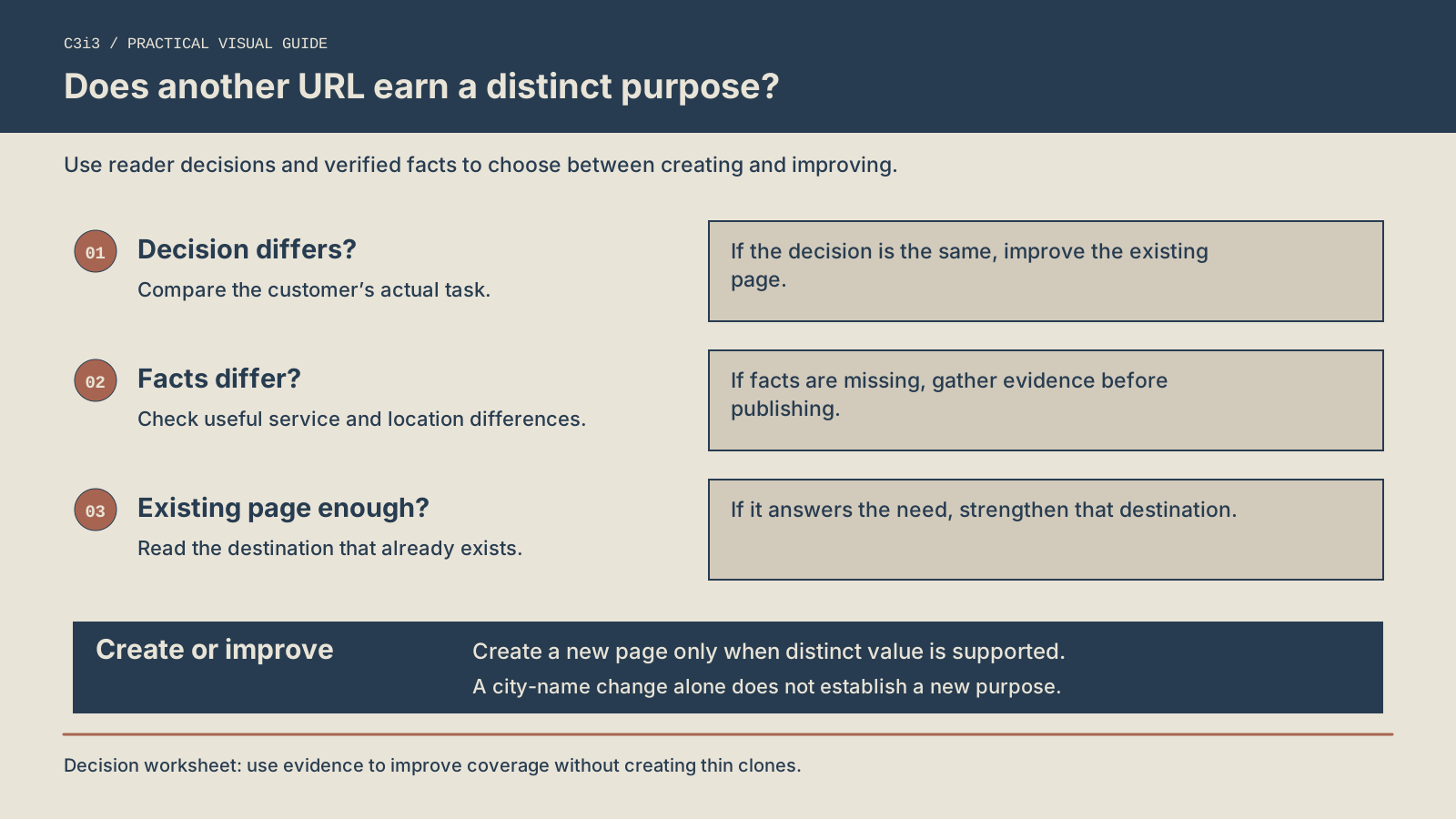
Create another URL when it earns a distinct reader decision and useful verified information.
How do you prevent service pages and supporting articles from competing?
Give each page a clear role and a distinct action. The service page helps a visitor establish fit and request the service; a supporting article resolves a narrower question that deserves fuller treatment.
Before drafting, inspect the existing title, opening, headings and contact path for the topic. Two pages can mention the same entity without serving the same purpose. The problem arises when both promise the same answer and neither provides a reason to prefer one destination. Rewrite the brief, merge the planned material or choose the stronger existing page.
Does adding a canonical tag fix duplicated editorial purpose?
A canonical signal is a technical tool, not an editorial reason to publish redundant pages. First decide what readers should find and where. If a new draft adds only a paragraph of useful information to an existing task, improve the existing destination where authorized rather than launching another competing page.
For a new independent lead asset, keep a page-purpose inventory with a short exclusion note. A landing page brief might say that it owns service fit and the inquiry sequence, while its supporting guide owns assessment preparation. The landing page design guide explains how to turn the selected service task into a coherent page.
Review overlap after launch too. Search query observations and actual requests may reveal that readers interpret the page differently from the original plan. Investigate the wording and page relationships before concluding that every new query needs its own destination.
How should internal links connect services, locations and buyer questions?
Place a link where the reader’s next question becomes specific. The destination should add information or support an action the current page does not fully resolve.
A service page can link to a substantial preparation guide at the point where it explains the initial assessment. That guide can return readers to the service page once they understand what to provide. A coverage explanation can link to a genuinely distinct service arrangement. These relationships form a useful navigation system because the reason for each connection is visible in the surrounding sentence.
What makes link text useful?
Describe the destination in ordinary language. “What to include in a service request” tells the reader more than “learn more.” Google’s link best practices recommend crawlable links and descriptive, concise anchor text. Use working HTML anchors and check the actual destination.
Do not link every keyword to a different city page or place a repetitive network of exact-match anchors at the bottom of each article. A meaningful connection may also cross the content plan: when the mapping worksheet identifies a problem with request quality, the next useful task is defining a qualified inquiry, not reading another near-identical keyword page.
Keep commercial buyer journeys distinct from service-customer journeys. Contractor lead evaluation guides can connect to implementation guidance on the C3i3 site. An independent service site should not send a homeowner through agency marketing articles to understand how to request help.
How do you validate the map before expanding the website?
Validate whether each page is useful, discoverable and connected to the intended request. Review search observations alongside page behavior and inquiry fit, preserving the limits of each data source.
Before publication, ask an unfamiliar reviewer to identify the page’s audience, service and next action without a verbal explanation. Compare the answer with the brief. Then test the route using labeled records and participating recipients. A map can be logically tidy while the actual page still makes the wrong promise.
Which evidence supports an architecture change?
Look for repeated, explainable patterns. A service page may attract relevant searches but leave an important service boundary unclear. A guide may attract readers who want do-it-yourself instructions when the intended audience needs a provider. A territory explanation may be difficult to find. Each observation suggests a different change.
Keep the date range, source and limitations with your review. A new page’s lack of visible query data does not alone establish that its topic has no demand. A short run of mismatched requests does not prove the architecture caused the problem. The non-recording attribution guide helps separate attempted contact from connected calls when phone evidence is part of the investigation.
Approve expansion by naming the unresolved reader decision, the new evidence available and the existing page that cannot adequately serve it. That is a stronger basis for another URL than a list of city names or an arbitrary content quota.
What else should you know about an SEO lead-generation map?
Use the map to choose useful destinations and avoid redundant publishing. The remaining decisions concern query grouping, real coverage and clear page roles.
Does every keyword need its own URL?
No. Related wording often describes one task. Group phrases around the intended reader and decision, then answer useful variations naturally within the page. Separate URLs need separate purposes. The worksheet should prevent unnecessary publishing as effectively as it identifies worthwhile gaps.
Can one page serve several nearby cities?
Yes, when the service and customer process are accurately explained for the territory. Make coverage clear and avoid implying offices that do not exist. A separate city page becomes useful when verified information changes the local decision enough to justify its own destination.
Where should searches for buying HVAC leads go?
They should go to a contractor buyer destination when the searcher is evaluating acquisition sources. That page should explain source evidence, fit and handoff expectations. It should not become a homeowner repair page simply because both audiences mention HVAC. Confirm intent before assigning the query.
Should a supporting article repeat the full service offer?
Give enough context for a reader arriving directly, then focus on the article’s specific task. Link to the service page when the reader is ready to assess fit or make a request. Repeating the entire offer across every article blurs page roles and makes updates harder.
Can a map guarantee rankings or qualified inquiries?
No. A map improves editorial decisions and navigation, but search visibility depends on factors beyond a worksheet. Qualification also depends on the actual offer, request and provider arrangement. Track those stages separately and use observations to improve the map rather than presenting it as a guaranteed acquisition formula.

How C3i3 Can Help
C3i3 can review your existing page inventory, separate contractor-buyer and service-customer intent and prepare a service-location architecture through Local SEO. When the mapped destination also needs a clearer request path, our Lead Generation Campaigns work can connect the content brief to a landing experience and measurement plan.
Bring your current URLs, proposed service territory and examples of suitable requests to discuss the architecture with C3i3. The first useful deliverable is a defensible set of page decisions and the evidence each page needs.